Vitamin D gegen D3, und was ein Etikett wirklich sagt
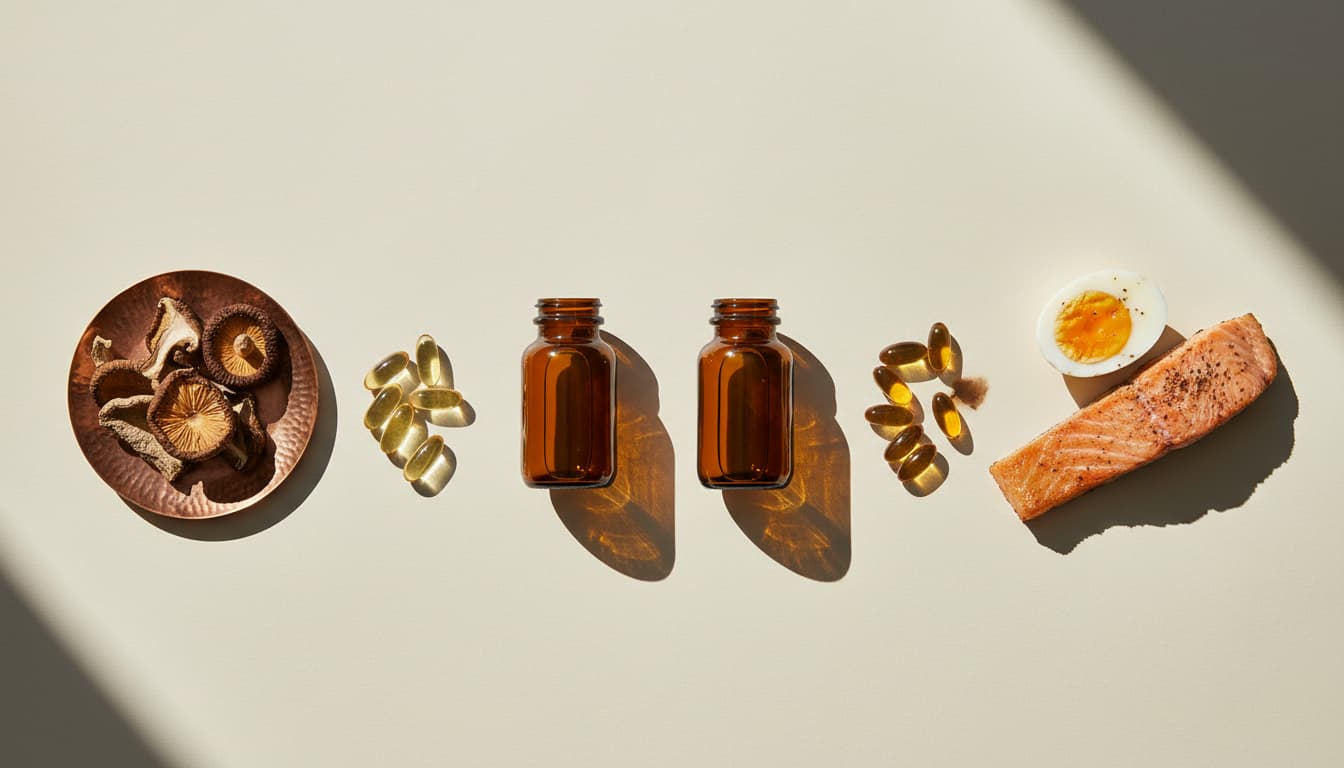
Vitamin D ist der Familienname. D2 und D3 sind die beiden verkauften Formen, beide in denselben Einheiten gezählt, und D3 hebt das Blut-25(OH)D pro Mikrogramm stärker. Was die Etikettwörter bedeuten und wann der Unterschied zählt.
- 01
Vitamin D ist ein Familienname; D2 und D3 sind die beiden verkauften Mitglieder
Vitamin D bezeichnet eine Gruppe fettlöslicher Secosteroide, und nur zwei tauchen in Präparaten und angereicherten Lebensmitteln auf: D2, Ergocalciferol, und D3, Cholecalciferol. Ein Produkt mit der bloßen Aufschrift Vitamin D könnte beides sein, die nützliche Information ist also der Klammerzusatz auf der Nährwerttabelle. Cholecalciferol heißt D3. Ergocalciferol heißt D2. Alles Nachgelagerte, die Einheiten, der Bluttest, der Tagesbedarf und die Obergrenze, ist beiden gemeinsam, weshalb sie oft als austauschbar behandelt werden, obwohl sie nicht gleich wirkstark sind.
- 02
Beide nehmen denselben Stoffwechselweg zum selben Blutmarker
Welche Form auch geschluckt wird, die Leber hydroxyliert sie zu 25-Hydroxyvitamin D, der zirkulierenden Speicherform und dem Marker, den ein Bluttest ausweist, und die Niere wandelt diese dann in 1,25-Dihydroxyvitamin D um, das aktive Hormon für Kalziumaufnahme und Knochenmineralisierung. Ein Serumtest berichtet das Gesamt-25(OH)D und trennt die aus D2 und aus D3 stammenden Anteile nicht, sofern das nicht eigens verlangt wird. Dieser gemeinsame Weg ist der Grund, warum beide Formen auf dasselbe Zufuhrziel zählen und warum die Einheiten identisch sind, mit 40 IE gleich einem Mikrogramm.
- 03
Der Wirkstärkeunterschied: D3 bewegt den Blutwert pro Mikrogramm weiter
Eine systematische Übersicht mit Metaanalyse fand Vitamin D3 wirksamer als D2 beim Heben und Halten des Serum-25(OH)D (Tripkovic et al. 2012). Die Folgestudie, randomisiert, doppelblind und placebokontrolliert, reicherte Saft und Kekse zwölf Wochen lang mit 15 mcg am Tag an, bei 335 südasiatischen und weißen europäischen Frauen, und die D3-Gruppen zeigten einen absoluten Zuwachs des Gesamt-25(OH)D von rund 15,3 und 16,0 nmol/L über der D2-Keksgruppe (Tripkovic et al. 2017). Bei gleicher aufgedruckter Dosis ist D3 der wirksamere Weg, die gemessene Zahl zu heben.
- 04
Woher jede Form stammt, samt der veganen Möglichkeit
D3 ist das, was die menschliche Haut aus 7-Dehydrocholesterin unter UVB-Licht bildet, und kommerziell wird es aus Lanolin aus Schafwolle gewonnen, was herkömmliches D3 für eine vegane Ernährung ungeeignet macht. Aus Flechten gewonnenes Cholecalciferol löst das, und es ist D3, nicht D2. Vitamin D2 entsteht durch ultraviolette Bestrahlung von Hefe und Pilzen, weshalb UV-belichtete Speisepilze zu den ganz wenigen pflanzlichen Lebensmitteln mit nennenswertem Vitamin-D-Gehalt zählen. Die Herkunft, nicht die Chemie, ist der Grund, warum D2 historisch die Standardwahl für pflanzliche Produkte wurde.
- 05
Hoch dosierte Verschreibungskapseln in den USA sind meist D2
Die in den USA zur Mangelkorrektur verschriebenen Kapseln mit 50.000 IE sind typischerweise Ergocalciferol, was ein praktischer Grund ist, den Unterschied zu kennen: die verschriebene Form und die frei verkäufliche im Regal sind häufig nicht dasselbe Molekül. Da D3 das 25(OH)D pro Mikrogramm weiter hebt, stützt sich ein Auffüllschema mit D2 auf eine deutlich größere Dosis, um dasselbe Serumziel zu erreichen. Wer einem ärztlich gesetzten Auffüllschema folgt, sollte es so befolgen, wie es verordnet ist, statt eigenmächtig die Form zu tauschen.
- 06
Die Zahlen, die sich mit der Form nicht ändern
Der Tagesbedarf liegt bei 600 IE (15 mcg) für Erwachsene bis 70 und bei 800 IE (20 mcg) für Erwachsene über 70, die tolerierbare Obergrenze bei 4.000 IE (100 mcg) am Tag, und ein Serum-25(OH)D von mindestens 50 nmol/L (20 ng/ml) gilt für die Knochengesundheit bei den meisten als ausreichend (NIH Office of Dietary Supplements). Keine dieser Schwellen ist formspezifisch, weil beide Formen denselben Marker speisen. Die Formfrage betrifft also, wie wirksam eine gegebene Dosis dorthin führt, nicht, wo das Ziel liegt.
Was als Nächstes gefragt wird.
- Ist Vitamin D dasselbe wie Vitamin D3?
- Nicht ganz. Vitamin D ist der Familienname für eine Gruppe fettlöslicher Secosteroide, und D3 (Cholecalciferol) ist eines der beiden verkauften Mitglieder, das andere ist D2 (Ergocalciferol). Ein Etikett, auf dem nur Vitamin D steht, sagt nicht, welches enthalten ist, der Klammerzusatz auf der Nährwerttabelle ist also der aufschlussreiche Teil. Beide werden in denselben Einheiten gezählt, beide heben das Serum-25-Hydroxyvitamin D und beide zählen auf denselben Tagesbedarf, doch sie sind nicht dasselbe Molekül.
- Ist D3 besser als D2?
- Beim Heben der Blutwerte ja. Eine systematische Übersicht mit Metaanalyse fand D3 wirksamer als D2 beim Steigern des Serum-25-Hydroxyvitamin D (Tripkovic et al. 2012), und eine zwölfwöchige randomisierte, doppelblinde, placebokontrollierte Studie mit 335 Frauen bei 15 mcg am Tag fand für die D3-Gruppen rund 15 bis 16 nmol/L mehr Zuwachs beim Gesamt-25(OH)D als für die D2-Gruppe (Tripkovic et al. 2017). Beide Formen wirken; D3 holt schlicht mehr aus derselben aufgedruckten Dosis.
- Wie erkenne ich, welche Form ein Präparat enthält?
- Lesen Sie die Klammer auf der Nährwerttabelle. Cholecalciferol ist Vitamin D3. Ergocalciferol ist Vitamin D2. Der Werbetext auf der Flaschenvorderseite lautet oft nur Vitamin D, was nicht genau genug ist. Nennt das Etikett Flechten oder Flechtenextrakt als Quelle, ist das vegan geeignetes D3; herkömmliches D3 stammt aus Lanolin aus Schafwolle, und D2 wird durch ultraviolette Bestrahlung von Hefe oder Pilzen hergestellt.
- Unterscheidet ein Bluttest zwischen D2 und D3?
- Ein Standardtest berichtet das Gesamt-25-Hydroxyvitamin D, das die aus D2 und aus D3 stammenden Anteile zusammenfasst, und trennt sie nicht, sofern der Test nicht eigens dazu angefordert wird. Genau das ist der Sinn des gemeinsamen Weges: welche Form auch genommen wird, die Leber wandelt sie in dieselbe gemessene Speicherform um. Deshalb zählen beide Formen auf dieselben Zufuhrziele, und deshalb ist auch eine Angemessenheitsschwelle von 50 nmol/L nicht formspezifisch.
- Ist veganes Vitamin D immer D2?
- Nein, nicht mehr. Vitamin D2 aus UV-bestrahlter Hefe und Pilzen war die historische vegane Standardwahl, weil herkömmliches D3 aus Lanolin aus Schafwolle stammt. Aus Flechten gewonnenes Cholecalciferol ist inzwischen breit verfügbar und tatsächlich D3, eine vegane Ernährung verlangt also nicht länger, die weniger wirksame Form hinzunehmen. Prüfen Sie die Quellenzeile: Flechte heißt veganes D3, Lanolin heißt tierisch gewonnenes D3, und Hefe oder Pilz als Herkunft heißt D2.
- Wie viel Vitamin D sollte man nehmen, und ändert die Form die Zahl?
- Der Tagesbedarf liegt bei 600 IE (15 mcg) für Erwachsene bis 70 und bei 800 IE (20 mcg) darüber, mit einer tolerierbaren Obergrenze von 4.000 IE (100 mcg) am Tag (NIH Office of Dietary Supplements). Die Ziele sind nicht formspezifisch. Was sich ändert, ist die Wirksamkeit: weil D3 das Serum-25(OH)D pro Mikrogramm weiter hebt, bewegt dieselbe aufgedruckte Dosis D2 den Blutwert weniger, was mit ein Grund dafür ist, dass ärztliche Auffüllschemata mit Ergocalciferol auf viel größere Dosen setzen.
Jede Aussage, belegt.
- [01]NIH Office of Dietary Supplements: Vitamin D Fact Sheet for Health Professionals. RDA 600 IU (15 mcg) to age 70 and 800 IU (20 mcg) beyond; upper limit 4,000 IU (100 mcg); D2 and D3 definitions and units.
- [02]Tripkovic L, Lambert H, Hart K, et al. 2012. Comparison of vitamin D2 and vitamin D3 supplementation in raising serum 25-hydroxyvitamin D status: a systematic review and meta-analysis. Am J Clin Nutr 95(6):1357-64.
- [03]Tripkovic L, Wilson LR, Hart K, et al. 2017. Daily supplementation with 15 mcg vitamin D2 compared with vitamin D3 in healthy South Asian and white European women: a 12-wk randomized, placebo-controlled food-fortification trial. Am J Clin Nutr 106(2):481-490. n=335; D3 incremental advantage 15.3 and 16.0 nmol/L.
- [04]Holick MF, Binkley NC, Bischoff-Ferrari HA, et al. 2011. Evaluation, treatment, and prevention of vitamin D deficiency: an Endocrine Society clinical practice guideline. J Clin Endocrinol Metab 96(7):1911-30. Context for high-dose ergocalciferol repletion protocols.
Das Larderlab-Team entwickelt evidenzbasierte Rahmenwerke fürs Essen, Trainieren und Bestücken einer Küche. Wir belegen jede Aussage. Wir veröffentlichen die Tabelle, wo möglich. Wir kaufen, was wir testen, zum Ladenpreis. Wenn neue Daten erscheinen, überarbeiten wir mit einer datierten Notiz.
Als Nächstes in diesem Ressort.
Bestes Vitamin-D-Präparat, sortiert nach $/1000 IU
Vitamin-D3-Präparate, sortiert nach $/1000 IU Cholecalciferol, mit Hinweisen zu D3 gegen D2, K2-/Magnesium-Cofaktoren und Status der Prüfung durch Dritte.
10 Min. · Rev. 2026-06-22Wann Vitamin D einnehmen: mit Fett, und warum täglich besser ist als eine Großdosis
Die Mahlzeit schlägt die Uhr. Der Plasmagipfel von Vitamin D3 lag mit einer fetthaltigen Mahlzeit 32 Prozent höher als mit einer fettfreien, und die Einnahme zur größten Mahlzeit hob das Serum-25(OH)D bei unveränderter Dosis um 57 Prozent.
8 Min. · Rev. 2026-08-21Was bewirkt Vitamin D? Die Funktionen, nach der Evidenz
Vitamin D ist eine Hormonvorstufe, die Calciumaufnahme, Knochenmineralisierung und Immunsignale steuert. Was es bewirkt, was die großen Studien fanden und die wirksame Dosis.
9 Min. · Rev. 2026-06-28Holen Sie sich den Larderlab-Makroplaner.
Ein Google Sheet, das Ihren Proteinbedarf berechnet, ihn auf 3-5 Mahlzeiten verteilt und 20 Proteinquellen nach $/Gramm sortiert. Kostenlos. Kopieren und nach Belieben anpassen.
Mit der Anmeldung stimmen Sie unserer Datenschutzerklärung zu. Jederzeit kündbar.