How much vitamin B12 you actually need per day
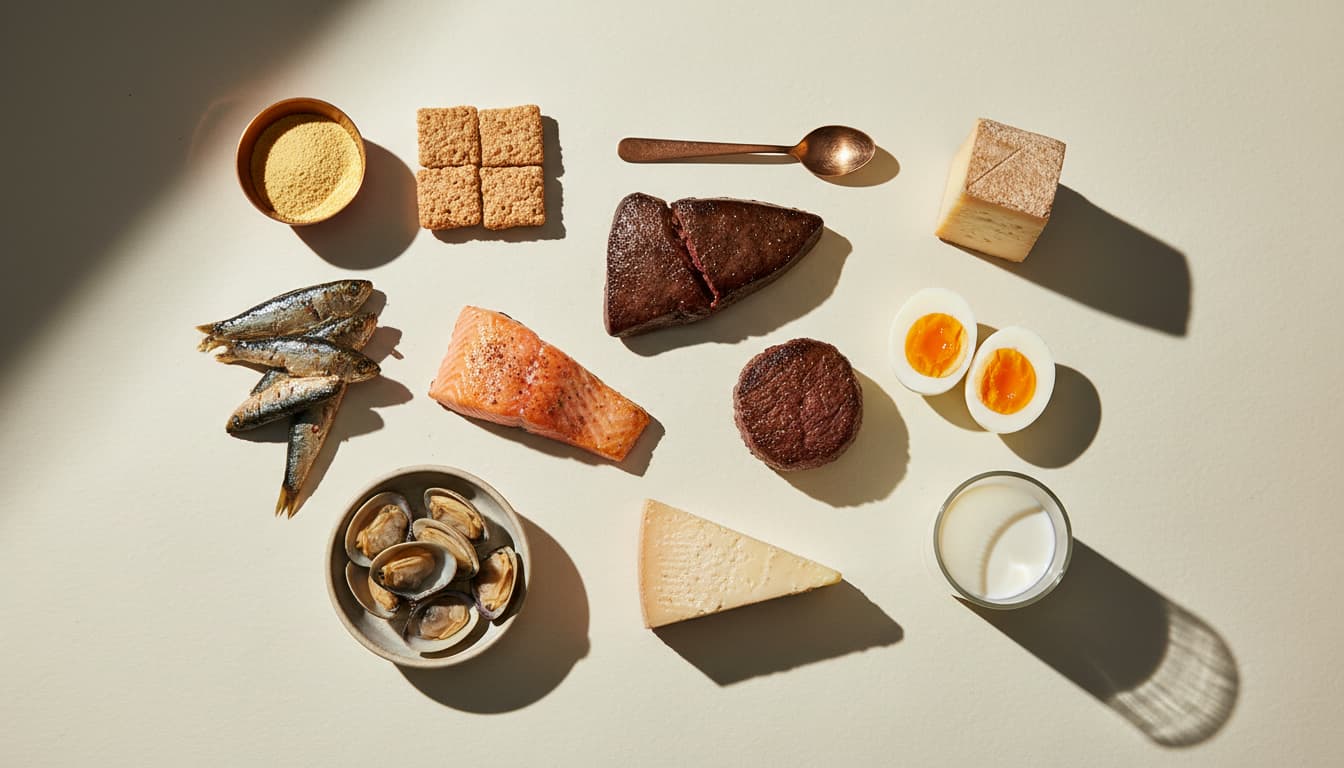
The RDA is just 2.4 mcg a day, but the body absorbs only a small amount per dose, which is why supplements list far higher numbers. The target, why B12 comes only from animal foods and fortified products, and who genuinely needs to supplement.
- 01
The target: just 2.4 mcg a day
The RDA for vitamin B12 is only 2.4 mcg a day for adults, rising to 2.6 and 2.8 mcg in pregnancy and breastfeeding, one of the smallest targets of any nutrient (NIH ODS). This tiny number is easily met from a small serving of animal food. The apparent mismatch between this figure and the hundreds or thousands of micrograms on supplement labels is explained not by a higher requirement but by the limits of how B12 is absorbed, the defining feature of this vitamin.
- 02
Why supplements list hundreds of micrograms
Absorption of B12 is saturable: the body can take up only about 1.5 to 2 mcg from any single dose through its active carrier system, plus a tiny fraction passively (NIH ODS). This is why a 500 or 1,000 mcg supplement is not the megadose it appears, only a small amount is actually absorbed, so a large dose is a way to get enough across the gut, not overkill. It also means B12 taken less often but in larger amounts can still work, because the passive route handles some of the surplus.
- 03
B12 comes only from animal foods and fortification
B12 is made by bacteria and accumulates in animal tissues, so natural dietary B12 comes essentially only from meat, fish, shellfish, eggs, and dairy, with plants containing effectively none in a reliably usable form (NIH ODS). This makes B12 the one nutrient that genuinely requires planning on a plant-based diet. Fortified foods, some plant milks, nutritional yeast, and cereals, plus supplements, are the reliable non-animal sources, and for vegans they are not optional.
- 04
Vegans and vegetarians must supplement
Because plants contain no reliable B12, vegans must obtain it from fortified foods or a supplement, and vegetarians who eat little dairy or eggs are also at risk (NIH ODS). This is the clearest example of a nutrient where a plant-based diet cannot rely on food choices alone. The good news is that fortified foods and cheap supplements make it easy to solve, but it does require deliberate action, and B12 deficiency in unsupplemented vegans is a real and serious problem, not a theoretical one.
- 05
Older adults and certain medications
Beyond diet, the major risk group is older adults: the stomach changes of aging (atrophic gastritis) reduce the acid needed to free B12 from food, so people over about 50 are advised to get much of their B12 from fortified foods or supplements, where it is not protein-bound (NIH ODS). People taking the diabetes drug metformin or long-term acid-reducing medications, and those with pernicious anemia or digestive diseases, are also at risk. These groups may need B12 even while eating plenty of animal food.
- 06
No upper limit: the risk is deficiency, not excess
B12 has no established tolerable upper intake level and very low toxicity, because the body absorbs only what it can use and excretes the rest (NIH ODS). This is why high-dose supplements are considered safe and why the concern with B12 is always deficiency rather than overload. Deficiency matters because it causes serious anemia and, if prolonged, nerve damage that can become permanent, so for at-risk groups, erring on the side of getting enough, even well above the 2.4 mcg target, is the sensible approach.
What people ask us next.
- How much vitamin B12 do I need a day?
- The RDA is just 2.4 mcg a day for adults, rising to 2.6 mcg in pregnancy and 2.8 mcg while breastfeeding, one of the smallest targets of any nutrient (NIH ODS). This tiny amount is easily met from a small serving of meat, fish, eggs, or dairy. The much larger numbers on supplement labels reflect the limits of B12 absorption, not a higher requirement, since the body absorbs only a small fraction of any single dose.
- Why do B12 supplements contain such high doses?
- Because B12 absorption is saturable: the body can only take up about 1.5 to 2 mcg from any single dose through its active carrier system, plus a tiny fraction passively (NIH ODS). So a 500 or 1,000 mcg supplement is not the megadose it looks like, only a small amount is actually absorbed, and the large dose is a way to ensure enough gets across the gut. This is also why less frequent, larger doses can still meet needs, thanks to the small passive absorption of the surplus.
- Can you get vitamin B12 from plants?
- Not reliably. B12 is made by bacteria and accumulates in animal tissues, so it occurs naturally only in meat, fish, shellfish, eggs, and dairy, and plants contain effectively none in a usable form (NIH ODS). Some plant foods like certain algae contain B12-like compounds that are not reliably active in humans. This makes B12 the one nutrient a vegan diet cannot supply through food choices alone, so vegans must use fortified foods or a supplement.
- Do vegans and vegetarians need a B12 supplement?
- Vegans definitely do, and many vegetarians benefit from one. Because plants contain no reliable B12, vegans must get it from fortified foods, some plant milks, nutritional yeast, and cereals, or a supplement, and this is not optional (NIH ODS). Vegetarians who eat little dairy or eggs are also at risk. B12 deficiency in unsupplemented vegans is a real and serious problem that can cause anemia and permanent nerve damage, so deliberate supplementation is important, not a theoretical precaution.
- Can you take too much vitamin B12?
- No established upper limit exists, because B12 has very low toxicity: the body absorbs only what it can use and excretes the rest in urine (NIH ODS). This is why high-dose supplements are considered safe and why the concern with B12 is always deficiency rather than excess. For at-risk groups, vegans, older adults, and people on certain medications, getting more than the 2.4 mcg target through fortified foods or supplements is sensible, since ensuring adequate intake matters far more than any risk from surplus.
Every claim, cited.
The Larderlab Team builds evidence-led frameworks for eating, lifting, and stocking a kitchen. We cite every claim. We publish the spreadsheet when possible. We buy what we review at retail price. When new data lands, we revise with a dated note.
Next in this hub.
When to Take Vitamin D: With Fat, and Why Daily Beats a Bolus
The meal beats the clock. Peak plasma vitamin D3 was 32 percent higher with a fat-containing meal than a fat-free one, and taking it with the largest meal raised serum 25(OH)D by 56 percent at an unchanged dose. Plus why large intermittent doses backfired.
8 min · rev 2026-08-21Foods High in Vitamin B12: The Densest Sources, by Micrograms
The RDA is 2.4 mcg/day, and clams, beef liver, and oily fish are the densest sources. The mcg-per-serving ranking, why B12 is almost absent from plant foods, and when vegetarians and vegans need a supplement.
8 min · rev 2026-07-07Vitamin B12 Deficiency Symptoms, Ranked by What the Evidence Shows
Fatigue and tingling in the hands and feet come first, and the danger is that nerve damage can arrive before anemia and become permanent. The B12 deficiency symptoms with real evidence, who is at risk, and why a normal serum B12 can miss it.
8 min · rev 2026-07-08Get the Larderlab Macro Planner.
A Google Sheet that calculates your protein target, splits it across 3-5 meals, and ranks 20 protein sources by $/gram. Free. Copy-and-modify your own version.
By subscribing, you agree to our Privacy Policy. Unsubscribe anytime.