Wie viel Ballaststoffe am Tag, nach Alter und Geschlecht
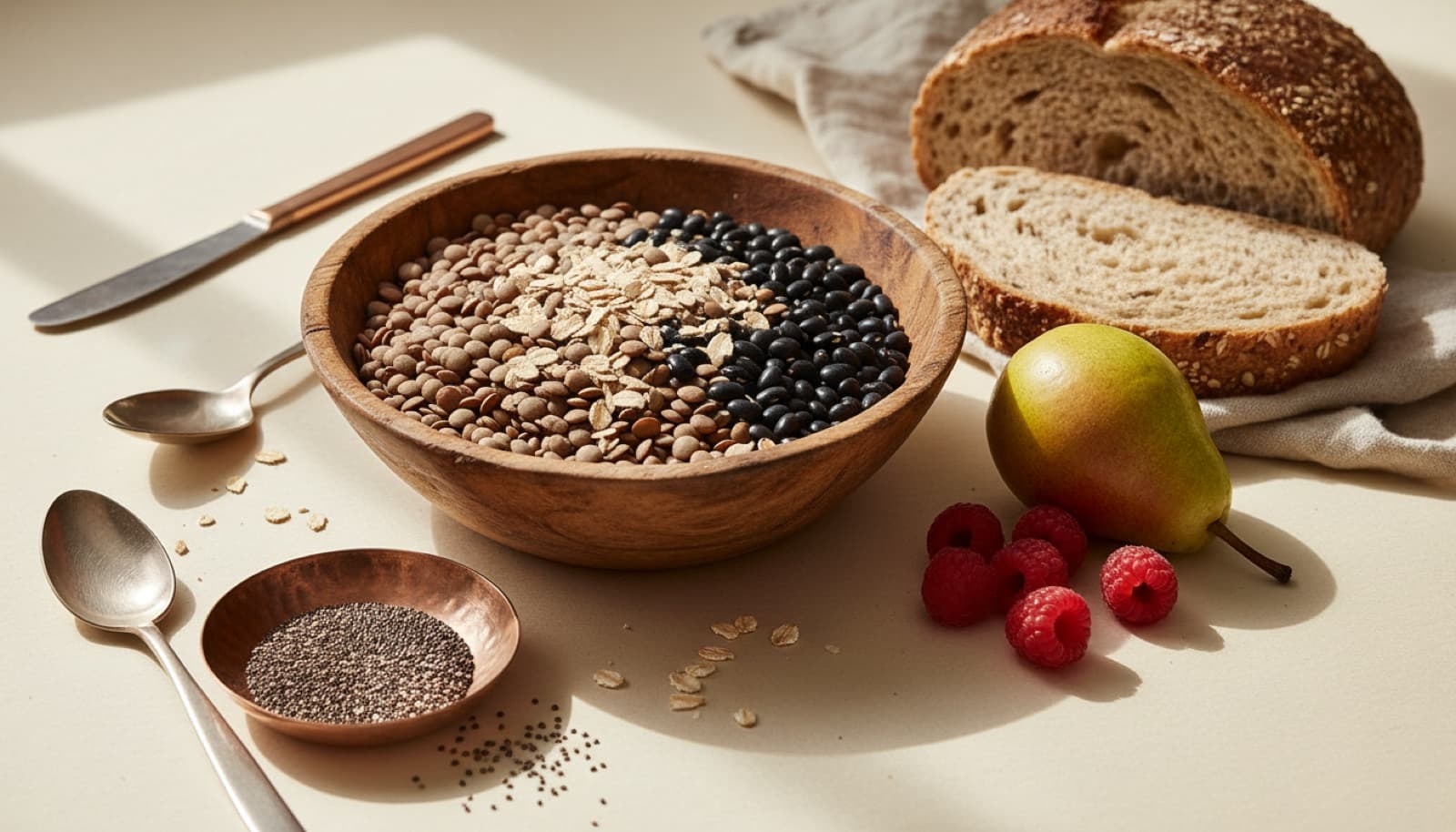
Das Ziel liegt bei 14 g Ballaststoffen je 1.000 aufgenommene Kalorien, also etwa 25 g/Tag für Frauen und 38 g/Tag für Männer. Die tägliche Ballaststoffmenge nach Alter und Geschlecht, warum die meisten nur die Hälfte erreichen und wie Sie die Lücke über die Nahrung schließen.
- 01
Erwachsene Frauen: etwa 25 g/Tag
Die angemessene Zufuhr für Frauen von 19-50 Jahren liegt bei 25 g/Tag und sinkt nach dem 50. Lebensjahr auf 21 g/Tag, wenn der Kalorienbedarf fällt (IOM 2005; NIH). Die Zahl leitet sich aus der Regel von 14 g je 1.000 Kalorien angewendet auf die typische weibliche Energiezufuhr ab. Die Schwangerschaft erhöht sie auf ~28 g/Tag und die Stillzeit auf ~29 g/Tag. Die meisten Frauen nehmen nur ~13-15 g auf, sodass die realistische Aufgabe darin besteht, die derzeitige Zufuhr etwa zu verdoppeln, nicht sie fein abzustimmen.
- 02
Erwachsene Männer: etwa 38 g/Tag
Die angemessene Zufuhr für Männer von 19-50 Jahren liegt bei 38 g/Tag und fällt nach dem 50. Lebensjahr auf 30 g/Tag (IOM 2005). Die höhere Zahl bei Männern spiegelt die höhere durchschnittliche Kalorienzufuhr wider, keinen anderen Mechanismus, da der zugrunde liegende Maßstab für alle 14 g je 1.000 Kalorien beträgt. Männer bleiben in ähnlichem Maße zurück wie Frauen, im Schnitt ~17-19 g/Tag, sodass 38 g gezielte Quellen bei jeder Mahlzeit erfordern statt eines einzelnen ballaststoffreichen Lebensmittels.
- 03
Der eigentliche Maßstab ist 14 g je 1.000 Kalorien
Die Zahlen 25 und 38 g sind Abkürzungen; die eigentliche Vorgabe lautet 14 g Ballaststoffe je 1.000 aufgenommene Kalorien (Dietary Guidelines 2020-2025). Deshalb sollte eine aktive Person mit 3.000 Kalorien näher an 42 g anstreben, während jemand mit 1.600 Kalorien ~22 g anpeilt. Sich an den Kalorien statt an einer festen Grammzahl zu orientieren, hält das Ziel über Körpergrößen und Aktivitätsniveaus hinweg ehrlich und erklärt, warum sich das Ballaststoffziel derselben Person ändert, wenn sich ihre Aufnahme ändert.
- 04
Kinder und Jugendliche: von 'Alter plus 5' bis altersbasierte Gramm
Die alte Regel 'Alter plus 5' (ein 6-Jähriger strebt ~11 g an) ist eine grobe Untergrenze; die aktuelle angemessene Zufuhr liegt bei 19-25 g/Tag für Kinder von 4-8 Jahren und 26-31 g/Tag für jugendliche Jungen sowie 22-26 g/Tag für jugendliche Mädchen (IOM 2005). Dieselbe Logik von 14 g je 1.000 Kalorien gilt. Die Defizite bei Kindern spiegeln die der Erwachsenen wider, getrieben durch raffinierte Getreide und geringen Gemüseverzehr, sodass die Lösung dieselbe ist: unverarbeitete Getreide, Obst mit Schale und Hülsenfrüchte statt ballaststoffangereicherter Snackprodukte.
- 05
Löslich vs. unlöslich: beide, aus der Nahrung
Lösliche Ballaststoffe (Hafer, Gerste, Bohnen, Äpfel, Flohsamen) bilden ein Gel, das das LDL-Cholesterin bei 5-10 g/Tag um ~5-10% senkt und den Glukoseanstieg nach dem Essen dämpft (Brown et al. 1999). Unlösliche Ballaststoffe (Weizenkleie, Vollkorn, Gemüseschalen) erhöhen das Volumen und beschleunigen die Passage, was Verstopfung lindert. Pflanzliche Vollwertkost enthält beide, sodass kein Verhältnis verfolgt werden muss. Die Gesamtzufuhr aus vielfältigen Pflanzen zu erhöhen erfasst automatisch beide Funktionen, weshalb Supplemente einzelner Typen eine Rückfalloption sind, keine Strategie.
- 06
Die dichtesten Alltagsquellen
Laut USDA FoodData Central: 1 Tasse gekochte schwarze Bohnen (~15 g), 1 Tasse gekochte Linsen (~15,6 g), 1 mittlere Avocado (~10 g), 1 oz Chiasamen (~10 g), 1 Tasse Himbeeren (~8 g), 1 mittlere Birne mit Schale (~5,5 g), 1 Tasse gekochter Hafer (~4 g). Hülsenfrüchte sind der ertragreichste Alltagshebel: eine einzige Tasse Bohnen oder Linsen liefert mehr als die Hälfte des Tagesziels einer Frau. Zwei Portionen Hülsenfrüchte plus Obst und ein unverarbeitetes Getreide erreichen 25-38 g ganz ohne Supplement.
- 07
Langsam steigern und Wasser trinken
Von 15 g an einem Tag auf 38 g zu springen verursacht zuverlässig Gase, Blähungen und Krämpfe, während sich die Darmbakterien anpassen. Erhöhen Sie über 2-3 Wochen um ~5 g alle paar Tage und steigern Sie zugleich die Flüssigkeitszufuhr, da Ballaststoffe, besonders die volumenbildende unlösliche Art, Wasser zum Weitertransport brauchen und Verstopfung ohne es verschlimmern können. Die Anpassung ist real: Das Unbehagen verschwindet, wenn sich das Mikrobiom umstellt, aber nur bei allmählicher Steigerung. Das ist der häufigste Grund, warum Menschen eine ballaststoffreichere Ernährung aufgeben.
Was als Nächstes gefragt wird.
- Wie viel Ballaststoffe sollte ich am Tag essen?
- Etwa 25 g/Tag für Frauen und 38 g/Tag für Männer von 19-50 Jahren, sinkend auf 21 g und 30 g nach dem 50. Lebensjahr (Institute of Medicine 2005). Der zugrunde liegende Maßstab ist 14 g Ballaststoffe je 1.000 aufgenommene Kalorien, sodass wer mehr isst mehr braucht und wer weniger isst weniger. Die meisten US-Erwachsenen nehmen nur ~15 g/Tag auf, sodass für die meisten die Aufgabe darin besteht, eine große Lücke zu schließen, statt eine exakte Zahl zu treffen.
- Sind 30 Gramm Ballaststoffe am Tag genug?
- Für die meisten Frauen ja; für viele Männer liegt es knapp, aber leicht unter dem Ziel von 38 g. 30 g/Tag liegen komfortabel in dem Bereich, der in der Lancet-Meta-Analyse von 2019 mit dem stärksten Rückgang bei Herzkrankheit, Typ-2-Diabetes und Darmkrebs verbunden war (Reynolds et al. 2019), wo der Nutzen ab 25-29 g/Tag aufwärts am größten war. Da die durchschnittliche Zufuhr ~15 g beträgt, erfasst das Erreichen von 30 g bereits den größten Teil des messbaren Nutzens.
- Wie viel Ballaststoffe am Tag zum Abnehmen?
- Es gibt kein eigenes Ballaststoffziel zum Abnehmen; es gelten dieselben 25-38 g/Tag. Ballaststoffe unterstützen das Gewichtsmanagement indirekt, indem sie die Sättigung erhöhen und die Magenentleerung verlangsamen, sodass ballaststoffreichere Mahlzeiten die gesamte Kalorienzufuhr ohne bewusstes Einschränken senken. In Studien führte allein das Anstreben von 30 g/Tag zu einem Gewichtsverlust vergleichbar mit komplexeren Diäten (Ma et al. 2015). Der Mechanismus ist Sättigung und Nahrungsvolumen, nicht Fettverbrennung.
- Kann ich genug Ballaststoffe allein aus der Nahrung beziehen?
- Ja, und das ist der bevorzugte Weg. Ein Tag mit 1 Tasse schwarzen Bohnen (~15 g), 1 Tasse Himbeeren (~8 g), 1 Birne mit Schale (~5,5 g) und 1 Tasse gekochtem Hafer (~4 g) übersteigt bereits 32 g (USDA FoodData Central). Nahrungsballaststoffe kommen mit Kalium, Magnesium und Polyphenolen, die einen Großteil ihres Nutzens erklären dürften, weshalb ein Supplement eher eine Rückfalloption für eine hartnäckige Lücke ist als ein Ersatz.
- Was passiert, wenn ich zu viele Ballaststoffe esse?
- Sehr hohe Zufuhren (weit über 50-70 g/Tag) können Blähungen, Gase und Krämpfe verursachen und in manchen Fällen die Aufnahme von Mineralstoffen wie Zink und Eisen verringern, wenn die Zufuhr plötzlich stark ansteigt. Das ist aber selten, da kaum jemand zu viele Ballaststoffe zu sich nimmt; das nahezu allgemeine Problem ist das Gegenteil. Das praktische Risiko ist, die Zufuhr zu schnell zu erhöhen: Steigern Sie um ~5 g alle paar Tage und trinken Sie mehr Wasser, um das vorübergehende Unbehagen zu vermeiden.
- Ist Ballaststoff ein Kohlenhydrat, und zählt er zu meinen Makros?
- Ja, Ballaststoffe sind ein Kohlenhydrat, aber weitgehend unverdaulich, sodass sie wenig nutzbare Energie liefern. Deshalb ziehen 'Netto-Kohlenhydrate' die Ballaststoffe vom gesamten Kohlenhydratgehalt ab. Wenn Sie ein tägliches Kohlenhydratziel setzen, zählen die Ballaststoffe innerhalb dieser Zahl, nicht als eigenes Makro. Um zu sehen, wie Ballaststoffe neben Ihren Eiweiß- und Fettzielen für einen vollständigen Tag stehen, setzt unser Makro-Rechner alle drei auf einmal.
Jede Aussage, belegt.
- [01]Institute of Medicine. 2005. Dietary Reference Intakes for Energy, Carbohydrate, Fiber, Fat, Fatty Acids, Cholesterol, Protein, and Amino Acids. National Academies Press. Adequate intake set at 14 g fiber per 1,000 kcal; 25 g/day (women) and 38 g/day (men).
- [02]US Departments of Agriculture and Health and Human Services. Dietary Guidelines for Americans, 2020-2025. Fiber recommendation of 14 g per 1,000 calories; most Americans fall short.
- [03]Reynolds A, Mann J, Cummings J, et al. 2019. Carbohydrate quality and human health: a series of systematic reviews and meta-analyses. Lancet 393(10170):434-445. Each 8 g/day fiber increment linked to 5-27% lower disease risk; strongest benefits from 25-29 g/day.
- [04]Quagliani D, Felt-Gunderson P. 2017. Closing America's Fiber Intake Gap. Am J Lifestyle Med 11(1):80-85. Average US intake ~15 g/day; only ~5% meet the recommendation.
- [05]Brown L, Rosner B, Willett WW, Sacks FM. 1999. Cholesterol-lowering effects of dietary fiber: a meta-analysis. Am J Clin Nutr 69(1):30-42. Soluble fiber lowers LDL cholesterol at 5-10 g/day.
Das Larderlab-Team entwickelt evidenzbasierte Rahmenwerke fürs Essen, Trainieren und Bestücken einer Küche. Wir belegen jede Aussage. Wir veröffentlichen die Tabelle, wo möglich. Wir kaufen, was wir testen, zum Ladenpreis. Wenn neue Daten erscheinen, überarbeiten wir mit einer datierten Notiz.
Als Nächstes in diesem Ressort.
Casein oder Whey: Whey gewinnt die Stunde, Casein gewinnt die Nacht
Whey hob die Muskelproteinsynthese um rund 93 Prozent über Casein in Ruhe und um 122 Prozent nach dem Training, doch Casein lieferte die bessere Nettobilanz über 7 Stunden. Casein vor dem Schlaf brachte über 12 Wochen 3,6 Quadratzentimeter mehr Quadrizepswachstum gegenüber Placebo.
14 Min. · Rev. 2026-09-10Beste Proteinpulver, sortiert nach $/Gramm Leucin
Wir haben 14 Proteinpulver nach der Kennzahl sortiert, die tatsächlich zählt: den Kosten pro Gramm geliefertem Leucin, mit Filtern für Tests durch Dritte.
14 Min. · Rev. 2026-04-21Beste Vollwert-Proteinquellen, sortiert nach $/Gramm
20 Vollwert-Proteinquellen, bepreist pro Gramm Protein, mit Costco- und Supermarkt-Benchmarks. Vierteljährlich aktualisiert.
10 Min. · Rev. 2026-04-21Holen Sie sich den Larderlab-Makroplaner.
Ein Google Sheet, das Ihren Proteinbedarf berechnet, ihn auf 3-5 Mahlzeiten verteilt und 20 Proteinquellen nach $/Gramm sortiert. Kostenlos. Kopieren und nach Belieben anpassen.
Mit der Anmeldung stimmen Sie unserer Datenschutzerklärung zu. Jederzeit kündbar.