Was Kreatin für Frauen bewirkt, nach der Evidenz
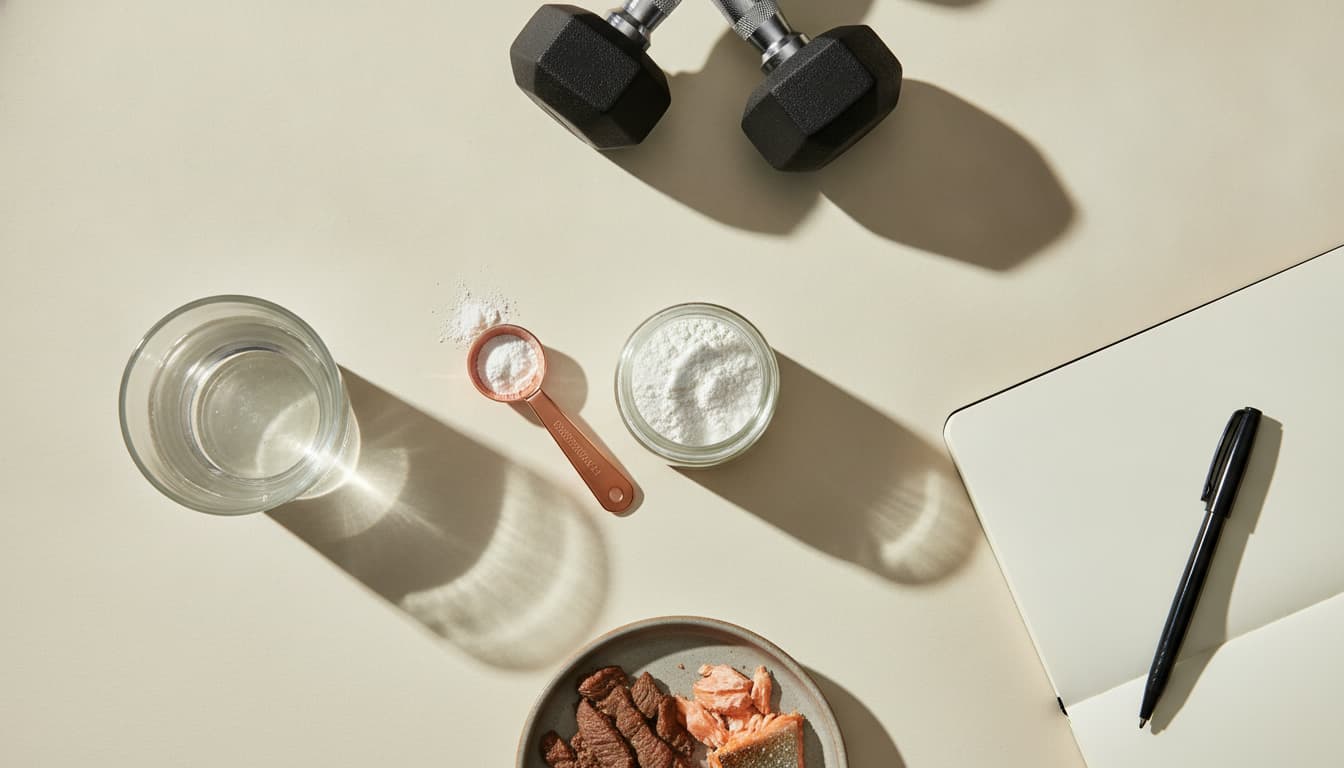
Frauen haben 70 bis 80 Prozent niedrigere körpereigene Kreatinspeicher als Männer, und die Dosis ist dieselbe von 3 bis 5 g am Tag. Kraft, Magermasse, Knochen, Stimmung und was die Evidenz über die Lebensspanne stützt.
- 01
Die Ausgangslücke: 70 bis 80 Prozent niedrigere körpereigene Speicher
Eine Übersicht über die Lebensspanne zu Kreatin in der Frauengesundheit berichtet, dass Frauen 70 bis 80 Prozent niedrigere körpereigene Kreatinspeicher als Männer aufweisen und dass Kreatinkinetik und Phosphokreatin-Resynthese mit dem Hormonmilieu wechseln (Smith-Ryan et al. 2021). Nahrungskreatin stammt fast ausschließlich aus Fleisch und Fisch, eine geringere Zufuhr beider verstärkt die Lücke also. Ein niedrigerer Ausgangsvorrat ist das mechanistische Argument dafür, dass eine Einnahme bei Frauen eher mehr als weniger zählt, wobei das eine Begründung ist und kein belegter größerer Effekt.
- 02
Vor der Menopause: Kraft und Leistungsfähigkeit
Dieselbe Übersicht kommt zu dem Schluss, dass eine Kreatineinnahme bei Frauen vor der Menopause Kraft und Leistungsfähigkeit verbessert (Smith-Ryan et al. 2021). Der Mechanismus ist nicht geschlechtsspezifisch: Kreatin erweitert den Phosphokreatinvorrat, der ATP bei kurzen, hochintensiven Belastungen erneuert, was mehr hochwertige Wiederholungen pro Einheit erlaubt, und die Anpassung folgt aus dem angesammelten Training, nicht aus der Substanz selbst. Deshalb schlägt Kreatin Placebo verlässlich, wenn es ein Trainingsprogramm begleitet, und bewirkt allein wenig.
- 03
Nach der Menopause: die höhere Dosis und der Knochenvorbehalt
Für Frauen nach der Menopause berichtet die Übersicht Vorteile für Muskelgröße und Muskelfunktion bei höheren Mengen um 0,3 g pro kg am Tag sowie günstige Wirkungen auf den Knochen, wenn Kreatin mit Krafttraining verbunden wird (Smith-Ryan et al. 2021). Die Bedingung ist der wichtige Teil: die Knochenergebnisse hängen am Training, nicht am Pulver. Die Richtung stützt eine Metaanalyse von 22 Studien mit 721 älteren Erwachsenen, die 1,37 kg mehr fettfreie Gewebemasse mit Kreatin während des Krafttrainings fand, dazu mehr Kraft im Ober- und Unterkörper (Chilibeck et al. 2017).
- 04
Der Waagewechsel ist Wasser und fettfreies Gewebe, kein Fett
Der häufigste Grund, warum Frauen Kreatin absetzen, ist die frühe Waagebewegung, und die gepoolten Zahlen klären sie. Über 143 randomisierte Studien hob Kreatin die Körpermasse um 0,86 kg (95% KI 0,76 bis 0,96), während die fettfreie Masse um 0,82 kg stieg und der Körperfettanteil um 0,28 Punkte sank (Pashayee-Khamene et al. 2024). Eine Studie, die die Flüssigkeitsräume mit Deuteriumoxid- und Natriumbromid-Verdünnung maß, fand, dass der frühe Zuwachs Gesamtkörperwasser ohne Änderung des Verhältnisses von intra- zu extrazellulär ist, das Wasser sitzt also in den Muskelzellen und nicht unter der Haut (Powers et al. 2003).
- 05
Stimmung und Kognition: vielversprechend und weiterhin vorläufig
Die Übersicht über die Lebensspanne hält präklinische und klinische Hinweise auf günstige Wirkungen von Kreatin auf Stimmung und Kognition fest, möglicherweise über die Wiederherstellung von Energieniveau und Homöostase im Gehirn, und wirft die Möglichkeit auf, dass dieser Weg bei Frauen besonders bedeutsam ist (Smith-Ryan et al. 2021). Das Gehirn ist ein energetisch teures Organ, das ebenfalls das Phosphokreatinsystem nutzt, der Mechanismus ist also stimmig. Die Evidenzbasis ist jedoch klein und uneinheitlich, und das gehört in die Spalte vernünftiger Hypothesen, nicht gesicherter Ergebnisse.
- 06
Dosis und Form: nichts Geschlechtsspezifisches zu kaufen
Die Alltagsdosis beträgt 3 bis 5 g reines Kreatinmonohydrat am Tag, täglich genommen, ohne nötige Ladephase, und es gibt keine Evidenz für eine geschlechtsspezifische Dosis im allgemeinen Gebrauch. Das Weglassen der Ladephase verteilt die Wasserverschiebung über etwa einen Monat statt über eine Woche. Monohydrat ist die Form mit der Evidenz dahinter; HCl-, gepufferte und flüssige Varianten kosten mehr ohne belegten Vorteil. Schwangerschaft und Wochenbett werden in der Übersicht als interessante Phasen benannt, doch Studien am Menschen fehlen, diese Entscheidung gehört also in ärztliche Hand.
Was als Nächstes gefragt wird.
- Was bewirkt Kreatin bei Frauen?
- Dasselbe wie bei Männern, von einem niedrigeren Ausgangspunkt aus. Eine Übersicht über die Lebensspanne berichtet, dass Frauen 70 bis 80 Prozent niedrigere körpereigene Kreatinspeicher als Männer aufweisen, und kommt zu dem Schluss, dass die Einnahme bei Frauen vor der Menopause Kraft und Leistungsfähigkeit verbessert, während Frauen nach der Menopause Vorteile für Muskelgröße und Muskelfunktion bei höheren Mengen um 0,3 g pro kg am Tag zeigen, dazu günstige Knochenwirkungen in Verbindung mit Krafttraining (Smith-Ryan et al. 2021).
- Wie viel Kreatin sollte eine Frau nehmen?
- 3 bis 5 g reines Kreatinmonohydrat am Tag, täglich, ohne nötige Ladephase. Für den allgemeinen Gebrauch gibt es keine Evidenz für eine geschlechtsspezifische Dosis. Die eine Ausnahme in der Literatur betrifft Muskel- und Knochenergebnisse nach der Menopause, wo die berichteten Vorteile aus höheren Mengen um 0,3 g pro kg am Tag in Verbindung mit Krafttraining stammten (Smith-Ryan et al. 2021), was eine deutlich größere Dosis und eine Entscheidung für das ärztliche Gespräch ist.
- Wird eine Frau von Kreatin massig oder setzt sie Fett an?
- Nein zum Fett, und die Sorge vor Masse liest den Mechanismus falsch. Gepoolt über 143 randomisierte Studien hob Kreatin die Körpermasse um 0,86 kg, während die fettfreie Masse um 0,82 kg stieg und der Körperfettanteil um 0,28 Punkte sank (Pashayee-Khamene et al. 2024). Der frühe Zuwachs ist Wasser im Inneren der Muskelzellen, und eine Studie, die die Räume direkt maß, fand keine Verschiebung des Verhältnisses von intra- zu extrazellulär (Powers et al. 2003). Muskel, der danach entsteht, kommt aus dem Trainingsprogramm, in dessen Tempo.
- Ist Kreatin für Frauen nach der Menopause sinnvoll?
- Dort ist der Fall wohl am stärksten. Die Übersicht über die Lebensspanne berichtet Vorteile für Muskelgröße und Muskelfunktion bei Mengen um 0,3 g pro kg am Tag sowie günstige Wirkungen auf den Knochen, wenn Kreatin mit Krafttraining verbunden statt allein genommen wird (Smith-Ryan et al. 2021). Eine Metaanalyse von 22 randomisierten Studien mit 721 älteren Erwachsenen fand 1,37 kg mehr fettfreie Gewebemasse und mehr Kraft beim Bankdrücken und in der Beinpresse, wenn Kreatin das Krafttraining begleitete (Chilibeck et al. 2017).
- Verändert der Menstruationszyklus die Wirkung von Kreatin?
- Möglicherweise, und die Evidenz ist vorläufig. Die Übersicht hält fest, dass Kreatinkinetik und Phosphokreatin-Resynthese mit dem Hormonmilieu schwanken, weshalb eine Einnahme während der Menstruation, in Schwangerschaft und Wochenbett sowie rund um die Menopause besonders bedeutsam sein könnte (Smith-Ryan et al. 2021). Das ist eine mechanistische Beobachtung, keine Dosierungsanweisung, und es gibt keine Evidenz dafür, die Dosis nach Zyklusphase zu wechseln. Tägliche, beständige Einnahme bleibt das Protokoll mit Evidenz dahinter.
- Ist Kreatin für Frauen langfristig sicher?
- Bei gesunden Erwachsenen ist die Sicherheitsbilanz stark. Über eine große Zahl von Studien hinweg, darunter Untersuchungen über mehr als vier Jahre, zeigt Kreatinmonohydrat mit 3 bis 5 g am Tag keine nachteiligen Wirkungen auf Nieren, Leber oder Herz-Kreislauf-System bei gesunden Menschen (Kreider et al. 2017). Die reproduzierbare Wirkung ist intrazelluläres Wasser in den ersten Wochen. Schwangerschaft und Stillzeit sind die Lücke: die Übersicht benennt sie als interessante Phasen, doch Studien am Menschen fehlen, die Entscheidung gehört also in ärztliche Hand.
Jede Aussage, belegt.
- [01]Smith-Ryan AE, Cabre HE, Eckerson JM, Candow DG. 2021. Creatine supplementation in women's health: a lifespan perspective. Nutrients 13(3). Reports 70-80% lower endogenous creatine stores in females; pre- and post-menopausal outcomes and the 0.3 g/kg/day figure.
- [02]Chilibeck PD, Kaviani M, Candow DG, Zello GA. 2017. Effect of creatine supplementation during resistance training on lean tissue mass and muscular strength in older adults: a meta-analysis. Open Access J Sports Med 8:213-226. 22 studies, n=721; lean tissue +1.37 kg.
- [03]Pashayee-Khamene F, Heidari Z, Asbaghi O, et al. 2024. Creatine supplementation protocols with or without training interventions on body composition: a GRADE-assessed systematic review and dose-response meta-analysis. J Int Soc Sports Nutr 21(1):2380058.
- [04]Powers ME, Arnold BL, Weltman AL, et al. 2003. Creatine supplementation increases total body water without altering fluid distribution. J Athl Train 38(1):44-50.
- [05]Kreider RB, Kalman DS, Antonio J, et al. 2017. ISSN position stand: safety and efficacy of creatine supplementation in exercise, sport, and medicine. J Int Soc Sports Nutr 14:18.
Das Larderlab-Team entwickelt evidenzbasierte Rahmenwerke fürs Essen, Trainieren und Bestücken einer Küche. Wir belegen jede Aussage. Wir veröffentlichen die Tabelle, wo möglich. Wir kaufen, was wir testen, zum Ladenpreis. Wenn neue Daten erscheinen, überarbeiten wir mit einer datierten Notiz.
Als Nächstes in diesem Ressort.
Bestes Creatin-Monohydrat, sortiert nach $/Gramm
Creapure-zertifiziertes Creatin sortiert nach $/Gramm, mit Status der Tests durch Dritte und Markentransparenz.
10 Min. · Rev. 2026-04-21Kreatin für das Gehirn: für wen die Kognitionsdaten wirklich gelten
Über sechs randomisierte Studien mit 281 Personen verbesserten sich Kurzzeitgedächtnis und Denkleistung, doch bei jungen Menschen blieb die Leistung unverändert, und Vegetarier schnitten bei Gedächtnisaufgaben besser ab als Fleischessende. Der Subgruppeneffekt und der Dosierungshaken.
8 Min. · Rev. 2026-08-26Nimmt man von Kreatin zu? Wasser, Muskel und Fett getrennt betrachtet
Ja, die Waage bewegt sich, um etwa 0,86 kg gepoolt über 143 Studien. Es ist intrazelluläres Wasser und fettfreie Masse, kein Fett, und der Körperfettanteil sinkt in den gepoolten Daten leicht. Die Zahlen und wie man den Sprung dämpft.
8 Min. · Rev. 2026-08-21Holen Sie sich den Larderlab-Makroplaner.
Ein Google Sheet, das Ihren Proteinbedarf berechnet, ihn auf 3-5 Mahlzeiten verteilt und 20 Proteinquellen nach $/Gramm sortiert. Kostenlos. Kopieren und nach Belieben anpassen.
Mit der Anmeldung stimmen Sie unserer Datenschutzerklärung zu. Jederzeit kündbar.