Wie lange hält Lebensmittel? Haltbarkeit nach Grundnahrungsmittel, mit Lagerlösungen
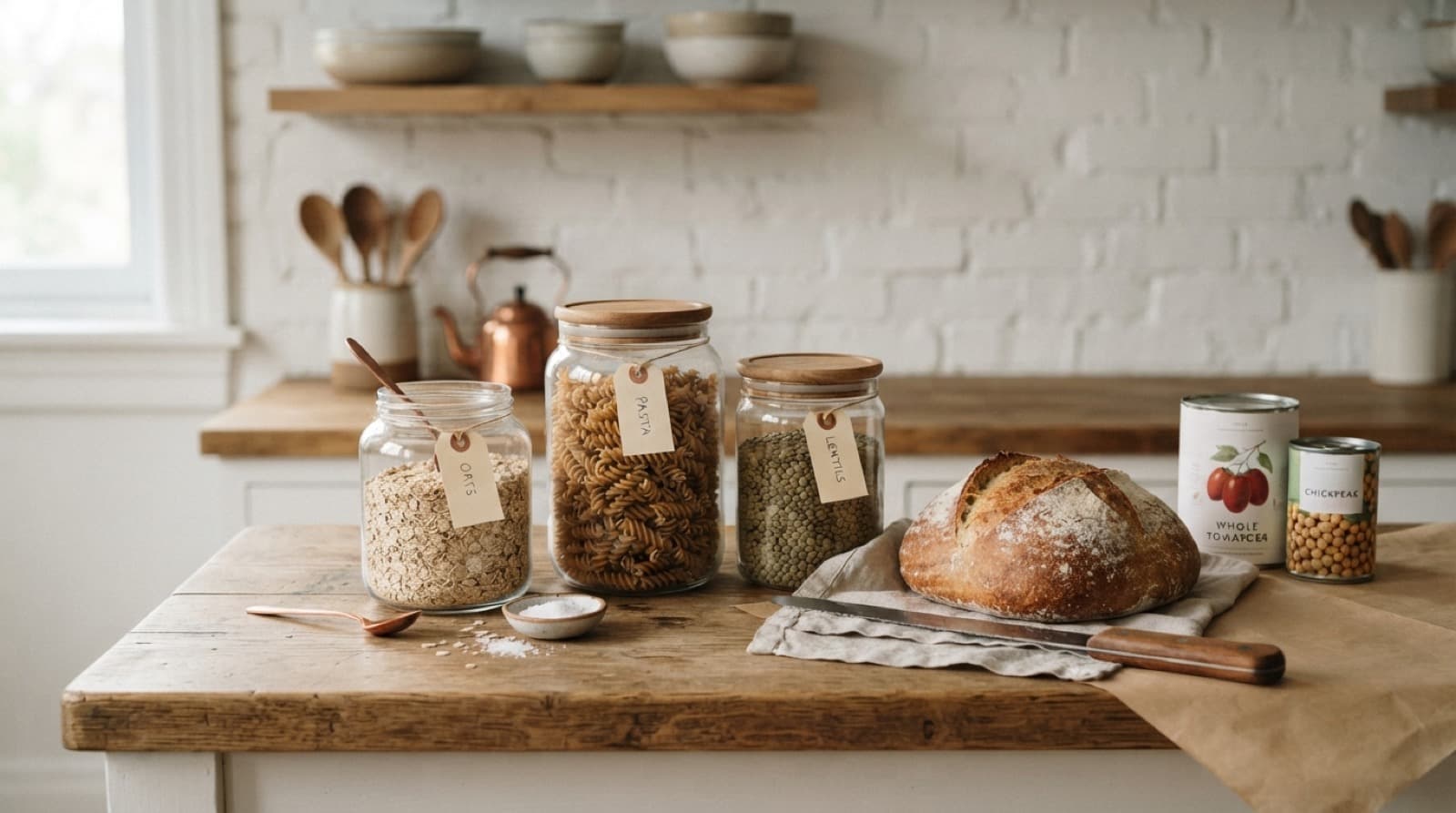
USDA-belegte Haltbarkeit für Vorrats-, Kühlschrank- und Gefrierstaples, plus die Lageränderung, die jede verlängert. Die Daten, die Qualität bedeuten, gegenüber denen, die Sicherheit bedeuten.
- 01
Haferflocken, Reis, Trockenpasta (versiegelt, kühl, dunkel)
Vorrat: ~12-24 Monate bei bester Qualität in luftdichten lebensmittelechten Behältern, laut USDA FoodKeeper. In der Originalverpackung etwa die Hälfte davon, wegen Luft- und Schädlingsexposition. Das sind Qualitätsdaten, keine Sicherheitsklippen: korrekt trocken gelagertes Getreide bleibt weit über die beste Qualität hinaus sicher. Lagerlösung: in versiegelte Eimer mit Dichtungsdeckeln umfüllen, die eine einzige Änderung, die aus einer 6-monatigen Nutzungsdauer 18-24 Monate macht.
- 02
Thunfisch, Lachs, Bohnen, Tomaten aus der Dose (lagerstabil)
Vorrat: 2-5 Jahre für säurearme Dosen (Thunfisch, Lachs, Bohnen), 12-18 Monate für säurereiche Dosen (Tomaten), laut USDA. Die Säure in Tomaten baut die Dosenbeschichtung und den Geschmack schneller ab als neutraler Inhalt. Das aufgedruckte Datum ist ein Datum für beste Qualität. Lagerlösung: Dosen unter 30 C halten und nach dem First-in-first-out-Prinzip rotieren; jede Dose entsorgen, die gewölbt, undicht oder durchgerostet ist.
- 03
Olivenöl und neutrale Speiseöle
Vorrat: ~18-24 Monate ungeöffnet, ~3-6 Monate bei bester Qualität nach dem Öffnen, schneller bei Lagerung nahe Hitze oder Licht. Oxidation, nicht Verderb, ist der Begrenzer; ranziges Öl riecht nach Wachsmalstiften oder Kitt. Lagerlösung: in dunklem Glas kaufen, fern vom Herd lagern und eine Größe kaufen, die Sie binnen 6 Monaten nach dem Öffnen aufbrauchen. Olivenöl in Großpackung gewinnt die Kosten-pro-Nutzung-Rechnung nur, wenn Sie es vor der Oxidation tatsächlich nutzen.
- 04
Eier (gekühlt)
Kühlschrank: 3-5 Wochen über das Verpackungsdatum hinaus bei 4 C oder darunter, laut USDA, weit über das Sell-by-Datum des Kartons hinaus. Der Schwimmtest ist eine grobe Frischeprüfung, kein Sicherheitstest. Lagerlösung: Eier im Hauptraum des Kühlschranks (nicht in der wärmeren Tür) in ihrem Karton aufbewahren, der Temperaturschwankungen abpuffert und Geruchsaufnahme verhindert.
- 05
Gegarte Proteine und Reste (gekühlt)
Kühlschrank: 3-4 Tage bei 4 C oder darunter, laut USDA, die feste Grenze für gegartes Hähnchen, Fisch, Bohnen und die meisten vorbereiteten Mahlzeiten. Das ist ein Sicherheitsfenster, keine Qualitätspräferenz, weil Erreger wie Listerien bei Kühlschranktemperaturen wachsen. Lagerlösung: binnen 2 Stunden abkühlen, in flachen versiegelten Behältern lagern und alles einfrieren, was Sie nicht bis Tag 3 essen.
- 06
Gefrorene Proteine (Hähnchen, Fisch, Hackfleisch)
Gefrierfach: beste Qualität 6-12 Monate in der Originalverpackung, 18-24 Monate vakuumversiegelt, laut USDA. Gefrorenes bleibt bei -18 C unbegrenzt sicher; die Daten betreffen Qualität (Gefrierbrand und Textur), nicht Sicherheit. Lagerlösung: vakuumieren oder doppelt einwickeln, mit Einfrierdatum beschriften und das Gefrierfach auf echten -18 C halten (ein Gefrierthermometer für $10 klärt die Frage).
- 07
Whey und Proteinpulver
Vorrat: beste Qualität bis zum aufgedruckten Datum (typischerweise 12-18 Monate voraus) und oft monatelang darüber hinaus nutzbar, wenn versiegelt und trocken gehalten, da der Fehlermodus Verklumpen und Geschmacksverlust ist, kein Erregerwachstum. Lagerlösung: den Schöpflöffel trocken halten, fest wiederverschließen und kühl lagern; Feuchtigkeit, nicht Zeit, ruiniert eine Dose Whey.
- 08
Honig, Salz und getrocknete Gewürze
Vorrat: Honig und Salz sind praktisch unbegrenzt haltbar (Honig kristallisiert, verdirbt aber nicht; sanftes Erwärmen kehrt das um). Ganze Gewürze halten ihr Aroma ~2-4 Jahre, gemahlene Gewürze ~1-2 Jahre, laut FoodKeeper, weil flüchtige Öle verblassen, nicht weil sie unsicher werden. Lagerlösung: Gewürze klein kaufen, fern von Hitze und Dampf des Herds lagern und nach Geruch ersetzen, nicht nach Verfallsdatum.
Wie das spezifiziert wurde
- 01Erfasste Eingangsgrößen
- Verkaufspreis (datiert) · Etikettenangabe · Certificate of Analysis · Test durch Dritte (Informed Sport / NSF / ConsumerLab / Clean Label) · Leucin pro Portion aus dem COA, nicht aus dem Marketing.
- 02Getestete Protokolle
- Zielwert pro kg aus vier Literaturbereichen (IOM RDA, Phillips 2017, Morton 2018, ISSN). Marken bewertet gegen die Leucin-pro-Dosis-Schwelle von Moore 2015 (~0,4 g/kg).
- 03Kostenbasis geprüft
- $/Gramm Protein und $/Gramm Leucin zu Warehouse-Preisen (Costco), Versandhandel (Amazon) und DTC-Einzelhandel. Vierteljährlich neu geprüft, markiert, wenn die Abweichung 15% übersteigt.
- 04Konfidenzniveau
- Hoch bei der Rangfolge. Mittel bei absoluten $/g (Preise wandern). Niedrig bei Portionsgrößenangaben, deren COA älter als 18 Monate ist, markiert mit [VERIFY].
Jede Aussage, belegt.
- [01]USDA FoodSafety.gov FoodKeeper App. 2024. Shelf-life data by product category and storage condition (pantry, refrigerator, freezer).
- [02]USDA Food Safety and Inspection Service. Food Product Dating. 'Best by', 'sell by', and 'use by' are quality indicators, not safety deadlines (except infant formula).
- [03]USDA FSIS. Refrigeration and Food Safety. Cooked foods 3-4 days at 40F or below; freezer storage indefinite for safety at 0F.
- [04]FDA. Are You Storing Food Safely? Temperature thresholds for refrigeration and freezing.
Das Larderlab-Team entwickelt evidenzbasierte Rahmenwerke fürs Essen, Trainieren und Bestücken einer Küche. Wir belegen jede Aussage. Wir veröffentlichen die Tabelle, wo möglich. Wir kaufen, was wir testen, zum Ladenpreis. Wenn neue Daten erscheinen, überarbeiten wir mit einer datierten Notiz.
Als Nächstes in diesem Ressort.
Getrocknete Bohnen vs Dosenbohnen: Kosten, Natrium, Zeit und ein echtes Risiko
Ein Pfund Trockenbohnen ergibt rund 6 Tassen gegart und ersetzt etwa 4 Dosen, bei 2,5- bis 5-fach niedrigeren Kosten pro Tasse. Dosenbohnen liefern 331 bis 655 mg Natrium pro Tasse gegenüber 1,7 mg selbst gekocht.
13 Min. · Rev. 2026-09-09Beste Meal-Prep-Behälter, 2026: Glas vs. Polypropylen, Stapel-Mathematik
Acht Behältersysteme bewertet nach Stapeldichte, Mikrowellen-/Ofentauglichkeit und Kosten pro Portion über eine 5-jährige Amortisation. Die Auslaugungstemperatur-Daten, die niemand veröffentlicht.
9 Min. · Rev. 2026-04-29Vorratsgrundlagen: wie man eine Küche nach Kosten pro Nutzung bestückt
Die lagerstabile kurze Liste, die die meisten Mahlzeiten abdeckt, sortiert nach Kosten pro Nutzung und Haltbarkeit. Die Regeln für den Großeinkauf, die Aufbewahrungsausrüstung, die sich rechnet, und was man nicht horten sollte.
12 Min. · Rev. 2026-06-29Holen Sie sich den Larderlab-Makroplaner.
Ein Google Sheet, das Ihren Proteinbedarf berechnet, ihn auf 3-5 Mahlzeiten verteilt und 20 Proteinquellen nach $/Gramm sortiert. Kostenlos. Kopieren und nach Belieben anpassen.
Mit der Anmeldung stimmen Sie unserer Datenschutzerklärung zu. Jederzeit kündbar.