Werden Nüsse ranzig, und warum eine einzelne Haltbarkeitszahl bedeutungslos ist
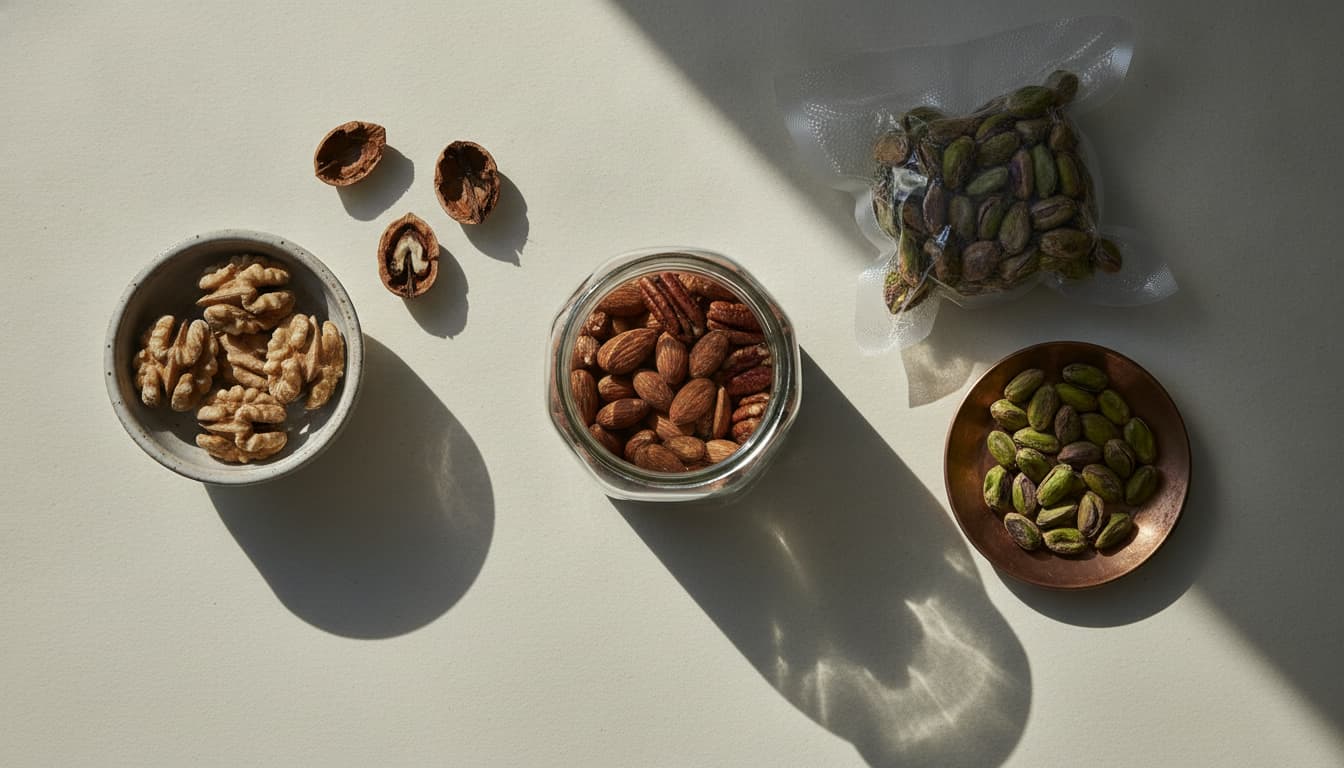
Mehrfach ungesättigtes Fett reicht von 47,2 g je 100 g bei Walnüssen bis 1,5 g bei Macadamias, eine 31-fache Spanne, die die Oxidationsuhr stellt (USDA FoodData Central). Ranzigkeit ist Chemie, nicht Mikrobiologie, und Aflatoxin ist die getrennte Gefahr bei 20 ppb (FDA).
- 01
Mehrfach ungesättigtes Fett schwankt um das 31-Fache, und diese Spanne ist die Antwort
Je 100 g liegt mehrfach ungesättigtes Fett bei 47,2 g in Walnüssen, 24,4 g in Paranüssen, 21,6 g in Pekannüssen, 15,6 g in rohen Erdnüssen, 14,4 g in rohen Pistazien, 12,3 g in Mandeln, 7,92 g in Haselnüssen, 7,84 g in rohen Cashews und 1,5 g in rohen Macadamias (USDA FoodData Central). Die Autoxidation greift die bis-allylischen Kohlenstoffe an, die nur mehrfach ungesättigte Ketten besitzen, diese Spalte stellt also die Uhr. Jede einzelne Haltbarkeitszahl muss über eine 31-fache Spanne mitteln.
- 02
Die Macadamia trägt das meiste Fett und das wenigste oxidierbare
Rohe Macadamias enthalten 75,8 g Gesamtfett je 100 g, den höchsten Wert der neun untersuchten Nüsse, davon 58,9 g einfach ungesättigt, 12,1 g gesättigt und nur 1,5 g mehrfach ungesättigt (USDA FoodData Central). Walnüsse enthalten mit 65,2 g weniger Gesamtfett, davon aber 47,2 g mehrfach ungesättigt. Als Anteil am Fett sind das 2 Prozent gegen 72 Prozent, ein 36-facher Unterschied im reaktiven Anteil, der gegenläufig zum Gesamtfett verläuft. Ein Nussregal nach Fettgehalt zu sortieren ergibt die falsche Lagerpriorität.
- 03
Die Walnuss ist doppelt der schlechteste Fall, in Menge und in Sorte
Die 47,2 g mehrfach ungesättigtes Fett der Walnuss je 100 g teilen sich in 38,1 g Linolsäure mit zwei Doppelbindungen und 9,08 g Alpha-Linolensäure mit drei, der instabilsten verbreiteten Nahrungsfettsäure (USDA FoodData Central). Mehr Doppelbindungen bedeuten mehr bis-allylische Positionen und eine steilere Geschwindigkeitskonstante, eine Walnuss trägt also eine reaktivere Sorte Substrat und mehr davon. Deshalb schmecken Walnüsse in einer gemischten Schale zuerst alt und deshalb ist die Oxidationsliteratur zur Walnuss größer als zu jeder anderen Nuss.
- 04
Vitamin E verläuft 140 zu 1 in die falsche Richtung
Alpha-Tocopherol je 100 g liegt bei 25,6 mg in Mandeln, 15,0 mg in Haselnüssen, 8,33 mg in rohen Erdnüssen, 5,65 mg in Paranüssen, 2,86 mg in rohen Pistazien, 1,4 mg in Pekannüssen, 0,9 mg in rohen Cashews, 0,7 mg in Walnüssen und 0,54 mg in rohen Macadamias (USDA FoodData Central). Je Gramm mehrfach ungesättigtem Fett sind das rund 2,1 mg bei einer Mandel und 0,015 mg bei einer Walnuss, rund 140 zu 1. Das kettenabbrechende Antioxidans ist dort am reichlichsten, wo das Substrat am knappsten ist.
- 05
Die Oxidation ist autokatalytisch, deshalb zählt eine schlechte Nuss
Die Initiation entzieht einem bis-allylischen Kohlenstoff unter Licht, Wärme oder Spuren von Eisen und Kupfer ein Wasserstoffatom. Die Propagation lagert Sauerstoff an und bildet ein Peroxylradikal, das der nächsten Fettsäure ein Wasserstoffatom entzieht und die Kette regeneriert, ein Initiationsereignis verbraucht also viele Substratmoleküle. Die angesammelten Hydroperoxide sind selbst instabil und zerfallen zu Alkoxyl- und Hydroxylradikalen, die neue Ketten starten. Ein Kern mit angesammelten Hydroperoxiden ist damit eine Radikalquelle in Kontakt mit frischem Substrat.
- 06
Die Peroxidzahl ist der frühe Marker, und 3 Milliäquivalente sind die Branchengrenze
In geschälten Walnüssen, die 28 Wochen bei 25 plus minus 2 Grad Celsius und 50 Prozent relativer Luftfeuchte unter Leuchtstofflicht gelagert wurden, stieg die Peroxidzahl bei Chandler von 1,0 auf 4,4 Milliäquivalente Sauerstoff je kg und bei Howard von 1,8 auf 6,4, gegen ein angegebenes Branchenmaximum von 3 für akzeptable Qualität geschälter Walnüsse (Grilo und Wang 2021). Die Peroxidzahl verfolgt das Zwischenprodukt und nicht den Endpunkt, sie steigt früh und kann wieder fallen, wenn Hydroperoxide zerfallen.
- 07
Hexanal ist, was die Nase wahrnimmt, und es stieg um das 43- bis 145-Fache
Derselbe Lagerversuch identifizierte dreizehn flüchtige Verbindungen als Oxidationsmarker, darunter Pentanal, Hexanal, Octanal, 1-Octen-3-ol und 2,4-Nonadienal, und fand Hexanal unter den gelagerten Proben in der höchsten Konzentration, mit einem Anstieg um das 43-Fache bei Chandler und das 145-Fache bei Howard über 28 Wochen (Grilo und Wang 2021). Hexanal ist speziell ein Zerfallsprodukt der Hydroperoxide der Linolsäure, was den Kreis zur Zusammensetzungstabelle schließt: die Nuss mit 38,1 g Linolsäure je 100 g erzeugt den Marker am schnellsten.
- 08
Je 10 Grad Celsius halbiert sich die Induktionszeit etwa
Walnusskerne, sechs Monate bei 25 Grad Celsius und 60 Prozent relativer Luftfeuchte gelagert und über den Oxidationsstabilitätsindex vermessen, ergaben Induktionszeiten von im Mittel 13,9 Stunden bei 110 Grad Celsius, 5,3 Stunden bei 120 und 2,6 Stunden bei 130, die Induktionszeit halbierte sich also etwa je 10 Grad Celsius, bei einer Korrelation der Kernstabilität mit der Peroxidzahl von r gleich minus 0,813 bis minus 0,874 (Grilo et al. 2020). Eine Extrapolation über 85 Grad verdient Skepsis, doch die Richtung erklärt, warum 4 und minus 18 Grad wirken.
- 09
FoodKeeper setzt geröstete Nüsse auf 1 bis 2 Wochen gegen 2 bis 9 Monate für das Glas
FoodKeeper führt geröstete Erdnüsse, Cashews und Mandeln ungeöffnet bis zum Verbrauchsdatum der Packung, danach 1 bis 2 Wochen im Schrank nach dem Öffnen und 4 Wochen gekühlt, während Nüsse in Gläsern oder Dosen ungeöffnet 1 Jahr, geöffnet 2 bis 9 Monate im Schrank, 4 bis 6 Monate gekühlt und 6 bis 12 Monate gefroren bekommen (FSIS FoodKeeper). Das ist ein rund acht- bis achtzehnfach kürzeres Fenster. Das Rösten zerreißt Zellwände und Ölkörper, die das Lipid einschlossen, und erzeugt die ersten Radikale direkt.
- 10
Die Kühlung bringt rund das 4- bis 6-Fache und das Einfrieren rund das 13- bis 19-Fache
Pinienkerne sind der einzige FoodKeeper-Nusseintrag, bei dem Schrank-, Kühl- und Gefrierzeiten für dasselbe ungeöffnete Erzeugnis gefüllt sind: 2 bis 3 Wochen im Schrank, 3 Monate gekühlt und 9 Monate gefroren (FSIS FoodKeeper). Das ist ein Vielfaches von rund 4 bis 6 für den Kühlschrank und rund 13 bis 19 für die Truhe. Die Zeile für Gläser und Dosen widerspricht sich an der Obergrenze selbst, mit 9 Monaten geöffnet im Schrank gegen 6 Monate gekühlt, was diese Bereiche als konservative Hüllkurven ausweist.
- 11
Ranzige Nüsse sind entwertet statt akut gefährlich, und die Übersichtsarbeiten widersprechen sich
Esterbauer kam zu dem Schluss, dass die orale Toxizität oxidierter Lipide unerwartet niedrig ist, dass die chronische Aufnahme großer Mengen bei Tieren Tumorhäufigkeit und Atherosklerose erhöht, und dass 4-Hydroxynonenal zwar in vivo zu erwartenden Konzentrationen genotoxisch wirkt, die pathologische Bedeutung aber alles andere als klar ist (Esterbauer 1993). Kanner kam zu dem Schluss, dass diese Endprodukte teilweise zyto- und genotoxisch sind, nach der Verdauung aufgenommen werden und wiederholter Verzehr eine chronische Bedrohung darstellt, als Überzeugung formuliert (Kanner 2007). Keine Humanstudie hat einen klinischen Endpunkt gemessen.
- 12
Aflatoxin ist ein Schimmelproblem mit Grenze bei 20 ppb, und es ist hitzestabil
Die Aflatoxine B1, B2, G1 und G2 sind Stoffwechselprodukte von Aspergillus flavus, Aspergillus nomius und Aspergillus parasiticus, und die FDA kann Lebensmittel mit Gesamtaflatoxinen über 20 Mikrogramm je Kilogramm nach Abschnitt 402(a)(1) des FD&C Act als verfälscht ansehen und nennt Erdnüsse, Mais, Paranüsse und Pistazien als anfälligste (FDA). Sie bleiben über 100 Grad Celsius stabil, Kochen und Einfrieren haben wenig Wirkung, und eine Dekontamination wurde erst ab 150 Grad Celsius berichtet (Kutasi et al. 2021), Rösten ist also keine Lösung.
Was als Nächstes gefragt wird.
- Werden Nüsse schlecht, und woran erkennt man das?
- Sie werden ranzig statt zu verderben, und der Marker ist der Geruch. Ranzigkeit ist die Oxidation des mehrfach ungesättigten Fettes und kein mikrobielles Wachstum, und die Verbindung, die die Nase registriert, ist Hexanal, das bei einer Walnusssorte um das 43-Fache und bei einer anderen um das 145-Fache über 28 Wochen bei 25 Grad Celsius unter Leuchtstofflicht anstieg (Grilo und Wang 2021). Die Beschreibungen lauten Farbe, Wachsmalstift oder Pappe, nicht sauer. Die Peroxidzahl stieg im selben Versuch von 1,0 auf 4,4 und von 1,8 auf 6,4 Milliäquivalente Sauerstoff je kg, gegen ein Branchenmaximum von 3.
- Wie lange halten Nüsse?
- Die Frage muss je Art gestellt werden, denn mehrfach ungesättigtes Fett je 100 g reicht von 47,2 g in Walnüssen bis 1,5 g in Macadamias, eine 31-fache Spanne, die die Oxidationsrate bestimmt (USDA FoodData Central). FoodKeeper gibt Nüssen in Gläsern oder Dosen ungeöffnet 1 Jahr im Schrank, danach 2 bis 9 Monate geöffnet, 4 bis 6 Monate gekühlt und 6 bis 12 Monate gefroren, während Pinienkerne nur 2 bis 3 Wochen im Schrank bekommen und geröstete Erdnüsse, Cashews und Mandeln nach dem Öffnen 1 bis 2 Wochen (FSIS FoodKeeper). Die Artzeile verwenden.
- Welche Nüsse gehören in den Kühlschrank oder die Gefriertruhe?
- Nach der Spalte der mehrfach ungesättigten Fettsäuren sortieren. Macadamias mit 1,5 g je 100 g sowie Cashews und Haselnüsse mit 7,84 und 7,92 g vertragen einen dicht verschlossenen Schrank, Haselnüsse zusätzlich geschützt durch 15,0 mg Alpha-Tocopherol. Mandeln mit 12,3 g sind wegen 25,6 mg Alpha-Tocopherol die bestgeschützte Nuss im Regal. Pistazien und Erdnüsse mit 14,4 und 15,6 g gehören nach dem Öffnen in den Kühlschrank. Pekannüsse und Paranüsse mit 21,6 und 24,4 g gehören in den Kühlschrank und über ein paar Monate hinaus in die Truhe. Walnüsse und Pinienkerne gehören in die Truhe.
- Ruiniert das Einfrieren die Textur von Nüssen?
- Nein, weil kaum freies Wasser zum Gefrieren vorhanden ist. Der Schaden durch Eiskristalle entsteht in feuchten Lebensmitteln, wenn Wasser sich ausdehnt und Zellwände sprengt, und ein geschälter Nusskern liegt bei rund 4 Prozent Feuchte, weit unterhalb des Punktes, an dem dieser Mechanismus wirkt. FoodKeeper führt 6 bis 12 Monate gefroren für Nüsse in Gläsern oder Dosen und 9 Monate für Pinienkerne gegen 2 bis 3 Wochen im Schrank, ein Vielfaches von rund 13 bis 19 (FSIS FoodKeeper). Der eigentliche Ausfallmodus ist Kondenswasser beim Auftauen.
- Lassen sich geröstete Nüsse wirklich schlechter lagern als rohe?
- Ja, in den maßgeblichen Zeitangaben mit deutlichem Abstand, und der Mechanismus ist klar, auch wenn das genaue Vielfache es nicht ist. FoodKeeper gibt gerösteten Erdnüssen, Cashews und Mandeln nach dem Öffnen 1 bis 2 Wochen im Schrank und 4 Wochen gekühlt, gegen 2 bis 9 Monate und 4 bis 6 Monate in der Zeile für Gläser und Dosen (FSIS FoodKeeper). Das Rösten zerreißt Zellwände und Ölkörper, bringt Öl im ganzen Kern mit Luft in Kontakt, verbraucht einen Teil des Tocopherols und erzeugt Startradikale. Eine abgestimmte Reihe roh gegen geröstet würde die Größenordnung festlegen.
- Ist der Verzehr ranziger Nüsse gefährlich?
- Die Datenlage stützt weder Alarm noch Abwiegeln, und die beiden meistzitierten Übersichtsarbeiten widersprechen sich. Esterbauer fand die orale Toxizität oxidierter Lipide unerwartet niedrig, mit erhöhter Tumorhäufigkeit und Atherosklerose bei Tieren nach chronischer Aufnahme großer Mengen und einer alles andere als klaren pathologischen Bedeutung von 4-Hydroxynonenal (Esterbauer 1993). Kanner kam zu dem Schluss, dass diese Endprodukte teilweise zyto- und genotoxisch sind, aufgenommen werden und wiederholter Verzehr eine chronische Bedrohung darstellt (Kanner 2007). Aus Qualitätsgründen entsorgen: Vitamin E und die mehrfach ungesättigten Fettsäuren sind die zerstörten Moleküle.
- Was ist Aflatoxin, und welche Nüsse tragen das Risiko?
- Die Aflatoxine B1, B2, G1 und G2 sind toxische Stoffwechselprodukte von Aspergillus flavus, Aspergillus nomius und Aspergillus parasiticus, und sie sind ein Schimmelproblem und kein Oxidationsproblem. Die FDA nennt Erdnüsse, Mais, einige Baumnüsse einschließlich Paranüssen und Pistazien sowie einige Kleingetreide wie Reis als anfälligste Lebensmittel und kann Lebensmittel mit Gesamtaflatoxinen über 20 Mikrogramm je Kilogramm, gleichbedeutend mit 20 Teilen je Milliarde, nach Abschnitt 402(a)(1) des FD&C Act als verfälscht ansehen, mit eigenen Leitlinien unter CPG 570.200, 570.375 und 570.500 (FDA).
- Zerstört Rösten oder Kochen das Aflatoxin?
- Nein. Aflatoxine haben eine hohe Thermostabilität und bleiben auch bei Temperaturen über 100 Grad Celsius stabil, Kochen, Einfrieren und Druckbehandlung haben wenig Wirkung, und eine nennenswerte Dekontamination wurde erst bei Erhitzen oder Rösten ab 150 Grad Celsius berichtet (Kutasi et al. 2021). Das Herausklauben der sichtbar verschimmelten Kerne funktioniert ebenfalls nicht, denn das Toxin diffundiert über die erzeugende Kolonie hinaus, der Rest kann also nicht als unterhalb der von der FDA angewandten 20 ppb angenommen werden (FDA). Den ganzen Beutel entsorgen.
Jede Aussage, belegt.
- [01]USDA FoodData Central, SR Legacy entries for tree nuts and peanuts, per 100 g. Nuts, walnuts, english: 65.2 g total fat comprising 6.13 g saturated, 8.93 g monounsaturated and 47.2 g polyunsaturated, of which 38.1 g is 18:2 linoleic acid and 9.08 g is 18:3 alpha-linolenic acid; 15.2 g protein, 0.7 mg alpha-tocopherol, 4.9 mcg selenium, 654 kcal. Nuts, brazilnuts, dried, unblanched: 67.1 g fat comprising 16.1 g saturated, 23.9 g monounsaturated and 24.4 g polyunsaturated; 14.3 g protein, 5.65 mg alpha-tocopherol, 1,920 mcg selenium. Nuts, pecans: 72.0 g fat comprising 6.18 g saturated, 40.8 g monounsaturated and 21.6 g polyunsaturated; 9.17 g protein, 1.4 mg alpha-tocopherol. Peanuts, all types, raw: 49.2 g fat comprising 6.28 g saturated, 24.4 g monounsaturated and 15.6 g polyunsaturated; 25.8 g protein, 8.33 mg alpha-tocopherol. Nuts, pistachio nuts, raw: 45.3 g fat comprising 5.91 g saturated, 23.3 g monounsaturated and 14.4 g polyunsaturated; 20.2 g protein, 2.86 mg alpha-tocopherol. Nuts, almonds: 49.9 g fat comprising 3.8 g saturated, 31.6 g monounsaturated and 12.3 g polyunsaturated; 21.2 g protein, 25.6 mg alpha-tocopherol. Nuts, hazelnuts or filberts: 60.8 g fat comprising 4.46 g saturated, 45.7 g monounsaturated and 7.92 g polyunsaturated; 15.0 g protein, 15.0 mg alpha-tocopherol. Nuts, cashew nuts, raw: 43.8 g fat comprising 7.78 g saturated, 23.8 g monounsaturated and 7.84 g polyunsaturated; 18.2 g protein, 0.9 mg alpha-tocopherol. Nuts, macadamia nuts, raw: 75.8 g fat comprising 12.1 g saturated, 58.9 g monounsaturated and 1.5 g polyunsaturated; 7.91 g protein, 0.54 mg alpha-tocopherol, 718 kcal. The polyunsaturated column spans 47.2 g to 1.5 g, a 31-fold range, and as a share of total fat 72 percent to 2 percent. Normalised per gram of polyunsaturated fat, alpha-tocopherol runs about 2.1 mg in almonds against about 0.015 mg in walnuts.
- [02]USDA Food Safety and Inspection Service FoodKeeper dataset, catalogued on Data.gov, the joint FSIS, FDA and Cornell University storage database giving product-level pantry, refrigerator and freezer timelines. Nut entries: nuts in jars or cans, 1 year in the pantry from date of purchase unopened, 2 to 9 months in the pantry after opening, 4 to 6 months refrigerated after opening, 6 to 12 months frozen. Roasted nuts, peanuts, cashews and almonds, package use-by date in the pantry unopened, 1 to 2 weeks in the pantry after opening, 4 weeks refrigerated after opening. Pine nuts, 2 to 3 weeks pantry, 3 months refrigerated, 9 months frozen, stored in a plastic bag within an airtight container. Nut oils, 6 to 12 months in the pantry unopened, 3 to 8 months in the pantry after opening, 6 to 8 months refrigerated after opening. Almond butter, 1 year pantry, with a note that the natural oil separating and floating to the top is normal. Cashew butter, 3 months pantry, and it does not need to be refrigerated. Peanut butter, commercially produced containing hydrogenated fat or other stabilizers, 6 to 9 months pantry unopened and 2 to 3 months pantry after opening; natural peanut butter, 12 months refrigerated from date of purchase or the package use-by date, whichever comes first, and 3 to 4 months refrigerated after opening.
- [03]Grilo FS, Wang SC. 2021. Walnut (Juglans regia L.) volatile compounds indicate kernel and oil oxidation. Foods 10(2):329. Shelled kernels of the Chandler and Howard cultivars were stored at 25 plus or minus 2 degrees Celsius and 50 percent relative humidity under fluorescent light for 28 weeks. Thirteen volatiles were identified as oxidation markers: 2-methylpropanal, pentanal, hexanal, (E)-2-pentenal, 3-octanone, octanal, (Z)-2-penten-1-ol, hexanol, (E)-2-octenal, 1-octen-3-ol, benzaldehyde, (E,E)-2,4-nonadienal and hexanoic acid. Hexanal was the volatile present at the highest concentration among stored samples and increased 43-fold in Chandler kernels and 145-fold in Howard kernels over the storage period. Peroxide value ranged from 1.0 to 4.4 milliequivalents of oxygen per kg in Chandler and from 1.8 to 6.4 in Howard, against a stated industry maximum of 3 milliequivalents per kg for acceptable shelled walnut quality. Multivariate classification separated samples into two clusters by oxidation level with 97 percent cross-validated accuracy, 64 of 66 samples correctly grouped.
- [04]Grilo FS, Srisaard Y, Wang SC. 2020. Prediction of walnut deterioration using kernel oxidative stability. Foods 9(9):1207. Chandler and Howard kernels were stored at 25 degrees Celsius and 60 percent relative humidity for 6 months with measurements taken initially, at four months and after six months. Kernel oxidative stability index induction times averaged 13.9 hours at 110 degrees Celsius, 5.3 hours at 120 degrees Celsius and 2.6 hours at 130 degrees Celsius, so induction time was about halved with each 10 degrees Celsius increase in temperature. Kernel oxidative stability index showed strong negative correlations with peroxide value, r equals minus 0.813 to minus 0.874 across the optimal parameters, and oxidative stability index measured at 110 degrees Celsius with 20 and 25 litres per hour airflow correlated significantly with rancidity at minus 0.7 to minus 0.8. Measurement at 110 degrees Celsius with 25 litres per hour airflow gave the lowest coefficient of variance at 4.4.
- [05]FDA Compliance Policy Guide Sec. 555.400, Aflatoxins in Human Food: Guidance for FDA Staff, issued 10/1/80 and revised most recently 06/01/2021. Aflatoxins B1, B2, G1 and G2 are toxic metabolites produced by the molds Aspergillus flavus, Aspergillus nomius and Aspergillus parasiticus; toxicological manifestations include teratogenicity, mutagenicity and carcinogenicity in susceptible animal species, and consumption of food with high levels of aflatoxins is associated with liver cancer in humans. Foods most susceptible to the molds that produce aflatoxins include peanuts, corn, some tree nuts including Brazil nuts and pistachios, and some small grains such as rice. The policy statement is that FDA may consider human food containing total aflatoxins greater than 20 micrograms per kilogram, equivalently parts per billion, to be adulterated within the meaning of section 402(a)(1) of the Federal Food, Drug, and Cosmetic Act, 21 U.S.C. 342(a)(1). The regulatory action criteria require that both original and check analyses show total aflatoxins greater than 20 ppb and that the identity of any aflatoxin present is confirmed. Separate compliance policy guides cover CPG Sec. 570.200 Aflatoxins in Brazil Nuts, CPG Sec. 570.375 Aflatoxins in Peanuts and Peanut Products, and CPG Sec. 570.500 Aflatoxins in Pistachio Nuts. The guidance also states that because aflatoxins are known carcinogens to humans, their presence in foods should be reduced to the lowest levels attainable using modern agricultural and processing techniques.
- [06]Kutasi K, Recek N, Zaplotnik R, Mozetic M, Krajnc M, Gselman P, Primc G. 2021. Approaches to inactivating aflatoxins, a review and challenges. International Journal of Molecular Sciences 22(24):13322. The review states that aflatoxins have strong thermal stability and remain stable even at temperatures above 100 degrees Celsius, which prevents them from thermally degrading during ordinary food manufacturing steps such as the pasteurization of milk and dairy products. Cooking, freezing and pressurizing are described as having little effect on aflatoxins. Significant decontamination was reported only when heating or roasting at temperatures of 150 degrees Celsius or higher, and even aggressive roasting does not achieve complete destruction. The practical consequence for a household is that thermal processing is not a control measure for aflatoxin, so contamination has to be prevented at the storage and supply-chain stage rather than corrected in the kitchen.
- [07]Esterbauer H. 1993. Cytotoxicity and genotoxicity of lipid-oxidation products. American Journal of Clinical Nutrition 57(5 Suppl):779S-785S. The autoxidation of unsaturated lipids in oils, fats and food, and the endogenous oxidative degradation of membrane lipids, result in a complex mixture of lipid hydroperoxides, chain-cleavage products and polymeric material. Animal studies and biochemical investigations support the hypothesis that lipid-oxidation products ingested with food or produced endogenously represent a health risk, but the review states directly that the oral toxicity of oxidized lipids is unexpectedly low. Chronic uptake of large amounts increases tumor frequency and the incidence of atherosclerosis in animals. 4-Hydroxynonenal, a chain-cleavage product of omega-6 fatty acids, disturbs gap-junction communication in cultured endothelial cells and induces genotoxic effects in hepatocytes and lymphocytes, and although the concentrations needed are in the range expected to occur in vivo, their pathological significance is far from clear. Proteins modified by 4-hydroxynonenal and malonaldehyde have been detected immunologically in atherosclerotic lesions.
- [08]Kanner J. 2007. Dietary advanced lipid oxidation endproducts are risk factors to human health. Molecular Nutrition and Food Research 51(9):1094-101. The oxidation of unsaturated fatty acids generates dietary advanced lipid oxidation endproducts which are in part cytotoxic and genotoxic. The gastrointestinal tract is constantly exposed to dietary oxidized food compounds and, after digestion, a portion is absorbed into the lymph or directly into the blood stream. After ingestion of oxidized fats, animals and humans have been shown to excrete increased amounts of malondialdehyde and lipophilic carbonyl compounds in urine, and oxidized cholesterol in the diet was found to be a source of oxidized lipoproteins in human serum. Some absorbed endproducts appear to act as injurious chemicals that activate an inflammatory response affecting the circulatory system, liver, kidney, lung and gut. The author states as a belief that repeated consumption of oxidized fat in the diet poses a chronic threat to human health, and argues that high concentrations of dietary antioxidants could prevent lipid oxidation in foods and under stomach conditions. Set against Esterbauer 1993, which found oral toxicity unexpectedly low and pathological significance far from clear, this is the live disagreement in the field.
Das Larderlab-Team entwickelt evidenzbasierte Rahmenwerke fürs Essen, Trainieren und Bestücken einer Küche. Wir belegen jede Aussage. Wir veröffentlichen die Tabelle, wo möglich. Wir kaufen, was wir testen, zum Ladenpreis. Wenn neue Daten erscheinen, überarbeiten wir mit einer datierten Notiz.
Als Nächstes in diesem Ressort.
Getrocknete Bohnen vs Dosenbohnen: Kosten, Natrium, Zeit und ein echtes Risiko
Ein Pfund Trockenbohnen ergibt rund 6 Tassen gegart und ersetzt etwa 4 Dosen, bei 2,5- bis 5-fach niedrigeren Kosten pro Tasse. Dosenbohnen liefern 331 bis 655 mg Natrium pro Tasse gegenüber 1,7 mg selbst gekocht.
13 Min. · Rev. 2026-09-09Beste Meal-Prep-Behälter, 2026: Glas vs. Polypropylen, Stapel-Mathematik
Acht Behältersysteme bewertet nach Stapeldichte, Mikrowellen-/Ofentauglichkeit und Kosten pro Portion über eine 5-jährige Amortisation. Die Auslaugungstemperatur-Daten, die niemand veröffentlicht.
9 Min. · Rev. 2026-04-29Vorratsgrundlagen: wie man eine Küche nach Kosten pro Nutzung bestückt
Die lagerstabile kurze Liste, die die meisten Mahlzeiten abdeckt, sortiert nach Kosten pro Nutzung und Haltbarkeit. Die Regeln für den Großeinkauf, die Aufbewahrungsausrüstung, die sich rechnet, und was man nicht horten sollte.
12 Min. · Rev. 2026-06-29Holen Sie sich den Larderlab-Makroplaner.
Ein Google Sheet, das Ihren Proteinbedarf berechnet, ihn auf 3-5 Mahlzeiten verteilt und 20 Proteinquellen nach $/Gramm sortiert. Kostenlos. Kopieren und nach Belieben anpassen.
Mit der Anmeldung stimmen Sie unserer Datenschutzerklärung zu. Jederzeit kündbar.