How much iodine per day, and why the usable window is only sevenfold wide
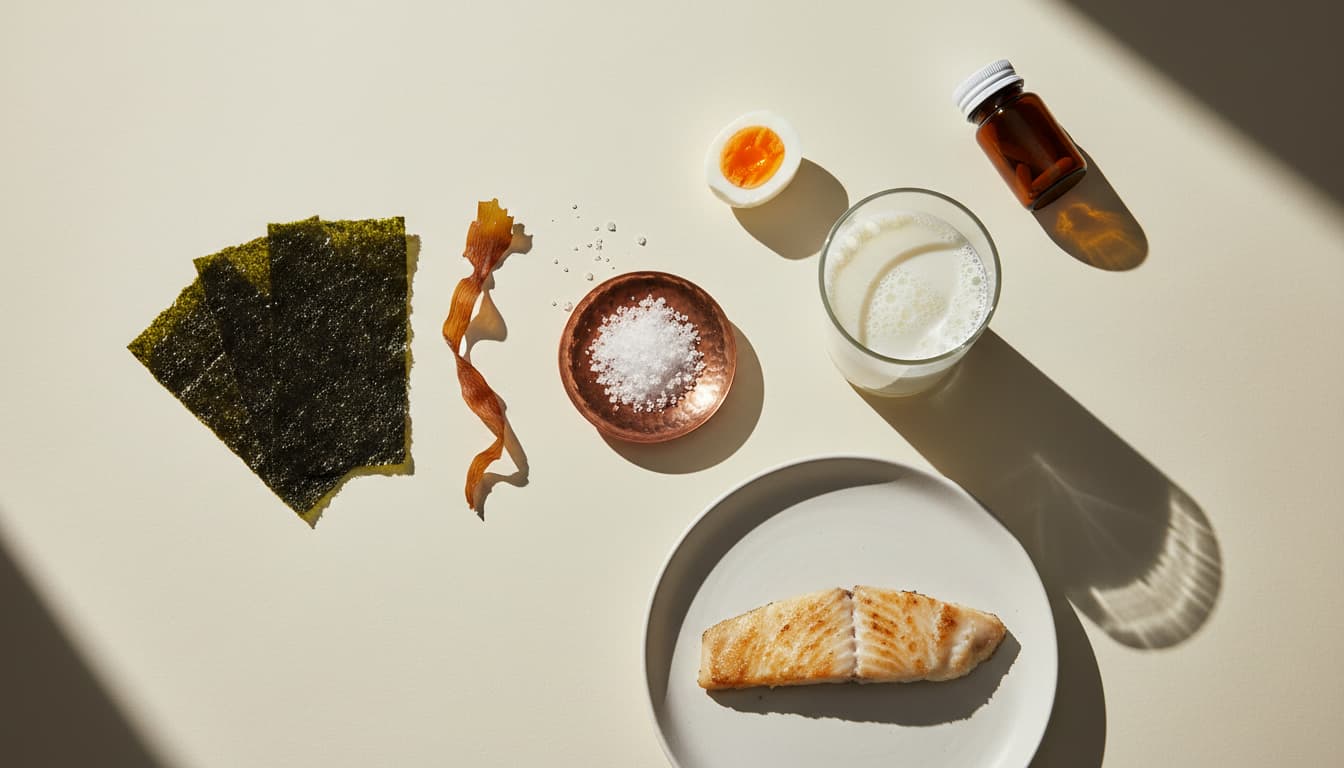
The adult RDA is 150 mcg a day and the Tolerable Upper Intake Level is 1,100 mcg, a ratio of about 7 to 1. One 1 gram sheet of dried kelp can deliver anywhere from 16 to 2,984 mcg, which spans that entire window.
- 01
The usable window runs 150 to 1,100 mcg, a factor of about 7
The adult Recommended Dietary Allowance is 150 mcg per day and the Tolerable Upper Intake Level is 1,100 mcg per day, so the whole safe range spans roughly sevenfold (NIH Office of Dietary Supplements). Most water-soluble vitamins have windows measured in tens or hundreds, which is why a doubled dose is uneventful there and is not here. The tightness of this window is the organising fact of the subject, and it is the reason a single concentrated source can push intake out of range in one serving.
- 02
The requirement by life stage, and the two figures that change
Infants have Adequate Intakes of 110 mcg from birth to 6 months and 130 mcg from 7 to 12 months. Children 1 to 8 years need 90 mcg per day, 9 to 13 years 120 mcg, and from 14 years the adult 150 mcg applies. Pregnancy raises the requirement to 220 mcg and lactation to 290 mcg (NIH Office of Dietary Supplements). Only two of these numbers move a household decision: the adult 150 mcg baseline and the near 50 percent uplift in pregnancy, which is the one point where a measured supplement is routinely warranted.
- 03
The Upper Limit tightens steeply with age
The Tolerable Upper Intake Level is 1,100 mcg per day for adults, 900 mcg at 14 to 18 years, 600 mcg at 9 to 13, 300 mcg at 4 to 8 and 200 mcg at 1 to 3 (NIH Office of Dietary Supplements). The pediatric column is the one people overlook. A seaweed snack that is a rounding error for an adult is a different exposure for a 3-year-old whose ceiling is 200 mcg, and it takes well under a gram of some dried kelp to reach that figure.
- 04
The thyroid is effectively the only consumer of dietary iodine
Iodine is required to synthesise the thyroid hormones thyroxine (T4) and triiodothyronine (T3), which regulate protein synthesis, enzyme activity and metabolic rate (NIH Office of Dietary Supplements). There is no large storage pool elsewhere and no alternative sink of consequence. That single-consumer structure is why both ends of the intake range produce the same clinical category of problem, and why the margin between adequate and excessive is narrower than for nutrients with several destinations.
- 05
The Daily Value is 150 mcg, so label percentages convert in your head
The Daily Value used on Nutrition and Supplement Facts labels is 150 mcg for iodine, identical to the adult RDA, so a percentage translates directly (FDA; NIH Office of Dietary Supplements). A product listing 100 percent DV supplies 150 mcg. A kelp tablet listing 1,000 percent DV supplies 1,500 mcg, which exceeds the adult Upper Limit of 1,100 mcg on its own before any food is counted. Checking that one percentage is the fastest useful test of a supplement in this category.
- 06
Where the iodine actually is: white fish, dairy, eggs, iodized salt
Baked cod supplies 158 mcg per 3 oz serving, more than the full adult RDA in one portion. Plain low-fat Greek yogurt gives 116 mcg per cup, milk 85 mcg per cup, a quarter teaspoon of iodized salt 76 mcg and one large egg 26 mcg (NIH Office of Dietary Supplements). Dairy and white fish carry most of a typical intake. Other seafood contributes as well, so wild salmon adds to the total, though far less per serving than cod does, and the dairy line is the one that moves most when a diet changes.
- 07
One gram of dried kelp spans the entire safe range
Seaweed is among the best food sources of iodine and the least predictable: a single 1 gram sheet of dried kelp can contain roughly 16 to 2,984 mcg (NIH Office of Dietary Supplements). The low end is a tenth of the RDA, the high end is 2.7 times the adult Upper Limit of 1,100 mcg, from the same nominal food in the same nominal quantity. Species, harvest site, season and processing all move the figure and none of it appears on the package. This is the most important practical number in the topic.
- 08
Iodized salt is the predictable source, at about 45 mcg per gram
Iodized salt in the United States contains approximately 45 mcg of iodine per gram of salt, which is where the figure of 76 mcg per quarter teaspoon comes from (NIH Office of Dietary Supplements). Two quarter-teaspoons across a day of home cooking cover the adult RDA of 150 mcg on their own. It is a modest, consistent and cheap source, and its consistency is the point: unlike seaweed, the dose per gram does not vary by a factor of 180.
- 09
Processed food uses non-iodized salt, so intake falls invisibly
Processed foods almost always use non-iodized salt, and specialty salts such as sea salt, kosher salt and pink salts are generally not iodized either (NIH Office of Dietary Supplements). A household that puts away the shaker while eating more packaged and restaurant food therefore lowers iodine intake with sodium intake unchanged, and nothing on any label reports it. This is the most common silent cause of a declining iodine intake in a diet that otherwise reads as an improvement.
- 10
Pregnancy at 220 mcg and lactation at 290 mcg justify a stated dose
The requirement rises to 220 mcg in pregnancy and 290 mcg in lactation, an increase of nearly 50 percent over the adult 150 mcg, at the point where the consequences of a shortfall are least reversible (NIH Office of Dietary Supplements). This is the one population in which a routine supplement is easy to justify, and a prenatal multivitamin that prints a specific iodine figure is the least error-prone route, because a printed microgram number is verifiable and a portion of seaweed is not.
- 11
US median urinary iodine fell from 135.0 to 103.5 mcg/L across two decades
Across nine NHANES cycles from 2001 to 2020 covering 6,828 women aged 14 to 45, median urinary iodine concentration declined from 135.0 mcg/L in 2001 to 2002 to 103.5 mcg/L in 2017 to 2020, and the proportion below 100 mcg/L rose from 37.6 percent to 47.7 percent; medians for pregnant and lactating women fell below the adequate range in 2007 to 2014 at 138.6 and 70.6 mcg/L (Cheng et al. 2025). A parallel review attributed the drift primarily to reduced milk consumption (Daniel and Mangano 2025).
- 12
Status is assessed by urinary iodine, not by the blood test people expect
A median urinary iodine concentration of 100 to 199 mcg/L in children and non-pregnant adults, and 150 to 249 mcg/L in pregnancy, indicates adequate intake (NIH Office of Dietary Supplements). Median urinary iodine reflects total intake from all sources and accurately identifies populations with excessive intake, with thyroglobulin as the complementary marker (Farebrother et al. 2019); other population measures include neonatal thyrotropin and thyroid volume (Sohn et al. 2024). One urine sample characterises a population well and one person poorly, because daily intake swings.
- 13
Excess causes the same thyroid dysfunction as deficiency
An acute iodine load can produce hypothyroidism through failure to escape the Wolff-Chaikoff effect, or hyperthyroidism through the Jod-Basedow phenomenon, in susceptible people (Sohn et al. 2024). High intakes are well tolerated by most healthy individuals, but those with preexisting thyroid disease or prior iodine deficiency may react at intakes only slightly above physiological needs; the dysfunction is usually mild and transient, though iodine-induced hyperthyroidism can be life-threatening in some individuals (Farebrother et al. 2019).
- 14
Who is actually at risk, and where goitrogens fit
The identifiable higher-risk groups are people who do not use iodized salt, people who eat no dairy and no seafood, people following restrictive plant-based patterns, and pregnant or lactating women, with prevalence of inadequate status in pregnancy running from 23 percent to 59 percent across studies (Daniel and Mangano 2025). Goitrogens in cruciferous vegetables and soy interfere with iodine uptake mainly when intake is already marginal (NIH Office of Dietary Supplements), so the correction is to fix the iodine rather than to drop the vegetables.
What people ask us next.
- How much iodine do you need per day?
- The Recommended Dietary Allowance for adults is 150 mcg per day, rising to 220 mcg in pregnancy and 290 mcg during lactation. Children need 90 mcg from 1 to 8 years and 120 mcg from 9 to 13, and infants have Adequate Intakes of 110 and 130 mcg (NIH Office of Dietary Supplements). One 3 oz portion of baked cod at 158 mcg covers the adult figure by itself, as does a cup of Greek yogurt at 116 mcg plus a large egg at 26 mcg, so the requirement is reachable from ordinary food without any supplement.
- Can you get too much iodine?
- Yes, and the margin is smaller than for most nutrients. The Tolerable Upper Intake Level is 1,100 mcg per day for adults and only 200 mcg at 1 to 3 years (NIH Office of Dietary Supplements). An acute load can cause hypothyroidism through failure to escape the Wolff-Chaikoff effect or hyperthyroidism through the Jod-Basedow phenomenon in susceptible people (Sohn et al. 2024), and those with existing thyroid disease or prior deficiency may react at intakes only slightly above physiological needs (Farebrother et al. 2019).
- Is a kelp or seaweed supplement a good way to get iodine?
- It is the least controllable way. A 1 gram sheet of dried kelp can contain anywhere from about 16 to 2,984 mcg, which runs from a tenth of the RDA to 2.7 times the adult Upper Limit of 1,100 mcg (NIH Office of Dietary Supplements). Nothing on the package resolves which end you have. Seaweed as an occasional food is not the issue; a daily kelp capsule with no stated microgram figure is, and if a supplement is wanted the sensible choice is one that prints an exact amount.
- Does sea salt or pink salt contain iodine?
- Generally not in any useful quantity. Iodized salt in the United States contains approximately 45 mcg per gram, which gives 76 mcg per quarter teaspoon, while sea salt, kosher salt and pink salts are usually not iodized (NIH Office of Dietary Supplements). Switching to a specialty salt therefore removes a predictable 150 mcg per day source without changing sodium intake at all, which is one of the more common unintentional ways to move iodine intake in the wrong direction.
- How much iodized salt covers the daily requirement?
- About half a teaspoon of iodized salt across a day of home cooking, since a quarter teaspoon supplies 76 mcg and the adult RDA is 150 mcg (NIH Office of Dietary Supplements). That is not a recommendation to add salt; it is a description of what the salt already in home-cooked food is contributing. The relevant risk is the reverse case, where home cooking falls and packaged food rises, because processed foods almost always use non-iodized salt.
- Do pregnant women need an iodine supplement?
- This is the one population where a routine supplement is straightforward to justify. The requirement rises from 150 to 220 mcg in pregnancy and 290 mcg in lactation (NIH Office of Dietary Supplements), and US population data has moved the wrong way, with median urinary iodine among women of childbearing age falling from 135.0 mcg/L to 103.5 mcg/L across 2001 to 2020 and inadequate status in pregnancy reported at 23 percent to 59 percent (Cheng et al. 2025; Daniel and Mangano 2025). A prenatal multivitamin with a stated iodine figure is the simplest route.
- How is iodine status actually tested?
- By urinary iodine concentration rather than by a blood iodine test. A median of 100 to 199 mcg/L in children and non-pregnant adults, and 150 to 249 mcg/L in pregnancy, indicates adequate intake (NIH Office of Dietary Supplements). Median urinary iodine reflects total intake from all sources and identifies populations with excess accurately, with thyroglobulin as a complementary marker (Farebrother et al. 2019). One sample describes a group well and an individual poorly, because intake varies day to day.
- Do broccoli, cabbage or soy block iodine?
- Only to a degree that matters when intake is already marginal. Goitrogens in cruciferous vegetables and soy interfere with iodine uptake, and the interference becomes clinically relevant mainly against a background of low intake (NIH Office of Dietary Supplements). Since the adult RDA is 150 mcg and a single 3 oz portion of cod supplies 158 mcg, the practical answer is to secure the iodine rather than to remove the vegetables. Note that fish oil capsules are a fat source, not an iodine source, and contribute nothing here.
Every claim, cited.
- [01]NIH Office of Dietary Supplements. Iodine, Fact Sheet for Health Professionals. Iodine is required for the synthesis of the thyroid hormones thyroxine (T4) and triiodothyronine (T3). Recommended Dietary Allowance: 150 mcg/day for adults, 220 mcg in pregnancy and 290 mcg in lactation; 90 mcg at 1 to 8 years, 120 mcg at 9 to 13 years and 150 mcg at 14 to 18 years; Adequate Intake 110 mcg from birth to 6 months and 130 mcg from 7 to 12 months. Tolerable Upper Intake Level: 1,100 mcg/day for adults, 900 mcg at 14 to 18 years, 600 mcg at 9 to 13, 300 mcg at 4 to 8 and 200 mcg at 1 to 3. The Daily Value used on labels is 150 mcg. Iodized salt in the United States contains approximately 45 mcg of iodine per gram of salt. Selected food values: seaweed is among the best sources but is highly variable, with a 1 g sheet of dried kelp ranging from approximately 16 to 2,984 mcg; cod, baked, 3 oz, 158 mcg; plain low-fat Greek yogurt, 1 cup, 116 mcg; iodized salt, 1/4 teaspoon, 76 mcg; milk, 1 cup, 85 mcg; 1 large egg, 26 mcg. Processed foods almost always use non-iodized salt. A median urinary iodine concentration of 100 to 199 mcg/L in children and non-pregnant adults, and 150 to 249 mcg/L in pregnancy, indicates adequate intake. Both deficiency and excess intake can cause thyroid dysfunction, and goitrogens in cruciferous vegetables and soy interfere with iodine uptake mainly when iodine intake is marginal.
- [02]US Food and Drug Administration. Daily Value on the Nutrition and Supplement Facts Labels. Daily Values are reference amounts of nutrients to consume or not to exceed each day, and the percent Daily Value shown on a label states how much a nutrient in one serving contributes to a total daily diet. The Daily Value for iodine is 150 mcg, which is identical to the adult Recommended Dietary Allowance, so a percentage on a supplement label converts directly into micrograms without further calculation.
- [03]Cheng L, Li Y, Chen Y, Wang W. 2025. Some subgroups of U.S. childbearing women are still at risk of iodine deficiency in the 21st century: a cross-sectional analysis of NHANES 2001-2020. BMC Pregnancy Childbirth 26(1):64. Urinary iodine concentrations were analysed for 6,828 women aged 14 to 45 across nine NHANES cycles, including 504 pregnant and 149 lactating women, with adequacy defined by WHO criteria. Median urinary iodine concentration among all women of childbearing age declined significantly from 135.0 mcg/L in 2001 to 2002 to 103.5 mcg/L in 2017 to 2020, while the proportion with a concentration below 100 mcg/L increased from 37.6% to 47.7%. Medians for pregnant and lactating women fell below the adequate range during 2007 to 2014, at 138.6 and 70.6 mcg/L respectively, and during 2015 to 2020, at 142.8 and 100.7 mcg/L. Non-Hispanic Black pregnant women and lactating women aged 35 to 45 showed notably lower medians.
- [04]Daniel KS, Mangano KM. 2025. Resurgence of iodine deficiency in the United States during pregnancy: potential implications for cognitive development in children. Nutr Rev 83(10):1944-1956. A systematic review following PRISMA 2020 of articles published from 2010 to 2024 examining urinary iodine concentration in non-pregnant, pregnant and lactating women in the United States, plus global evidence on maternal iodine status and offspring neurodevelopment. Nine articles addressed current status in US women, four of them using NHANES. NHANES data from 2011 to 2020 showed declining median urinary iodine concentration among women of reproductive age, with medians in pregnant women below the WHO recommendation of 150 mcg/L. The prevalence of inadequate iodine status ranged from 23% to 59% in pregnant women. The primary contributing factor identified was dietary change, specifically reduced milk consumption.
- [05]Farebrother J, Zimmermann MB, Andersson M. 2019. Excess iodine intake: sources, assessment, and effects on thyroid function. Ann N Y Acad Sci 1446(1):44-65. High iodine intakes are well tolerated by most healthy individuals, but in some people excess intake may precipitate hyperthyroidism, hypothyroidism, goiter and thyroid autoimmunity. Individuals with preexisting thyroid disease or previous exposure to iodine deficiency may be more susceptible, in some cases at intakes only slightly above physiological needs. Thyroid dysfunction due to excess iodine is usually mild and transient, but iodine-induced hyperthyroidism can be life-threatening in some individuals. At population level, excess intake may arise from overiodized salt, drinking water, animal milk rich in iodine, certain seaweeds, iodine-containing dietary supplements, or a combination. Median urinary iodine concentration reflects total iodine intake from all sources and can accurately identify populations with excessive intakes; thyroglobulin is a complementary biomarker.
- [06]Sohn SY, Inoue K, Rhee CM, Leung AM. 2024. Risks of iodine excess. Endocr Rev 45(6):858-879. Common sources of iodine include an iodine-rich diet, iodine-fortified foods, amiodarone, iodine-containing supplements and iodinated contrast media. Methods used to assess population iodine status include urinary iodine concentration, blood thyroglobulin, the prevalence of elevated neonatal thyrotropin, and thyroid volume. Although excessive iodine intake or exposure is generally well tolerated, an acute iodine load may result in thyroid dysfunction, either hypothyroidism through failure to escape the Wolff-Chaikoff effect or hyperthyroidism through the Jod-Basedow phenomenon, in certain susceptible individuals. The review notes the need for more data to define safe upper limits for iodine intake, particularly in high-risk populations.
- [07]USDA FoodData Central. Search results for seaweed, covering raw and dried kelp, wakame, nori and other marine algae entries. FoodData Central is the reference point for the composition of the underlying food, and the iodine picture in this category has to be read against the variability documented by NIH, where a 1 g sheet of dried kelp ranges from approximately 16 to 2,984 mcg depending on species, harvest location, season and processing, so a database mean for seaweed cannot be applied to a specific package.
- [08]Dietary Guidelines for Americans. The Guidelines set the pattern-level recommendations within which micronutrient intakes are met, including the dairy and seafood recommendations that carry most iodine intake in the United States. The relevance to iodine is indirect but structural: the food groups the Guidelines identify as commonly underconsumed, dairy and seafood, are the same groups that supply most dietary iodine outside iodized salt, which is why intake in this nutrient tracks pattern-level dietary change rather than supplement use.
The Larderlab Team builds evidence-led frameworks for eating, lifting, and stocking a kitchen. We cite every claim. We publish the spreadsheet when possible. We buy what we review at retail price. When new data lands, we revise with a dated note.
Next in this hub.
How Much Selenium Per Day: 55 mcg, a 400 mcg Ceiling, and the Brazil Nut
The RDA is 55 mcg a day and the tolerable upper limit is 400 mcg, a window of only about 7 to 1. One ounce of Brazil nuts carries 544 mcg, 989 percent of the Daily Value, above the adult ceiling from a single serving.
12 min · rev 2026-09-04How Much Folate Per Day: 400 mcg DFE, and the Unit Almost Nobody Converts
The RDA is 400 mcg DFE and the upper limit is 1,000 mcg of folic acid, and they are not the same unit. A 400 mcg tablet on an empty stomach supplies 800 mcg DFE, which is where the double-counting starts.
13 min · rev 2026-09-09How Much Choline Per Day: 550 mg, 425 mg, and Why It Is an AI Not an RDA
The Adequate Intake is 550 mg a day for men and 425 mg for women, and only 10.8 percent of Americans reach it. What an AI actually means, the egg at 147 mg, and the arithmetic of getting there from food.
12 min · rev 2026-09-04Get the Larderlab Macro Planner.
A Google Sheet that calculates your protein target, splits it across 3-5 meals, and ranks 20 protein sources by $/gram. Free. Copy-and-modify your own version.
By subscribing, you agree to our Privacy Policy. Unsubscribe anytime.