Wild vs farmed salmon, compared on what matters
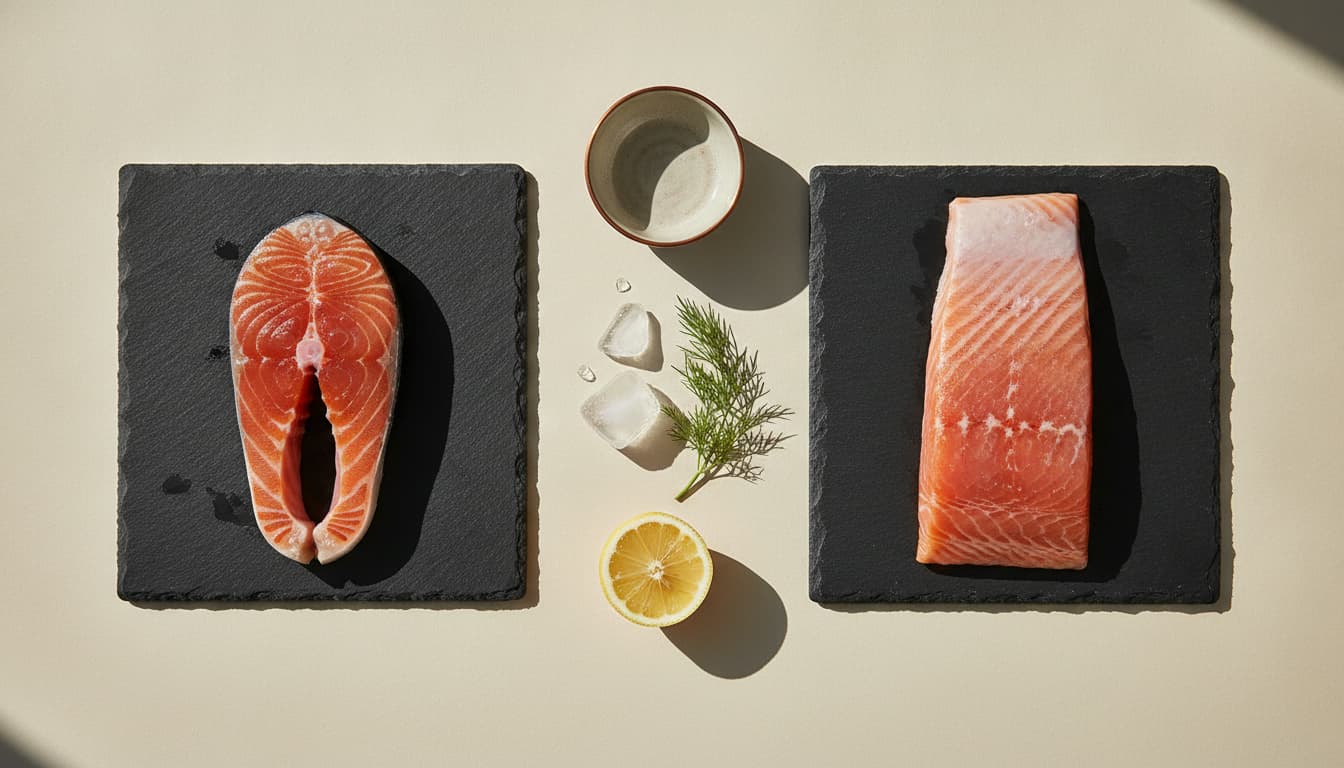
Farmed salmon is fattier and often higher in total omega-3 per serving, while wild is leaner with a better omega ratio and fewer calories. The honest comparison on nutrition, contaminants, color, cost, and why both are a healthy choice.
Both wild and farmed salmon are among the healthiest proteins you can eat, and the differences are smaller than the marketing suggests. Farmed salmon is fattier, so it often carries more total omega-3 per serving, but also more omega-6 and more calories, and a lower omega-3-to-6 ratio. Wild salmon is leaner, slightly higher in some minerals, and lower in calories, with color that comes naturally from its diet rather than from added feed pigment. Contaminant levels in farmed salmon, once a real concern, have fallen with better feed and are within safe limits, and mercury is low in both. Cost and availability usually decide: farmed is cheaper and year-round, wild is pricier and often seasonal.
Salmon is one of the most nutritious foods in the diet, a rich source of the long-chain omega-3 fats EPA and DHA, high-quality protein, vitamin D, vitamin B12, and selenium, and the wild-versus-farmed question is one of the most common at the fish counter (Harvard T.H. Chan School of Public Health; USDA). The honest answer is that both are excellent and the differences are narrower than either side's marketing implies. On fat and omega-3, the key fact is that farmed salmon is fattier than wild, because farmed fish are fed a rich diet and move less, so a serving of farmed salmon often contains more total omega-3 than wild simply because it contains more fat overall. But that extra fat also brings more omega-6 and more calories, and because farmed feed has included more plant oils over time, the ratio of beneficial omega-3 to omega-6 is generally better in wild salmon. Both, however, are strong omega-3 sources that easily beat most other foods. Wild salmon is leaner, lower in calories, and tends to be slightly higher in some minerals, while farmed can be higher in vitamin D depending on feed. On contaminants, the picture has genuinely changed: an influential 2004 study found higher levels of PCBs and dioxins in farmed salmon, but feed and farming practices have improved substantially since, and current levels in farmed salmon are within safety limits set by authorities, with the health benefits of eating salmon judged to outweigh the small contaminant risk for the general population. Mercury is low in both wild and farmed salmon, unlike the large predatory fish covered in our mercury-in-fish guide. Color is a common point of confusion: the pink-orange of wild salmon comes from astaxanthin in the krill and shrimp it eats, while farmed salmon, whose flesh would otherwise be pale gray, is given astaxanthin in its feed to achieve the same color, which is a cosmetic addition, not a health difference. Practically, cost and availability usually decide the choice: farmed salmon makes up the large majority of the market, is cheaper, and is available year-round, while wild salmon is pricier and often seasonal, and sustainability considerations cut both ways depending on the specific fishery or farm. For the general reader, the evidence-aligned takeaway is that the best salmon is the one you will actually eat regularly: both wild and farmed deliver the omega-3s and nutrients that make salmon worth eating, the differences are modest, and variety, along with buying from reputable sources, matters more than a rigid rule favoring one over the other.
The differences that are measurable.
- 01
Omega-3 and fat: farmed is fattier
Farmed salmon is fattier than wild because farmed fish are fed richly and move less, so a serving of farmed often contains more total omega-3 simply because it has more fat overall (Harvard; USDA). But the extra fat also brings more omega-6 and more calories. Wild salmon is leaner with a generally better omega-3-to-6 ratio. Both are strong omega-3 sources that far exceed most other foods, so on this measure both win against the alternatives, with farmed edging out on total amount and wild on ratio and calories.
- 02
Calories and minerals: wild is leaner
Because it is leaner, wild salmon is lower in calories than farmed and tends to be slightly higher in some minerals, while farmed can be higher in vitamin D depending on its feed (USDA). The differences are modest and unlikely to matter much within an overall healthy diet. For someone watching calories, wild has a small edge; for someone focused on total omega-3 per serving, farmed does. Neither difference is large enough to make one an unhealthy choice.
- 03
Contaminants: the picture has improved
An influential 2004 study found higher levels of PCBs and dioxins in farmed salmon, but feed and farming practices have improved substantially since, and current levels are within the safety limits set by authorities (Harvard). Regulators and researchers judge the health benefits of eating salmon to outweigh the small contaminant risk for the general population. This is a case where an old concern is often repeated as if unchanged, when the actual situation has moved on considerably, so it should not by itself steer most people away from farmed salmon.
- 04
Mercury: low in both
Unlike large predatory fish such as swordfish and king mackerel, salmon, both wild and farmed, is low in mercury, which is one reason it is recommended even for pregnant women and children as a safe fish choice (FDA; Harvard). This is a meaningful advantage salmon shares regardless of source, and it distinguishes it from the higher-mercury species covered in our mercury-in-fish guide. On the mercury question specifically, there is no meaningful difference between wild and farmed salmon.
- 05
Color: natural pigment vs added feed pigment
The pink-orange color of wild salmon comes from astaxanthin, a pigment in the krill and shrimp it eats, while farmed salmon, whose flesh would otherwise be pale gray, is given astaxanthin in its feed to achieve the same color (Harvard). This is a common point of confusion but is essentially cosmetic: the added pigment matches the natural one and is not a health concern. Color intensity is therefore not a reliable indicator of quality or nutrition when comparing wild and farmed.
- 06
Cost, availability, and the practical verdict
In practice, cost and availability usually decide: farmed salmon makes up the large majority of the market, is cheaper, and is available year-round, while wild is pricier and often seasonal (USDA). Sustainability cuts both ways depending on the specific fishery or farm. The evidence-aligned verdict is that the best salmon is the one you will eat regularly, since both deliver the omega-3s and nutrients that make salmon worth eating. Variety and buying from reputable sources matter more than a rigid rule favoring one type.
How this was specified
- 01Inputs measured
- Retail price (dated) · label claim · Certificate of Analysis · third-party test (Informed Sport / NSF / ConsumerLab / Clean Label) · leucine per serving from COA, not marketing.
- 02Protocols tested
- Per-kg target from four literature ranges (IOM RDA, Phillips 2017, Morton 2018, ISSN). Brands scored against Moore 2015 leucine-per-dose threshold (~0.4 g/kg).
- 03Cost-basis verified
- $/gram of protein and $/gram of leucine at warehouse pricing (Costco), mail-order (Amazon), and DTC retail. Re-checked quarterly, flagged when drift exceeds 15%.
- 04Confidence level
- High on ranked order. Medium on absolute $/g (prices drift). Low on serving-size claims where COA is older than 18 months, flagged [VERIFY].
What people ask us most.
- Is wild or farmed salmon healthier?
- Both are among the healthiest proteins you can eat, and the differences are smaller than the marketing suggests (Harvard T.H. Chan School of Public Health). Farmed salmon is fattier, so it often has more total omega-3 per serving, but also more omega-6 and calories, while wild is leaner with a better omega ratio and fewer calories. Both are excellent sources of omega-3, protein, vitamin D, and B12. The best choice is the one you will eat regularly, since variety matters more than favoring one type.
- Does farmed salmon have more omega-3 than wild?
- Often yes, in total amount, but with a caveat. Farmed salmon is fattier than wild because farmed fish are fed richly and move less, so a serving frequently contains more total omega-3 simply because it has more fat (Harvard; USDA). However, that extra fat also brings more omega-6, so wild salmon generally has a better omega-3-to-6 ratio. Both are strong omega-3 sources that far exceed most other foods, so both are good choices on this measure.
- Is farmed salmon safe to eat despite contaminants?
- Yes, for the general population. An influential 2004 study found higher PCBs and dioxins in farmed salmon, but feed and farming practices have improved substantially since, and current levels are within the safety limits set by authorities (Harvard). Regulators judge the health benefits of eating salmon to outweigh the small contaminant risk. This is a case where an old concern is often repeated as if nothing has changed, when the situation has actually improved considerably.
- Why is farmed salmon dyed?
- Farmed salmon is not dyed in the sense of artificial coloring; it is given astaxanthin in its feed, the same natural pigment that colors wild salmon (Harvard). Wild salmon gets its pink-orange color from astaxanthin in the krill and shrimp it eats, whereas farmed salmon's flesh would otherwise be pale gray, so the pigment is added to the feed to match. It is essentially cosmetic and not a health concern, and it means color is not a reliable indicator of quality when comparing the two.
- Does wild or farmed salmon have more mercury?
- Neither has much: salmon, both wild and farmed, is low in mercury, unlike large predatory fish such as swordfish and king mackerel (FDA; Harvard). This is why salmon is recommended as a safe fish choice even for pregnant women and children. On the mercury question specifically, there is no meaningful difference between wild and farmed salmon, so mercury is not a reason to choose one over the other, a contrast with the higher-mercury species covered in our mercury-in-fish guide.
A published Certificate of Analysis from a ranked brand that contradicts the label claim we scored against. An independent lab result (Clean Label, ConsumerLab) finding heavy-metal or amino-spiking failures on a current top pick. A peer-reviewed meta-analysis that shifts the leucine-per-dose threshold. Any of those triggers a dated revision within a week.
Every claim, cited.
The Larderlab Team builds evidence-led frameworks for eating, lifting, and stocking a kitchen. We cite every claim. We publish the spreadsheet when possible. We buy what we review at retail price. When new data lands, we revise with a dated note.
Next in this hub.
How to Store Tomatoes: The 12 Degree Threshold and the Flavor Cost of the Fridge
Flavor volatiles are sensitive below 12 degrees Celsius, and 30 days at 4 degrees cut volatile concentration by 66 percent. Some genes recover on return to 20 degrees Celsius and some do not.
12 min · rev 2026-09-03Mercury in Fish: The Low-Mercury, High-Omega-3 Short List
Mercury (ppm) by species against omega-3 yield, using FDA and EPA data. The fish that maximize EPA+DHA per serving while staying under the weekly mercury limit, and the ones to limit.
9 min · rev 2026-06-29Grass-Fed vs Grain-Fed Beef: The Ratio Improves, the Milligrams Do Not
USDA lists grass-fed ground beef at 88 mg of total omega-3 per 100 g, of which 1 mg is EPA and none is DHA. The fatty acid ratio genuinely improves on grass. The absolute amounts stay too small to matter for an omega-3 target.
8 min · rev 2026-08-25Get the Larderlab Macro Planner.
A Google Sheet that calculates your protein target, splits it across 3-5 meals, and ranks 20 protein sources by $/gram. Free. Copy-and-modify your own version.
By subscribing, you agree to our Privacy Policy. Unsubscribe anytime.