How much choline you need per day, and why that number is a different kind of number
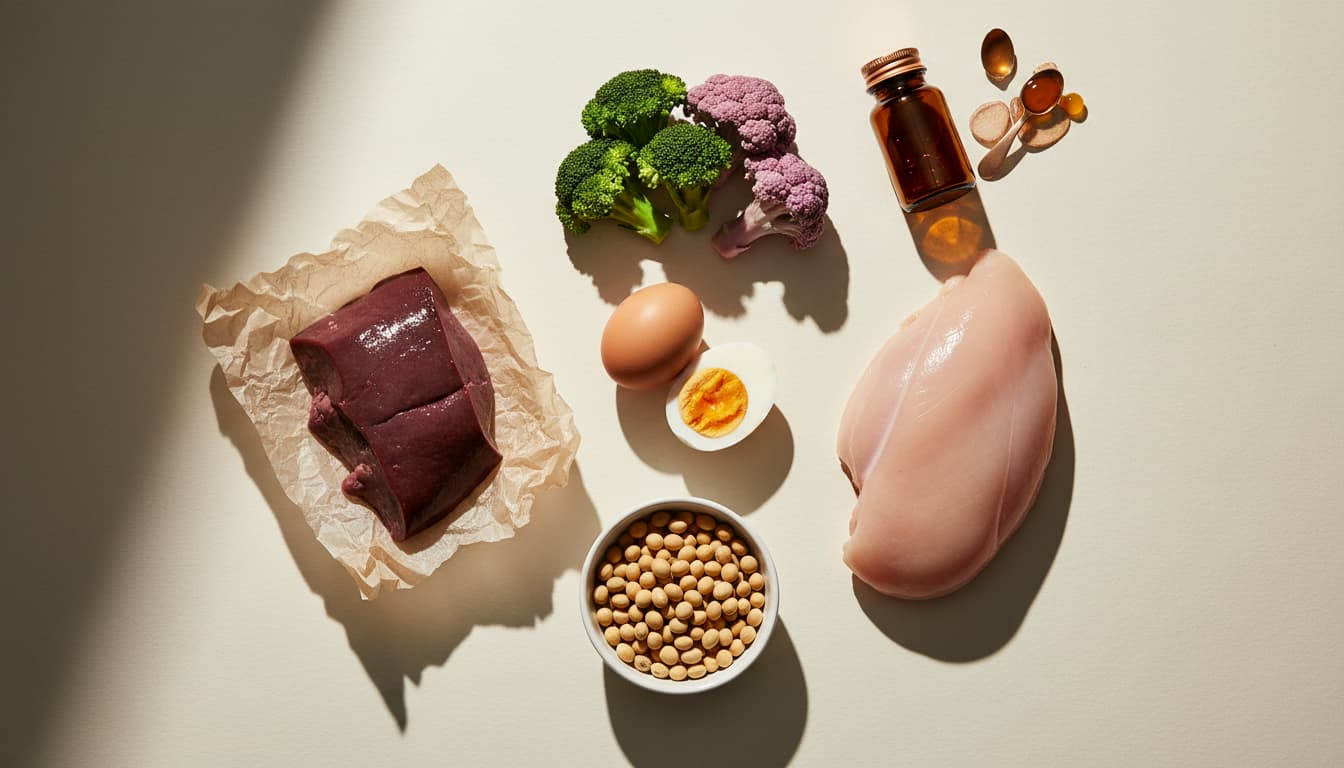
The Adequate Intake is 550 mg a day for men and 425 mg for women, and only 10.8 percent of Americans reach it. What an AI actually means, the egg at 147 mg, and the arithmetic of getting there from food.
- 01
Choline has an Adequate Intake, not an RDA, and that changes the reading
An RDA is derived from an Estimated Average Requirement and set to cover nearly all healthy individuals. An Adequate Intake is used when the evidence is insufficient to establish an EAR, and is set from observed or approximated intakes in apparently healthy people (NIH Office of Dietary Supplements). Choline has the second kind of number. So 550 mg is a working target rather than a threshold that defines deficiency, and it carries no built-in margin for individual variation.
- 02
The targets: 550 mg for men, 425 mg for women, 450 mg in pregnancy
The AI is 550 mg a day for adult men and 425 mg for adult women, rising to 450 mg in pregnancy and 550 mg during lactation, with 200 mg at 1 to 3 years, 250 mg at 4 to 8, 375 mg at 9 to 13, and 550 mg for boys against 400 mg for girls at 14 to 18 (NIH Office of Dietary Supplements). The Daily Value on Nutrition and Supplement Facts labels is 550 mg (FDA).
- 03
The ceiling is 3,500 mg, so the upper limit is not the binding constraint
The tolerable upper intake level for adults is 3,500 mg a day, with 3,000 mg at 14 to 18 years, 2,000 mg at 9 to 13 and 1,000 mg at 1 to 8 (NIH Office of Dietary Supplements). At nearly six and a half times the male AI, the ceiling is far enough away that it does not shape everyday decisions, which is the opposite of the situation with selenium or vitamin A.
- 04
What choline is actually used for
Choline is the backbone of phosphatidylcholine and sphingomyelin, the phospholipids of cell membranes; the precursor of acetylcholine, the neurotransmitter of the neuromuscular junction; and, oxidised to betaine, a methyl donor in the conversion of homocysteine to methionine (NIH Office of Dietary Supplements). Phosphatidylcholine is also required to package triglyceride into very-low-density lipoprotein for export from the liver. That last function is the direct mechanical reason choline deprivation produces liver fat rather than a vague symptom.
- 05
PEMT synthesis is real, and it is not enough
The enzyme phosphatidylethanolamine N-methyltransferase converts phosphatidylethanolamine to phosphatidylcholine in the liver, which is a genuine endogenous supply (NIH Office of Dietary Supplements). The Institute of Medicine classified choline as essential in 1998 precisely because that synthesis does not meet requirements. The distinction matters because a nutrient the body can make is often assumed to need no dietary attention, and choline is the clearest counterexample in the micronutrient set: the pathway exists, is regulated, and still leaves a dietary requirement behind.
- 06
The depletion study that shows the AI is not universally protective
Fifty-seven adults, 26 men, 16 premenopausal women and 15 postmenopausal women, were fed 550 mg of choline per 70 kg per day for 10 days, then under 50 mg per 70 kg per day for up to 42 days. When deprived, 77 percent of men and 80 percent of postmenopausal women developed fatty liver or muscle damage, against 44 percent of premenopausal women, and 6 men developed those signs while still consuming 550 mg, the AI itself (Fischer et al. 2007).
- 07
The food table: liver is the outlier, the egg is the hero
Beef liver, pan fried, 3 oz, supplies 356 mg, 65 percent of the Daily Value, and one large hard-boiled egg supplies 147 mg, 27 percent (NIH Office of Dietary Supplements; USDA FoodData Central). Then beef top round 3 oz 117 mg, roasted soybeans half a cup 107 mg, chicken breast 3 oz 72 mg, one large red potato 57 mg, wheat germ 1 oz 51 mg, kidney beans half a cup 45 mg, milk 1 cup 43 mg and Brussels sprouts half a cup 32 mg.
- 08
The arithmetic of 550 mg on an ordinary day
Two large eggs 294 mg, a 3 oz chicken breast 72 mg, a cup of milk 43 mg, half a cup of kidney beans 45 mg, one large red potato 57 mg, half a cup of Brussels sprouts 32 mg. That is 543 mg, essentially the male AI, from a day containing nothing unusual (NIH Office of Dietary Supplements). Remove the eggs and the same day lands at 249 mg.
- 09
Only 10.8 percent of Americans meet the AI
Applying the National Cancer Institute method to 2009 to 2012 NHANES data on 16,809 participants, 10.8 percent of Americans aged 2 and over achieved the AI for choline, 15.6 percent of males and 6.1 percent of females; adults aged 19 and over reached it at 6.6 percent and adolescents aged 14 to 18 at 1.8 percent, while children aged 2 to 3 exceeded it at 62.9 percent (Wallace and Fulgoni 2016).
- 10
Pregnancy: why the AI rises, and what the trial actually found
The AI rises to 450 mg in pregnancy because the fetus and placenta draw on maternal choline. A controlled feeding trial randomised women entering the third trimester to 480 mg or 930 mg a day until delivery, 13 per group, and tested 24 infants at 4, 7, 10 and 13 months; mean reaction time was significantly faster in the 930 mg group, and within the 480 mg group longer exposure tracked faster reaction times (Caudill et al. 2018).
- 11
Individual variation: PEMT, MTHFD1 and estrogen
Estrogen induces PEMT expression, so premenopausal women synthesise more of their own choline and have a lower dietary requirement, which is the reason the female AI is 425 mg rather than 550 mg (NIH Office of Dietary Supplements). The depletion data fit: 44 percent of premenopausal women developed organ dysfunction on deprivation against 80 percent of postmenopausal women (Fischer et al. 2007). Common variants in PEMT and in MTHFD1 shift requirement further, a dispersion a single population figure cannot express.
- 12
The TMAO question, stated as what it is
Gut bacteria convert some dietary choline to trimethylamine, which the liver oxidises to TMAO. A phosphatidylcholine challenge of two hard-boiled eggs raised plasma TMAO, and in 4,007 patients undergoing elective coronary angiography the highest TMAO quartile carried a hazard ratio of 2.54 (95% CI 1.96 to 3.28) for death, myocardial infarction or stroke over three years (Tang et al. 2013). That is a mechanism plus an association in a high-risk clinical cohort, and the NIH Office of Dietary Supplements states the evidence is not conclusive.
- 13
Deficiency shows up as liver fat and muscle damage
Choline deprivation does not present as a vague fatigue syndrome. Because phosphatidylcholine is required to export triglyceride from the liver as very-low-density lipoprotein, the first measurable consequences are hepatic steatosis and elevated creatine phosphokinase indicating muscle damage, both of which resolved when choline was added back incrementally (NIH Office of Dietary Supplements; Fischer et al. 2007). That specificity is useful: it means the endpoint is measurable in a clinic rather than inferred from symptoms.
- 14
The decision rule: eggs first, supplements last
If eggs are eaten, choline is largely handled and the rest of the day supplies the remainder. If they are not, the target needs deliberate work from beef, soy, fish, legumes and wheat germ, and much of that overlaps with the best whole-food protein sources anyway. Check the label before assuming coverage, because most multivitamin products carry little or no choline, and the ones that do supply a fraction of it (NIH Office of Dietary Supplements; FDA).
What people ask us next.
- How much choline do I need per day?
- The Adequate Intake is 550 mg a day for adult men and 425 mg for adult women, 450 mg in pregnancy and 550 mg during lactation, with 200 mg at 1 to 3 years, 250 mg at 4 to 8, 375 mg at 9 to 13, and 550 mg for boys against 400 mg for girls at 14 to 18 (NIH Office of Dietary Supplements). The Daily Value on labels is 550 mg (FDA).
- Why does choline have an AI instead of an RDA?
- Because the evidence was judged insufficient to establish an Estimated Average Requirement, which is the statistical basis an RDA is built on (NIH Office of Dietary Supplements). An Adequate Intake is instead set from observed or approximated intakes in apparently healthy people. For choline there is direct evidence of the limitation: 6 men in a controlled feeding study developed fatty liver or muscle damage while consuming the AI itself (Fischer et al. 2007).
- How many eggs is 550 mg of choline?
- One large hard-boiled egg supplies 147 mg, 27 percent of the Daily Value, so 550 mg from eggs alone would take just under four (NIH Office of Dietary Supplements). The rest of an ordinary day contributes: two eggs at 294 mg plus a 3 oz chicken breast at 72 mg, a cup of milk at 43 mg, half a cup of kidney beans at 45 mg, a large red potato at 57 mg and half a cup of Brussels sprouts at 32 mg reaches 543 mg.
- Do most people get enough choline?
- By the AI standard, no. Using the National Cancer Institute method on 2009 to 2012 NHANES data covering 16,809 participants, only 10.8 percent of Americans aged 2 and over met the AI, 15.6 percent of males and 6.1 percent of females, with adults aged 19 and over at 6.6 percent (Wallace and Fulgoni 2016). Because the reference is an Adequate Intake rather than an RDA, those percentages are not a deficiency prevalence.
- Should pregnant women take a choline supplement?
- That is a clinical decision, and the evidence base is thinner than the enthusiasm around it. A controlled feeding trial randomised third-trimester women to 480 mg or 930 mg a day, 13 per group, and found significantly faster mean infant reaction times across tests at 4, 7, 10 and 13 months in the 930 mg group (Caudill et al. 2018). Thirteen women per arm is small, and the study was partly funded by the Egg Nutrition Center and the Beef Checkoff.
- Can you take too much choline?
- The tolerable upper intake level for adults is 3,500 mg a day, with 3,000 mg at 14 to 18 years, 2,000 mg at 9 to 13 and 1,000 mg at 1 to 8 (NIH Office of Dietary Supplements). Adverse effects associated with excessive intakes include a fishy body odor, sweating, excessive salivation, hypotension and liver toxicity. Those levels are not reachable from food; the male AI of 550 mg sits at roughly one sixth of the ceiling.
- Is choline bad for the heart because of TMAO?
- The association is real and the conclusion is not established. In 4,007 patients undergoing elective coronary angiography the highest fasting TMAO quartile carried a hazard ratio of 2.54 (95% CI 1.96 to 3.28) for death, myocardial infarction or stroke over three years (Tang et al. 2013). That cohort was high-risk rather than general population, and the NIH Office of Dietary Supplements states that the evidence linking choline to cardiovascular disease through TMAO is not conclusive.
- Do women really need less choline than men?
- Premenopausal women do, and the mechanism is specific. Estrogen induces PEMT, the enzyme that makes phosphatidylcholine endogenously, so premenopausal women synthesise more of their own choline and have a lower dietary requirement, which is why the AI is 425 mg against 550 mg for men (NIH Office of Dietary Supplements). The depletion evidence matches: 44 percent of premenopausal women developed fatty liver or muscle damage on a deprivation diet, against 80 percent of postmenopausal women and 77 percent of men (Fischer et al. 2007).
Every claim, cited.
- [01]NIH Office of Dietary Supplements, Choline Fact Sheet for Health Professionals. Choline has no RDA, only an Adequate Intake, because the evidence was insufficient to establish an Estimated Average Requirement. AI 550 mg per day for adult men and 425 mg for adult women, 450 mg in pregnancy and 550 mg during lactation, 200 mg at 1 to 3 years, 250 mg at 4 to 8, 375 mg at 9 to 13, 550 mg for boys and 400 mg for girls at 14 to 18. Tolerable upper intake level 3,500 mg per day for adults, 3,000 mg at 14 to 18 years, 2,000 mg at 9 to 13 and 1,000 mg at 1 to 8. Daily Value 550 mg. Selected food figures: beef liver pan fried 3 oz 356 mg and 65 percent of the Daily Value; one large hard-boiled egg 147 mg and 27 percent; beef top round 3 oz 117 mg; roasted soybeans half a cup 107 mg; chicken breast 3 oz 72 mg; cod 3 oz 71 mg; one large red potato 57 mg; wheat germ 1 oz 51 mg; kidney beans half a cup 45 mg; milk 1 cup 43 mg; cooked quinoa 1 cup 43 mg; Brussels sprouts half a cup 32 mg. Choline is used to make phosphatidylcholine and sphingomyelin for membranes, acetylcholine, and betaine as a methyl donor. Endogenous synthesis via PEMT is not sufficient to meet requirements, which is why the Institute of Medicine designated choline an essential nutrient in 1998. Most people in the United States consume below the AI. Gut bacteria convert some dietary choline to trimethylamine, which the liver oxidises to TMAO, and higher TMAO has been associated with cardiovascular disease in observational work, but the evidence is not conclusive. Common variants in PEMT and MTHFD1 alter individual requirement, and estrogen induces PEMT, which is why premenopausal women have a lower requirement than men.
- [02]US Food and Drug Administration, Daily Value on the Nutrition and Supplement Facts Labels. The Daily Value for choline is 550 mg, and percent Daily Value expresses the amount in one serving as a proportion of that single reference figure rather than of an age-specific or sex-specific recommendation. Daily Values are labeling references and are not identical to the Dietary Reference Intakes used in dietary assessment, which matters particularly for choline because the underlying reference is an Adequate Intake that differs by 125 mg between adult men and adult women while the label figure does not.
- [03]Dietary Guidelines for Americans. The Guidelines build recommendations around overall dietary patterns and identify eggs, lean meats and poultry, seafood, dairy, legumes, nuts and seeds and whole grains as the nutrient-dense core of a healthy eating pattern. Eggs are included in the protein foods group of every recommended pattern, which is the practical route by which the choline Adequate Intake becomes reachable in an ordinary diet.
- [04]USDA FoodData Central, search results for eggs. Composition data for whole eggs including hard-boiled preparations, used here to confirm the serving basis for the figure of 147 mg of choline per large egg and to check the relationship between egg size categories and per-egg nutrient totals. FoodData Central also carries the entries for beef liver, beef top round, cod and chicken breast used in the ranking above.
- [05]Fischer LM, daCosta KA, Kwock L, Stewart PW, Lu TS, Stabler SP, Allen RH, Zeisel SH. Sex and menopausal status influence human dietary requirements for the nutrient choline. Am J Clin Nutr 2007;85(5):1275-1285. Fifty-seven adult subjects, 26 men, 16 premenopausal women and 15 postmenopausal women, were fed a diet containing 550 mg choline per 70 kg per day for 10 days followed by under 50 mg choline per 70 kg per day, with or without a 400 mcg folic acid supplement, for up to 42 days. When deprived of dietary choline, 77 percent of men and 80 percent of postmenopausal women developed fatty liver or muscle damage, whereas only 44 percent of premenopausal women developed such signs of organ dysfunction. Six men developed these signs while consuming 550 mg choline per 70 kg per day, the AI for choline. Folic acid supplementation did not alter the response. The authors concluded that subject characteristics including menopausal status modulate the dietary requirement for choline and that a daily intake at the current AI was not sufficient to prevent organ dysfunction in 19 of the subjects.
- [06]Wallace TC, Fulgoni VL 3rd. Assessment of Total Choline Intakes in the United States. J Am Coll Nutr 2016;35(2):108-112. The National Cancer Institute method was used to assess usual intakes of choline from foods in 16,809 participants of the 2009 to 2012 National Health and Nutrition Examination Survey. Only 10.8 percent of participants aged 2 years and over achieved the Adequate Intake for choline, comprising 15.6 percent of males and 6.1 percent of females. Children aged 2 to 3 years were most likely to exceed the AI at 62.9 percent, followed by children aged 4 to 8 at 45.4 percent and 9 to 13 at 9.0 percent, compared with adolescents aged 14 to 18 at 1.8 percent and adults aged 19 and over at 6.6 percent. Males consumed significantly more choline than females in every age group. The authors recommended that revision of the dietary reference intakes for choline include replacement of the AI with an estimated average requirement and a recommended dietary allowance, so that population estimates of inadequate intake can be calculated accurately.
- [07]Caudill MA, Strupp BJ, Muscalu L, Nevins JEH, Canfield RL. Maternal choline supplementation during the third trimester of pregnancy improves infant information processing speed: a randomized, double-blind, controlled feeding study. FASEB J 2018;32(4):2172-2180. Women entering their third trimester were randomized to consume, until delivery, either 480 mg choline per day (n = 13) or 930 mg choline per day (n = 13), with intake of choline and other nutrients tightly controlled. Infant information processing speed and visuospatial memory were tested at 4, 7, 10 and 13 months of age (n = 24). Mean reaction time averaged across the four ages was significantly faster for infants born to mothers in the 930 mg group. Within the 480 mg group there was a significant linear effect of exposure duration, with infants exposed longer showing faster reaction times. The work was funded in part by the Egg Nutrition Center, The Beef Checkoff and public agencies, and the authors state that no funding source had a role in trial design, data analysis or interpretation.
- [08]Tang WH, Wang Z, Levison BS, Koeth RA, et al. Intestinal microbial metabolism of phosphatidylcholine and cardiovascular risk. N Engl J Med 2013;368(17):1575-1584. Plasma and urinary TMAO and plasma choline and betaine were quantified after a phosphatidylcholine challenge consisting of two hard-boiled eggs plus deuterium-labeled phosphatidylcholine, in healthy participants before and after suppression of intestinal microbiota with oral broad-spectrum antibiotics. Plasma TMAO rose after the challenge, was markedly suppressed by antibiotics and reappeared after antibiotic withdrawal, establishing that TMAO production from dietary phosphatidylcholine depends on the intestinal microbiota. In a separate prospective analysis of 4,007 patients undergoing elective coronary angiography, followed for three years, increased fasting plasma TMAO was associated with an increased risk of death, myocardial infarction or stroke, with a hazard ratio for the highest versus lowest TMAO quartile of 2.54 (95% CI 1.96 to 3.28, P less than 0.001), which persisted after adjustment for traditional risk factors.
The Larderlab Team builds evidence-led frameworks for eating, lifting, and stocking a kitchen. We cite every claim. We publish the spreadsheet when possible. We buy what we review at retail price. When new data lands, we revise with a dated note.
Next in this hub.
L-Theanine Benefits: The Caffeine Pairing Has the Evidence, the Solo Dose Mostly Does Not
A 200 ml cup of black tea holds 24.2 mg of L-theanine, so a 200 mg capsule is roughly eight cups. Pooled trials show attention switching accuracy improved with caffeine at a standardised mean difference of 0.33, while EFSA found no cause and effect for theanine alone.
14 min · rev 2026-09-07NMN Supplements: The Regulator Changed Its Mind in 2025, and the Biomarker Still Is Not the Outcome
FDA reversed itself on 29 September 2025 and determined NMN is not excluded from the dietary supplement definition. Blood NAD rose at 300, 600 and 900 mg, while the largest positive outcome trial moved one tissue in 25 people.
14 min · rev 2026-09-05Berberine Side Effects: Why the Gut Takes the Dose and the Liver Takes the Interaction
Absolute oral bioavailability measured 0.36 percent in rats, so the gut receives almost the whole dose and 34.5 percent of patients reported transient gastrointestinal events. Two weeks at 300 mg three times a day raised the CYP2D6 probe ratio ninefold.
14 min · rev 2026-09-05Get the Larderlab Macro Planner.
A Google Sheet that calculates your protein target, splits it across 3-5 meals, and ranks 20 protein sources by $/gram. Free. Copy-and-modify your own version.
By subscribing, you agree to our Privacy Policy. Unsubscribe anytime.