How much folate you need per day, and why the unit is the whole problem
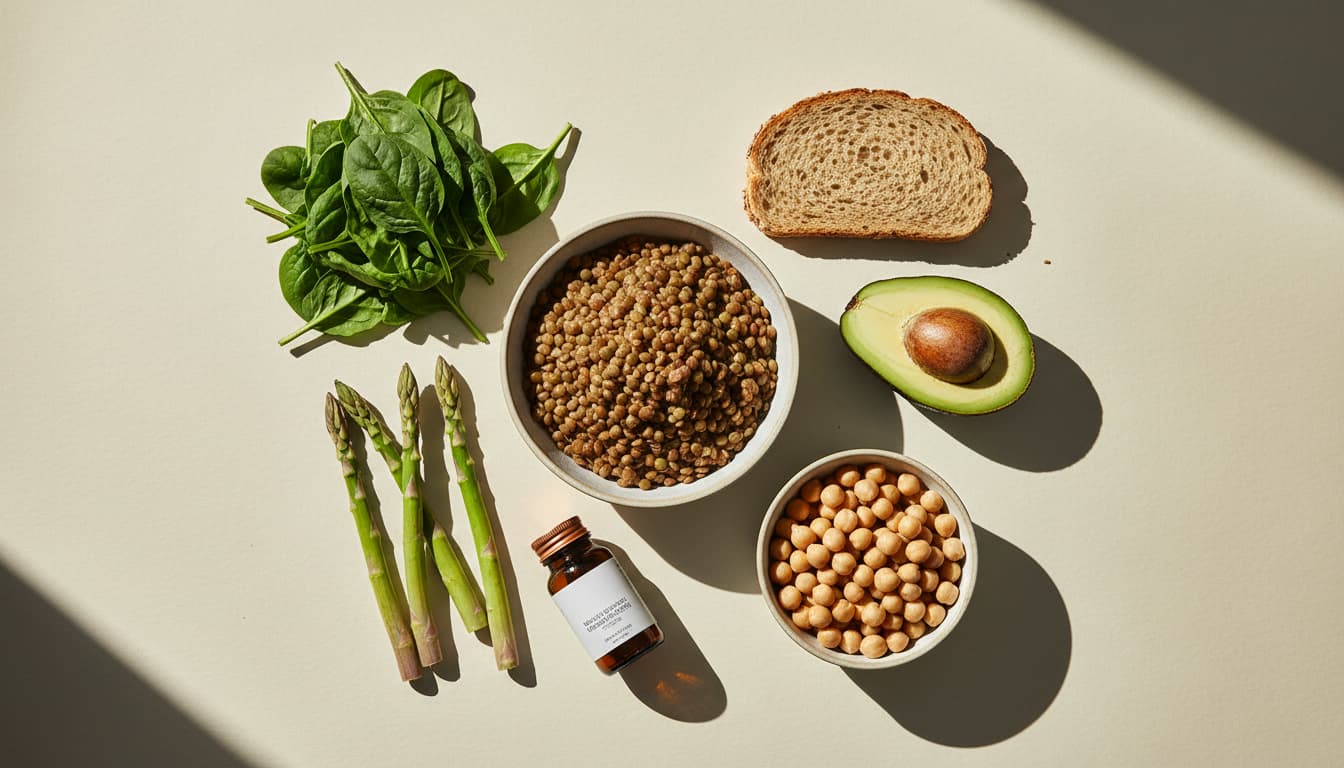
The RDA is 400 mcg DFE and the upper limit is 1,000 mcg of folic acid, and they are not the same unit. A 400 mcg tablet on an empty stomach supplies 800 mcg DFE, which is where the double-counting starts.
- 01
The unit is the whole problem: what a DFE is
Folate is the generic term, food folate is what occurs naturally in food, and folic acid is the synthetic fully oxidised form used in fortification and supplements. They are absorbed at different rates, so requirements are expressed in Dietary Folate Equivalents to put them on one scale (NIH Office of Dietary Supplements). One mcg DFE equals 1 mcg of food folate, or 0.6 mcg of folic acid taken with food, or 0.5 mcg of folic acid on an empty stomach.
- 02
The conversion, worked in both directions
Forward: a 400 mcg folic acid tablet with a meal is 400 divided by 0.6, about 667 mcg DFE; on an empty stomach it is 400 divided by 0.5, exactly 800 mcg DFE. A cereal declaring 400 mcg DFE per serving contains 240 mcg of actual folic acid. Backward: meeting the 400 mcg DFE RDA entirely from food folate takes 400 mcg of food folate, but meeting it entirely from folic acid taken with food takes only 240 mcg (NIH Office of Dietary Supplements).
- 03
The RDA by life stage, in DFE
The RDA is 400 mcg DFE a day for adults, 600 mcg DFE in pregnancy and 500 mcg DFE during lactation, with 150 mcg DFE at 1 to 3 years, 200 at 4 to 8, 300 at 9 to 13 and 400 at 14 to 18 (NIH Office of Dietary Supplements). The Daily Value on Nutrition and Supplement Facts labels is 400 mcg DFE (FDA). The label unit switched to DFE, so an old and a new panel can show different numbers for the same tablet.
- 04
The 1,000 mcg upper limit applies to folic acid only
The tolerable upper intake level is 1,000 mcg a day for adults, and it applies to folic acid from fortified foods and supplements, not to folate found naturally in foods, which has no upper limit (NIH Office of Dietary Supplements). That distinction is not decorative: it means a bowl of spinach cannot contribute to exceeding the UL, while a fortified cereal and a tablet can. It also means the UL and the RDA are quoted in different currencies.
- 05
Why a 400 mcg tablet is not 400 mcg toward the RDA
A 400 mcg folic acid tablet taken on an empty stomach supplies 800 mcg DFE, which is 200 percent of the adult RDA of 400 mcg DFE, while simultaneously being 40 percent of the 1,000 mcg UL for folic acid (NIH Office of Dietary Supplements). Both statements are true because they use different units. That is the most common arithmetic error in folate self-assessment, and it runs both ways: people read their headroom, and their shortfall, wrongly.
- 06
The neural tube closes before most pregnancies are recognised
The neural tube closes during the first month of pregnancy, which is before most pregnancies are recognised, so a recommendation addressed to pregnant women would arrive after the window it protects had closed (NIH Office of Dietary Supplements). That is why women capable of becoming pregnant are advised to get 400 mcg a day of folic acid from fortified foods or supplements in addition to food folate. The recommendation is deliberately addressed to a much larger group than the one it will benefit.
- 07
The MRC trial: a 72 percent reduction in recurrence
A randomised double-blind factorial trial at 33 centres in seven countries enrolled 1,817 women at high risk because of a previous affected pregnancy. Among 1,195 completed pregnancies with known outcome there were 27 neural tube defects, 6 in the folic acid groups against 21 in the groups without, a 72 percent protective effect with a relative risk of 0.28 (95% CI 0.12 to 0.71) (MRC Vitamin Study Research Group 1991).
- 08
Fortification since January 1998, and corn masa in 2016
Since January 1998 the FDA has required enriched breads, cereals, flours, cornmeals, pastas and rice to be fortified with 140 mcg of folic acid per 100 g, and in 2016 permitted the same level in corn masa flour (NIH Office of Dietary Supplements; Williams et al. 2015). The consequence for a reader is that enriched grain products are a folic acid delivery system, so the pantry staples in most kitchens contribute to the folic acid column rather than the food folate column.
- 09
What fortification bought: about 1,326 births a year
Data from 19 population-based birth defects surveillance programs covering 1999 to 2011 put the number of births occurring annually without neural tube defects that would otherwise have been affected at approximately 1,326 (95% CI 1,122 to 1,531), with birth prevalence remaining relatively stable after the initial post-fortification decline (Williams et al. 2015). The same analysis notes remaining prevention opportunities among women with lower folic acid intakes, particularly Hispanic women, which is part of the reason the corn masa provision followed.
- 10
The food table, in DFE, and what it mixes together
Beef liver 3 oz 215 mcg DFE, boiled spinach half a cup 131 mcg DFE, black-eyed peas half a cup 105 mcg DFE, fortified breakfast cereals one serving 100 to 400 mcg DFE, enriched white rice half a cup 90 mcg DFE, asparagus 4 spears 89 mcg DFE, broccoli half a cup 52 mcg DFE (NIH Office of Dietary Supplements; USDA FoodData Central). Cereal and enriched rice are folic acid expressed as DFE, so their true folic acid content is 0.6 times the figure shown.
- 11
Folate is water-soluble and heat-labile, so boiling costs
Folate is a water-soluble vitamin and it is heat-labile, so boiling both leaches it into the water and destroys a substantial fraction, which is why the same spinach can deliver very different amounts depending on preparation (NIH Office of Dietary Supplements). The implication is specific to the vegetable sources: raw salad greens, lightly steamed asparagus and avocado retain more than a long boil does. Fortified grain products are unaffected by this, since the folic acid is added to a dry product.
- 12
The B12 masking mechanism is why the upper limit exists
High folic acid intake can correct the megaloblastic anemia of vitamin B12 deficiency while the neurological damage progresses undetected (NIH Office of Dietary Supplements). Among 1,459 seniors in NHANES 1999 to 2002 with low B12 status, serum folate above 59 nmol/L was associated with anemia (OR 3.1, 95% CI 1.5 to 6.6) and cognitive impairment (OR 2.6, 95% CI 1.1 to 6.1), while in those with normal B12 high folate was associated with protection against cognitive impairment (OR 0.4, 95% CI 0.2 to 0.9) (Morris et al. 2007).
- 13
Unmetabolized folic acid and the ceiling on DHFR
In six human livers from organ donors or surgery, reduction of folic acid by DHFR per gram averaged less than 2 percent of the rat liver rate at physiological pH, with almost a 5-fold variation between human samples (Bailey and Ayling 2009). The authors concluded that benefit from high-dose folic acid will be limited by saturation of DHFR, particularly in people with lower than average activity, and that this is consistent with reports of unmetabolized folic acid in plasma and urine.
- 14
Methylfolate and MTHFR, handled skeptically
Common MTHFR variants, most often C677T, reduce the activity of the enzyme producing 5-methyltetrahydrofolate, and carriers can show higher homocysteine and lower circulating folate. What can be said is that the fortification programme uses folic acid and produced a measured reduction in neural tube defects across a population carrying the usual frequency of these variants (Williams et al. 2015). What cannot be said on current evidence is that carriers should avoid folic acid or that methylfolate improves clinical outcomes.
What people ask us next.
- How much folate do I need per day?
- The RDA is 400 mcg DFE a day for adults, 600 mcg DFE in pregnancy and 500 mcg DFE during lactation, with 150 to 400 mcg DFE across childhood (NIH Office of Dietary Supplements). The Daily Value on labels is 400 mcg DFE (FDA). Separately, women capable of becoming pregnant are advised to obtain 400 mcg a day of folic acid from fortified foods or supplements in addition to the food folate in a varied diet.
- What is a DFE and why does it matter?
- A Dietary Folate Equivalent puts food folate and folic acid on a single scale, because folic acid is absorbed more efficiently. One mcg DFE equals 1 mcg of food folate, or 0.6 mcg of folic acid taken with food, or 0.5 mcg of folic acid on an empty stomach (NIH Office of Dietary Supplements). It matters because the same number then means different things: a 400 mcg folic acid tablet on an empty stomach is 800 mcg DFE, twice the adult RDA.
- Is folate the same as folic acid?
- No. Folate is the generic term for the vitamin in its various forms, food folate is the naturally occurring version in foods such as spinach, lentils and liver, and folic acid is the synthetic fully oxidised form used in supplements and in fortified grain products (NIH Office of Dietary Supplements). The practical differences are absorption, which is why the DFE conversion exists, and regulation, since the upper limit applies only to folic acid from fortified foods and supplements.
- Can you take too much folic acid?
- The tolerable upper intake level is 1,000 mcg a day of folic acid from fortified foods and supplements (NIH Office of Dietary Supplements). High folic acid intake can correct the megaloblastic anemia of vitamin B12 deficiency while the neurological damage progresses undetected. Among 1,459 older NHANES participants with low B12 status, serum folate above 59 nmol/L was associated with anemia (OR 3.1, 95% CI 1.5 to 6.6) and cognitive impairment (OR 2.6, 95% CI 1.1 to 6.1) (Morris et al. 2007).
- When should I start taking folic acid before pregnancy?
- Before conception rather than after a positive test. The neural tube closes during the first month of pregnancy, before most pregnancies are recognised, which is why the recommendation is addressed to all women capable of becoming pregnant (NIH Office of Dietary Supplements). The trial evidence comes from a randomised factorial study in 1,817 high-risk women, where folic acid produced a 72 percent protective effect with a relative risk of 0.28 (95% CI 0.12 to 0.71) (MRC Vitamin Study Research Group 1991).
- Does cooking destroy folate?
- A substantial fraction of it, yes. Folate is water-soluble and heat-labile, so boiling both leaches it into the cooking water and degrades it, which is why the same vegetable can deliver very different amounts depending on preparation (NIH Office of Dietary Supplements). Boiled spinach still supplies 131 mcg DFE per half cup, but raw greens, lightly steamed asparagus at 89 mcg DFE for 4 spears and avocado at 59 mcg DFE per half cup hold their content better.
- Should I take methylfolate instead of folic acid if I have an MTHFR variant?
- There is no mainstream recommendation to do so, and the evidence does not currently support treating it as necessary. Common MTHFR variants reduce activity of the enzyme producing 5-methyltetrahydrofolate and can raise homocysteine. But the US fortification programme uses folic acid and produced a measured reduction in neural tube defects across a population carrying the usual frequency of those variants (Williams et al. 2015; NIH Office of Dietary Supplements). Genotype testing to choose a folate form is not part of standard guidance.
- Do I still need a supplement if grain products are fortified?
- For a general adult, usually not: 400 mcg DFE is reachable from a varied diet plus the fortified grain supply, and the pantry staples in most kitchens already contribute folic acid (NIH Office of Dietary Supplements). For anyone capable of becoming pregnant, the 400 mcg a day of folic acid is recommended in addition to dietary folate. Check the multivitamin already in use before adding a standalone product, since most contain the full 400 mcg and stacking them is the classic double-count.
Every claim, cited.
- [01]NIH Office of Dietary Supplements, Folate Fact Sheet for Health Professionals. RDA 400 mcg DFE per day for adults, 600 mcg DFE in pregnancy, 500 mcg DFE during lactation, with 150 mcg DFE at 1 to 3 years, 200 at 4 to 8, 300 at 9 to 13 and 400 at 14 to 18. Tolerable upper intake level 1,000 mcg per day of folic acid from fortified foods and supplements, applying to synthetic forms only and not to folate found naturally in foods. Daily Value 400 mcg DFE. Dietary Folate Equivalents: 1 mcg DFE equals 1 mcg food folate, or 0.6 mcg folic acid from fortified food or a supplement taken with food, or 0.5 mcg folic acid from a supplement taken on an empty stomach. Since January 1998 the FDA has required enriched breads, cereals, flours, cornmeals, pastas and rice to be fortified with 140 mcg of folic acid per 100 g, and in 2016 permitted corn masa flour at the same level. Selected foods: beef liver 3 oz 215 mcg DFE; boiled spinach half a cup 131 mcg DFE; black-eyed peas half a cup 105 mcg DFE; fortified breakfast cereals one serving 100 to 400 mcg DFE; enriched white rice half a cup 90 mcg DFE; asparagus 4 spears 89 mcg DFE; avocado half a cup 59 mcg DFE; broccoli half a cup 52 mcg DFE. Women capable of becoming pregnant are advised to get 400 mcg per day of folic acid from fortified foods or supplements in addition to food folate, because the neural tube closes in the first month of pregnancy. High folic acid intake can correct the megaloblastic anemia of vitamin B12 deficiency while the neurological damage progresses undetected, which is the reason the upper limit exists. Folate is water-soluble and heat-labile, so boiling loses a substantial fraction.
- [02]US Food and Drug Administration, Daily Value on the Nutrition and Supplement Facts Labels. The Daily Value for folate is 400 mcg DFE, and the label unit is Dietary Folate Equivalents rather than raw micrograms of folic acid, which is why a Supplement Facts panel may declare both a DFE figure and the underlying folic acid quantity. Percent Daily Value expresses the amount in one serving as a proportion of that single reference figure and is not identical to the life-stage-specific Recommended Dietary Allowances used in dietary assessment. Comparing a folate figure across an old and a new label requires checking which unit each uses.
- [03]Dietary Guidelines for Americans. The Guidelines treat folate as a nutrient supplied by an overall dietary pattern combining vegetables, particularly dark green vegetables and legumes, with fortified and enriched grain products, and they identify enriched grains as an important contributor of folic acid for women capable of becoming pregnant. The healthy eating patterns include whole grains alongside enriched products, and the folate discussion is one of the specific places where the Guidelines distinguish naturally occurring and added forms of the same nutrient.
- [04]USDA FoodData Central, search results for spinach. Composition data for raw, boiled and frozen spinach preparations, used here to confirm the half-cup boiled serving basis for the figure of 131 mcg DFE and to check the difference between raw and boiled entries, which illustrates the cooking loss discussed above. FoodData Central also carries the asparagus, avocado, broccoli, black-eyed pea and enriched rice entries used in the ranking.
- [05]MRC Vitamin Study Research Group. Prevention of neural tube defects: results of the Medical Research Council Vitamin Study. Lancet 1991;338(8760):131-137. A randomised double-blind prevention trial with a factorial design conducted at 33 centres in seven countries, to determine whether supplementation with folic acid or a mixture of seven other vitamins (A, D, B1, B2, B6, C and nicotinamide) around the time of conception can prevent neural tube defects, comprising anencephaly, spina bifida and encephalocele. A total of 1,817 women at high risk of having a pregnancy with a neural tube defect because of a previous affected pregnancy were allocated at random to folic acid, other vitamins, both, or neither. Of these, 1,195 had a completed pregnancy in which the fetus or infant was known to have or not have a neural tube defect; 27 had a known neural tube defect, 6 in the folic acid groups and 21 in the two other groups, a 72 percent protective effect with relative risk 0.28 (95% CI 0.12 to 0.71). The other vitamins showed no significant protective effect, relative risk 0.80 (95% CI 0.32 to 1.72). The authors concluded that folic acid supplementation starting before pregnancy can be firmly recommended for all women who have had an affected pregnancy, and that public health measures should ensure that the diet of all women who may bear children contains an adequate amount of folic acid.
- [06]Williams J, Mai CT, Mulinare J, Isenburg J, et al. Updated estimates of neural tube defects prevented by mandatory folic acid fortification, United States, 1995-2011. MMWR Morb Mortal Wkly Rep 2015;64(1):1-5. In 1992 the US Public Health Service recommended that all women capable of becoming pregnant consume 400 mcg of folic acid daily to prevent neural tube defects. Beginning in 1998 the United States mandated fortification of enriched cereal grain products with 140 mcg of folic acid per 100 g, and immediately after mandatory fortification the birth prevalence of neural tube defect cases declined, with fortification estimated to avert approximately 1,000 affected pregnancies annually. Using data from 19 population-based birth defects surveillance programs covering 1999 to 2011, the analysis found that after the initial decrease, neural tube defect birth prevalence during the post-fortification period has remained relatively stable, and that the number of births occurring annually without neural tube defects that would otherwise have been affected is approximately 1,326 (95% CI 1,122 to 1,531). The authors concluded that mandatory folic acid fortification remains an effective public health intervention and that prevention opportunities remain among women with lower folic acid intakes, especially Hispanic women.
- [07]Morris MS, Jacques PF, Rosenberg IH, Selhub J. Folate and vitamin B-12 status in relation to anemia, macrocytosis, and cognitive impairment in older Americans in the age of folic acid fortification. Am J Clin Nutr 2007;85(1):193-200. Relations between serum folate and vitamin B-12 status and anemia, macrocytosis and cognitive impairment were examined in senior participants of the 1999 to 2002 US National Health and Nutrition Examination Survey, in 1,459 subjects with normal serum creatinine and no history of stroke, alcoholism, recent anemia therapy or liver, thyroid or coronary disease. Low versus normal vitamin B-12 status was associated with anemia (OR 2.7, 95% CI 1.7 to 4.2), macrocytosis (OR 1.8, 95% CI 1.01 to 3.3) and cognitive impairment (OR 2.5, 95% CI 1.6 to 3.8). In the group with low vitamin B-12 status, serum folate above 59 nmol/L, the 80th percentile, was associated with anemia (OR 3.1, 95% CI 1.5 to 6.6) and cognitive impairment (OR 2.6, 95% CI 1.1 to 6.1). In the normal vitamin B-12 group, high versus normal serum folate was associated with protection against cognitive impairment (OR 0.4, 95% CI 0.2 to 0.9).
- [08]Bailey SW, Ayling JE. The extremely slow and variable activity of dihydrofolate reductase in human liver and its implications for high folic acid intake. Proc Natl Acad Sci USA 2009;106(36):15424-15429. All functions of folate are performed by tetrahydrofolate and its one-carbon derivatives, while folic acid is a synthetic oxidized form not significantly found in fresh natural foods, which must be converted to tetrahydrofolate by dihydrofolate reductase. Using a sensitive assay developed by the authors, the reduction of folic acid by DHFR per gram of human liver obtained from organ donors or directly from surgery (n = 6) was, on average, less than 2 percent of that in rat liver at physiological pH, and in contrast to rats there was almost a 5-fold variation of DHFR activity among the human samples. The authors concluded that this limited ability to activate the synthetic vitamer raises issues for clinical trials using high levels of folic acid, that benefit from high doses will be limited by saturation of DHFR especially in individuals with lower than average activity, and that these results are consistent with reports of unmetabolized folic acid in plasma and urine.
The Larderlab Team builds evidence-led frameworks for eating, lifting, and stocking a kitchen. We cite every claim. We publish the spreadsheet when possible. We buy what we review at retail price. When new data lands, we revise with a dated note.
Next in this hub.
How Much Selenium Per Day: 55 mcg, a 400 mcg Ceiling, and the Brazil Nut
The RDA is 55 mcg a day and the tolerable upper limit is 400 mcg, a window of only about 7 to 1. One ounce of Brazil nuts carries 544 mcg, 989 percent of the Daily Value, above the adult ceiling from a single serving.
12 min · rev 2026-09-04How Much Iodine Per Day: The 150 mcg RDA and the 1,100 mcg Ceiling
The adult RDA is 150 mcg a day and the Tolerable Upper Intake Level is 1,100 mcg, a ratio of about 7 to 1. One 1 gram sheet of dried kelp can deliver anywhere from 16 to 2,984 mcg, which spans that entire window.
12 min · rev 2026-09-03Foods High in Folate: The Densest Sources, by Micrograms
The daily target is 400 mcg for adults and 600 mcg in pregnancy, and lentils, beef liver, leafy greens, and beans are the densest sources. The mcg-per-serving ranking, why cooking destroys folate, and folate versus folic acid.
8 min · rev 2026-07-19Get the Larderlab Macro Planner.
A Google Sheet that calculates your protein target, splits it across 3-5 meals, and ranks 20 protein sources by $/gram. Free. Copy-and-modify your own version.
By subscribing, you agree to our Privacy Policy. Unsubscribe anytime.