How much selenium you need per day, and the one food that clears the ceiling
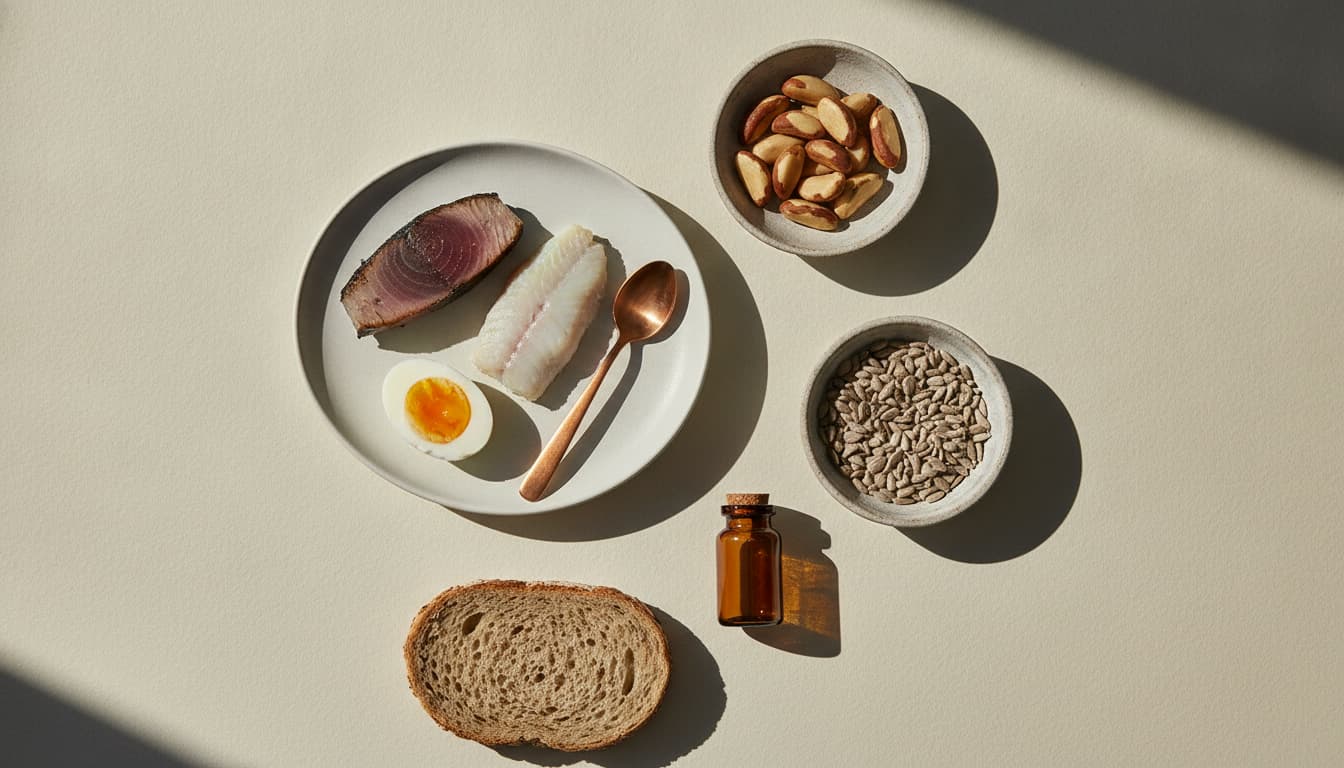
The RDA is 55 mcg a day and the tolerable upper limit is 400 mcg, a window of only about 7 to 1. One ounce of Brazil nuts carries 544 mcg, 989 percent of the Daily Value, above the adult ceiling from a single serving.
- 01
The target is 55 mcg a day, and it is the same for men and women
The RDA for selenium is 55 mcg a day for adult men and women alike, rising to 60 mcg in pregnancy and 70 mcg during lactation, with children scaled from 20 mcg at 1 to 3 years, 30 mcg at 4 to 8, 40 mcg at 9 to 13 and 55 mcg at 14 to 18 (NIH Office of Dietary Supplements). The Daily Value used on Nutrition and Supplement Facts labels is the same 55 mcg (FDA).
- 02
The ceiling is 400 mcg, a window of only about 7 to 1
The tolerable upper intake level for adults is 400 mcg a day from food, fortified products and supplements combined, which sits only about seven times above the 55 mcg RDA (NIH Office of Dietary Supplements). A narrow ratio matters because it removes the margin that makes casual supplementation harmless elsewhere. A 200 mcg capsule added to a diet already supplying 100 mcg leaves 100 mcg of headroom, which is less than a quarter of one serving of Brazil nuts.
- 03
One ounce of Brazil nuts is 544 mcg, above the adult ceiling
One ounce of Brazil nuts, six to eight nuts, carries 544 mcg of selenium, 989 percent of the Daily Value and more than the 400 mcg adult upper limit from a single serving (NIH Office of Dietary Supplements). The rule that follows is unusual for a nut: portion Brazil nuts the way a supplement is portioned, because one or two several times a week already covers the RDA with a wide margin.
- 04
Selenium works as selenoproteins, not as a free mineral
Selenium is incorporated as the amino acid selenocysteine into roughly 25 selenoproteins, and those proteins do the work (NIH Office of Dietary Supplements). The glutathione peroxidases reduce hydrogen peroxide and lipid hydroperoxides. Thioredoxin reductase maintains the thioredoxin system. The iodothyronine deiodinases convert thyroid hormone between forms. The requirement is therefore measured in micrograms rather than milligrams, because the mineral is a catalytic component of a small set of enzymes rather than a structural material like calcium.
- 05
The thyroid link runs through the deiodinases
The iodothyronine deiodinases convert thyroxine (T4) to the active triiodothyronine (T3) and inactivate both, and they are selenoproteins, which places selenium directly downstream of iodine in thyroid hormone metabolism (NIH Office of Dietary Supplements). That is a genuine mechanism and it is the reason selenium appears in thyroid discussions, but a mechanism is not a trial result. Correcting a documented deficiency is a different intervention from adding selenium to an intake that is already adequate.
- 06
The food table after Brazil nuts is orderly and safe
Yellowfin tuna 3 oz 92 mcg, sardines 3 oz 45 mcg, ham 3 oz 42 mcg, shrimp 3 oz 42 mcg, beef steak 3 oz 37 mcg, cottage cheese 1 cup 20 mcg, one large egg 15 mcg (NIH Office of Dietary Supplements; USDA FoodData Central). Seafood and muscle meat carry the load, which is why a 3 oz portion of wild salmon contributes meaningfully here as well as in the omega-3 accounting.
- 07
Soil selenium is why plant figures travel badly
Plant selenium content tracks the selenium in the soil the plant grew in, so the same grain grown in a selenium-rich region and a selenium-poor one can differ by an order of magnitude, which is why national intakes vary so widely (NIH Office of Dietary Supplements). Animal food content varies far less, because feed is blended across sources and animals regulate tissue concentrations. A table figure for beef or tuna therefore transfers reasonably well, while one for wheat, rice or vegetables is a regional average.
- 08
Keshan disease fixes the low end of the curve
Keshan disease, a cardiomyopathy first described in very low-selenium areas of China, is the classic deficiency endpoint and the finding that established selenium as essential for humans (NIH Office of Dietary Supplements). Frank deficiency of that kind is not a North American or western European risk. Its relevance to a reader here is that it defines where the requirement becomes visible, not that a typical mixed diet is anywhere near it.
- 09
Selenosis has a specific and recognisable presentation
Chronic excess intake produces selenosis: brittleness or loss of hair and nails, a garlic odor on the breath, gastrointestinal upset, skin rash, fatigue, irritability and nervous system abnormalities (NIH Office of Dietary Supplements). Hair and nail changes are usually noticed first. The 400 mcg ceiling applies to the total from all sources, and the two realistic routes to exceeding it are a daily ounce of Brazil nuts or a high-dose standalone capsule stacked on a diet that was already adequate.
- 10
SELECT: 35,533 men, 200 mcg a day, no benefit
The largest test of selenium supplementation in an adequately nourished population randomised 35,533 men across 427 sites to 200 mcg a day of selenium as L-selenomethionine, 400 IU of vitamin E, both or placebo (Lippman et al. 2009). At a median follow-up of 5.46 years the hazard ratio for prostate cancer with selenium was 1.04 (99% CI 0.87 to 1.24), and no prespecified cancer endpoint differed significantly. There was a nonsignificant increase in type 2 diabetes in the selenium group (relative risk 1.07, 99% CI 0.94 to 1.22).
- 11
The diabetes signal from the Nutritional Prevention of Cancer trial
Among 1,202 participants without type 2 diabetes at baseline, living in low-selenium areas of the eastern United States, 200 mcg a day over an average 7.7 years produced 58 cases of type 2 diabetes against 39 on placebo, an incidence of 12.6 versus 8.4 per 1,000 person-years and a hazard ratio of 1.55 (95% CI 1.03 to 2.33) (Stranges et al. 2007). Risk rose across baseline plasma selenium tertiles, reaching a hazard ratio of 2.70 (95% CI 1.30 to 5.61) in the highest tertile.
- 12
The pooled verdict, and the long post-trial follow-up
The Cochrane review found no reduction in overall cancer incidence with supplementation (RR 0.99, 95% CI 0.86 to 1.14; 5 studies, 21,860 participants) or cancer mortality (RR 0.81, 95% CI 0.49 to 1.32), rated the absence of benefit as high certainty, and noted the reported excesses of high-grade prostate cancer and type 2 diabetes (Vinceti et al. 2018). A later post-intervention analysis of SELECT across 341,697 person-years reported higher risks of Hodgkin lymphoma, multiple myeloma and amyotrophic lateral sclerosis (Vinceti et al. 2026).
- 13
The decision rule: food, portioned nuts, and read the label
If the diet includes seafood, meat, eggs or dairy on most days, the 55 mcg RDA is already met and a selenium tablet has no target. If it excludes all of them, one or two Brazil nuts several times a week solves it with the portion under deliberate control. Before adding a standalone 200 mcg capsule, check what a multivitamin already supplies, because most broad-spectrum products carry 55 to 70 mcg and the 400 mcg ceiling applies to the sum (NIH Office of Dietary Supplements; FDA).
What people ask us next.
- How much selenium do I need per day?
- The RDA is 55 mcg a day for adult men and women, 60 mcg in pregnancy and 70 mcg during lactation, and the Daily Value used on labels is the same 55 mcg (NIH Office of Dietary Supplements; FDA). The tolerable upper intake level for adults is 400 mcg a day from all sources combined. A diet that includes seafood, meat, eggs or dairy on most days reaches the target without any planning at all.
- How many Brazil nuts is too many?
- One ounce, six to eight nuts, supplies 544 mcg of selenium, 989 percent of the Daily Value and more than the 400 mcg adult upper limit in a single serving (NIH Office of Dietary Supplements). Two ounces is roughly 1,088 mcg. That makes an ounce a day a poor habit over months, while one or two nuts several times a week covers the 55 mcg RDA with a wide margin.
- What are the symptoms of too much selenium?
- Chronic excess produces selenosis: brittleness or loss of hair and nails, a garlic odor on the breath, gastrointestinal upset, skin rash, fatigue, irritability and nervous system abnormalities (NIH Office of Dietary Supplements). The 400 mcg adult ceiling applies to food, fortified products and supplements together, and the realistic routes to exceeding it are a daily habit of Brazil nuts or a high-dose standalone capsule added to a diet that was already adequate.
- Does selenium help the thyroid?
- The mechanism is real: the iodothyronine deiodinases that convert T4 to T3 are selenoproteins, and the thyroid holds a high selenium concentration per gram of tissue (NIH Office of Dietary Supplements). What does not follow is that supplementing an adequate intake improves thyroid outcomes. Correcting a documented deficiency is a different intervention from adding 200 mcg to a diet already supplying 100 mcg. Selenium and iodine are best assessed together, since the adult iodine RDA of 150 mcg is the more commonly missed target in people who avoid iodized salt and dairy.
- Should I take a selenium supplement?
- For most people in North America and western Europe, no. The RDA is 55 mcg and typical mixed diets exceed it, while the ceiling is 400 mcg, so a 200 mcg capsule consumes half the remaining headroom for no demonstrated benefit (NIH Office of Dietary Supplements). Randomised trials in adequately nourished populations found no reduction in cancer incidence and reported more type 2 diabetes (Vinceti et al. 2018; Stranges et al. 2007).
- Does selenium prevent cancer?
- Not in adequately nourished populations. SELECT randomised 35,533 men to 200 mcg a day and found a hazard ratio of 1.04 (99% CI 0.87 to 1.24) for prostate cancer, with no significant difference in any prespecified cancer endpoint (Lippman et al. 2009). The Cochrane review found no reduction in overall cancer incidence (RR 0.99, 95% CI 0.86 to 1.14; 5 studies, 21,860 participants) and rated that absence of benefit high certainty (Vinceti et al. 2018).
- Do vegetarians and vegans get enough selenium?
- Usually, but with more variance than meat-eaters, because plant selenium tracks soil selenium while animal food content does not (NIH Office of Dietary Supplements). Someone eating grains and vegetables grown in a low-selenium region has a genuinely lower intake than the same diet sourced elsewhere, and a food table cannot say which applies. The simplest correction is not a capsule: one or two Brazil nuts several times a week supplies the 55 mcg RDA several times over.
- How much selenium is in a multivitamin?
- Most broad-spectrum products supply somewhere between 55 and 70 mcg, at or near the 55 mcg Daily Value, which is a reasonable amount and not a concern on its own (FDA; NIH Office of Dietary Supplements). The problem arises when that product sits alongside a standalone 200 mcg capsule and a seafood-heavy week, because the 400 mcg ceiling applies to the sum. Reading the Supplement Facts panel for the actual microgram figure, rather than assuming a trace mineral must be trivially dosed, is the whole of the advice.
Every claim, cited.
- [01]NIH Office of Dietary Supplements, Selenium Fact Sheet for Health Professionals. RDA 55 mcg per day for adults, 60 mcg in pregnancy and 70 mcg during lactation, with 20 mcg at 1 to 3 years, 30 mcg at 4 to 8, 40 mcg at 9 to 13 and 55 mcg at 14 to 18. Tolerable upper intake level 400 mcg per day for adults from all sources. Daily Value 55 mcg. Selenium is incorporated as selenocysteine into selenoproteins including the glutathione peroxidases, thioredoxin reductase and the iodothyronine deiodinases, which convert thyroxine to triiodothyronine. Selected food figures: Brazil nuts 1 oz, six to eight nuts, 544 mcg and 989 percent of the Daily Value; yellowfin tuna 3 oz 92 mcg; sardines 3 oz 45 mcg; ham 3 oz 42 mcg; shrimp 3 oz 42 mcg; beef steak 3 oz 37 mcg; cottage cheese 1 cup 20 mcg; one large egg 15 mcg. Plant selenium content tracks soil selenium, which is why intakes vary widely by region, while animal food content varies much less. Keshan disease is the classic deficiency syndrome from very low-selenium areas of China. Chronic excess intake, selenosis, presents as brittleness or loss of hair and nails, garlic breath odor, gastrointestinal upset, skin rash, fatigue and nervous system abnormalities.
- [02]US Food and Drug Administration, Daily Value on the Nutrition and Supplement Facts Labels. The Daily Value for selenium is 55 mcg, and percent Daily Value on a Supplement Facts panel expresses the amount in one serving as a proportion of that reference figure. Daily Values are reference amounts for labeling purposes and are not identical to the age-specific and life-stage-specific Recommended Dietary Allowances used in dietary assessment, which is why a single label percentage cannot be read as a personal target. Percent Daily Value is intended to let a consumer compare products and judge whether a serving contributes a high or low amount of a nutrient relative to a single reference intake.
- [03]Dietary Guidelines for Americans. The Guidelines frame nutrient adequacy as a property of overall dietary patterns rather than of individual supplements, and identify nutrient-dense foods, including seafood, lean meats and poultry, eggs, dairy, legumes, nuts and seeds, as the primary route to meeting micronutrient recommendations across life stages. Seafood is specifically recommended within the healthy eating patterns, which is the category that carries most of the selenium in a mixed diet.
- [04]USDA FoodData Central, search results for Brazil nuts. Composition data for raw and dried Brazil nuts, used here to confirm the per-ounce serving basis behind the selenium figure of 544 mcg per ounce, equivalent to roughly six to eight nuts. FoodData Central entries also record the wide dispersion in selenium values across samples, which reflects the soil selenium of the region in which the trees grew.
- [05]Lippman SM, Klein EA, Goodman PJ, Lucia MS, et al. Effect of selenium and vitamin E on risk of prostate cancer and other cancers: the Selenium and Vitamin E Cancer Prevention Trial (SELECT). JAMA 2009;301(1):39-51. A randomized, placebo-controlled trial of 35,533 men from 427 sites in the United States, Canada and Puerto Rico, assigned between August 2001 and June 2004 to selenium 200 mcg per day from L-selenomethionine, vitamin E 400 IU per day, both, or placebo. Median overall follow-up 5.46 years. Hazard ratios for prostate cancer were 1.04 (99% CI 0.87 to 1.24) for selenium, 1.13 (99% CI 0.95 to 1.35) for vitamin E and 1.05 (99% CI 0.88 to 1.25) for the combination against placebo. No significant differences in any other prespecified cancer endpoint. Statistically nonsignificant increased risk of type 2 diabetes in the selenium group, relative risk 1.07 (99% CI 0.94 to 1.22). The authors concluded that selenium or vitamin E, alone or combined at the doses and formulations used, did not prevent prostate cancer in this population of relatively healthy men.
- [06]Stranges S, Marshall JR, Natarajan R, Donahue RP, et al. Effects of long-term selenium supplementation on the incidence of type 2 diabetes: a randomized trial. Ann Intern Med 2007;147(4):217-223. Secondary analysis of a randomized, double-blind, placebo-controlled trial in areas of low selenium consumption of the eastern United States, in 1,202 persons without type 2 diabetes at baseline, given oral selenium 200 mcg per day or placebo. During an average follow-up of 7.7 years, type 2 diabetes developed in 58 selenium recipients and 39 placebo recipients, an incidence of 12.6 versus 8.4 cases per 1,000 person-years, hazard ratio 1.55 (95% CI 1.03 to 2.33). An exposure-response gradient was found across tertiles of baseline plasma selenium, with a significantly increased risk in the highest tertile, hazard ratio 2.70 (95% CI 1.30 to 5.61). The authors concluded that selenium supplementation does not seem to prevent type 2 diabetes and may increase risk for the disease. Diabetes was a secondary outcome in the parent trial.
- [07]Vinceti M, Filippini T, Del Giovane C, Dennert G, et al. Selenium for preventing cancer. Cochrane Database Syst Rev 2018;1:CD005195. Selenium supplementation did not reduce overall cancer incidence (RR 0.99, 95% CI 0.86 to 1.14; 5 studies, 21,860 participants) nor cancer mortality (RR 0.81, 95% CI 0.49 to 1.32; 2 studies, 18,698 participants). In the largest trial, SELECT, selenium supplementation increased risks of alopecia and dermatitis, and for participants with the highest background selenium status also increased risk of high-grade prostate cancer; randomized trials showed a slightly increased risk of type 2 diabetes. Seventy observational cohort studies covering over 2,360,000 participants showed lower cancer incidence (OR 0.72, 95% CI 0.55 to 0.93) and lower cancer mortality (OR 0.76, 95% CI 0.59 to 0.97) in the highest category of selenium exposure, but certainty of evidence was very low for each outcome and no dose-response relation emerged. The authors concluded that well-designed randomized trials have shown no beneficial effect of selenium supplements in reducing cancer risk, at high certainty of evidence.
- [08]Vinceti M, Till C, Goodman PJ, Filippini T, et al. The Selenium and Vitamin E Cancer Prevention Trial (SELECT): a secondary, post-intervention analysis on potential excess chronic disease incidence induced by selenium administration. Am J Epidemiol, published 2026. SELECT assigned 34,887 eligible men aged 55 or older to selenium 200 mcg from L-selenomethionine, vitamin E 400 IU, both, or placebo, and was stopped for futility and concerns about adverse effects. Using Medicare incidence and mortality data through 2019 and the National Death Index through 2024 across 341,697 person-years of follow-up, the authors found little increased risk for lung cancer, near-null associations for leukemia, non-Hodgkin lymphoma and Parkinson disease, lower risk for melanoma and colorectal cancer, and higher risk for Hodgkin lymphoma, multiple myeloma and amyotrophic lateral sclerosis. The latter associations were based on few cases but were consistent with other studies, possibly indicating long-term adverse effects of this organic selenium compound.
The Larderlab Team builds evidence-led frameworks for eating, lifting, and stocking a kitchen. We cite every claim. We publish the spreadsheet when possible. We buy what we review at retail price. When new data lands, we revise with a dated note.
Next in this hub.
How Much Folate Per Day: 400 mcg DFE, and the Unit Almost Nobody Converts
The RDA is 400 mcg DFE and the upper limit is 1,000 mcg of folic acid, and they are not the same unit. A 400 mcg tablet on an empty stomach supplies 800 mcg DFE, which is where the double-counting starts.
13 min · rev 2026-09-09How Much Iodine Per Day: The 150 mcg RDA and the 1,100 mcg Ceiling
The adult RDA is 150 mcg a day and the Tolerable Upper Intake Level is 1,100 mcg, a ratio of about 7 to 1. One 1 gram sheet of dried kelp can deliver anywhere from 16 to 2,984 mcg, which spans that entire window.
12 min · rev 2026-09-03Foods High in Selenium: The Densest Sources, by Micrograms
The daily selenium target is 55 mcg for adults, and Brazil nuts, tuna, sardines, and organ meats are the densest sources. The mcg-per-serving ranking, why one Brazil nut can cover a day, and how much is too much.
8 min · rev 2026-07-18Get the Larderlab Macro Planner.
A Google Sheet that calculates your protein target, splits it across 3-5 meals, and ranks 20 protein sources by $/gram. Free. Copy-and-modify your own version.
By subscribing, you agree to our Privacy Policy. Unsubscribe anytime.