Best multivitamin, 2026: ranked by nutrient coverage per dollar
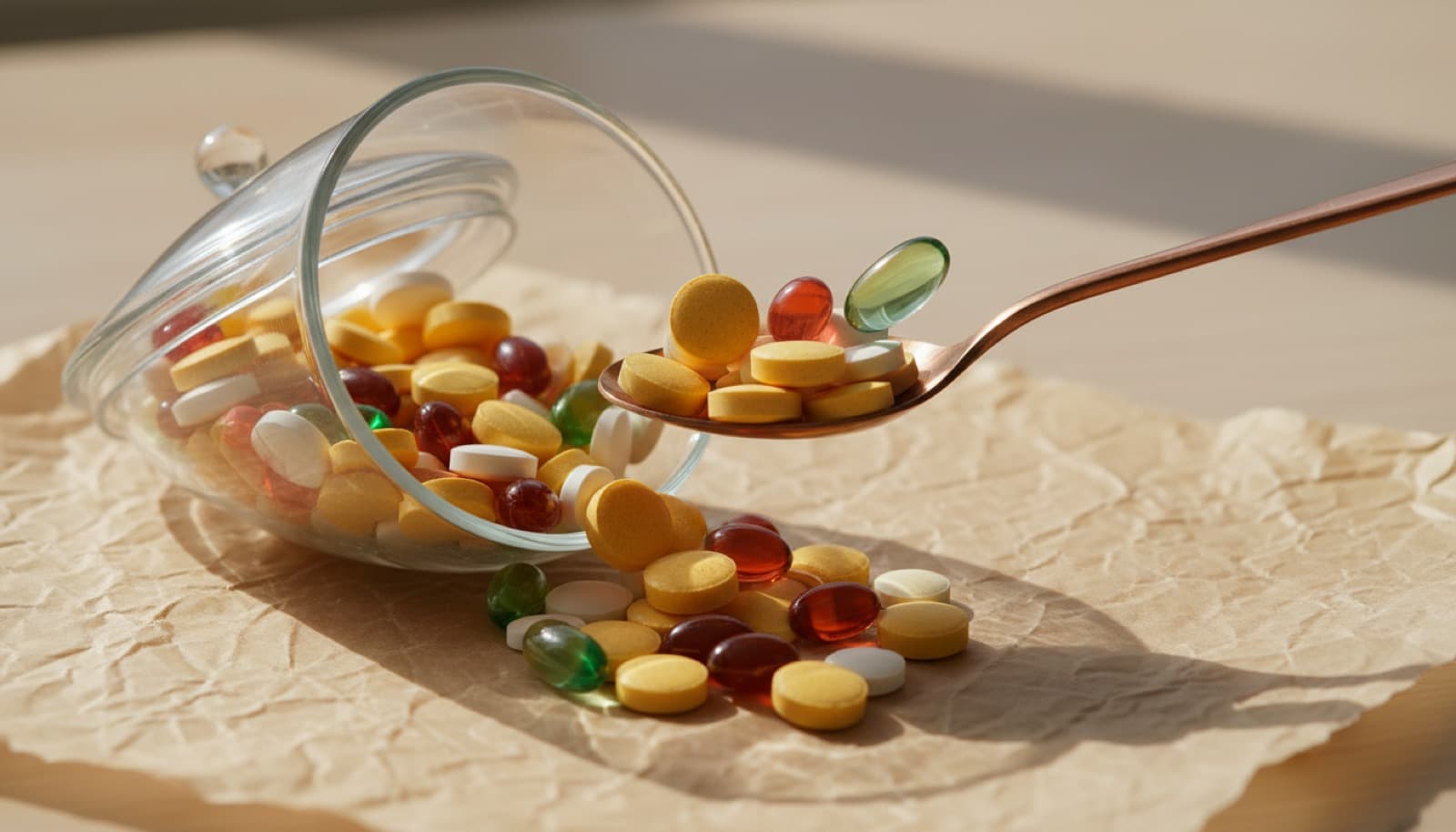
Eight multivitamins scored on the 13 RDA-relevant nutrients an actual diet typically under-delivers. Methylated B-vitamins, the iron-versus-no-iron split, and the cost-per-day math.
Thorne Basic Nutrients 2/Day
Methylated B-vitamins (5-MTHF folate, methylcobalamin B12, the bioactive forms that bypass the MTHFR-genotype-dependent activation step), iron-free, NSF Certified for Sport, ~$0.30/day at 60-day pricing. The 2-capsule format keeps the dose splittable across morning and evening for steady plasma levels. Outranks AG1 on nutrient-per-dollar at 4× lower cost; outranks Costco Kirkland on B-vitamin form quality.
Every product, ranked.
| # | Notes | Confidence | |||
|---|---|---|---|---|---|
| 01 | Thorne Basic Nutrients 2/Day | Best methylated multi | 01 | Methylated B-vitamins (5-MTHF, methylcobalamin), bioactive vitamin K2, NSF Certified for Sport. Iron-free formulation suitable for menopause and male prescribing contexts. ~$0.30/day at 60-capsule pricing. Direct from Thorne or via Amazon authorized listings only, counterfeit incidence on this brand is meaningful. | High |
| 02 | Pure Encapsulations O.N.E. Multivitamin | Best single-pill methylated multi | 02 | 1-pill-per-day form factor with methylated B-vitamins. Trace lutein + zeaxanthin (eye health) + alpha lipoic acid. ~$0.40/day. Useful for readers who won't reliably take a 2-capsule split. Same NSF-grade quality control as Thorne. | High |
| 03 | Costco Kirkland Daily Multi | Best $/day mass-market | 03 | USP-verified, broad RDA coverage, ~$0.07/day. Uses cyanocobalamin (B12) and folic acid (not methylated forms), adequate for adults without MTHFR-pathway considerations. The cheapest defensible multi on the page; ~75% of the value of premium methylated multis at 25% of the cost. | High |
| 04 | Garden of Life Vitamin Code Men's / Women's 50+ | Best whole-food-derived multi | 04 | Whole-food-derived nutrient sources rather than synthetic isolates. Methylated B-vitamins, raw + uncooked formulation. Higher cost (~$0.55/day) reflects the whole-food sourcing, clinically equivalent to synthetic methylated alternatives but defensible for readers who prefer whole-food matrices. | Medium |
| 05 | Optimum Nutrition Opti-Men / Opti-Women | Best for active adults with stacking goals | 05 | Multi + amino-acid + antioxidant stack in single tablet. Higher dose iron in Opti-Women (a feature for menstruating women, a flag for men). ~$0.20/day. Reasonable choice for athletes who would otherwise stack a multi with separate aminos. NSF Certified for Sport. | Medium |
| 06 | Ritual Essential Multivitamin (Women's 18+, Men's 18+) | Best clean-label brand-forward | 06 | Traceable ingredient sourcing, methylated folate, iron-only-where-needed (Women's 50+ removes iron). $0.86/day. Brand premium reflects the traceability + DTC packaging. Coverage profile is solid; the cost sits well above what equivalent-coverage Thorne delivers. | Medium |
| 07 | AG1 (Athletic Greens) | Most-marketed multi in the comparison set | 07 | Greens-powder formulation with vitamin + mineral blend + adaptogen complex. ~$1.30/day at the subscription price. Coverage profile is broadly comparable to Thorne Basic Nutrients at roughly 4× the cost. The marketing premium is the variable; the underlying nutrition is competitive but not differentiated enough to justify the price gap. We rank it for completeness, not endorsement. | Medium |
| 08 | Centrum Silver / Adult | Most-prescribed retail multi | 08 | Pharmacy-default multi; widely studied in retrospective cohorts. Coverage is broad but uses cyanocobalamin and folic acid (not methylated forms). $0.10/day. The default choice for risk-averse readers; clinically defensible but not the optimization choice. | Medium |
How this was specified
- 01Inputs measured
- Retail price (dated) · label claim · Certificate of Analysis · third-party test (Informed Sport / NSF / ConsumerLab / Clean Label) · leucine per serving from COA, not marketing.
- 02Protocols tested
- Per-kg target from four literature ranges (IOM RDA, Phillips 2017, Morton 2018, ISSN). Brands scored against Moore 2015 leucine-per-dose threshold (~0.4 g/kg).
- 03Cost-basis verified
- $/gram of protein and $/gram of leucine at warehouse pricing (Costco), mail-order (Amazon), and DTC retail. Re-checked quarterly, flagged when drift exceeds 15%.
- 04Confidence level
- High on ranked order. Medium on absolute $/g (prices drift). Low on serving-size claims where COA is older than 18 months, flagged [VERIFY].
What people ask us most.
- Should I take a multivitamin at all?
- The trial evidence on hard endpoints is mixed. The Physicians' Health Study II (Gaziano 2012, JAMA) reported an 8% reduction in cancer incidence over 11 years on a daily multivitamin, but no effect on cardiovascular events. The COSMOS trial (Yeung 2023, Am J Clin Nutr) reported modest cognitive benefit. The opposing evidence: most US adults consuming a varied diet meet RDA for the nutrients a multi provides, and a multi adds zero benefit to a deficient diet that should be addressed at the meal level. The reasonable use case: insurance against rotation-day micronutrient gaps, particularly for vitamin D, B12 (especially in plant-based diets), folate (especially in pregnant and pre-pregnant women), and omega-3 (separate supplement, see best-fish-oil).
- What are methylated B-vitamins and do I need them?
- B-vitamin methylation is the activation step that converts dietary forms into the bioactive cofactors (5-MTHF folate from folic acid; methylcobalamin from cyanocobalamin). In adults without MTHFR-gene polymorphisms (~50% of the population), the body methylates standard forms efficiently and synthetic folic acid + cyanocobalamin work fine. In adults with MTHFR C677T or A1298C polymorphisms, the methylation step is reduced 30–70% and methylated forms bypass the bottleneck. Without genetic testing, the methylated forms are insurance with no downside. The cost premium is small at $0.07–$0.30 per day delta.
- Why iron-free?
- Adult men, postmenopausal women, and most non-pregnant adults do not have iron deficiency and excess iron is pro-oxidant. The Iowa Women's Health Study (Mursu 2011, Arch Intern Med) reported increased mortality risk associated with iron-supplement use in older women. Iron-containing multivitamins are appropriate for menstruating women and pregnant women under medical supervision. Iron-free multis (Thorne Basic, Centrum Adult Plus) are the default for everyone else.
- What about AG1 and the greens-powder category?
- AG1 is a multivitamin with an adaptogen blend repackaged as a daily greens powder, priced at the premium end of the market. The coverage profile is competitive with Thorne Basic Nutrients but at 4× the cost. The marketing case for the differentiator (gut-health blend, adaptogens) is weakly supported by trial data at the doses delivered. For readers who already have an established daily-greens-drink habit, AG1 is a reasonable single-purchase that absorbs multiple supplement categories. For readers picking the best value-per-nutrient supplement: Thorne or Pure Encapsulations beats it on every measurable axis.
- How does a multi compare with separate single-nutrient supplements?
- Single-nutrient supplements address documented deficiencies (vitamin D in low-sunlight latitudes, B12 in plant-based diets, iron in menstruating women with confirmed low ferritin). Multivitamins are the broad-coverage insurance for un-tested gaps. The reasonable stack: multivitamin daily + vitamin D 1,000–4,000 IU based on serum 25-OH levels + EPA/DHA 500–2,000 mg from fish oil. Separate magnesium glycinate at 200–400 mg if sleep is the goal (most multis under-dose magnesium). Beyond that, single-nutrient supplements should follow blood work, not marketing.
A published Certificate of Analysis from a ranked brand that contradicts the label claim we scored against. An independent lab result (Clean Label, ConsumerLab) finding heavy-metal or amino-spiking failures on a current top pick. A peer-reviewed meta-analysis that shifts the leucine-per-dose threshold. Any of those triggers a dated revision within a week.
Every claim, cited.
- [01]Gaziano JM et al. 2012. Multivitamins in the prevention of cancer in men: the Physicians' Health Study II. JAMA 308(18):1871-80.
- [02]Yeung LK et al. 2023. Multivitamin supplementation improves memory in older adults: COSMOS-Web trial. Am J Clin Nutr 118(1):273-282.
- [03]Mursu J et al. 2011. Dietary supplements and mortality rate in older women: the Iowa Women's Health Study. Arch Intern Med 171(18):1625-33.
- [04]NIH Office of Dietary Supplements, Multivitamin/Mineral Supplements fact sheet.
- [05]USP Verified Mark, supplement quality assurance program.
The Larderlab Team builds evidence-led frameworks for eating, lifting, and stocking a kitchen. We cite every claim. We publish the spreadsheet when possible. We buy what we review at retail price. When new data lands, we revise with a dated note.
Next in this hub.
Best Electrolyte Powders, 2026: Ranked by $/mg of Sodium
Eight electrolyte powders ranked on cost-per-mg of sodium, the actual ingredient most consumers under-dose. LMNT, Liquid IV, Re-Lyte, and 5 alternatives, with the failure modes nobody publishes.
11 min · rev 2026-04-29Best Vitamin D Supplement, Ranked by $/1000 IU
Vitamin D3 supplements ranked by $/1000 IU of cholecalciferol, with D3-vs-D2, K2/magnesium cofactor notes, and third-party testing status.
10 min · rev 2026-06-22Is Vitamin D the Same as D3? The Difference That Actually Matters
Vitamin D is the family name. D2 and D3 are the two forms sold, both counted in the same units, and D3 raises blood 25(OH)D more per microgram. What the label words mean and when the difference is worth paying for.
7 min · rev 2026-08-21Get the Larderlab Macro Planner.
A Google Sheet that calculates your protein target, splits it across 3-5 meals, and ranks 20 protein sources by $/gram. Free. Copy-and-modify your own version.
By subscribing, you agree to our Privacy Policy. Unsubscribe anytime.