Best whole-food protein sources, ranked by $/gram
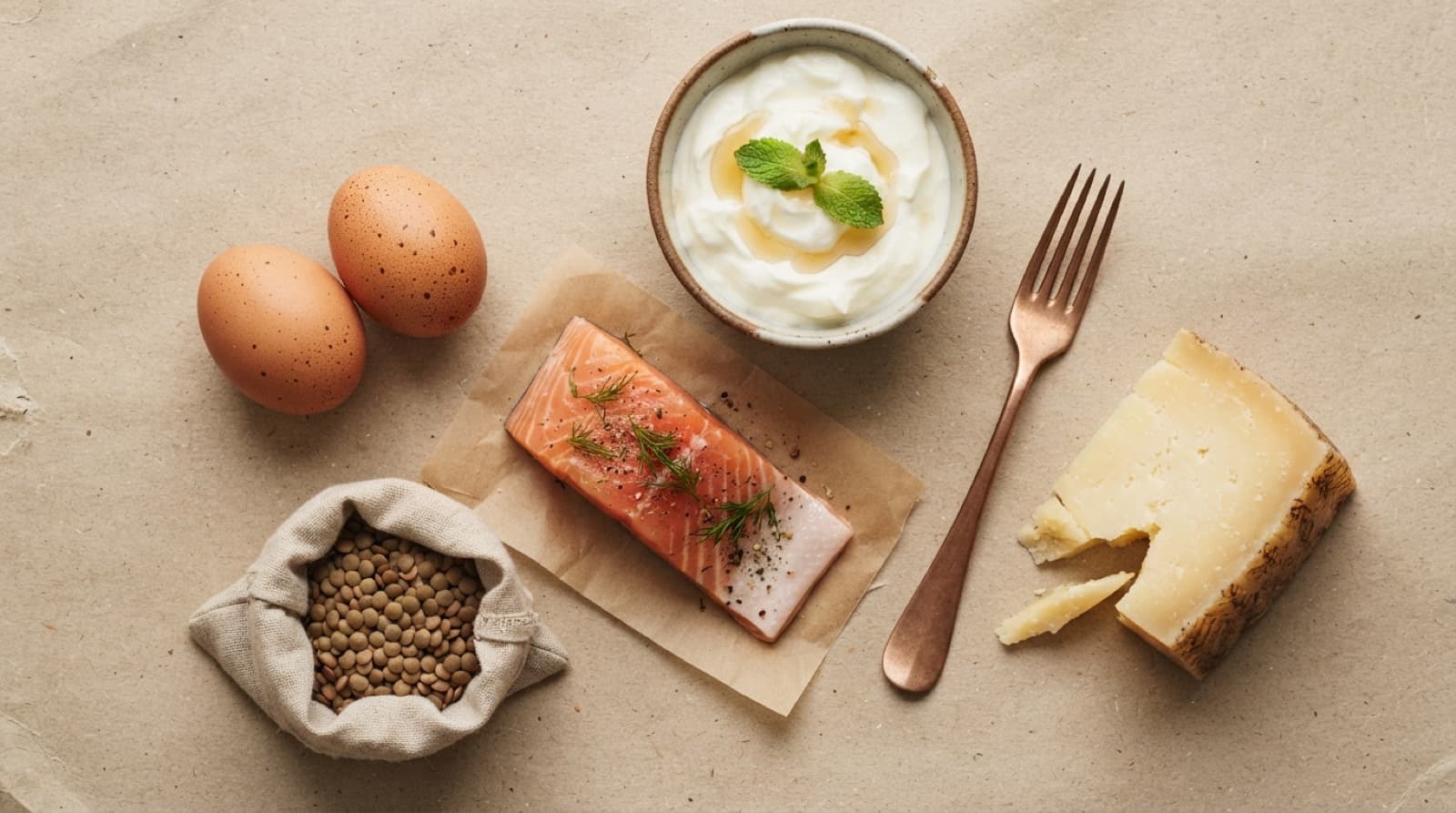
20 whole-food protein sources priced per gram of protein, with Costco and grocery-store benchmarks. Updated quarterly.
Whole chicken (bone-in) at Costco
Roast whole, pull meat, bone-stock the carcass. ~$0.015/g protein at Costco warehouse pricing for the raw bird; yields ~450 g cooked protein per 2 kg whole chicken. Beats chicken breast on $/g and yields bone stock as a byproduct. The compounding win is what moves the weekly grocery bill.
Every product, ranked.
| # | Notes | Confidence | |||
|---|---|---|---|---|---|
| 01 | Whole chicken (bone-in, Costco) | Best overall $/g | 01 | ~$0.015/g cooked protein. 2 kg raw bird yields ~450 g cooked meat plus bones for stock. Roast at 220 C for 75 min, cool, pull. Refrigerate portioned for 4 days. | High |
| 02 | Eggs (18-count, bulk) | Best versatile $/g | 02 | ~$0.020/g protein at ~$0.25/egg for 6 g protein. Hard-boil in 10-egg batches; keeps 7 days refrigerated. Breakfast primitive. Zero cook time after the initial boil. | High |
| 03 | Chicken thighs (bone-in, Costco) | Best $/g with fat included | 03 | ~$0.017/g cooked protein. Higher fat than breast; tolerates overcooking. Roast a sheet pan at 220 C for 35 min. Better flavor-to-effort ratio than breast if you're cooking ahead for a week. | High |
| 04 | Canned tuna (chunk light, in water) | Best shelf-stable $/g | 04 | ~$0.025/g protein at $1.00 for a 142 g can (~22 g protein). Chunk light has lower mercury than albacore (EPA 2023 advisories). Bulk 12-packs at Costco drop $/g further. | Medium |
| 05 | Canned sardines | Best $/g with omega-3 | 05 | ~$0.030/g protein plus ~1 g EPA+DHA per 100 g tin. One of the only foods that beats the dollar-for-dollar math on protein and omega-3 simultaneously. Wild Planet, King Oscar, Bela, buy whichever is cheapest per gram. | Medium |
| 06 | Chicken breast (boneless, Costco) | Best low-fat $/g | 06 | ~$0.022/g cooked protein. Lower $/g than grocery chicken breast but higher than bone-in at Costco. Pay the 30% premium if fat macros are tight; otherwise choose thighs. | Medium |
| 07 | Greek yogurt (bulk tub, Costco) | Best $/g dairy | 07 | ~$0.028/g protein on the 2% Kirkland tub. 17-20 g protein per 170 g serving. Low-lift breakfast; stack with frozen berries and 30 g whey concentrate to clear 40 g protein in 3 minutes. | Medium |
| 08 | Cottage cheese (4% bulk) | Best $/g slow-release protein | 08 | ~$0.032/g protein. 24 g protein per cup; predominantly casein. Overnight absorption kinetics make it the pre-bed pick if you care about nighttime MPS (Res et al. 2012). Good Culture and Kirkland both viable. | Medium |
| 09 | Milk (2%, gallon) | Best $/g liquid | 09 | ~$0.035/g protein. 8 g protein per cup. Useful as a base for oats, smoothies, or a 500 mL between-meal top-up. Diminishing returns as a primary source (lactose + liquid calories). | Medium |
| 10 | Ground turkey (93/7) | Best $/g lean ground | 10 | ~$0.045/g protein. Lower fat than beef at comparable price; absorbs seasoning aggressively. 1 lb raw yields ~110 g protein cooked. Sheet-pan with vegetables, 200 C for 25 min. | Medium |
| 11 | 93/7 ground beef (Costco) | Best $/g red meat | 11 | ~$0.050/g protein. Higher heme-iron content than poultry; the pick during deliberate iron-loading blocks (menstruating athletes, plant-leaning diets). Brown in 500 g batches, portion, freeze. | Medium |
| 12 | Pork shoulder (whole, Costco) | Best batch-cooking $/g | 12 | ~$0.030/g cooked protein. 5 kg raw shoulder yields ~2 kg pulled meat. Slow-cook 90 C for 8 hours with salt; portion into 150 g containers and freeze. Highest-yield batch cook per dollar on this list. | Medium |
| 13 | Beans + rice (complete-protein combo) | Best plant $/g | 13 | ~$0.020/g protein when bought dry in 10 lb bags. The lysine-deficient/methionine-deficient pair completes the essential amino profile. Leucine still ~50% lower per gram than whey; use as calorie base, not primary protein driver. | Medium |
| 14 | Lentils (dry) | Best $/g legume | 14 | ~$0.025/g protein. 18 g protein per cooked cup. Best bought in 5-10 lb bags. 25 min simmer, no soak required. Pair with vitamin C source to boost non-heme iron absorption (Hallberg 1989). | Medium |
| 15 | Tempeh | Best fermented plant $/g | 15 | ~$0.055/g protein. 19 g protein per 100 g. Whole-food plant option with better amino profile than most bean/rice combos because of soy fermentation. Lightlife and Tofurky mainstream; buy whichever is cheapest per gram. | Medium |
| 16 | Tofu (extra-firm, bulk) | Plant reference | 16 | ~$0.045/g protein. 10 g protein per 100 g. Cheaper than tempeh but lower protein density. Press, cube, air-fry at 200 C for 15 min for a workable texture. | Medium |
| 17 | Frozen wild shrimp | Seafood reference | 17 | ~$0.080/g protein. Low-calorie, low-fat, zero-prep. Sears in 3 min from frozen. A premium flex for variety, not a $/g winner. | Medium |
| 18 | Salmon (frozen, Costco) | Best $/g with high-dose omega-3 | 18 | ~$0.095/g protein but ~2 g EPA+DHA per 150 g fillet. Pay the premium when the omega-3 delivery matters. Farmed Atlantic is cheaper; wild Alaskan is the lower-contaminant pick (EPA/FDA 2022 advisory). | Medium |
Named, with the reason.
Greek yogurt single-serve cups
Skip (cost multiplier)~$0.060/g protein, 2x the bulk tub for identical macros. Convenience premium on a category where the bulk format requires zero extra prep. Buy the tub.
Beef jerky
Skip (cost + sodium)~$0.150/g protein. Ten times the price of ground beef for shelf stability. The sodium load (400-600 mg per 28 g serving) is significant if you eat multiple bags. A travel-day tool, not a daily protein source.
How this was specified
- 01Inputs measured
- Retail price (dated) · label claim · Certificate of Analysis · third-party test (Informed Sport / NSF / ConsumerLab / Clean Label) · leucine per serving from COA, not marketing.
- 02Protocols tested
- Per-kg target from four literature ranges (IOM RDA, Phillips 2017, Morton 2018, ISSN). Brands scored against Moore 2015 leucine-per-dose threshold (~0.4 g/kg).
- 03Cost-basis verified
- $/gram of protein and $/gram of leucine at warehouse pricing (Costco), mail-order (Amazon), and DTC retail. Re-checked quarterly, flagged when drift exceeds 15%.
- 04Confidence level
- High on ranked order. Medium on absolute $/g (prices drift). Low on serving-size claims where COA is older than 18 months, flagged [VERIFY].
What people ask us most.
- Why does whey concentrate beat whole foods on $/g if this is a whole-food list?
- It does, whey is the cheapest protein per gram by a margin. We covered it in the protein powders comparison. This list answers the reader asking 'which foods from my grocery store deliver protein cheapest,' which is a distinct question. Use whey as your cheap base; use this list to decide what goes on the actual plate.
- Why Costco pricing and not Whole Foods or a regional grocer?
- Costco warehouse pricing is the tightest national benchmark available. Regional groceries swing 15-40% above Costco on the same SKU. If you don't have Costco access, add a ~25% premium to every number on this list and the rank order mostly holds.
- How current are the prices on this list?
- Re-checked quarterly. The 'checked YYYY-MM' stamp sits at the top of the post. Eggs and chicken are the most volatile (avian-influenza cycles); beef and pork move more slowly. Expect drift of 10-25% between refresh cycles.
- Does this list account for cooked-yield losses?
- Yes. All $/g numbers reference cooked protein yield, not raw weight. Chicken breast loses ~25% water on a sheet pan; ground beef loses ~20% fat and water; shrimp drops ~15%. USDA FoodData Central cooked-weight entries anchor the calculation.
- Is there a vegan version of this ranking?
- Beans + rice, lentils, tempeh, tofu, and pea-isolate protein powder cover the math for a plant-based reader. Whole-food plant protein never matches whey on $/g of leucine; the plant analog of this list tops out around $0.045/g protein with a weaker amino profile per dollar. The plant-forward ranking is its own post.
A published Certificate of Analysis from a ranked brand that contradicts the label claim we scored against. An independent lab result (Clean Label, ConsumerLab) finding heavy-metal or amino-spiking failures on a current top pick. A peer-reviewed meta-analysis that shifts the leucine-per-dose threshold. Any of those triggers a dated revision within a week.
Every claim, cited.
- [01]USDA FoodData Central. 2024. Standard Reference Legacy Database, protein and amino acid values per 100 g cooked.
- [02]Morton RW et al. 2018. Protein supplementation and resistance training-induced gains in muscle mass and strength. Br J Sports Med 52(6):376-384.
- [03]Res PT et al. 2012. Protein ingestion before sleep improves postexercise overnight recovery. Med Sci Sports Exerc 44(8):1560-1569.
- [04]EPA/FDA. 2022. Advice about eating fish: guidelines and mercury levels by species.
- [05]Banaszek A et al. 2019. Whey vs pea protein, 8-week HIFT trial. Sports (Basel) 7(1):12.
The Larderlab Team builds evidence-led frameworks for eating, lifting, and stocking a kitchen. We cite every claim. We publish the spreadsheet when possible. We buy what we review at retail price. When new data lands, we revise with a dated note.
Next in this hub.
Best Protein Powders Ranked by $/gram of Leucine
We ranked 14 protein powders by the metric that actually matters, cost per gram of leucine delivered, with third-party testing filters.
14 min · rev 2026-04-2112 High-Protein Foods Ranked by $/gram
A shopping list to hit 150 g of protein a day for under $5, built from 12 foods ranked by cost-per-gram.
9 min · rev 2026-04-21Healthy Fats: The Best Whole-Food Sources, by the Numbers
Most fat in a good diet should be unsaturated, and olive oil, avocado, nuts, seeds, and oily fish are the densest whole-food sources. The fat-per-serving numbers, what mono- and polyunsaturated mean, and how much fat per day.
9 min · rev 2026-07-18Get the Larderlab Macro Planner.
A Google Sheet that calculates your protein target, splits it across 3-5 meals, and ranks 20 protein sources by $/gram. Free. Copy-and-modify your own version.
By subscribing, you agree to our Privacy Policy. Unsubscribe anytime.