L-theanine benefits, and why the caffeine pairing carries the evidence the solo capsule does not
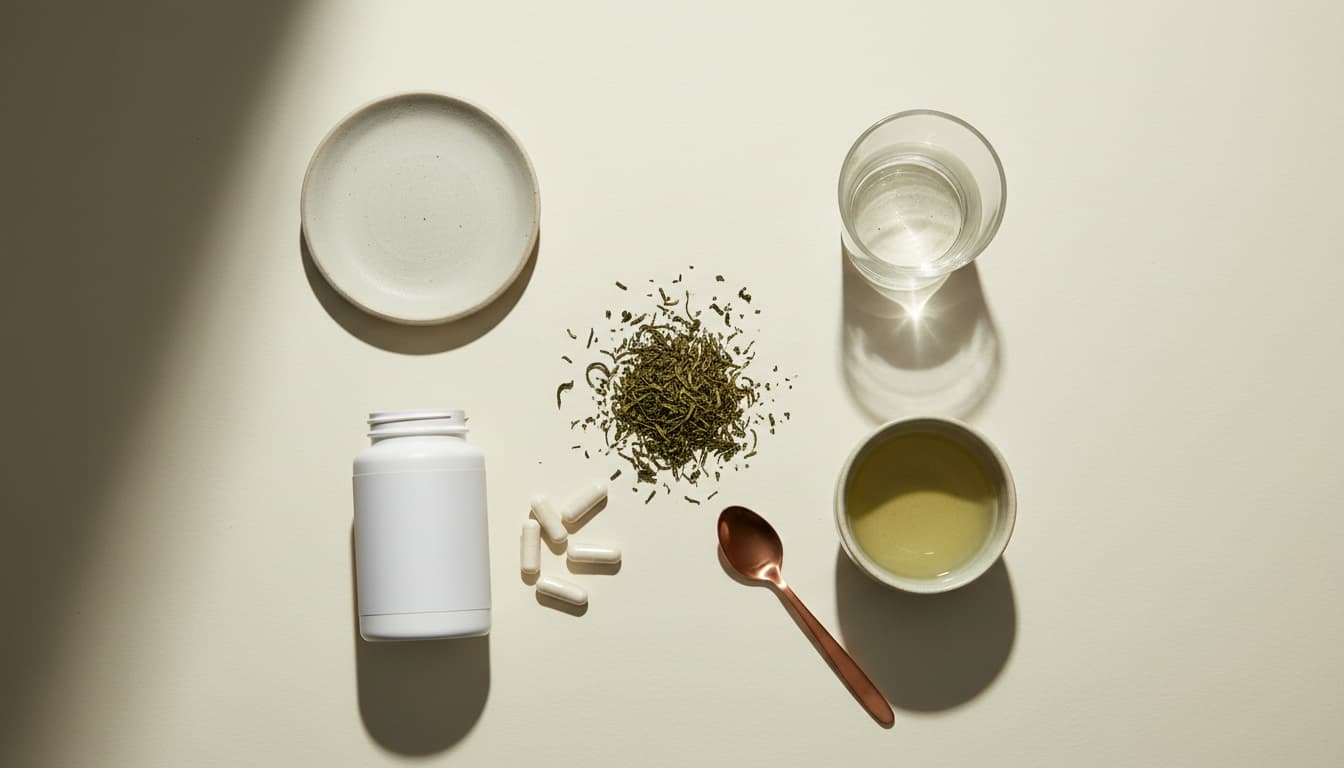
A 200 ml cup of black tea holds 24.2 mg of L-theanine, so a 200 mg capsule is roughly eight cups. Pooled trials show attention switching accuracy improved with caffeine at a standardised mean difference of 0.33, while EFSA found no cause and effect for theanine alone.
- 01
A 200 mg capsule is about eight cups of black tea
Measured by reversed-phase high performance liquid chromatography on commercially available teas, a standard 200 ml cup of black tea contained 24.2 plus or minus 5.7 mg of L-theanine (Keenan et al. 2011). A 200 mg capsule is therefore roughly eight cups. The long human history of tea drinking is evidence about a 25 mg exposure, not about the supplement dose, and any safety argument built on tea consumption is extrapolating across an order of magnitude.
- 02
Black tea beat green tea, which is the opposite of the popular claim
In the same analysis a cup of green tea contained the least L-theanine at 7.9 plus or minus 3.8 mg, and the authors explicitly note this is contrary to previous research (Keenan et al. 2011). Brewing time was the major determinant of the amount extracted, small amounts of milk and sugar made no significant difference, and high levels of milk markedly lowered the level of detectable L-theanine. A green tea marketed on its theanine content is marketed on the weaker of the two.
- 03
The replicated benefit is attention switching, not general cognition
With 50 mg caffeine and 100 mg L-theanine, the combination improved both speed and accuracy of an attention-switching task at 60 minutes and reduced susceptibility to distracting information in a memory task at 60 and 90 minutes (Owen et al. 2008). With 97 mg theanine and 40 mg caffeine in 44 adults, the combination improved task switching accuracy and self-reported alertness, both P less than 0.01, with no significant effects on visual search, choice reaction time or mental rotation (Giesbrecht et al. 2010).
- 04
The pooled combination effect is 1.1 percent on switching accuracy
Across 16 trials with 484 participants, median sample size 27, theanine plus caffeine in the second hour after intake gave a standardised mean difference of 0.71 lower for simple reaction time, about 26.54 milliseconds, 0.33 for attention switching accuracy, about 1.10 percent, and 0.20 for digit vigilance accuracy, about 1.59 percent (Payne et al. 2025). Those are real, replicated and small. A subjectively obvious change is not what this literature describes.
- 05
The mood effects did not clear zero
In the same meta-analysis, alertness for theanine plus caffeine had a standardised mean difference of 0.28 with a 95 percent confidence interval of 0.08 lower to 0.65 higher, and overall mood 0.26 with an interval of 0.10 lower to 0.63 higher (Payne et al. 2025). Both intervals cross zero, meaning the pooled data does not distinguish the combination from placebo on self-reported mood, even while it does distinguish it on objective attentional measures.
- 06
Theanine alone moved one pooled measure
For L-theanine without caffeine, the only significant pooled cognitive result was choice reaction time in the first hour after intake, at a standardised mean difference of 0.35 lower, equivalent to about 18.17 milliseconds, and the sleep findings were inconclusive across studies (Payne et al. 2025). The authors phrase the conclusion carefully: theanine plus caffeine likely improves performance in attentional tasks, while theanine alone may improve performance in certain tasks.
- 07
At 250 mg alone it increased headache ratings and worsened serial sevens
In a randomised, placebo-controlled, double-blind, balanced crossover of 250 mg L-theanine and 150 mg caffeine alone and in combination, L-theanine on its own increased headache ratings and decreased correct serial seven subtractions (Haskell et al. 2008). That is the single most useful and least cited result in the field, because it shows the solo profile is not simply a weaker version of the combination profile but a different one.
- 08
The same trial showed the combination doing what the solo dose did not
In combination, the treatment improved rapid visual information processing accuracy, attenuated increases in self-reported mental fatigue, produced faster simple reaction time and faster numeric working memory reaction time, improved sentence verification accuracy, reduced headache and tired ratings, raised alert ratings, and showed a significant positive caffeine by L-theanine interaction on delayed word recognition reaction time (Haskell et al. 2008). A statistical interaction term is the formal version of the claim that these two are better together.
- 09
The 1:2 ratio is a description of trial design, not an optimisation
Owen used 50 mg caffeine with 100 mg theanine, Giesbrecht used 40 with 97 mg, and Haskell used 150 with 250 mg, which is nearer 1:1.7. No published trial varied the ratio as an independent variable. So the widely repeated 1:2 rule accurately describes what has been tested and says nothing about whether 1:1 or 1:3 would work better. Stating it as an optimised ratio is a claim the literature does not support.
- 10
The four-week standalone trial is positive, small and industry co-authored
Thirty healthy adults, nine men and 21 women with a mean age of 48.3 years, took 200 mg per day or placebo for four weeks in a double-blind crossover. Depression, trait anxiety and Pittsburgh Sleep Quality Index scores all fell, P equals 0.019, 0.006 and 0.013, with sleep latency, sleep disturbance and sleep medication subscales reduced against placebo, and verbal fluency and executive function improved, P equals 0.001 and 0.031 (Hidese et al. 2019). Two authors were employed by the theanine manufacturer.
- 11
The European regulator rejected all four claim categories
Reviewing the submitted file, the EFSA panel concluded that a cause and effect relationship had not been established between consumption of L-theanine from Camellia sinensis and improvement of cognitive function, alleviation of psychological stress, maintenance of normal sleep, or reduction of menstrual discomfort (EFSA NDA Panel 2011). A rejected claim is not proof of absence, it is a finding that the evidence submitted did not meet the bar, which is what small single-site trials typically fail to clear.
- 12
Alpha waves are a mechanism, not an outcome
Increases in alpha band electroencephalographic activity, described as synonymous with a relaxed yet alert state, are the most cited biological rationale for theanine and appear as such in the analytical literature (Nobre et al. 2008, as cited in Keenan et al. 2011). Treating an electroencephalographic change as evidence of relaxation is the same category error as treating a plasma concentration as evidence of clinical benefit. The mechanism is plausible; it is not the result.
- 13
Regulatory safety status is settled at up to 250 mg per serving
L-theanine holds a generally recognised as safe notice that the regulator responded to with no questions, filed for use in beverages, chocolate, confectionery and chewing gum at levels up to 250 milligrams per serving (FDA GRN 000209). No tolerable upper intake level exists, which reflects the absence of an assessment rather than the presence of a high ceiling. Trial doses cluster at 100 to 250 mg, and the one documented negative signal at 250 mg alone was increased headache ratings.
- 14
The defensible use is narrow, and it is cheap
Take 100 to 200 mg alongside caffeine when the work involves switching between tasks under distraction, which is the specific condition the trials tested and replicated. From bulk powder that dose costs a few cents; from a branded blend it costs more than ten times as much for the same molecule plus botanicals with thinner evidence. As a standalone sleep or anxiety product it is being sold ahead of its evidence, and the budget belongs on categories with outcome data.
What people ask us next.
- How much L-theanine should be taken?
- Trial doses cluster at 100 to 250 mg, and the combination studies that produced the replicated attention effects used 100 mg with 50 mg caffeine and 97 mg with 40 mg caffeine (Owen et al. 2008; Giesbrecht et al. 2010). The four-week standalone trial used 200 mg per day (Hidese et al. 2019). The regulatory notice covers use up to 250 milligrams per serving in the food categories it names (FDA GRN 000209). The one documented downside signal appeared at 250 mg taken alone, where headache ratings increased (Haskell et al. 2008), which argues for the lower end.
- Does L-theanine work without caffeine?
- Less well, and the pooled data says so directly. In a meta-analysis of 16 trials in 484 participants, L-theanine alone produced one significant pooled cognitive result, choice reaction time in the first hour at a standardised mean difference of 0.35 lower, about 18.17 milliseconds, and sleep results were inconclusive, while the combination with caffeine improved simple reaction time, attention switching accuracy and digit vigilance accuracy (Payne et al. 2025). One trial found that 250 mg alone increased headache ratings and worsened serial seven subtractions (Haskell et al. 2008).
- What is the correct caffeine to L-theanine ratio?
- There is no established correct ratio, only a set of ratios that happen to have been tested. Owen used 50 mg caffeine with 100 mg theanine, Giesbrecht used 40 mg with 97 mg, and Haskell used 150 mg with 250 mg, which is closer to 1:1.7 (Owen et al. 2008; Giesbrecht et al. 2010; Haskell et al. 2008). No published trial varied the ratio as an independent variable, so the widely repeated 1:2 rule describes trial design rather than an optimisation. Combinations in that neighbourhood work on attention switching; nothing is known about alternatives.
- How much L-theanine is in a cup of tea?
- Measured by high performance liquid chromatography on commercially available teas, a standard 200 ml cup of black tea contained 24.2 plus or minus 5.7 mg and a cup of green tea 7.9 plus or minus 3.8 mg, with black tea the higher of the two contrary to previous research (Keenan et al. 2011). Brewing time was the major determinant of the amount extracted; small amounts of milk and sugar made no significant difference, while high levels of milk markedly lowered detectable L-theanine. A 200 mg capsule is roughly eight cups of black tea.
- Does L-theanine help with sleep?
- The evidence is thin and the regulator was not persuaded. The pooled analysis found sleep results inconclusive across studies (Payne et al. 2025), and the European panel concluded that a cause and effect relationship had not been established between L-theanine and maintenance of normal sleep (EFSA NDA Panel 2011). The most favourable data is a four-week crossover in 30 adults where Pittsburgh Sleep Quality Index scores fell, P equals 0.013, with sleep latency and sleep disturbance subscales reduced against placebo (Hidese et al. 2019), a small trial with two manufacturer-employed authors.
- Does L-theanine reduce anxiety?
- Not on the strength of the current file. The European panel concluded that a cause and effect relationship had not been established between L-theanine consumption and alleviation of psychological stress (EFSA NDA Panel 2011). The supporting trial is a four-week crossover in 30 healthy adults where State-Trait Anxiety Inventory trait scores decreased, P equals 0.006 (Hidese et al. 2019). Thirty participants across multiple outcomes, with industry co-authorship, is a reason to hold the result loosely rather than to dismiss it.
- Is L-theanine safe?
- The regulatory position is settled for food use: L-theanine holds a generally recognised as safe notice that the agency answered with no questions, covering beverages, chocolate, confectionery and chewing gum at up to 250 milligrams per serving (FDA GRN 000209). No tolerable upper intake level has been set, which reflects an absence of assessment rather than an established ceiling. The documented adverse signal in the trial literature is increased headache ratings at 250 mg taken alone (Haskell et al. 2008). Anyone on blood pressure medication should raise it with a clinician.
- How big is the effect in practical terms?
- Small and specific. In the pooled analysis the combination of theanine and caffeine improved attention switching accuracy by a standardised mean difference of 0.33, equivalent to about 1.10 percent, digit vigilance accuracy by 0.20, about 1.59 percent, and simple reaction time by 0.71, about 26.54 milliseconds (Payne et al. 2025). None of the mood measures cleared zero. This is a measurable edge on distractor-heavy attentional work, not a state change, and any product page describing it as calm focus is describing a feeling the trials did not reliably detect.
Every claim, cited.
- [01]Keenan EK, Finnie MDA, Jones PS, Rogers PJ, Priestley CM. 2011. How much theanine in a cup of tea? Effects of tea type and method of preparation. Food Chemistry 125(2):588-594. Reversed-phase high performance liquid chromatography was applied to commercially available teas prepared by a standard method. Brewing time was found to be a major determinant of the amount of L-theanine extracted, while the addition of small amounts of milk and sugar made no significant difference; high levels of milk resulted in a marked lowering of the level of detectable L-theanine. Contrary to previous research, a standard 200 ml cup of black tea was found to contain the most L-theanine at 24.2 plus or minus 5.7 mg, while a cup of green tea contained the least at 7.9 plus or minus 3.8 mg. The paper also records that L-theanine has been reported to increase alpha brain waves, described as synonymous with a relaxed yet alert state, citing Nobre, Rao and Owen 2008.
- [02]Owen GN, Parnell H, De Bruin EA, Rycroft JA. 2008. The combined effects of L-theanine and caffeine on cognitive performance and mood. Nutr Neurosci 11(4):193-8. The study compared 50 mg caffeine, with and without 100 mg L-theanine, against placebo in 27 participants, measuring word recognition, rapid visual information processing, critical flicker fusion threshold, attention switching and mood at baseline and again at 60 and 90 minutes after each treatment, separated by a seven-day washout. Caffeine improved subjective alertness at 60 minutes and accuracy on the attention-switching task at 90 minutes. The L-theanine and caffeine combination improved both speed and accuracy of performance on the attention-switching task at 60 minutes, and reduced susceptibility to distracting information in the memory task at both 60 and 90 minutes.
- [03]Haskell CF, Kennedy DO, Milne AL, Wesnes KA, Scholey AB. 2008. The effects of L-theanine, caffeine and their combination on cognition and mood. Biol Psychol 77(2):113-22. A randomised, placebo-controlled, double-blind, balanced crossover study of L-theanine at 250 mg and caffeine at 150 mg, in isolation and in combination, with salivary caffeine levels co-monitored. L-theanine alone increased headache ratings and decreased correct serial seven subtractions. Caffeine led to faster digit vigilance reaction time, improved rapid visual information processing accuracy and attenuated increases in self-reported mental fatigue. The combination additionally led to faster simple reaction time, faster numeric working memory reaction time and improved sentence verification accuracy, with headache and tired ratings reduced and alert ratings increased, and a significant positive caffeine by L-theanine interaction on delayed word recognition reaction time.
- [04]Giesbrecht T, Rycroft JA, Rowson MJ, De Bruin EA. 2010. The combination of L-theanine and caffeine improves cognitive performance and increases subjective alertness. Nutr Neurosci 13(6):283-90. The study investigated a combination of 97 mg L-theanine and 40 mg caffeine against placebo on cognitive performance, alertness, blood pressure and heart rate in 44 young adults, measured at baseline and at 20 and 70 minutes after administration. The combination significantly improved accuracy during task switching and self-reported alertness, both P less than 0.01, and reduced self-reported tiredness, P less than 0.05. There were no significant effects on other cognitive tasks including visual search, choice reaction times or mental rotation. The authors conclude that 97 mg of L-theanine with 40 mg of caffeine helps to focus attention during a demanding cognitive task.
- [05]Payne A and colleagues. 2025. Effects of tea (Camellia sinensis) or its bioactive compounds L-theanine or L-theanine plus caffeine on cognition, sleep and mood in healthy participants: a systematic review and meta-analysis of randomized controlled trials. Nutrition Reviews 83(10):1873. Fifty randomised controlled trials were reviewed, with 16 trials and 484 participants eligible for meta-analysis, 229 female, median sample size 27, weighted mean age 32 years. For L-theanine plus caffeine in the second hour after intake: simple reaction time standardised mean difference 0.71 lower, 95 percent confidence interval 0.92 to 0.50 lower, about 26.54 milliseconds; digit vigilance accuracy 0.20, 95 percent confidence interval 0.02 to 0.38, about 1.59 percent; attention switching accuracy 0.33, 95 percent confidence interval 0.13 to 0.54, about 1.10 percent. Alertness 0.28, 95 percent confidence interval 0.08 lower to 0.65 higher, and overall mood 0.26, 95 percent confidence interval 0.10 lower to 0.63 higher, both crossed zero. For L-theanine alone, choice reaction time in the first hour was 0.35 lower, 95 percent confidence interval 0.61 to 0.10 lower, about 18.17 milliseconds; sleep results were inconclusive.
- [06]Hidese S, Ogawa S, Ota M, Ishida I, Yasukawa Z, Ozeki M, Kunugi H. 2019. Effects of L-theanine administration on stress-related symptoms and cognitive functions in healthy adults: a randomized controlled trial. Nutrients 11(10):2362. A randomised, placebo-controlled, crossover, double-blind trial in 30 individuals, nine men and 21 women, mean age 48.3 plus or minus 11.9 years, with no major psychiatric illness, assigned to L-theanine at 200 mg per day or placebo for four weeks. Self-rating Depression Scale, State-Trait Anxiety Inventory trait and Pittsburgh Sleep Quality Index scores decreased after L-theanine, P equals 0.019, 0.006 and 0.013 respectively. The Pittsburgh subscale scores for sleep latency, sleep disturbance and use of sleep medication reduced compared with placebo, all P less than 0.05. Verbal fluency and executive function scores improved, P equals 0.001 and 0.031. Two of the seven authors were affiliated with the manufacturer supplying the theanine.
- [07]EFSA Panel on Dietetic Products, Nutrition and Allergies. 2011. Scientific opinion on the substantiation of health claims related to L-theanine from Camellia sinensis (L.) Kuntze (tea) and improvement of cognitive function (ID 1104, 1222, 1600, 1601, 1707, 1935, 2004, 2005), alleviation of psychological stress (ID 1598, 1601), maintenance of normal sleep (ID 1222, 1737, 2004) and reduction of menstrual discomfort (ID 1599) pursuant to Article 13(1) of Regulation (EC) No 1924/2006. EFSA Journal 9(6):2238. The Panel concluded that a cause and effect relationship had not been established between the consumption of L-theanine from Camellia sinensis and any of the four claimed effects assessed. None of these claims is authorised for use on foods in the European Union.
- [08]US Food and Drug Administration, GRAS Notice Inventory, GRN No. 000209, L-theanine, submitted by Taiyo Kagaku for Suntheanine. The agency responded with a letter raising no questions regarding the notifier's conclusion that L-theanine is generally recognised as safe under the intended conditions of use, which cover fruit juices and drinks, non-herbal teas, sports beverages, specialty bottled waters, chocolate bars and chews, hard candies and breath mints, and chewing gum, at levels up to 250 milligrams per serving. No tolerable upper intake level has been established for L-theanine, which reflects the absence of a formal intake assessment rather than the establishment of a high ceiling.
The Larderlab Team builds evidence-led frameworks for eating, lifting, and stocking a kitchen. We cite every claim. We publish the spreadsheet when possible. We buy what we review at retail price. When new data lands, we revise with a dated note.
Next in this hub.
Creatine for Women: What the Evidence Shows, and the Dose
Women hold 70 to 80 percent lower endogenous creatine stores than men, and the dose is the same 3 to 5 g a day. Strength, lean mass, bone, mood, and what the evidence does and does not support across the lifespan.
8 min · rev 2026-08-20Magnesium for Sleep: Which Form, What Dose, and the Evidence
Does magnesium help you sleep? The mechanism is real, the trial evidence is modest. Which form (glycinate), what dose (100-350 mg), and who actually benefits.
9 min · rev 2026-06-28What Is Magnesium Good For? The Benefits, by the Evidence
The strongest evidence is for blood pressure and glucose metabolism, with real but mixed support for cramps, migraine, and sleep. What magnesium helps, and how strong the evidence is for each claim.
8 min · rev 2026-07-02Get the Larderlab Macro Planner.
A Google Sheet that calculates your protein target, splits it across 3-5 meals, and ranks 20 protein sources by $/gram. Free. Copy-and-modify your own version.
By subscribing, you agree to our Privacy Policy. Unsubscribe anytime.