Foods high in vitamin A, ranked by micrograms
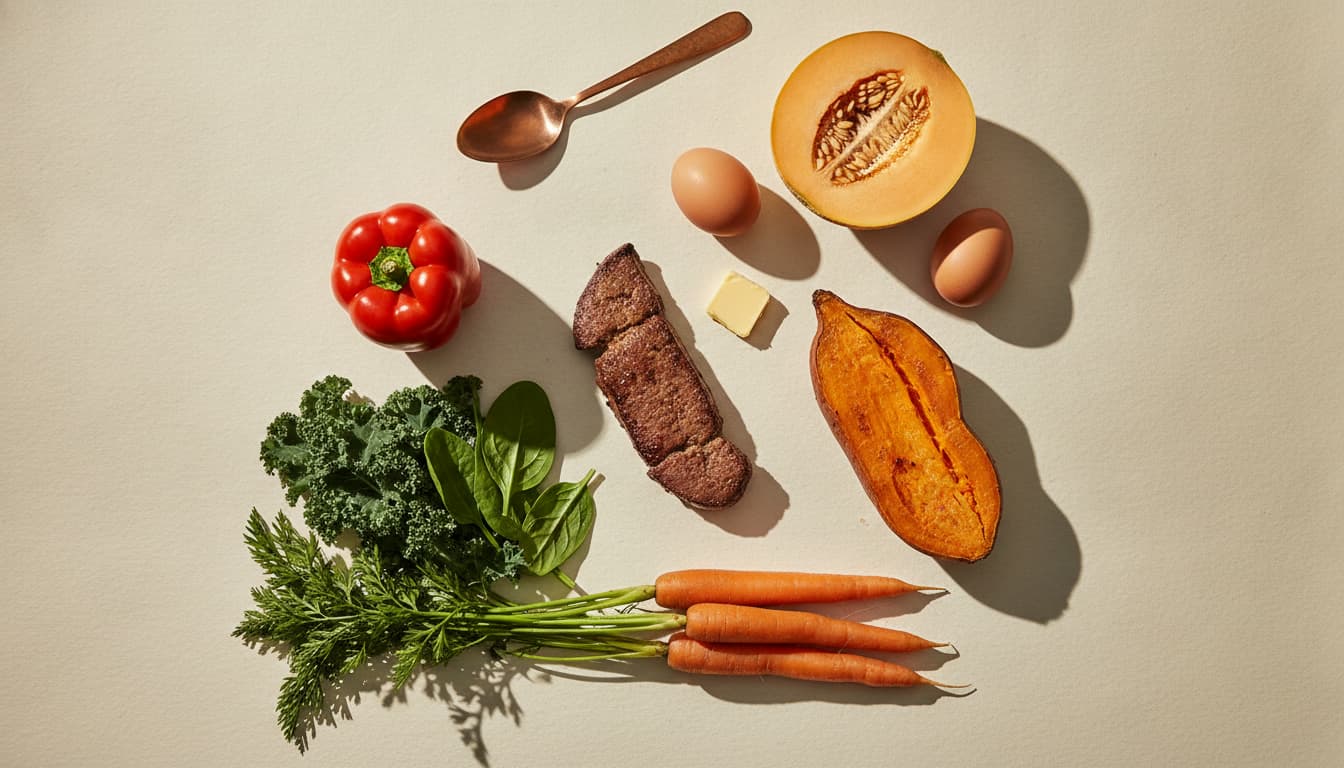
The RDA is 900 mcg RAE for men and 700 mcg for women, and liver, sweet potato, and carrots lead by a wide margin, but preformed retinol from animal foods and beta-carotene from plants are counted differently. The mcg-per-serving ranking, why the two forms are not equal, and the one food to limit.
- 01
Beef liver and organ meats: ~6,500-9,400 mcg RAE per 3 oz
Cooked beef liver is the densest source of vitamin A by a wide margin at ~6,500-9,400 mcg RAE per 3 oz, several days of the target in one small serving, with chicken and lamb liver similar (USDA FoodData Central). This is preformed retinol, used directly by the body, and liver is also the richest common source of B12 and a strong iron source, which is why it tops our iron rankings too. The same potency is the catch: one serving exceeds the 3,000 mcg upper limit for preformed vitamin A, so liver is a food to eat occasionally, not daily, and pregnant women are advised to limit it.
- 02
Cod liver oil: ~1,350 mcg RAE per teaspoon
A teaspoon of cod liver oil supplies ~1,350 mcg RAE of preformed vitamin A, close to a full day's target, alongside vitamin D and omega-3s (USDA). It is a concentrated supplement rather than a food, which is its strength and its risk: the vitamin A is preformed retinol, so stacking cod liver oil with liver or a retinol multivitamin can push preformed intake past the upper limit. Taken at the labeled dose it is a useful way to cover vitamin A, vitamin D, and omega-3 at once, but it should be counted toward the preformed-retinol ceiling, not treated as a free extra.
- 03
Sweet potato: ~1,400 mcg RAE per medium potato
A medium baked sweet potato with skin delivers ~1,400 mcg RAE from beta-carotene, more than the daily target and the densest plant source most people eat (USDA). Because it is a carotenoid rather than preformed retinol, there is no toxicity ceiling: the body converts only what it needs. The deep orange color is the beta-carotene itself, so the richer the color the higher the content, and eating it with a little fat, and with the skin on, raises how much is absorbed. It is the single easiest whole food for covering vitamin A without any risk of excess.
- 04
Carrots and pumpkin: ~950-1,000 mcg RAE per half cup
A half-cup of cooked carrots supplies ~1,000 mcg RAE and cooked pumpkin a similar amount, both from beta-carotene (USDA). Carrots are the food most associated with vitamin A for good reason, and the old claim that they help vision traces to real deficiency, where vitamin A is essential for the retina, not to improving already-normal sight. A practical detail: lightly cooking carrots and eating them with fat breaks down the cell walls and dissolves the carotene, raising absorption well above what raw sticks provide, so cooked carrots with a little oil beat raw ones for vitamin A.
- 05
Dark leafy greens: spinach and kale, ~500-570 mcg RAE per half cup
A half-cup of cooked spinach carries ~570 mcg RAE and cooked kale ~500 mcg, from beta-carotene bound up with the green chlorophyll that masks its orange color (USDA). Cooking wilts a large raw volume into a compact serving, so cooked greens are far denser per bite than a raw salad, and a little fat in the pan improves absorption. Greens stack vitamin A with vitamin K, folate, and, in the case of spinach, non-heme iron, so a serving of cooked greens quietly covers several targets at once alongside its vitamin A.
- 06
Red bell pepper, cantaloupe, and mango: ~120-470 mcg RAE per serving
A cup of cantaloupe delivers ~270 mcg RAE, a red bell pepper ~120-190 mcg, and a mango ~180 mcg, all from carotenoids (USDA). These are mid-pack sources but their advantage is that they are eaten raw and enjoyed freely, so they add vitamin A without cooking or planning. Red and orange fruits and vegetables share this trait: the pigment that makes them colorful is the provitamin A itself, so choosing the reddest pepper or the ripest cantaloupe is a rough guide to the highest content.
- 07
Eggs, dairy, and butter: ~75-260 mcg RAE per serving
A large egg supplies ~80 mcg RAE, a cup of whole milk ~110 mcg, and a tablespoon of butter ~95 mcg, all as preformed retinol (USDA). Fortified milk adds more. These are modest per serving but they are eaten daily by many people, so they form a reliable background contribution rather than a headline source. Because the amounts are small, they do not raise the toxicity concern that liver and high-dose supplements do, which makes eggs and dairy a steady, low-risk way to top up vitamin A across the day.
How this was specified
- 01Inputs measured
- Retail price (dated) · label claim · Certificate of Analysis · third-party test (Informed Sport / NSF / ConsumerLab / Clean Label) · leucine per serving from COA, not marketing.
- 02Protocols tested
- Per-kg target from four literature ranges (IOM RDA, Phillips 2017, Morton 2018, ISSN). Brands scored against Moore 2015 leucine-per-dose threshold (~0.4 g/kg).
- 03Cost-basis verified
- $/gram of protein and $/gram of leucine at warehouse pricing (Costco), mail-order (Amazon), and DTC retail. Re-checked quarterly, flagged when drift exceeds 15%.
- 04Confidence level
- High on ranked order. Medium on absolute $/g (prices drift). Low on serving-size claims where COA is older than 18 months, flagged [VERIFY].
Every claim, cited.
- [01]National Institutes of Health, Office of Dietary Supplements. Vitamin A and Carotenoids Fact Sheet for Health Professionals. RDA 900 mcg RAE (men) and 700 mcg RAE (women), 12:1 beta-carotene conversion, 3,000 mcg upper limit for preformed vitamin A.
- [02]US Department of Agriculture, Agricultural Research Service. FoodData Central. Vitamin A (RAE) content of beef liver, cod liver oil, sweet potato, carrots, pumpkin, spinach, kale, cantaloupe, red pepper, mango, eggs, and dairy.
- [03]National Academies of Sciences, Engineering, and Medicine. Dietary Reference Intakes for Vitamin A, Vitamin K, Arsenic, Boron, Chromium, Copper, Iodine, Iron. RAE definition and tolerable upper intake level for preformed vitamin A.
The Larderlab Team builds evidence-led frameworks for eating, lifting, and stocking a kitchen. We cite every claim. We publish the spreadsheet when possible. We buy what we review at retail price. When new data lands, we revise with a dated note.
Next in this hub.
Foods High in Biotin (Vitamin B7): The Densest Sources, by Micrograms
The adequate intake is just 30 mcg a day, and beef liver, eggs, and salmon cover it easily. The mcg-per-serving ranking, why deficiency is rare, why raw egg whites work against you, and why hair-growth megadoses are mostly wasted.
7 min · rev 2026-08-06Foods High in Vitamin K: The Densest Sources, by Micrograms
The adequate intake is 120 mcg/day for men and 90 mcg for women, and cooked leafy greens dominate while fermented natto tops the list. The mcg-per-serving ranking, why K1 and K2 count the same, and what people on blood thinners actually need to do.
8 min · rev 2026-07-27Foods High in Vitamin B12: The Densest Sources, by Micrograms
The RDA is 2.4 mcg/day, and clams, beef liver, and oily fish are the densest sources. The mcg-per-serving ranking, why B12 is almost absent from plant foods, and when vegetarians and vegans need a supplement.
8 min · rev 2026-07-07Get the Larderlab Macro Planner.
A Google Sheet that calculates your protein target, splits it across 3-5 meals, and ranks 20 protein sources by $/gram. Free. Copy-and-modify your own version.
By subscribing, you agree to our Privacy Policy. Unsubscribe anytime.