Foods high in vitamin B12, ranked by micrograms
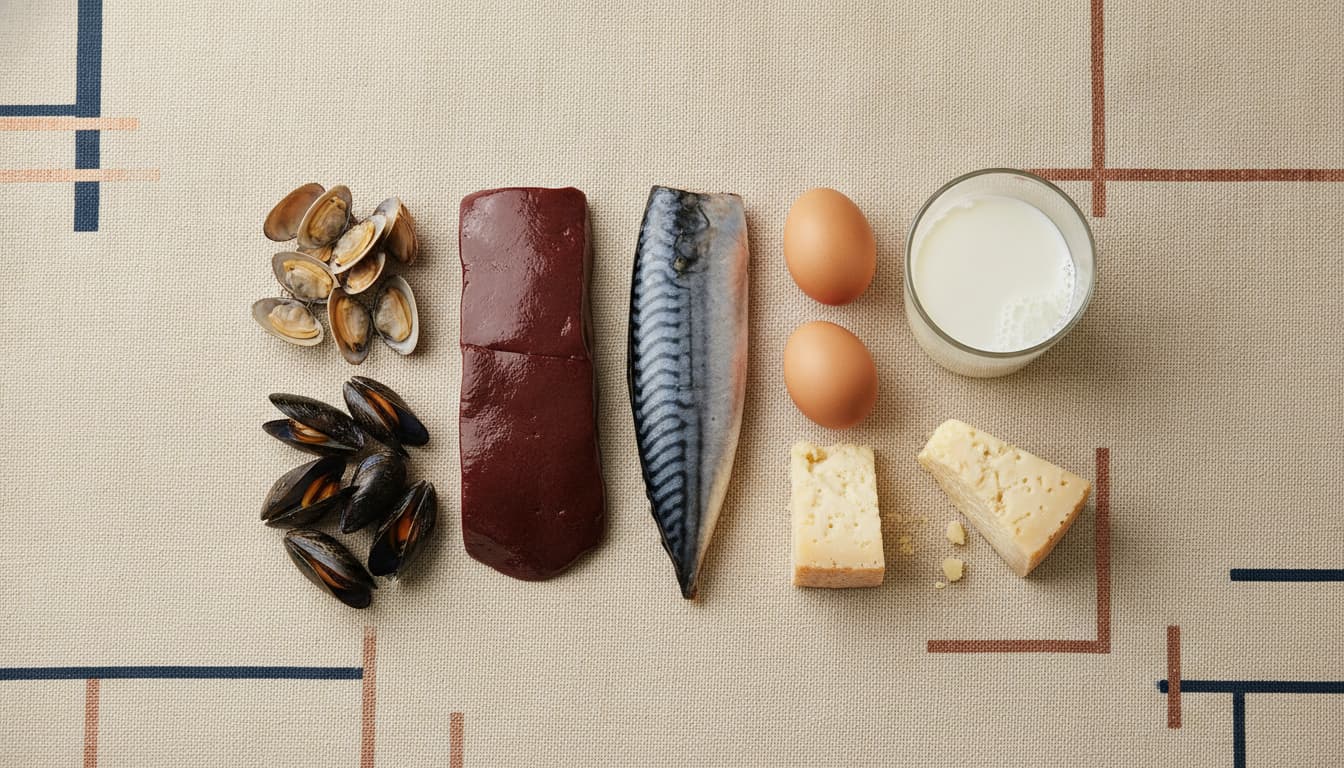
The RDA is 2.4 mcg/day, and clams, beef liver, and oily fish are the densest sources. The mcg-per-serving ranking, why B12 is almost absent from plant foods, and when vegetarians and vegans need a supplement.
- 01
Clams: ~99 mcg per 100 g
Clams are the single densest source by a wide margin, carrying ~99 mcg of B12 per 100 g, roughly 40 times the daily target in one serving (USDA FoodData Central). Other shellfish such as mussels and oysters are also rich. They arrive with iron, selenium, and protein. Because the dose is so high, clams are an occasional powerhouse rather than a daily food, and eating them a few times a month meaningfully raises average intake.
- 02
Beef liver and organ meats: ~70-83 mcg per 100 g
Cooked beef liver supplies ~70-83 mcg per 100 g, dozens of times the daily target, and lamb and chicken liver are similar (USDA). Liver is also the densest common source of vitamin A and a strong iron source. A modest 50-100 g serving once a week covers B12 for days. The catch is its very high vitamin A content, which is why liver is best eaten occasionally rather than daily, especially in pregnancy.
- 03
Oily fish: mackerel, herring, salmon, ~3-19 mcg per 100 g
Mackerel leads oily fish at ~19 mcg per 100 g, with herring ~8.5 mcg, sardines ~9 mcg, and salmon ~3-5 mcg (USDA). One serving covers several days of the target while also delivering the EPA and DHA omega-3s that anchor a separate nutrition goal, so a twice-weekly oily-fish habit quietly covers B12 and omega-3s at once. Trout and tuna add useful amounts too.
- 04
Beef, lamb, and red meat: ~2-5 mcg per 100 g
A 100 g cooked serving of beef or lamb supplies ~2-5 mcg, roughly one to two days' worth, alongside highly absorbable heme iron, zinc, and complete protein (USDA). Red meat is the most practical everyday B12 source for meat eaters: a modest daily or near-daily serving effectively guarantees adequate intake, which is why deficiency is rare among people who eat it regularly.
- 05
Eggs: ~0.6 mcg each
One large egg supplies ~0.6 mcg of B12, most of it in the yolk (USDA). Eggs are a modest but convenient and well-absorbed source, and two or three across a day add up to a meaningful share of the target. For lacto-ovo vegetarians who eat no fish or meat, eggs and dairy become the main dietary B12, though many still fall short and benefit from fortified foods.
- 06
Dairy: milk, yogurt, and cheese, ~0.5-1.5 mcg per serving
A cup of milk supplies ~1.2 mcg, a serving of yogurt ~1 mcg, and hard cheeses such as Swiss ~0.9-1.6 mcg per ounce (USDA). Dairy B12 is well absorbed and, taken across the day, is a reliable background source. For vegetarians who eat dairy but not eggs, meat, or fish, milk and cheese are the main dietary supply, though hitting 2.4 mcg from dairy alone takes deliberate stacking.
- 07
Fortified foods and supplements: for vegans and older adults
Unfortified plant foods contain essentially no active B12, so fortified plant milks, nutritional yeast, and some breakfast cereals, plus a supplement, are the route for vegans and strict vegetarians (NIH). The B12 in algae and seaweed is largely an inactive analogue and does not count. Adults over 50 are also advised to lean on fortified foods or supplements, because age-related loss of stomach acid reduces how well B12 is freed from food.
How this was specified
- 01Inputs measured
- Retail price (dated) · label claim · Certificate of Analysis · third-party test (Informed Sport / NSF / ConsumerLab / Clean Label) · leucine per serving from COA, not marketing.
- 02Protocols tested
- Per-kg target from four literature ranges (IOM RDA, Phillips 2017, Morton 2018, ISSN). Brands scored against Moore 2015 leucine-per-dose threshold (~0.4 g/kg).
- 03Cost-basis verified
- $/gram of protein and $/gram of leucine at warehouse pricing (Costco), mail-order (Amazon), and DTC retail. Re-checked quarterly, flagged when drift exceeds 15%.
- 04Confidence level
- High on ranked order. Medium on absolute $/g (prices drift). Low on serving-size claims where COA is older than 18 months, flagged [VERIFY].
Every claim, cited.
- [01]National Institutes of Health, Office of Dietary Supplements. Vitamin B12 Fact Sheet for Health Professionals. RDA 2.4 mcg/day for adults; absorption limits; risk groups.
- [02]US Department of Agriculture, Agricultural Research Service. FoodData Central. Vitamin B12 content of clams, liver, oily fish, meat, eggs, and dairy.
- [03]Deutsche Gesellschaft fuer Ernaehrung (DGE). Referenzwerte fuer die Naehrstoffzufuhr: Vitamin B12. Schaetzwert 4,0 mcg/Tag fuer Erwachsene.
- [04]Watanabe F, et al. 2014. Vitamin B12-containing plant food sources for vegetarians. Nutrients 6(5):1861-1873. Algae and seaweed contain inactive B12 analogues.
The Larderlab Team builds evidence-led frameworks for eating, lifting, and stocking a kitchen. We cite every claim. We publish the spreadsheet when possible. We buy what we review at retail price. When new data lands, we revise with a dated note.
Next in this hub.
Foods High in Biotin (Vitamin B7): The Densest Sources, by Micrograms
The adequate intake is just 30 mcg a day, and beef liver, eggs, and salmon cover it easily. The mcg-per-serving ranking, why deficiency is rare, why raw egg whites work against you, and why hair-growth megadoses are mostly wasted.
7 min · rev 2026-08-06Foods High in Vitamin K: The Densest Sources, by Micrograms
The adequate intake is 120 mcg/day for men and 90 mcg for women, and cooked leafy greens dominate while fermented natto tops the list. The mcg-per-serving ranking, why K1 and K2 count the same, and what people on blood thinners actually need to do.
8 min · rev 2026-07-27Foods High in Vitamin A: The Densest Sources, by Micrograms
The RDA is 900 mcg RAE for men and 700 mcg for women, and liver, sweet potato, and carrots lead by a wide margin, but preformed retinol from animal foods and beta-carotene from plants are counted differently. The mcg-per-serving ranking, why the two forms are not equal, and the one food to limit.
8 min · rev 2026-07-13Get the Larderlab Macro Planner.
A Google Sheet that calculates your protein target, splits it across 3-5 meals, and ranks 20 protein sources by $/gram. Free. Copy-and-modify your own version.
By subscribing, you agree to our Privacy Policy. Unsubscribe anytime.