Foods high in vitamin K, ranked by micrograms
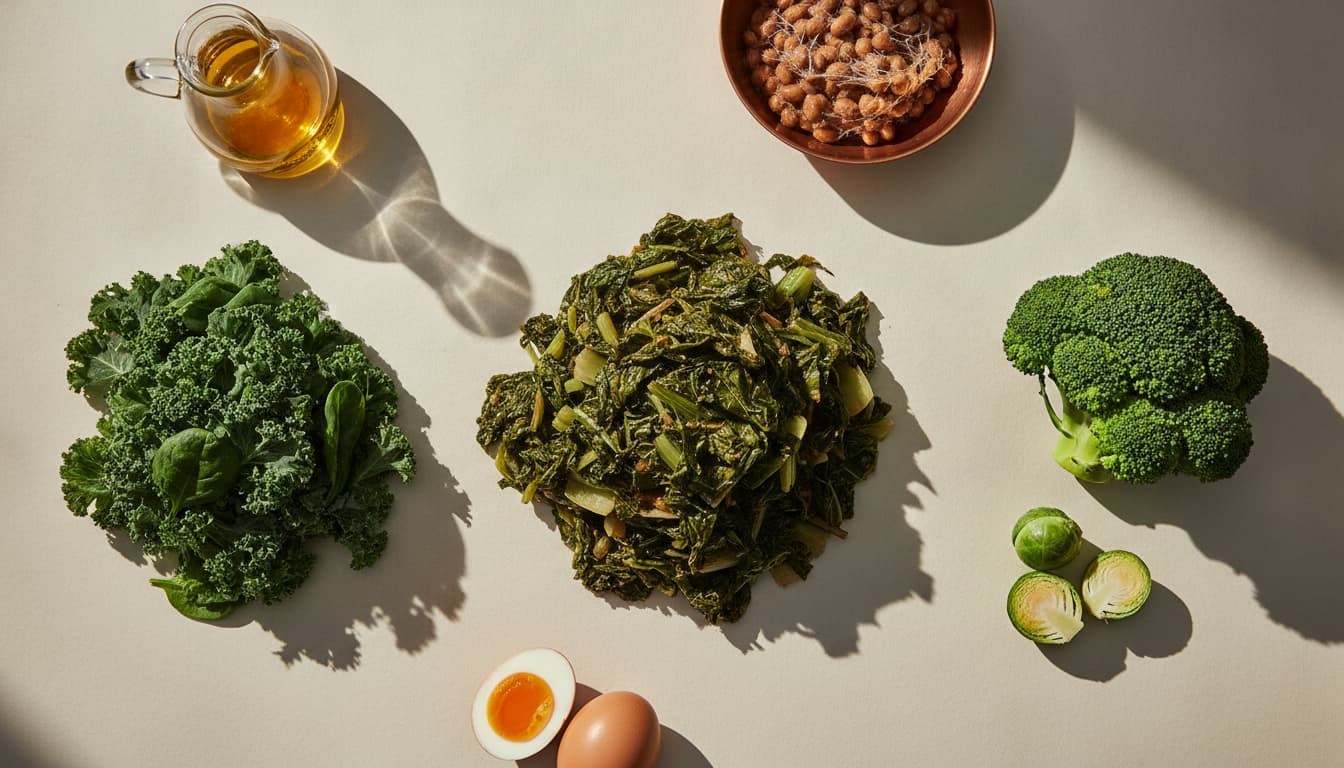
The adequate intake is 120 mcg/day for men and 90 mcg for women, and cooked leafy greens dominate while fermented natto tops the list. The mcg-per-serving ranking, why K1 and K2 count the same, and what people on blood thinners actually need to do.
- 01
Natto (fermented soybeans): ~850 mcg per 3 oz, the outlier
Natto, the sticky Japanese dish of fermented soybeans, is the single richest source of vitamin K at ~850 mcg per 3 oz, and unusually it delivers it almost entirely as MK-7, a long-acting form of K2 produced by the fermenting bacteria (NIH ODS; USDA FoodData Central). One small serving covers several days of the 120 mcg target on its own. Natto is an acquired taste and not a Western staple, but it is worth knowing as the one food that is both extraordinarily high in vitamin K and rich in the K2 form that most other foods barely provide. For anyone who eats it, it is in a class by itself.
- 02
Cooked collard and turnip greens: ~426-530 mcg per half cup
Frozen boiled collard greens supply ~530 mcg of vitamin K per half cup and turnip greens ~426 mcg, the densest of the leafy greens and all in the K1 form (NIH ODS). These are the everyday powerhouses of vitamin K: a single cooked half-cup serving clears the daily target several times over. They stack vitamin K with calcium, folate, and, like other dark greens, the beta-carotene that also puts them high on the foods-high-in-vitamin-A list, so a habit of cooked greens quietly covers several targets at once.
- 03
Cooked spinach and kale: ~440-530 mcg per half cup
Cooked spinach carries ~440 mcg of vitamin K per half cup and cooked kale a similar amount, both K1 (USDA FoodData Central). The key detail is cooking: raw spinach lists a much lower number per cup simply because a cup of raw leaves weighs far less than a cooked half cup, so heat concentrates the vitamin K by shrinking the volume. Eaten with a little fat, since vitamin K is fat-soluble, more of it is absorbed, which is one more reason sauteed greens beat an equal pile of raw salad for this nutrient.
- 04
Broccoli and Brussels sprouts: ~110-150 mcg per half cup
Cooked broccoli supplies ~110 mcg of vitamin K per half cup and Brussels sprouts ~110-150 mcg, so a single serving of either meets or exceeds the daily target (NIH ODS; USDA). They are the accessible middle of the list: not as dense as leafy greens but eaten in larger, more familiar servings, and they bring fiber, vitamin C, and folate along with the vitamin K. For anyone who does not eat cooked leafy greens often, a regular serving of broccoli or sprouts is the simplest reliable source.
- 05
Other green vegetables and plant oils: ~10-60 mcg per serving
Asparagus, cabbage, green beans, okra, and peas add ~20-60 mcg per serving, and soybean and canola oil contribute ~10-25 mcg per tablespoon as K1 (NIH ODS; USDA). None is a standout, but because oils are used in cooking and these vegetables turn up across ordinary meals, they form a steady background contribution. Soybean oil in particular is a meaningful source in Western diets simply because of how widely it is used, the same per-portion-versus-density logic that runs through the rest of this site.
- 06
K2 from animal and fermented foods: chicken, egg yolk, cheese
Outside natto, the K2 menaquinones come from animal and fermented foods in modest amounts: a 3 oz chicken breast supplies ~13 mcg, egg yolk and hard aged cheeses a few micrograms each, and fermented dairy a little more (NIH ODS; USDA). These numbers are small next to leafy greens, but they matter because K2 is the form linked in research to directing calcium into bone and away from arteries, and it is scarce in the plant foods that dominate total vitamin K intake. The gut bacteria also make some K2, though how much the body absorbs from that source is uncertain.
- 07
The warfarin caveat: consistency, not avoidance
The one group for whom vitamin K intake needs active management is people taking the anticoagulant warfarin, which works by blocking vitamin K recycling (NIH ODS). The common mistake is to avoid green vegetables entirely, which is both unnecessary and unhealthy. The actual goal is consistency: a steady day-to-day vitamin K intake lets the drug dose be set correctly, whereas a sudden large plate of greens, or suddenly cutting them out, can swing the drug's effect out of its safe range. Newer anticoagulants do not have this interaction, so the caveat applies specifically to warfarin and should be managed with a clinician, not by guesswork.
How this was specified
- 01Inputs measured
- Retail price (dated) · label claim · Certificate of Analysis · third-party test (Informed Sport / NSF / ConsumerLab / Clean Label) · leucine per serving from COA, not marketing.
- 02Protocols tested
- Per-kg target from four literature ranges (IOM RDA, Phillips 2017, Morton 2018, ISSN). Brands scored against Moore 2015 leucine-per-dose threshold (~0.4 g/kg).
- 03Cost-basis verified
- $/gram of protein and $/gram of leucine at warehouse pricing (Costco), mail-order (Amazon), and DTC retail. Re-checked quarterly, flagged when drift exceeds 15%.
- 04Confidence level
- High on ranked order. Medium on absolute $/g (prices drift). Low on serving-size claims where COA is older than 18 months, flagged [VERIFY].
Every claim, cited.
- [01]National Institutes of Health, Office of Dietary Supplements. Vitamin K Fact Sheet for Health Professionals. Adequate Intake 120 mcg (men) and 90 mcg (women), K1 and K2 forms, food sources, warfarin interaction, and absence of a tolerable upper limit.
- [02]US Department of Agriculture, Agricultural Research Service. FoodData Central. Vitamin K content of natto, collard and turnip greens, spinach, kale, broccoli, Brussels sprouts, soybean and canola oil, chicken, egg, and cheese.
- [03]Institute of Medicine (National Academies). Dietary Reference Intakes for Vitamin A, Vitamin K, Arsenic, Boron, Chromium, Copper, Iodine, Iron. Adequate Intake basis for vitamin K.
The Larderlab Team builds evidence-led frameworks for eating, lifting, and stocking a kitchen. We cite every claim. We publish the spreadsheet when possible. We buy what we review at retail price. When new data lands, we revise with a dated note.
Next in this hub.
Foods High in Biotin (Vitamin B7): The Densest Sources, by Micrograms
The adequate intake is just 30 mcg a day, and beef liver, eggs, and salmon cover it easily. The mcg-per-serving ranking, why deficiency is rare, why raw egg whites work against you, and why hair-growth megadoses are mostly wasted.
7 min · rev 2026-08-06Foods High in Vitamin B12: The Densest Sources, by Micrograms
The RDA is 2.4 mcg/day, and clams, beef liver, and oily fish are the densest sources. The mcg-per-serving ranking, why B12 is almost absent from plant foods, and when vegetarians and vegans need a supplement.
8 min · rev 2026-07-07Foods High in Vitamin A: The Densest Sources, by Micrograms
The RDA is 900 mcg RAE for men and 700 mcg for women, and liver, sweet potato, and carrots lead by a wide margin, but preformed retinol from animal foods and beta-carotene from plants are counted differently. The mcg-per-serving ranking, why the two forms are not equal, and the one food to limit.
8 min · rev 2026-07-13Get the Larderlab Macro Planner.
A Google Sheet that calculates your protein target, splits it across 3-5 meals, and ranks 20 protein sources by $/gram. Free. Copy-and-modify your own version.
By subscribing, you agree to our Privacy Policy. Unsubscribe anytime.