Does freezing kill bacteria, and what it does destroy
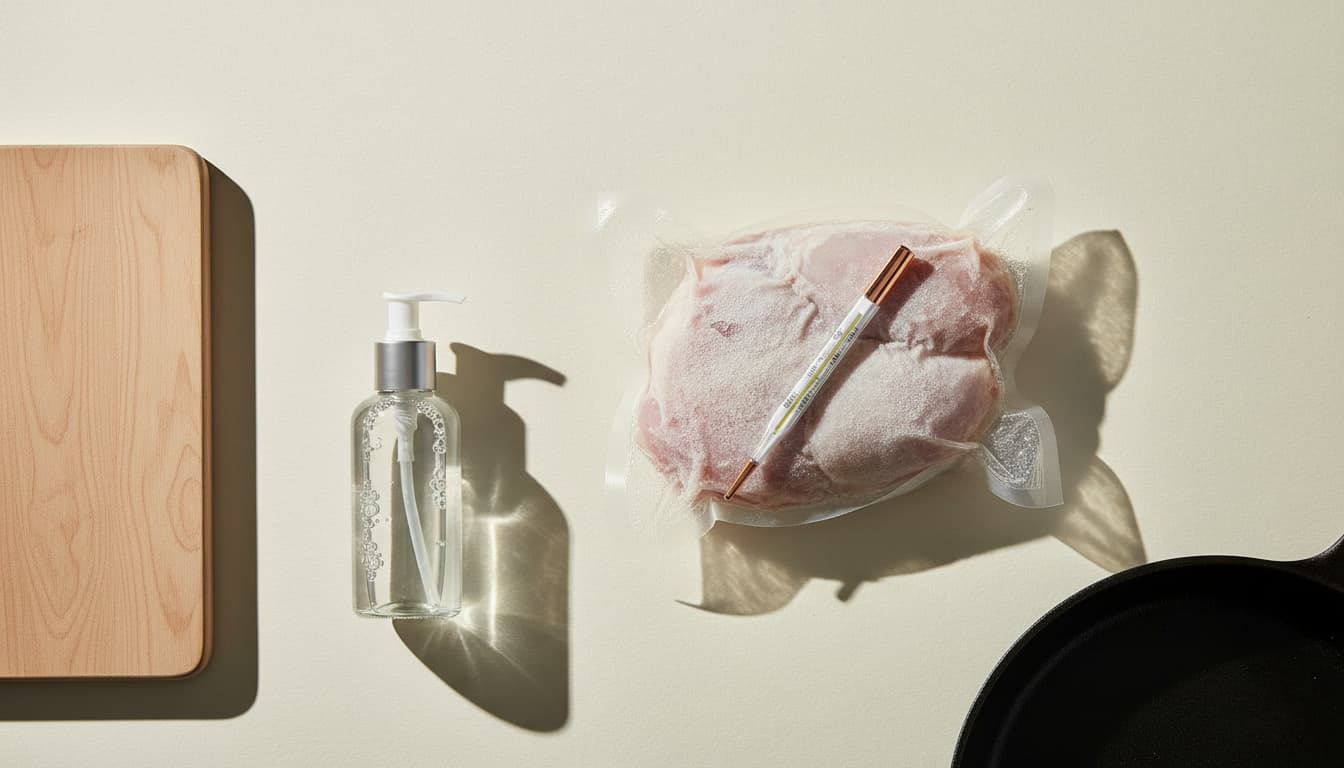
Freezing to 0 degrees Fahrenheit inactivates microbes rather than destroying them, and they resume growth on thawing. Parasites are the exception, and the destruction parameters are written into the Food Code.
- 01
Inactivate is not destroy
Freezing to 0 degrees Fahrenheit inactivates any microbes, bacteria, yeasts and molds, present in food; once thawed, however, these microbes can again become active, multiplying under the right conditions to levels that can lead to foodborne illness, and since they will then grow at about the same rate as microorganisms on fresh food, thawed items must be handled as any perishable food (USDA FSIS). Freezing keeps food safe by slowing molecular movement and pushing microbes into a dormant stage.
- 02
Salmonella survived 16 weeks at minus 20 degrees Celsius
Four Salmonella strains inoculated into frozen chicken nuggets and strips at 10 to the fourth through 10 to the fifth colony-forming units per gram held relatively constant populations on nonselective and minimal agars across 16 weeks of storage at minus 20 degrees Celsius (Dominguez and Schaffner 2009). At least eight salmonellosis outbreaks between 1998 and 2008 implicated undercooked frozen chicken nuggets, strips and entrees.
- 03
Frozen survivors can read as absent on selective media
In the same study, cell populations were significantly lower when measured on selective agar throughout the 16 weeks, which the authors interpreted as structural injury rather than death, and concluded that microbial counts on selective agar are not representative of the total population of samples subject to freezing (Dominguez and Schaffner 2009). Injured cells recover; a low selective count is not a clean product.
- 04
Freezing selects for the more resistant organism
Across a 0 to 60 day freezing period in beef, mutton and goat juice models, survival of Listeria monocytogenes was higher than that of Salmonella Typhimurium, cell surface hydrophobicity increased over the freezing period, and acid resistance of both organisms, especially L. monocytogenes, increased with freezing time (Kaboudari and Aliakbarlu 2025). Time in the freezer is not neutral for what survives it.
- 05
Parasites are the real exception, with published parameters
Raw, raw-marinated, partially cooked or marinated-partially cooked fish sold ready to eat must be frozen and stored at minus 20 degrees Celsius or below for a minimum of 168 hours, or frozen at minus 35 degrees Celsius or below until solid and stored at minus 35 for at least 15 hours, or frozen at minus 35 until solid and stored at minus 20 for at least 24 hours (FDA Food Code 2022, 3-402.11). Records of the freezing temperature and time must be retained for 90 days.
- 06
The aquaculture exemption is about feed, not species
The parasite-destruction requirement does not apply to molluscan shellfish, shucked scallop adductor muscle, several named Thunnus tuna species, or aquacultured fish raised in net-pens or in land-based ponds and tanks and fed formulated feed, such as pellets, that contains no live parasites infective to the fish (FDA Food Code 2022, 3-402.11). That is why farmed salmon is handled differently from wild-caught fish for raw service.
- 07
A domestic freezer does not run the schedule
Trichina and other parasites can be destroyed by sub-zero freezing temperatures, however very strict government-supervised conditions must be met, and home freezing cannot be relied upon to destroy trichina; thorough cooking, however, will destroy all parasites (USDA FSIS). A household appliance that warms every time the door opens is not holding minus 20 degrees Celsius continuously for 168 hours.
- 08
What freezing does reliably deliver
Food stored constantly at 0 degrees Fahrenheit will always be safe and only the quality suffers with lengthy storage, freezing preserves food by preventing the growth of the microorganisms that cause both spoilage and illness, and the freezing process itself does not destroy nutrients, with little change in nutrient value during freezer storage of meat and poultry (USDA FSIS). Prevention of growth, not elimination of what is present, is the actual mechanism.
What people ask us next.
- Does freezing food kill bacteria?
- No. Freezing to 0 degrees Fahrenheit inactivates any microbes present, but once thawed these microbes can again become active and multiply to levels that can lead to foodborne illness, growing at about the same rate as they would on fresh food (USDA FSIS). The measured case is Salmonella in frozen chicken products holding roughly constant counts across 16 weeks at minus 20 degrees Celsius (Dominguez and Schaffner 2009).
- Does freezing kill parasites?
- Under specified conditions, yes. For fish served raw, the requirement is freezing and storage at minus 20 degrees Celsius or below for at least 168 hours, or at minus 35 degrees Celsius until solid followed by 15 hours at minus 35 or 24 hours at minus 20 (FDA Food Code 2022, 3-402.11). For trichina, very strict government-supervised conditions must be met and home freezing cannot be relied upon, though thorough cooking will destroy all parasites (USDA FSIS).
- Can I freeze fish at home and then eat it raw?
- The domestic answer is that a home freezer is not verified to run the schedule. The destruction parameters require a continuous minus 20 degrees Celsius or below for 168 hours, and commercial operations have to record the freezing temperature and time and retain those records for 90 calendar days (FDA Food Code 2022, 3-402.11). A household appliance that warms on every door opening and has no logging is not evidence that the schedule was met.
- Why did the laboratory counts drop if the bacteria survived?
- Because selective media undercount injured cells. In frozen chicken nuggets and strips, counts on nonselective and minimal agars stayed relatively constant across 16 weeks at minus 20 degrees Celsius while counts on selective agar fell significantly, which the authors attributed to structural injury and used to conclude that selective-agar counts are not representative of the total population of frozen samples (Dominguez and Schaffner 2009). Injured is not dead.
- So what is freezing actually good for?
- Holding a state. Food stored constantly at 0 degrees Fahrenheit will always be safe, freezing prevents the growth of the microorganisms that cause spoilage and illness, and the process itself does not destroy nutrients (USDA FSIS). The correct mental model is that freezing preserves whatever quality and whatever microbial load it receives, which is why freezing at peak quality and handling thawed food as fresh perishable food are the two decisions that matter.
Every claim, cited.
- [01]USDA Food Safety and Inspection Service. Freezing and Food Safety. Freezing keeps food safe by slowing the movement of molecules, causing microbes to enter a dormant stage; freezing to 0 degrees Fahrenheit inactivates any microbes, bacteria, yeasts and molds, present in food; once thawed, however, these microbes can again become active, multiplying under the right conditions to levels that can lead to foodborne illness, and since they will then grow at about the same rate as microorganisms on fresh food, thawed items must be handled as any perishable food; trichina and other parasites can be destroyed by sub-zero freezing temperatures, however very strict government-supervised conditions must be met and home freezing cannot be relied upon to destroy trichina, though thorough cooking will destroy all parasites; food stored constantly at 0 degrees Fahrenheit will always be safe and only the quality suffers with lengthy freezer storage; the freezing process itself does not destroy nutrients and in meat and poultry products there is little change in nutrient value during freezer storage.
- [02]US Food and Drug Administration. FDA Food Code 2022, section 3-402.11 Parasite Destruction. Before service or sale in ready-to-eat form, raw, raw-marinated, partially cooked, or marinated-partially cooked fish shall be frozen and stored at a temperature of minus 20 degrees Celsius (minus 4 degrees Fahrenheit) or below for a minimum of 168 hours (7 days) in a freezer; or frozen at minus 35 degrees Celsius (minus 31 degrees Fahrenheit) or below until solid and stored at minus 35 degrees Celsius or below for a minimum of 15 hours; or frozen at minus 35 degrees Celsius or below until solid and stored at minus 20 degrees Celsius or below for a minimum of 24 hours. The requirement does not apply to molluscan shellfish, a scallop product consisting only of the shucked adductor muscle, named Thunnus tuna species, aquacultured fish such as salmon raised in net-pens or in land-based ponds or tanks and fed formulated feed such as pellets containing no live parasites infective to the fish, or fish eggs removed from the skein and rinsed. Section 3-402.12 requires the person in charge to record the freezing temperature and time and retain the records for 90 calendar days beyond the time of service or sale.
- [03]Dominguez SA, Schaffner DW. 2009. Survival of Salmonella in processed chicken products during frozen storage. J Food Prot 72(10):2088-2092. At least eight salmonellosis outbreaks from 1998 to 2008 implicated undercooked frozen chicken nuggets, strips, and entrees as infection vehicles; four Salmonella strains isolated from poultry were inoculated into frozen chicken nuggets (fully cooked) and frozen chicken strips (containing raw poultry) at initial populations of 10 to the fourth to 10 to the fifth CFU/g; cell populations measured on plate count agar, plate count agar with tetracycline and minimal M9 agar remained relatively constant during the entire 16 weeks of storage at minus 20 degrees for both nuggets and strips; populations measured on selective XLT4 agar were significantly lower throughout, suggesting structurally injured cells; the authors concluded that Salmonella can survive frozen storage in frozen processed chicken products and that microbial counts on selective agar are not representative of the total population of samples subject to freezing.
- [04]Kaboudari A, Aliakbarlu J. 2025. Effects of freezing period and meat juice model type on the survival, hydrophobicity, and acid resistance of Listeria monocytogenes and Salmonella Typhimurium. BMC Microbiol 25(1):321. Survival was determined over a freezing period of 0 to 60 days in beef, mutton and goat juice models; survival of both bacteria was significantly higher in mutton juice than in the other juices; the survival rate of L. monocytogenes under freezing conditions was higher than that of S. Typhimurium; cell surface hydrophobicity increased during the freezing period; the acid resistance of both bacteria, especially L. monocytogenes, increased with increasing freezing time.
The Larderlab Team builds evidence-led frameworks for eating, lifting, and stocking a kitchen. We cite every claim. We publish the spreadsheet when possible. We buy what we review at retail price. When new data lands, we revise with a dated note.
Next in this hub.
How Long Can Food Sit Out? Two Hours, One Hour, and Why
Two hours at room temperature, one hour above 90 degrees Fahrenheit. The number comes from a 20-minute doubling time, and the reason it is not negotiable is that some toxins formed during the delay survive cooking.
8 min · rev 2026-08-31Safe Internal Cooking Temperatures and the Times Behind Them
145, 160 and 165 degrees Fahrenheit are the consumer endpoints, but the regulation behind them is a set of time and temperature pairs. 145 for 3 minutes and 158 instantaneously do the same job on ground meat.
9 min · rev 2026-08-31How to Thaw Chicken: Three Methods, and the One That Is Not One
There are three safe methods and a reason the countertop is excluded that most people have never heard: some organisms create toxins that survive cooking. Thawing rate also decides drip loss, so the safe methods are the quality methods.
8 min · rev 2026-08-30Get the Larderlab Macro Planner.
A Google Sheet that calculates your protein target, splits it across 3-5 meals, and ranks 20 protein sources by $/gram. Free. Copy-and-modify your own version.
By subscribing, you agree to our Privacy Policy. Unsubscribe anytime.