How long food can sit out, and the growth rate behind the limit
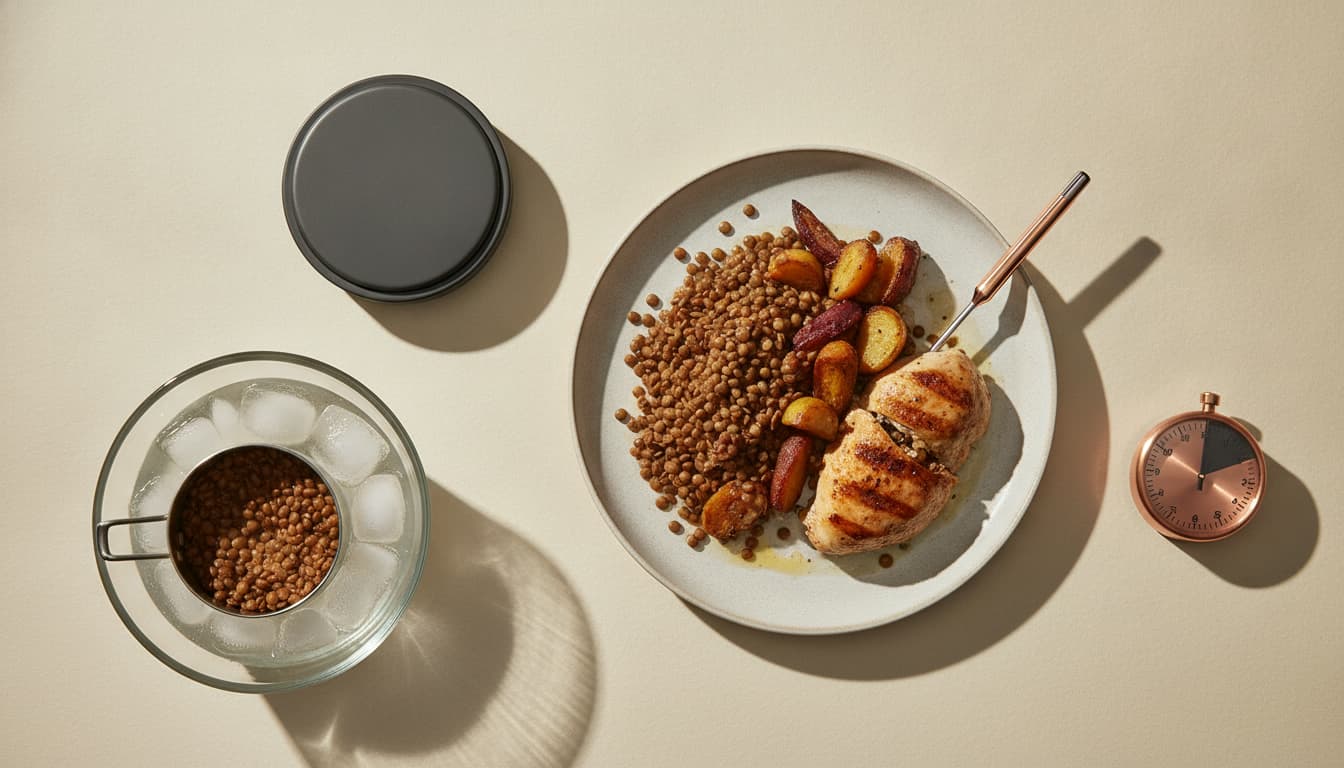
Two hours at room temperature, one hour above 90 degrees Fahrenheit. The number comes from a 20-minute doubling time, and the reason it is not negotiable is that some toxins formed during the delay survive cooking.
- 01
The two numbers: two hours, one hour above 90 degrees
Perishables should never sit at room temperature for more than 2 hours, and the limit is 1 hour if the air temperature is above 90 degrees Fahrenheit. The same window applies to leftovers, to takeaway and doggie bags, and to groceries in a car, which is usually hotter than a typical room (FDA). The clock starts when the food leaves temperature control, not when the meal finishes.
- 02
Where the number comes from
At room temperature the numbers of bacteria that cause foodborne sickness can double every 20 minutes, and chilling foods to proper temperatures is one of the best ways to slow that growth (FDA). Two hours is therefore about six doubling intervals, which is why the guidance is a cut-off rather than a gradient: exponential growth stays visually unremarkable and then is not.
- 03
Cooking does not undo the delay
If left unrefrigerated, some organisms can create toxins that will survive the cooking process even if the food is cooked to temperatures that kill the bacteria themselves (FDA). This is the clause that defeats the argument that a hot oven fixes a long afternoon. Cooking kills cells; it does not remove what the cells produced, which is why the limit is on the delay rather than on the final internal temperature.
- 04
In the refrigerator is not the same as cold
A deep mass of hot food loses heat slowly from the centre, so a full stockpot moved straight into a fridge can hold its middle in the growth range for hours while the surface reads cold. The guidance addresses this directly: refrigerate or freeze leftovers within 2 hours, divide them into smaller containers before refrigerating to cool faster, and note that putting hot food in the refrigerator does not harm the appliance (FDA).
- 05
What a slow cooling curve costs, measured
Noncured ground pork cooled from 54.4 to 7.2 degrees Celsius over 20 hours showed a 2.8 log colony-forming unit per gram increase in Clostridium perfringens, roughly a six-hundred-fold rise, with nothing ever left on a counter (Marquez-Gonzalez et al. 2012). Cooling is a step with its own exposure window, and depth is the variable that sets how long that window stays open.
- 06
Formulation changes the outcome
In cured ground pork under the same abusive cooling, C. perfringens decreased by 1.1 log from 54.4 to 36.3 degrees Celsius and then increased by 0.9 log until the product reached 7.2 degrees, and even from an initial 5 log colony-forming units per gram the final counts did not exceed 3.4 log, leading the authors to conclude no risk under the tested conditions (Marquez-Gonzalez et al. 2012). Curing salts change the answer, which is why laboratory results do not transfer uniformly.
- 07
The field version: cooking fine, holding not
A hazard analysis of cooked food vending found cooking usually gave time-temperature exposures lethal for vegetative pathogens, while holding often provided exposures conducive to growth, particularly overnight. Ten million Clostridium perfringens per gram came from leftover beef stew, above 100,000 Staphylococcus aureus from leftover chicken, and above 10 to the seventh Bacillus cereus from leftover rice (Jermini et al. 1997).
- 08
Reheating did not close the gap
In that same analysis, time-temperature exposures during reheating had variable effects in terms of killing the microorganisms that germinated from surviving spores or reached the foods after cooking, and heat-stable toxins would not have been inactivated (Jermini et al. 1997). Once the delay has happened, the safe response is to discard rather than to reheat harder, because the surviving component is the one heat cannot reach.
What people ask us next.
- How long can cooked food sit out before it is unsafe?
- Two hours at room temperature, and one hour if the air temperature is above 90 degrees Fahrenheit (FDA). The limit is derived from a growth rate rather than chosen arbitrarily: at room temperature the bacteria that cause foodborne sickness can double every 20 minutes, so two hours is roughly six doubling intervals. The clock starts when the food leaves temperature control, which for a served dish is when it comes off the heat.
- Can I just reheat it thoroughly instead?
- No, and this is the most important correction on the topic. If left unrefrigerated, some organisms can create toxins that will survive the cooking process even if the food is cooked to temperatures that kill the bacteria themselves (FDA). A field hazard analysis of foods held overnight found reheating had variable effects on organisms germinating from surviving spores and that heat-stable toxins would not have been inactivated (Jermini et al. 1997). Discard rather than reheat.
- Should I let food cool before putting it in the fridge?
- No. Putting hot food in the refrigerator does not harm the appliance, and leftovers need to be refrigerated or frozen within 2 hours, so waiting on the worktop spends the budget on nothing (FDA). What does need attention is depth: divide leftovers into smaller, shallower containers before refrigerating, because that is what allows the centre to reach a safe temperature quickly rather than sitting warm inside a cold appliance.
- Does slow cooling in the fridge actually matter?
- Measurably. Noncured ground pork cooled from 54.4 to 7.2 degrees Celsius over 20 hours showed a 2.8 log colony-forming unit per gram increase in Clostridium perfringens, roughly a six-hundred-fold rise, without ever being left at room temperature (Marquez-Gonzalez et al. 2012). Cooling is its own exposure window, and the depth of the container is the variable that determines how long the centre stays in the growth range.
- Does the two-hour rule apply to groceries?
- Yes. Raw meat, poultry, seafood, eggs and produce that requires refrigeration should never sit at room temperature for more than 2 hours, with a 1-hour limit above 90 degrees Fahrenheit, and a car is usually hotter than a typical room, so groceries should not be left in it longer than absolutely necessary and never more than 2 hours, or 1 hour on a hot day (FDA). The shopping trip is part of the same budget as the meal.
- What about food left out overnight that looks and smells fine?
- Appearance is not informative here, because the organisms of concern do not necessarily spoil the food. In a field analysis, leftover beef stew held overnight yielded ten million Clostridium perfringens per gram, leftover chicken above 100,000 Staphylococcus aureus and leftover rice above 10 to the seventh Bacillus cereus, and heat-stable toxins would not have been inactivated by reheating (Jermini et al. 1997). Overnight at ambient temperature is a discard regardless of how it looks.
Every claim, cited.
- [01]FDA. Refrigerator Thermometers: Cold Facts about Food Safety. At room temperature the numbers of bacteria that cause foodborne sickness can double every 20 minutes; never allow raw meat, poultry, seafood, eggs, or produce that requires refrigeration to sit at room temperature for more than 2 hours, with a limit of 1 hour if the air temperature is above 90 degrees Fahrenheit; the same 2-hour rule applies to leftovers, doggie bags and take-out foods, and to groceries left in a car; leftovers need to be refrigerated or frozen within 2 hours; putting hot food in the refrigerator does not harm the appliance; dividing leftovers into smaller containers before refrigerating helps them cool faster; if left unrefrigerated, some organisms can create toxins that will survive the cooking process even if the food is cooked to temperatures that kill the bacteria themselves; keep the refrigerator at 40 degrees Fahrenheit or below.
- [02]Marquez-Gonzalez M, Cabrera-Diaz E, Hardin MD, Harris KB, Lucia LM, Castillo A. 2012. Survival and germination of Clostridium perfringens spores during heating and cooling of ground pork. J Food Prot 75(4):682-9. Under temperature abuse during cooling from 54.4 to 7.2 degrees Celsius within 20 hours, noncured ground pork showed a 2.8 log CFU/g increase in C. perfringens; in cured ground pork the organism decreased by 1.1 log CFU/g during cooling from 54.4 to 36.3 degrees and then increased by 0.9 log CFU/g until the product reached 7.2 degrees; even with an initial spore level of 5 log CFU/g in cured pork, final counts after abusive cooling did not exceed 3.4 log CFU/g; when pork was heated at 4 degrees Celsius per hour, growth occurred between 44 and 56 degrees.
- [03]Jermini M, Bryan FL, Schmitt R, et al. 1997. Hazards and Critical Control Points of Food Vending Operations in a City in Zambia. J Food Prot 60(3):288-299. Cooking usually gave time-temperature exposures that would have been lethal for vegetative forms of foodborne pathogens; holding of foods often provided time-temperature exposures conducive to microbial growth, particularly in foods held overnight; ten million Clostridium perfringens per gram were isolated from leftover beef stew, populations above 100,000 Staphylococcus aureus from leftover chicken, and populations above 10 to the seventh Bacillus cereus from leftover rice; time-temperature exposures during reheating had variable effects on organisms germinating from surviving spores, and heat-stable toxins would not have been inactivated.
The Larderlab Team builds evidence-led frameworks for eating, lifting, and stocking a kitchen. We cite every claim. We publish the spreadsheet when possible. We buy what we review at retail price. When new data lands, we revise with a dated note.
Next in this hub.
BPA in Canned Food: Two Regulators, One Molecule, and a 20,000-Fold Disagreement
Five days of canned soup raised urinary BPA from 1.1 to 20.8 micrograms per litre, a 1,221 percent increase. EFSA cut its tolerable daily intake 20,000-fold in 2023 while FDA holds that current levels are safe. The EU banned BPA in food contact materials from January 2025.
14 min · rev 2026-09-10How Long Does Flour Last? Two Clocks, Only One of Them Ticking
Flour has a quality clock that runs on fat and moisture and a pathogen clock that barely runs at all. Salmonella survived 52 weeks on stored wheat with D-values of 22.9 to 25.2 weeks, which is why raw flour is a cooking rule rather than a date rule.
8 min · rev 2026-08-30High Protein Meal Prep: The 4-Hour Sunday System
Engineered meal prep targeting 30–40 g protein per meal, 4 hours of work for 18–20 servings. Cost-per-gram math, the four base proteins, and the assembly grid that beats recipe sites.
12 min · rev 2026-04-29Get the Larderlab Macro Planner.
A Google Sheet that calculates your protein target, splits it across 3-5 meals, and ranks 20 protein sources by $/gram. Free. Copy-and-modify your own version.
By subscribing, you agree to our Privacy Policy. Unsubscribe anytime.