How to thaw chicken, and why the counter is not an option
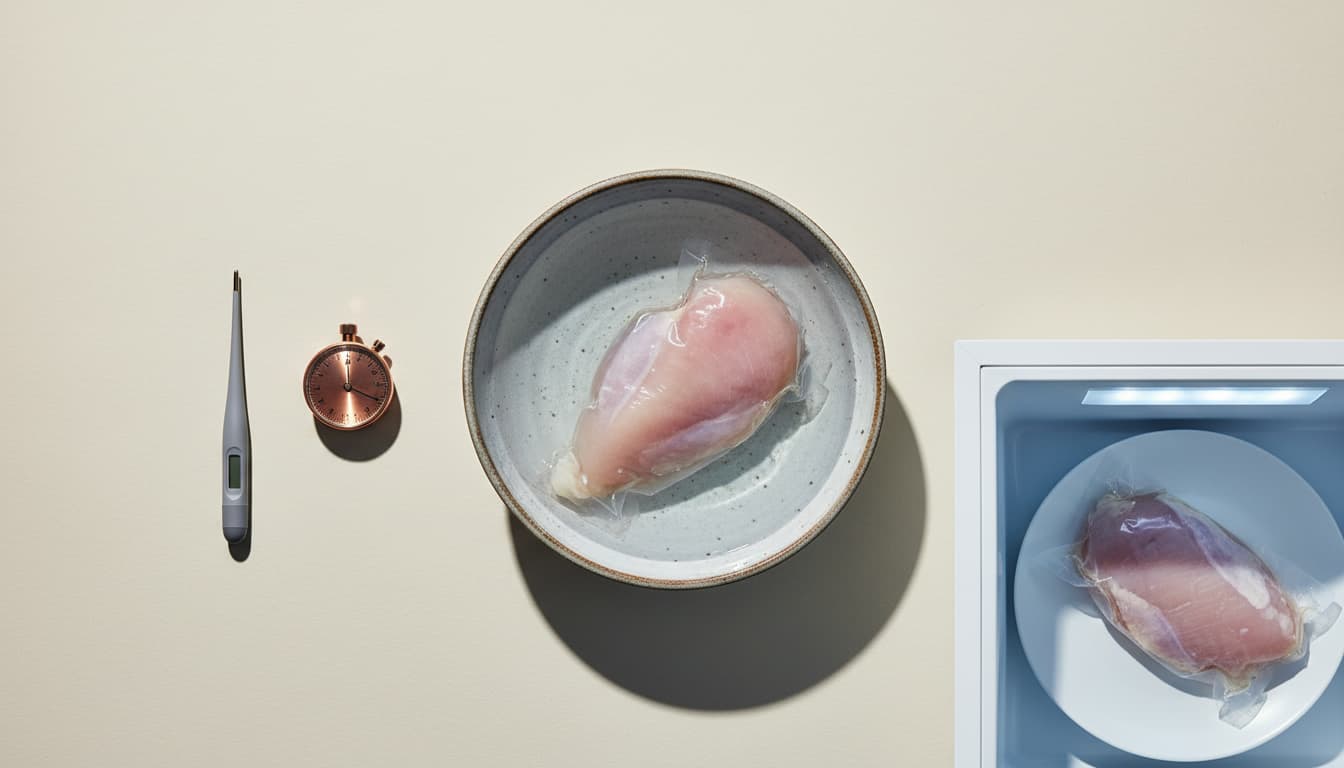
There are three safe methods and a reason the countertop is excluded that most people have never heard: some organisms create toxins that survive cooking. Thawing rate also decides drip loss, so the safe methods are the quality methods.
- 01
The three approved methods
There are three ways to thaw safely: in the refrigerator, in cold water, and in the microwave. If thawing in cold water, change the water every half hour to make sure it stays cold. Foods thawed in the microwave must be cooked immediately after thawing (FDA). Everything else is a variation on one of these three or an unsafe shortcut, and the differences between them are speed, evenness and how much slack they leave afterwards.
- 02
Why the countertop is excluded, in the actual words
Because bacteria can multiply so rapidly in unrefrigerated food, it is simply unsafe to let food thaw at room temperature, and if left unrefrigerated, some organisms can create toxins that will survive the cooking process even if the food is cooked to temperatures that kill the bacteria themselves (FDA). That second clause is the one that matters: cooking is a cell-killing step and not a toxin-removing step, so a correctly cooked chicken can still be unsafe.
- 03
The clock the exclusion is built on
At room temperature the numbers of bacteria that cause foodborne sickness can double every 20 minutes, perishables should not sit at room temperature for more than 2 hours, and the limit falls to 1 hour if the air temperature is above 90 degrees Fahrenheit (FDA). A large frozen bird holds its surface in the warm range for many hours before the centre thaws, so the countertop breaches those limits by a wide margin on the part of the bird that carries the contamination.
- 04
Refrigerator: slowest, most forgiving, only one with slack
Refrigerator thawing never lets the food leave the safe band, which is why it is the only method that does not come with an instruction to cook immediately. The appliance should be at 40 degrees Fahrenheit or below, verified with a freestanding thermometer rather than a dial, since few refrigerator controls show actual temperatures (FDA). Budget roughly a day per two to three kilograms of whole bird and several hours for individual portions.
- 05
Cold water: faster, and the half-hour rule has a purpose
Water conducts heat far better than air, so cold-water thawing is much quicker than the refrigerator. The requirement to change the water every half hour exists because the water warms as it absorbs heat from the food, and the method only works while the surrounding medium stays cold (FDA). Keep the package sealed so water does not enter the meat, and cook promptly rather than holding the portion afterwards.
- 06
Microwave: fastest, least even, cook immediately
Microwave energy is absorbed unevenly, so edges begin to cook while the centre is still frozen, which is why anything thawed in the microwave must be cooked immediately after thawing (FDA). Parts of the food have already left the safe temperature band by the time the centre is workable. This is a method for the case where the pan is already hot, not a way to get a portion ready for later.
- 07
Thawing rate decides drip loss too
A comparison of four thawing methods measured thawing loss, tenderness, colour variation, protein secondary structure and moisture content, and found the fastest method tested gave the highest quality, accelerating the thawing rate with minimal impact on tenderness, reducing protein and lipid oxidation, enhancing the binding capacity of protein and water molecules, reducing drip loss and maintaining colour stability (Liu et al. 2024). Speed protects yield as well as safety.
- 08
The mechanism is the same one that governs freezing
The extent to which tenderness, water holding capacity, colour and flavour are affected depends on ice crystalline size and distribution, governed by freezing rate and storage temperature and duration, and freezing generally improves tenderness while negatively affecting the other attributes (Dang et al. 2021). Large crystals damage the structures holding water inside the muscle, and a slow thaw lets crystals recrystallise larger, which is why the liquid ends up in the tray.
What people ask us next.
- Can I thaw chicken on the counter overnight?
- No, and the reason is stronger than the usual one. Because bacteria can multiply so rapidly in unrefrigerated food, it is simply unsafe to let food thaw at room temperature, and if left unrefrigerated, some organisms can create toxins that will survive the cooking process even if the food is cooked to temperatures that kill the bacteria themselves (FDA). At room temperature, foodborne bacteria can double every 20 minutes, and perishables should not sit out beyond 2 hours.
- Does cooking chicken thoroughly make unsafe thawing irrelevant?
- It does not, and this is the single most useful correction on the topic. Cooking kills bacterial cells but some organisms create toxins that survive the cooking process even at temperatures that kill the bacteria themselves (FDA). A correctly cooked bird that spent an afternoon warming on a worktop can therefore still cause illness. The same logic applies to cooked rice, where the emetic toxin of Bacillus cereus survives reheating.
- How long does chicken take to thaw in the refrigerator?
- Plan roughly a day per two to three kilograms for a whole bird and several hours for individual portions, and verify the appliance is at 40 degrees Fahrenheit or below with a freestanding thermometer rather than trusting the dial, since few refrigerator controls show actual temperatures (FDA). Refrigerator thawing is the only method with no requirement to cook immediately afterwards, because the food never leaves the safe temperature band.
- Why do I have to change the water every half hour?
- Because the method only works while the surrounding water stays cold, and the water warms as it absorbs heat from the frozen food. The instruction is to change the water every half hour to make sure it stays cold (FDA). Keep the package sealed so water does not enter the meat, and cook the portion promptly rather than holding it, since cold-water thawing does not offer the same slack as the refrigerator.
- Why does thawed chicken release so much liquid?
- Because water holding capacity is one of the quality attributes freezing degrades, and the extent depends on ice crystal size and distribution, governed by freezing rate and storage temperature and duration (Dang et al. 2021). Large crystals rupture the structures that hold water inside the muscle. A slow thaw compounds it by letting crystals recrystallise larger, which is why the fastest method in a four-way comparison produced the lowest drip loss (Liu et al. 2024).
- Can I refreeze chicken after thawing it?
- The quality cost is the reason to avoid it rather than an absolute rule. Each freeze and thaw cycle is another round of crystal formation and recrystallisation against structures that hold water, and water holding capacity is precisely the attribute freezing degrades (Dang et al. 2021). The practical answer is to freeze in the portion size that will actually be cooked, which removes the question and also thaws faster and therefore better.
Every claim, cited.
- [01]FDA. Refrigerator Thermometers: Cold Facts about Food Safety. There are three ways to thaw safely: in the refrigerator, in cold water, and in the microwave; if thawing in cold water, change the water every half hour to make sure it stays cold; foods thawed in the microwave must be cooked immediately after thawing; because bacteria can multiply so rapidly in unrefrigerated food, it is unsafe to let food thaw at room temperature, and if left unrefrigerated some organisms can create toxins that will survive the cooking process even if the food is cooked to temperatures that kill the bacteria themselves; at room temperature the numbers of bacteria that cause foodborne sickness can double every 20 minutes; perishables should not sit at room temperature more than 2 hours, or 1 hour above 90 degrees Fahrenheit; keep the refrigerator at 40 degrees Fahrenheit or below and use a freestanding appliance thermometer because few refrigerator controls show actual temperatures.
- [02]Liu J, Li X, Geng F, et al. 2024. Ultrasound-assisted improvement of thawing quality of Tibetan pork by inhibiting oxidation. Ultrason Sonochem 110:107029. Four thawing methods compared (ultrasound, refrigerator, hydrostatic and microwave) for thawing loss, tenderness, colour variation, protein secondary structure and moisture content; the fastest method tested yielded the highest quality samples, significantly accelerated the thawing rate with minimal impact on tenderness, reduced protein and lipid oxidation, enhanced the binding capacity of protein and water molecules, reduced drip loss and maintained colour stability. Matrix was pork rather than poultry; the mechanism is the muscle water-holding pathway common to both.
- [03]Dang DS, Bastarrachea LJ, Martini S, Matarneh SK. 2021. Crystallization Behavior and Quality of Frozen Meat. Foods 10(11):2707. Quality attributes of concern are tenderness, water holding capacity, colour and flavour; freezing generally improves tenderness but negatively affects the others; the extent to which these attributes are affected depends on ice crystalline size and distribution, which is governed by freezing rate and storage temperature and duration.
The Larderlab Team builds evidence-led frameworks for eating, lifting, and stocking a kitchen. We cite every claim. We publish the spreadsheet when possible. We buy what we review at retail price. When new data lands, we revise with a dated note.
Next in this hub.
Does Freezing Kill Bacteria? It Suspends Them, With One Exception
Freezing to 0 degrees Fahrenheit inactivates microbes rather than destroying them, and they resume growth on thawing. Parasites are the exception, and the destruction parameters are written into the Food Code.
8 min · rev 2026-09-01How Long Can Food Sit Out? Two Hours, One Hour, and Why
Two hours at room temperature, one hour above 90 degrees Fahrenheit. The number comes from a 20-minute doubling time, and the reason it is not negotiable is that some toxins formed during the delay survive cooking.
8 min · rev 2026-08-31How to Store Bread: The Fridge Is the One Place It Should Not Go
Staling is starch recrystallisation plus water migration, not drying out. In a household storage trial, lowering the storage temperature accelerated staling, which is why the refrigerator is the worst container in the kitchen.
8 min · rev 2026-09-01Get the Larderlab Macro Planner.
A Google Sheet that calculates your protein target, splits it across 3-5 meals, and ranks 20 protein sources by $/gram. Free. Copy-and-modify your own version.
By subscribing, you agree to our Privacy Policy. Unsubscribe anytime.