Safe internal cooking temperatures, and why each number is really a pair
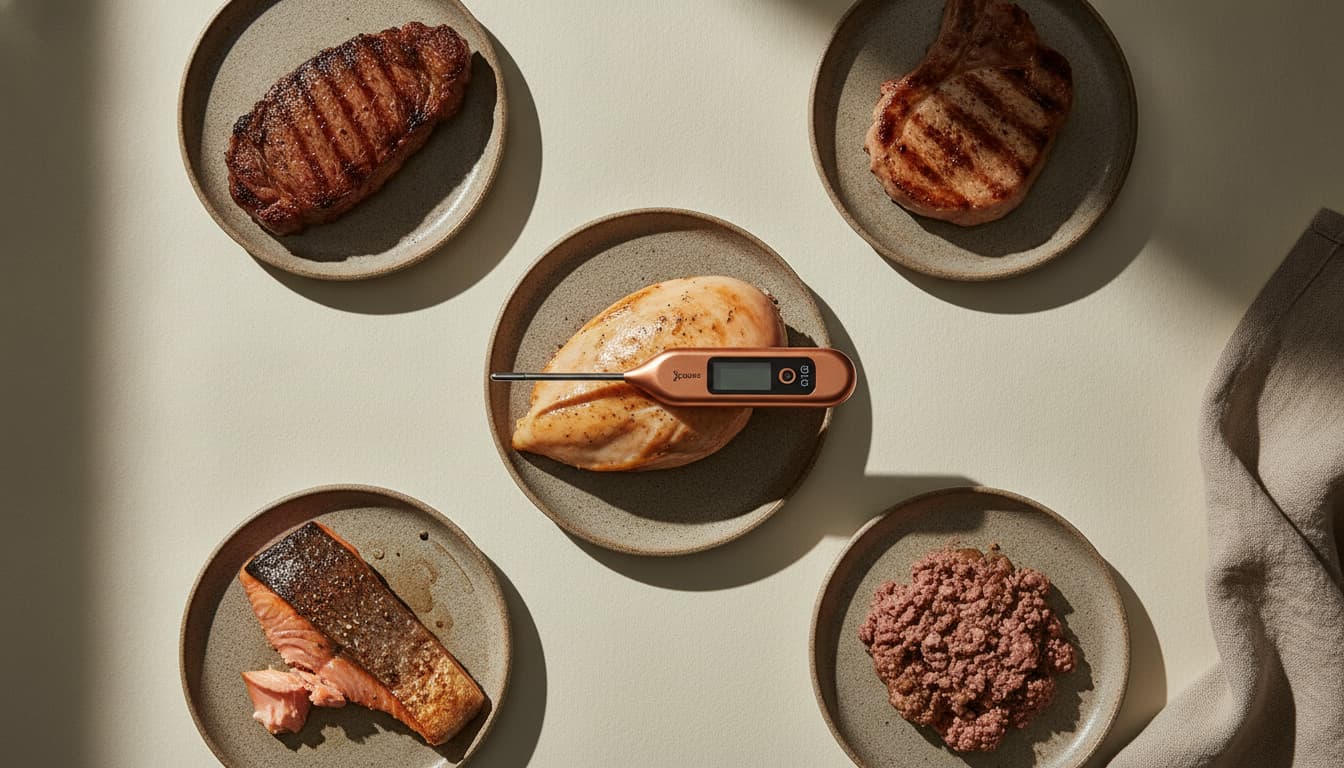
145, 160 and 165 degrees Fahrenheit are the consumer endpoints, but the regulation behind them is a set of time and temperature pairs. 145 for 3 minutes and 158 instantaneously do the same job on ground meat.
- 01
The consumer table, in full
Beef, pork, veal and lamb steaks, chops and roasts: 145 degrees Fahrenheit (62.8 Celsius) with a rest of at least 3 minutes. Ground meats: 160 (71.1). Ground poultry: 165. All poultry including breasts, whole bird, legs, thighs, wings, giblets and stuffing: 165 (73.9). Eggs: 160 (71.1). Fish and shellfish: 145 (62.8). Leftovers: 165 (73.9). Casseroles: 165 (73.9) (USDA FSIS). Cook to these before removing food from the heat source.
- 02
Ham has two entries, and they are different problems
Fresh or smoked uncooked ham goes to 145 degrees Fahrenheit (62.8 Celsius) with a rest of at least 3 minutes, the same as any other whole cut. Fully cooked ham is a reheating question rather than a cooking question: reheat cooked hams packaged in USDA-inspected plants to 140 degrees Fahrenheit (60 Celsius) and all others to 165 degrees Fahrenheit (73.9 Celsius) (USDA FSIS). The provenance of the package sets the number.
- 03
Why grinding raises the number
On an intact cut, contamination sits on the surface, which is the part that heats first and hardest, and the regulation formalises this by allowing a whole-muscle intact beef steak to be served rare if it is prepared so that it remains intact and is cooked on both top and bottom to a surface temperature of 63 degrees Celsius with a cooked colour change on all external surfaces (FDA Food Code 2022). Grinding distributes that surface through the mass, which is why mince goes to 160.
- 04
Every number is really a time and temperature pair
The regulation sets 63 degrees Celsius (145 Fahrenheit) for 15 seconds for intact meat and fish, 68 degrees Celsius (155 Fahrenheit) for 17 seconds for comminuted and non-intact meats, and 74 degrees Celsius (165 Fahrenheit) for under a second for poultry, baluts, stuffed fish, stuffed meat, stuffed pasta, stuffed poultry and stuffing (FDA Food Code 2022, 3-401.11). The consumer chart quotes the instantaneous end of each pair because households cannot log holding times.
- 05
The published equivalents for ground meat
For comminuted and non-intact meats the alternatives to 155 degrees Fahrenheit for 17 seconds are 63 degrees Celsius (145 Fahrenheit) for 3 minutes, 66 degrees Celsius (150 Fahrenheit) for 1 minute, or 70 degrees Celsius (158 Fahrenheit) instantaneously (FDA Food Code 2022, 3-401.11(A)(2)). Same lethality, three routes. This is the table that explains why a burger held at a lower temperature for longer is not a compromise.
- 06
Whole roasts get their own curve
The roast table runs from 54.4 degrees Celsius (130 Fahrenheit) for 112 minutes, through 57.2 (135) for 36 minutes, 60.0 (140) for 12 minutes and 62.8 (145) for 4 minutes, to 68.3 (155) for 22 seconds and 70.0 (158) for zero seconds, with holding time permitted to include post-oven heat rise, plus a minimum oven temperature by roast weight (FDA Food Code 2022, 3-401.11(B)). Low and slow is a different point on the same curve, not an exception to it.
- 07
The 3-minute rest is a lethality step
For safety and quality, meat should be allowed to rest for at least three minutes before carving or consuming, and after removing meat from a grill, oven or other heat source, allowing it to rest for the specified amount of time allows the temperature to remain constant or continue to rise, which destroys harmful germs (USDA FSIS). Cutting a 145-degree steak immediately removes part of the treatment, not part of the presentation.
- 08
Microwaves are a separate procedure
Raw animal foods cooked in a microwave oven shall be rotated or stirred throughout or midway during cooking to compensate for uneven distribution of heat, covered to retain surface moisture, heated to a temperature of at least 74 degrees Celsius (165 Fahrenheit) in all parts of the food, and allowed to stand covered for 2 minutes after cooking to obtain temperature equilibrium (FDA Food Code 2022, 3-401.12). Uneven heating is the reason all four steps exist.
What people ask us next.
- What temperature should chicken be cooked to?
- 165 degrees Fahrenheit (73.9 Celsius) for all poultry, including breasts, whole bird, legs, thighs, wings, ground poultry, giblets and stuffing, measured with a food thermometer (USDA FSIS). The underlying regulatory requirement is 74 degrees Celsius for less than one second, which is why 165 is treated as an instantaneous endpoint rather than a temperature to hold (FDA Food Code 2022, 3-401.11(A)(3)).
- Why is ground beef 160 when steak is 145?
- Because grinding relocates the contamination. On an intact cut, pathogens are on the surface, which is the fastest-heating part; grinding distributes that surface through the whole mass. The regulation reflects this by permitting a whole-muscle intact beef steak to be served rare when it remains intact and both faces reach a 63 degrees Celsius surface temperature with a cooked colour change, while comminuted meat requires 155 degrees Fahrenheit for 17 seconds or a listed equivalent (FDA Food Code 2022).
- Do I really have to rest meat for 3 minutes?
- For the 145-degree endpoints, yes, because the rest is part of the treatment. For safety and quality, meat should be allowed to rest for at least three minutes before carving or consuming, and resting allows the temperature to remain constant or continue to rise, which destroys harmful germs (USDA FSIS). The regulatory version of that endpoint is 63 degrees Celsius held for 15 seconds, so the rest is what supplies the hold in a domestic kitchen.
- Is a lower temperature ever acceptable?
- Only with a longer hold, and the equivalents are published. For comminuted and non-intact meats, 63 degrees Celsius (145 Fahrenheit) for 3 minutes and 66 degrees Celsius (150 Fahrenheit) for 1 minute are listed alongside 155 for 17 seconds; whole roasts have a table running from 130 degrees Fahrenheit for 112 minutes to 158 degrees Fahrenheit for zero seconds (FDA Food Code 2022, 3-401.11). Without a way to verify the hold, use the instantaneous numbers.
- Can I judge doneness by colour or by clear juices?
- No. Colour appears in the regulation only as a supplementary criterion in the narrow intact-steak exception, where a cooked colour change on all external surfaces accompanies a measured 63 degrees Celsius surface temperature (FDA Food Code 2022). Everywhere else the instruction is to cook all food to the minimum internal temperature as measured with a food thermometer, placed in the thickest part of the food away from bone, fat or gristle (USDA FSIS).
Every claim, cited.
- [01]USDA Food Safety and Inspection Service. Safe Minimum Internal Temperature Chart. Cook all food to these minimum internal temperatures as measured with a food thermometer before removing food from the heat source. Beef, pork, veal and lamb steaks, chops and roasts: 145 degrees Fahrenheit (62.8 Celsius) and allow to rest for at least 3 minutes. Ground meats: 160 degrees Fahrenheit (71.1 Celsius). Ground poultry: 165 degrees Fahrenheit. Ham, fresh or smoked (uncooked): 145 degrees Fahrenheit (62.8 Celsius) and allow to rest for at least 3 minutes. Fully cooked ham (to reheat): reheat cooked hams packaged in USDA-inspected plants to 140 degrees Fahrenheit (60 Celsius) and all others to 165 degrees Fahrenheit (73.9 Celsius). All poultry (breasts, whole bird, legs, thighs, wings, ground poultry, giblets and stuffing): 165 degrees Fahrenheit (73.9 Celsius). Eggs: 160 degrees Fahrenheit (71.1 Celsius). Fish and shellfish: 145 degrees Fahrenheit (62.8 Celsius). Leftovers: 165 degrees Fahrenheit (73.9 Celsius). Casseroles: 165 degrees Fahrenheit (73.9 Celsius). For safety and quality, allow meat to rest for at least three minutes before carving or consuming; resting allows the temperature to remain constant or continue to rise, which destroys harmful germs.
- [02]US Food and Drug Administration. FDA Food Code 2022, sections 3-401.11 Raw Animal Foods and 3-401.12 Microwave Cooking. Raw animal foods shall be cooked to heat all parts of the food to a temperature and for a time complying with one of the following: 63 degrees Celsius (145 degrees Fahrenheit) or above for 15 seconds for raw eggs prepared for immediate service and for fish and intact meat; 68 degrees Celsius (155 degrees Fahrenheit) for 17 seconds for ratites, non-intact meats, comminuted fish and game animals, and raw eggs not prepared for immediate service, with the equivalent chart giving 63 degrees Celsius (145 Fahrenheit) for 3 minutes, 66 degrees Celsius (150 Fahrenheit) for 1 minute and 70 degrees Celsius (158 Fahrenheit) for less than 1 second; or 74 degrees Celsius (165 degrees Fahrenheit) or above for less than 1 second for poultry, baluts, wild game animals, stuffed fish, stuffed meat, stuffed pasta, stuffed poultry, stuffed ratites, or stuffing containing fish, meat, poultry or ratites. Whole meat roasts shall be cooked per a chart running from 54.4 degrees Celsius (130 degrees Fahrenheit) for 112 minutes through 57.2 (135) for 36 minutes, 60.0 (140) for 12 minutes and 62.8 (145) for 4 minutes to 68.3 (155) for 22 seconds and 70.0 (158) for 0 seconds, with holding time permitted to include post-oven heat rise, and cooked in an oven preheated per a weight-based schedule. A raw or undercooked whole-muscle intact beef steak may be served ready to eat if the establishment does not serve a highly susceptible population, the steak is prepared so that it remains intact, and it is cooked on both the top and bottom to a surface temperature of 63 degrees Celsius (145 degrees Fahrenheit) or above with a cooked colour change achieved on all external surfaces. Raw animal foods cooked in a microwave oven shall be rotated or stirred throughout or midway during cooking to compensate for uneven distribution of heat, covered to retain surface moisture, heated to at least 74 degrees Celsius (165 degrees Fahrenheit) in all parts of the food, and allowed to stand covered for 2 minutes after cooking to obtain temperature equilibrium.
The Larderlab Team builds evidence-led frameworks for eating, lifting, and stocking a kitchen. We cite every claim. We publish the spreadsheet when possible. We buy what we review at retail price. When new data lands, we revise with a dated note.
Next in this hub.
Does Freezing Kill Bacteria? It Suspends Them, With One Exception
Freezing to 0 degrees Fahrenheit inactivates microbes rather than destroying them, and they resume growth on thawing. Parasites are the exception, and the destruction parameters are written into the Food Code.
8 min · rev 2026-09-01What to Avoid When Taking Collagen: Five Caveats With Evidence Behind Them
Do not count it toward your protein target, do not judge it before 8 to 12 weeks, and if you form kidney stones, know that 30 g of gelatin raised urinary oxalate by 43 percent in a controlled study. The real caveats, and the myths.
8 min · rev 2026-08-24High Protein Meal Prep: The 4-Hour Sunday System
Engineered meal prep targeting 30–40 g protein per meal, 4 hours of work for 18–20 servings. Cost-per-gram math, the four base proteins, and the assembly grid that beats recipe sites.
12 min · rev 2026-04-29Get the Larderlab Macro Planner.
A Google Sheet that calculates your protein target, splits it across 3-5 meals, and ranks 20 protein sources by $/gram. Free. Copy-and-modify your own version.
By subscribing, you agree to our Privacy Policy. Unsubscribe anytime.