What temperature a fridge should be, and why most run warmer
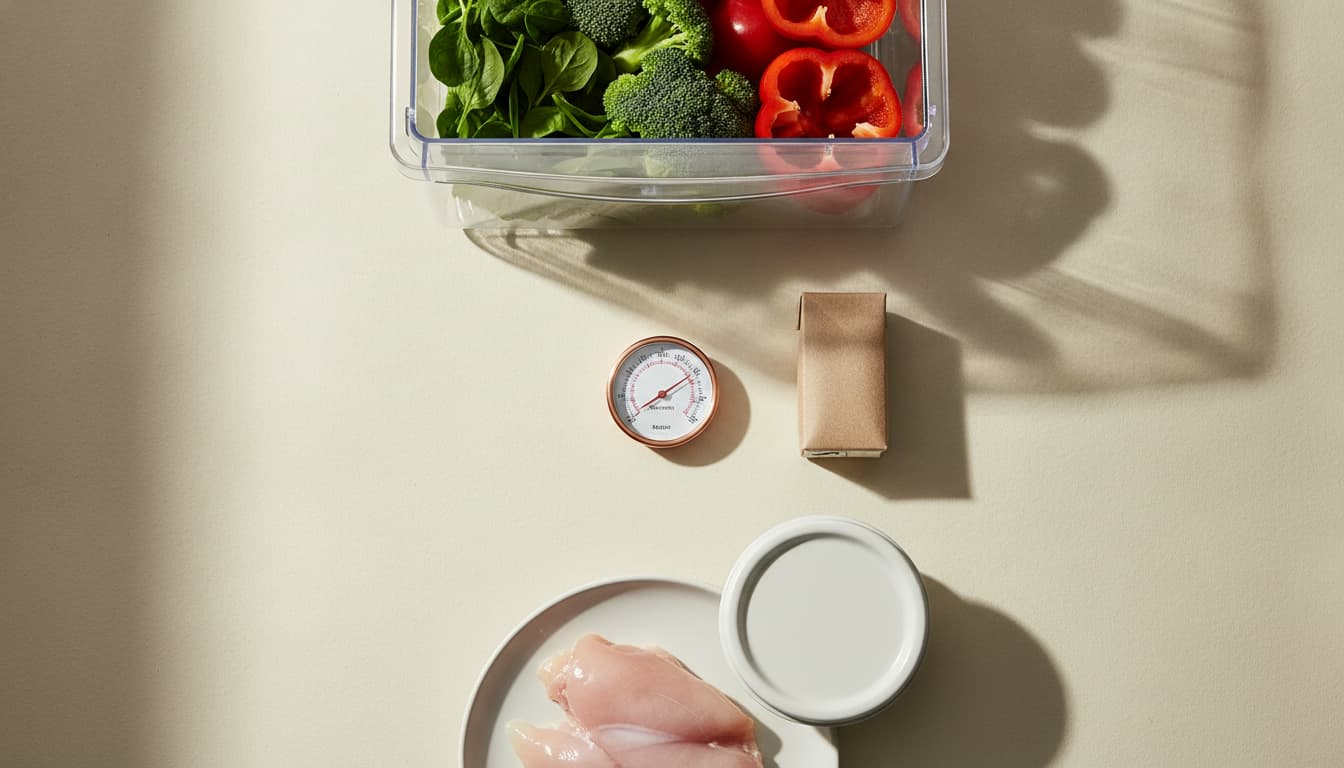
The target is 40 degrees Fahrenheit or below with the freezer at 0. Surveys put most domestic refrigerators above the recommendation, mean measured food temperatures reach 7.4 degrees Celsius, and ambient temperature is the largest single driver.
- 01
The number: 40 degrees Fahrenheit, freezer at 0
Keep the refrigerator at 40 degrees Fahrenheit or below and the freezer at 0 degrees Fahrenheit. Since few refrigerator controls show actual temperatures, an inexpensive freestanding appliance thermometer is what turns a dial setting into a measured number, and the guidance is explicit that one should be bought for the fridge and one for the freezer, and checked often (FDA). Every published shelf life for a perishable assumes this condition holds.
- 02
Why that number: a 20-minute doubling time
At room temperature the numbers of bacteria that cause foodborne sickness can double every 20 minutes, and chilling to proper temperatures is one of the most effective ways to slow that growth (FDA). The refrigerator is therefore not a preservation device but a rate control, which is the reason the same food carries a three to four day window at 40 degrees and a two hour window on a countertop.
- 03
What most refrigerators actually run at
In 102 households asked to buy seven chilled items and store them normally, mean storage temperatures ranged from 6.2 degrees Celsius for minced meat to 7.4 degrees for ready-to-eat salad, with maxima from 11.3 to 18.2 degrees, and 5 to 20 percent of items stored above 10 degrees (Marklinder et al. 2004). A modelling analysis notes surveys showing 77 percent of domestic refrigerators operate above the recommended 4 degrees Celsius (Gonzalez de la Garza et al. 2024).
- 04
It is not an old-appliance problem
In the same household study there were no significant relationships between measured temperature and the respondent's sex, age, education, or the age of the refrigerator (Marklinder et al. 2004). That removes the most convenient explanation. Where food was stored was usually decided by practical considerations rather than by temperature, which points at habit and placement rather than at hardware as the thing to change.
- 05
The gap is feedback, not knowledge
Most respondents knew the recommended maximum temperature, but fewer than one fourth claimed to know the temperature inside their own refrigerator, and the authors concluded the situation might improve if consumers were persuaded to use a thermometer (Marklinder et al. 2004). This is the cheapest intervention in the whole pantry: a few units of currency for a device that converts a guess into a number.
- 06
Ambient temperature is the largest single driver
A refrigerator performance analysis using time-temperature data and a predictive Listeria model found that ambient temperature had the highest impact on preservation performance, through its effect on how much food warmed during door openings and while out of the appliance during use, and called for reductions in exposure time and door-opening frequency (Gonzalez de la Garza et al. 2024). A hot kitchen or an unconditioned garage works against a correct setpoint continuously.
- 07
Real temperature profiles beat a constant setpoint on paper only
In that analysis all deterministic and probabilistic performance estimates slightly exceeded the desirable value of 1.0, meaning the variable temperatures food actually experienced inside a domestic refrigerator running at 5 degrees Celsius were worse for preservation than holding it constantly at the temperature agencies recommend (Gonzalez de la Garza et al. 2024). The domestic refrigerator is described in that work as the weakest link in the cold chain.
- 08
Two mechanics that override the dial: packing and Listeria
Cold air must circulate around refrigerated foods to keep them chilled, so overpacking defeats a correct setting, and Listeria can grow at refrigerated temperatures, so a correct setting extends rather than stops the clock on ready-to-eat foods (FDA). The practical pair is to leave air gaps and to keep using date-based limits on cooked and ready-to-eat items even in a cold, well-measured appliance.
What people ask us next.
- What should I set my fridge dial to?
- The dial is the wrong unit. The target is 40 degrees Fahrenheit or below in the fridge and 0 degrees Fahrenheit in the freezer, and since few refrigerator controls show actual temperatures, the recommended approach is a freestanding appliance thermometer in each compartment, checked often (FDA). Set the dial, measure the result after a day, and adjust. That loop is the only way to know where the appliance is actually sitting.
- Is 5 degrees Celsius cold enough?
- It is above the recommended line and measurably worse than it looks. A performance analysis of cheese held in a residential refrigerator running at 5 degrees Celsius found the variable temperatures food actually experienced were worse for preservation than constant storage at the agency-recommended temperature, and cited surveys showing 77 percent of domestic refrigerators operate above the recommended 4 degrees (Gonzalez de la Garza et al. 2024). Aiming at 4 degrees or below leaves headroom for door openings.
- Does it matter where in the fridge I put things?
- It does, and household measurement shows placement is usually decided by convenience instead. Mean storage temperatures across seven chilled items ranged from 6.2 to 7.4 degrees Celsius with maxima from 11.3 to 18.2, and where food was stored was usually determined by practical considerations (Marklinder et al. 2004). Doors are the warmest zone because they take the full ambient hit at every opening, which makes them the wrong place for milk, cooked meats or ready-to-eat items.
- Can I put hot food straight in the refrigerator?
- Yes. Putting hot food in the refrigerator does not harm the appliance, and leftovers need to be refrigerated or frozen within 2 hours, so waiting for food to cool on the counter is the greater risk. Dividing leftovers into smaller containers before refrigerating helps them cool faster (FDA). The reason speed matters is the growth rate: bacteria that cause foodborne sickness can double every 20 minutes at room temperature.
- Does a fuller fridge stay colder?
- No, and this is a common inversion. Cold air must circulate around refrigerated foods to keep them properly chilled, so overpacking works against a correct thermostat setting (FDA). A densely packed compartment also takes longer to recover after each door opening, which matters because ambient temperature acting through door openings was the single highest-impact factor on preservation performance in a modelling analysis (Gonzalez de la Garza et al. 2024).
- How long can food stay in the fridge after a power cut?
- If the refrigerator is still at or below 40 degrees Fahrenheit, or the food has been above 40 degrees for only 2 hours or less, it should be safe to eat, and frozen food that still has ice crystals is in a comparable position. Keeping the doors closed as much as possible is what buys that time, and freezing water in sealed bags ahead of a predicted outage extends it (FDA). A thermometer in each compartment is what makes the judgement possible.
Every claim, cited.
- [01]FDA. Refrigerator Thermometers: Cold Facts about Food Safety. At room temperature the numbers of bacteria that cause foodborne sickness can double every 20 minutes; keep the refrigerator at 40 degrees Fahrenheit or below and the freezer at 0 degrees Fahrenheit; few refrigerator controls show actual temperatures, so use an inexpensive freestanding appliance thermometer in each compartment and check often; avoid overpacking because cold air must circulate; Listeria can grow at refrigerated temperatures; perishables should not sit at room temperature more than 2 hours, or 1 hour above 90 degrees Fahrenheit; leftovers refrigerated or frozen within 2 hours and divided into smaller containers to cool faster; putting hot food in the refrigerator does not harm the appliance; after a power cut, food at or below 40 degrees Fahrenheit or above 40 degrees for 2 hours or less should be safe.
- [02]Marklinder IM, Lindblad M, Eriksson LM, Finnson AM, Lindqvist R. 2004. Home storage temperatures and consumer handling of refrigerated foods in Sweden. J Food Prot 67(11):2570-7. Consumers from 102 households purchased seven chilled items and stored them by normal practice; mean storage temperatures 6.2 degrees Celsius for minced meat to 7.4 degrees for ready-to-eat salad; maximum temperatures 11.3 to 18.2 degrees; 5 to 20 percent of items stored above 10 degrees; no significant relations between temperature and respondent sex, age, education or refrigerator age; most respondents knew the recommended maximum temperature but fewer than one fourth claimed to know the temperature in their own refrigerator.
- [03]Gonzalez de la Garza D, Martinez-Martinez E, Fernandez Villanueva G, et al. 2024. Assessing refrigerated preservation performance using Listeria predictive microbiology models and temperature data. J Food Sci 89(9):5812-5822. All deterministic and probabilistic refrigerator performance indicator estimates slightly exceeded the desirable 1.0 value, meaning variable in-appliance temperatures were worse than constant storage at the agency-recommended temperature; ambient temperature was the factor with the highest impact on performance through its effect on warming during door openings and use; surveys show 77 percent of domestic refrigerators operate above the recommended 4 degrees Celsius; the domestic refrigerator is described as the weakest link in the cold chain.
The Larderlab Team builds evidence-led frameworks for eating, lifting, and stocking a kitchen. We cite every claim. We publish the spreadsheet when possible. We buy what we review at retail price. When new data lands, we revise with a dated note.
Next in this hub.
How to Store Bread: The Fridge Is the One Place It Should Not Go
Staling is starch recrystallisation plus water migration, not drying out. In a household storage trial, lowering the storage temperature accelerated staling, which is why the refrigerator is the worst container in the kitchen.
8 min · rev 2026-09-01How to Store Coffee: Temperature, Water Activity and the Grind
Beans held at 20 degrees Celsius aged fastest across a 12-month comparison, while minus 10 and plus 10 performed similarly. Water activity sets the staling rate of ground coffee, and cold beans grind finer and more evenly.
8 min · rev 2026-09-02How to Store Vegetables: Temperature, Ethylene, and the 12 Degree Line
Tomato flavour volatiles are damaged below 12 degrees Celsius and some of the genes never recover. Ethylene accelerates ripening at micromolar concentrations. And 15 days at 4 degrees drastically cut antioxidant activity across 19 items.
8 min · rev 2026-08-26Get the Larderlab Macro Planner.
A Google Sheet that calculates your protein target, splits it across 3-5 meals, and ranks 20 protein sources by $/gram. Free. Copy-and-modify your own version.
By subscribing, you agree to our Privacy Policy. Unsubscribe anytime.