How to store bread, and why refrigeration is the documented mistake
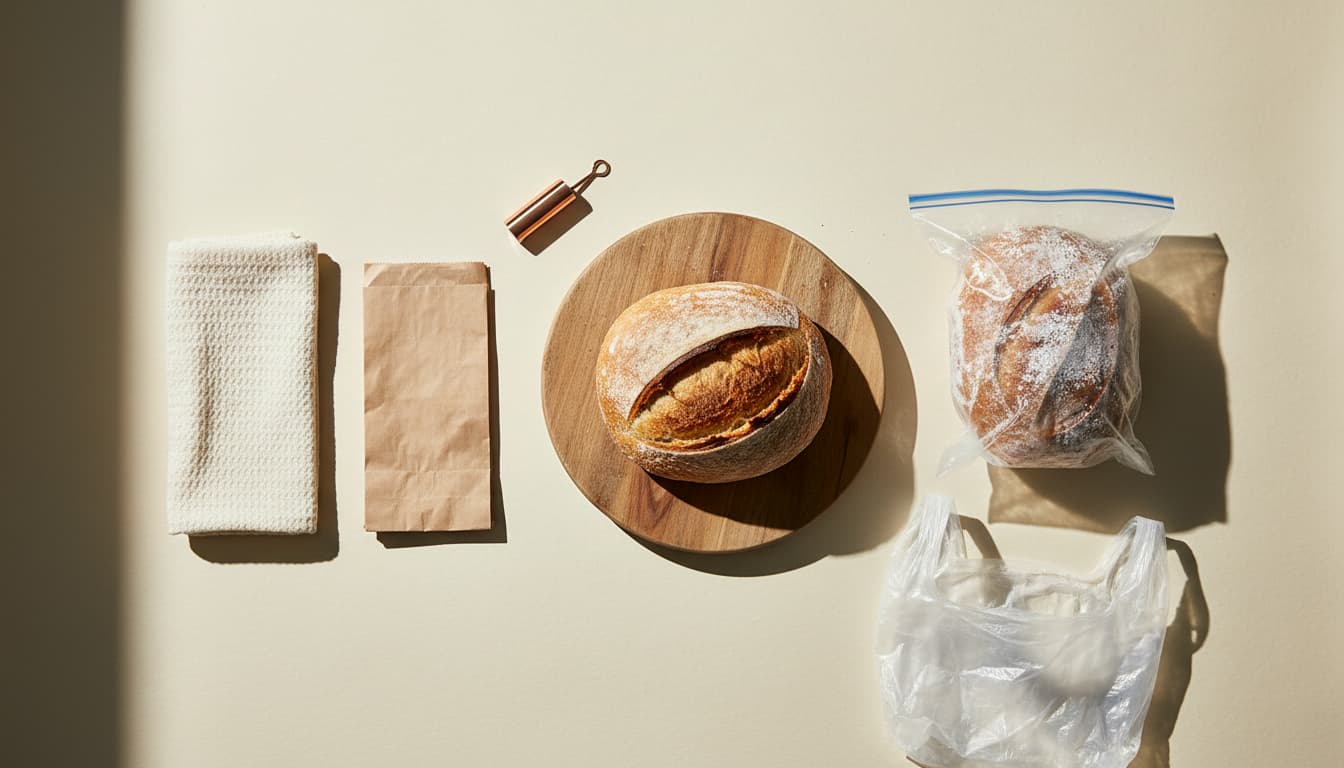
Staling is starch recrystallisation plus water migration, not drying out. In a household storage trial, lowering the storage temperature accelerated staling, which is why the refrigerator is the worst container in the kitchen.
- 01
Lowering the temperature accelerated staling
In a trial comparing a polyethylene-layered microperforated paper bag, a plastic bag, the fridge and a bread box, storage temperature especially was found to influence the kinetics of staling processes, as a reduction accelerated the staling process (Alpers et al. 2021). This is the finding that disqualifies the refrigerator: it is not neutral for bread, it makes the main quality failure arrive sooner.
- 02
Staling is starch reordering, not simple drying
Across five commercial bread brands, all bread hardness values underwent a rapid increase during storage at room temperature, and the increase in hardness was attributed to the ordered configuration of the amylopectin structures resulting from water evaporation, established using infrared spectroscopy, disulfide bond analysis, solid-state nuclear magnetic resonance, X-ray diffraction and differential scanning calorimetry (Wang et al. 2024).
- 03
The loaf is a variable before storage starts
The same study found the sequence of hardness increase differed markedly between the five brands tested and reported that bread hardness was likely associated with gliadin content, with more gliadin corresponding to higher hardness (Wang et al. 2024). Two loaves stored identically will not stale identically, which is one reason household advice generalises badly.
- 04
Moisture is a two-sided variable
Crumb moisture loss was found to contradict a long shelf life but, on the other hand, elevated humidity was shown to provoke excessive microbial growth and should therefore be observed when designing suitable storage methods (Alpers et al. 2021). A sealed bag slows firming and feeds mould; an open one does the reverse. There is no ambient-temperature container that wins on both axes.
- 05
Looking at the loaf is an adequate mould control
Everyday routines such as visual inspection were compared with microbiological techniques and found to represent an adequate tool for microbial safety control, and visually undetectable fungal growth was not found to produce fumonisins B1 and B2 or ochratoxin A in quantifiable or harmful concentrations within the limits of the experimental setup (Alpers et al. 2021). The fridge is not buying an invisible margin that justifies the staling cost.
- 06
The correct variable is a time horizon, not a container
Because the two failure modes pull in opposite directions at ambient temperature, the decision that matters is how long the loaf has to last. Inside two or three days, ambient storage that limits airflow without sealing in humidity is the best compromise the tested methods offer. Beyond that, the ambient options are all losing on one axis or the other, and the container choice cannot fix it.
- 07
Freeze for the long horizon, slice first
Freezing removes the crumb from the temperature band in which the measured staling kinetics run and immobilises the water whose migration drives amylopectin ordering, rather than merely slowing the process as refrigeration fails to do. Slicing before freezing matters for a practical reason: portions can then leave the freezer individually, and the number that predicts waste is how often the whole package has to be opened.
- 08
Store a cut loaf on its cut face
The exposed crumb is where water evaporation proceeds fastest, and water evaporation is the driver behind the amylopectin ordering that registers as hardness (Wang et al. 2024). Resting the loaf on its cut face uses the board as a seal for the only unprotected surface, which is a free intervention that costs nothing and needs no equipment.
What people ask us next.
- Should bread be kept in the fridge?
- No. In a storage trial designed around household methods, the storage temperature especially was found to influence the kinetics of staling processes, as a reduction accelerated the staling process (Alpers et al. 2021). Refrigeration moves bread into the range where the firming measured in that study runs faster, so it trades a small delay in mould for a clear acceleration of the primary quality failure.
- Why does bread go hard rather than just dry out?
- Because the starch reorders. Across five commercial breads stored at room temperature, all hardness values rose rapidly, and the increase was attributed to the ordered configuration of the amylopectin structures resulting from water evaporation, using infrared spectroscopy, nuclear magnetic resonance, X-ray diffraction and differential scanning calorimetry (Wang et al. 2024). Water leaving the crumb is the driver, but the hardness comes from the structure it leaves behind.
- Plastic bag or paper bag?
- Neither wins outright, and the study says why. Crumb moisture loss contradicts a long shelf life, while elevated humidity provokes excessive microbial growth and should be observed when designing suitable storage methods (Alpers et al. 2021). Plastic holds moisture and slows firming at the cost of feeding mould; paper does the reverse. A microperforated bag or a bread box is the compromise between the two.
- Is bread with a small amount of mould safe if I cut it off?
- Treat any visible growth as a discard for the loaf. The relevant finding is the opposite one, that visual inspection is an adequate control because visually undetectable fungal growth was not found to produce fumonisins B1 and B2 or ochratoxin A in quantifiable or harmful concentrations within that experimental setup (Alpers et al. 2021). That supports trusting your eyes to catch a problem early, not eating around one you can already see.
- What is the best system for a household that does not finish a loaf?
- Split the loaf by horizon at the point of purchase. Keep two or three days of slices at ambient temperature in a container that limits airflow without sealing in humidity, and freeze the rest sliced, so single portions can be removed without opening the whole package. This converts a storage problem into a portioning problem, which is the same move that reduces waste across the rest of the pantry.
Every claim, cited.
- [01]Alpers T, Kerpes R, Frioli M, Nobis A, Hoi KI, Bach A, Jekle M, Becker T. 2021. Impact of Storing Condition on Staling and Microbial Spoilage Behavior of Bread and Their Contribution to Prevent Food Waste. Foods 10(1):76. The influence of storage parameters on staling and spoilage behaviour of German bread was investigated within the limits of common household methods, using a polyethylene-layered microperforated paper bag, a plastic bag, and fridge and bread box storage. Everyday routines of life, such as visual inspection, were compared with microbiological techniques and were found to represent an adequate tool for microbial safety control. Visually undetectable fungal growth has not been found to result in the production of mycotoxins (fumonisins B1 and B2 and ochratoxin A) in quantifiable or harmful concentrations. The storage temperature especially was found to influence the kinetics of staling processes, as a reduction accelerated the staling process. Crumb moisture loss was found to contradict a long shelf life but, on the other hand, an elevated humidity was shown to provoke excessive microbial growth and should therefore be observed when designing suitable storage methods.
- [02]Wang H, Liu W, Zhang P, Lian X. 2024. The Mechanism Underlying the Increase in Bread Hardness in Association with Alterations in Protein and Starch Characteristics During Room-Temperature Storage. Foods 13(23):3921. Hardness and retrogradation rates of five popular bread brands during storage at room temperature were determined, and the mechanism of increased hardness was examined by Fourier transform infrared spectroscopy, disulfide bonds, 13C solid-state nuclear magnetic resonance, X-ray diffraction and differential scanning calorimetry. All bread hardness values underwent a rapid increase during storage at room temperature. The bread hardness was likely associated with the gliadin content; the more gliadin, the higher the hardness of the bread. The increase in the hardness of the bread was attributed to the ordered configuration of the amylopectin structures resulting from water evaporation.
The Larderlab Team builds evidence-led frameworks for eating, lifting, and stocking a kitchen. We cite every claim. We publish the spreadsheet when possible. We buy what we review at retail price. When new data lands, we revise with a dated note.
Next in this hub.
How to Store Eggs: Why the US Refrigerates and the EU Does Not
The United States requires refrigeration at 40 degrees Fahrenheit or below. European rules say Class A eggs shall not be washed and should in general not be refrigerated before sale. One processing step explains the split.
8 min · rev 2026-09-02What Temperature Should a Fridge Be? The Number and the Gap
The target is 40 degrees Fahrenheit or below with the freezer at 0. Surveys put most domestic refrigerators above the recommendation, mean measured food temperatures reach 7.4 degrees Celsius, and ambient temperature is the largest single driver.
8 min · rev 2026-08-27Dried Beans vs Canned Beans: Cost, Sodium, Time and One Real Hazard
One pound of dry beans yields about 6 cups cooked and replaces roughly 4 cans at 2.5 to 5 times lower cost per cup. Canned beans carry 331 to 655 mg sodium per cup against 1.7 mg home-cooked.
13 min · rev 2026-09-09Get the Larderlab Macro Planner.
A Google Sheet that calculates your protein target, splits it across 3-5 meals, and ranks 20 protein sources by $/gram. Free. Copy-and-modify your own version.
By subscribing, you agree to our Privacy Policy. Unsubscribe anytime.