How to store coffee, and the three variables that actually move quality
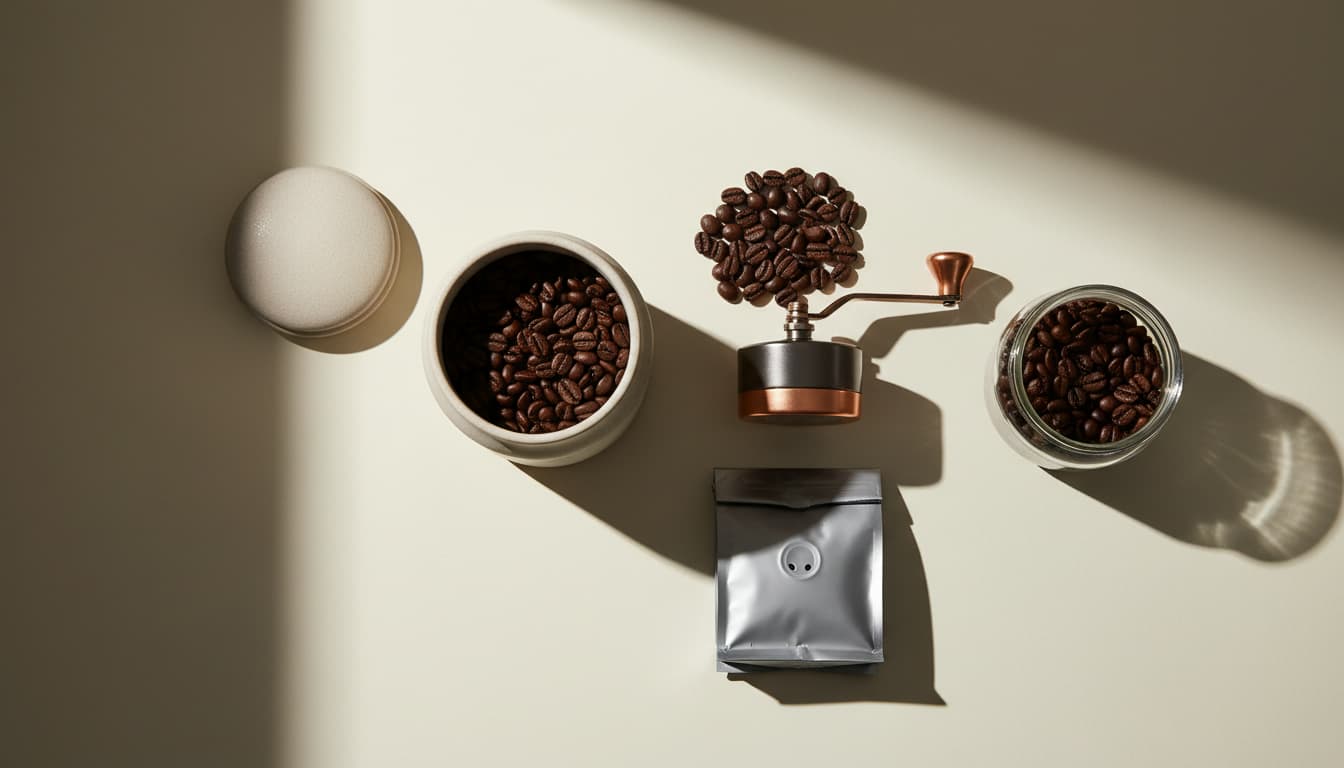
Beans held at 20 degrees Celsius aged fastest across a 12-month comparison, while minus 10 and plus 10 performed similarly. Water activity sets the staling rate of ground coffee, and cold beans grind finer and more evenly.
- 01
Twenty degrees Celsius aged the beans fastest
Across a 12-month comparison of green and roasted beans stored at minus 10, 10 and 20 degrees Celsius in jute and polymer packaging and evaluated at 3, 6, 9 and 12 months, the research shows that grain stored at 20 degrees Celsius ages the fastest (Blaszkiewicz et al. 2023). Room temperature is the default in most kitchens and the condition with the measured penalty.
- 02
Cold cupboard and freezer performed similarly
Grains stored in the minus 10 and 10 degree Celsius chambers performed similarly well across the same 12 months, and among the beans stored in those two chambers the processing method, natural or washed, had a greater impact on the results than the type of packaging (Blaszkiewicz et al. 2023). A cold cupboard captures most of the benefit before any specialist container is bought.
- 03
Ground coffee runs a secondary shelf-life clock
Ground dark-roast coffee equilibrated to water activity values up to 0.44 and stored at 30 degrees Celsius for up to a month, with the headspace periodically perturbed by opening and reclosing the packaging to simulate home storage, showed that headspace volatile compounds are representative indexes of quality depletion, and the authors modelled secondary shelf life from water activity at a given temperature (Anese et al. 2006).
- 04
Water activity has a threshold, not a gradient
In freeze-dried coffee brew stored from minus 30 to 60 degrees Celsius for up to 10 months, the rate of hydronium ion formation was considerably low only when water activity was reduced below 0.5, increased beyond that critical boundary to a maximum at about 0.8, and fell again with further hydration, with the temperature dependence across the whole range described by the Arrhenius equation (Manzocco and Nicoli 2007).
- 05
Grinding cold narrows the particle distribution
Particle size distribution on grinding was found to be independent of bean origin and processing method, while the influence of bean temperature was clear: grinding cold results in a narrower particle size distribution and reduced mean particle size, a result the authors expected to influence how coffee is stored and used daily (Uman et al. 2016). Fewer fines and fewer boulders is the mechanical basis of an even extraction.
- 06
The storage decision and the grinding decision are one decision
If the reserve is already held cold for the reason the 12-month comparison gives, the beans arriving at the grinder are cold, which is the condition that produced the narrower distribution and lower mean particle size (Blaszkiewicz et al. 2023; Uman et al. 2016). Two separate findings converge on a single household habit, which is unusual and worth exploiting.
- 07
Packaging mattered less than expected
Between the two well-performing temperature chambers, the type of packaging, a jute bag versus a GrainPro polymer bag with different permeability, did not differentiate the grains to a significant extent, while the processing method did (Blaszkiewicz et al. 2023). Temperature is the lever worth paying for first, ahead of any container upgrade.
- 08
Staling is invisible, so measure it by taste
Both storage studies used volatile compounds as the quality index, with headspace volatiles serving as representative indexes of quality depletion during home usage (Anese et al. 2006; Blaszkiewicz et al. 2023). Beans that have lost their aromatics look identical to fresh beans, so an appearance check is uninformative here and the only accessible household measurement is the cup.
What people ask us next.
- Should coffee be kept in the freezer?
- It is not clearly better than a cold cupboard. Across a 12-month comparison at minus 10, 10 and 20 degrees Celsius, grain stored at 20 degrees Celsius aged the fastest, while grains stored at minus 10 and at 10 degrees performed similarly well (Blaszkiewicz et al. 2023). The result argues for getting the beans out of a warm kitchen rather than for buying freezer equipment, and it makes the cold cupboard a legitimate option.
- Does grinding cold beans actually change anything?
- Yes, measurably. Particle size distribution on grinding was independent of bean origin and processing method, but grinding cold resulted in a narrower particle size distribution and reduced mean particle size (Uman et al. 2016). A narrower distribution means fewer fines and fewer oversized fragments, which is the mechanical basis for a more even extraction from the same dose.
- Why does ground coffee go stale so much faster?
- Because grinding multiplies the surface exposed to air and water. Studies of ground roasted coffee use headspace volatiles as the quality index and model a secondary shelf life, the clock that starts once the package has been opened, from the water activity value at a given temperature (Anese et al. 2006). Every opening and reclosing of the pack refreshes the headspace, which is the perturbation those studies deliberately simulated.
- How dry does coffee need to be kept?
- Below the threshold rather than merely dry-ish. In freeze-dried coffee brew stored across a wide temperature range, the rate of the acidity marker used to track staling was considerably low only when water activity was reduced below 0.5, and rose past that boundary to a maximum around 0.8 (Manzocco and Nicoli 2007). Practically that means a sealed container and no open jar next to a kettle.
- Does the container type matter much?
- Less than temperature does. In the 12-month comparison, among beans stored in the two better-performing temperature chambers the processing method had a greater impact on the results than the type of packaging, and the jute and polymer bags with different permeability did not differentiate the grains to a significant extent (Blaszkiewicz et al. 2023). Fix the temperature first; the container is the second-order decision.
Every claim, cited.
- [01]Blaszkiewicz J, Nowakowska-Bogdan E, Barabosz K, Kulesza R, Dresler E, Woszczynski P, Bilos L, Matuszek DB, Szkutnik K. 2023. Effect of green and roasted coffee storage conditions on selected characteristic quality parameters. Sci Rep 13(1):6447. Coffee beans processed washed or natural were stored in two types of packaging with different permeability, a jute bag and a GrainPro polymer bag, in three temperature chambers at minus 10, 10 and 20 degrees Celsius, and evaluated after 3, 6, 9 and 12 months; the analysed parameters were cupping and three selected volatile organic compounds in roasted coffee and average water activity, content of volatile fatty acids and six selected volatile organic compounds in green coffee. The research shows that grain stored at 20 degrees Celsius ages the fastest. Grains stored in the minus 10 and 10 degree chambers perform similarly well. Among the grains stored in these two chambers, the method of grain processing (natural or washed) had a greater impact on the results, while the type of packaging did not differentiate the grains to such a significant extent.
- [02]Uman E, Colonna-Dashwood M, Colonna-Dashwood L, Perger M, Klatt C, Leighton S, Miller B, Butler KT, Melot BC, Speirs RW, Hendon CH. 2016. The effect of bean origin and temperature on grinding roasted coffee. Sci Rep 6:24483. The particle size distribution is independent of the bean origin and processing method; the influence of bean temperature on particle size distribution was elucidated, concluding that grinding cold results in a narrower particle size distribution and reduced mean particle size; the authors anticipated the results would influence the production of coffee industrially as well as contribute to how coffee is stored and used daily.
- [03]Anese M, Manzocco L, Nicoli MC. 2006. Modeling the secondary shelf life of ground roasted coffee. J Agric Food Chem 54(15):5571-5576. Fresh dark-roasted ground coffee samples were equilibrated at increasing water activity values up to 0.44 and stored at 30 degrees Celsius for up to 1 month; to simulate home storage conditions the headspace atmosphere was periodically perturbed by opening for a short time and then closing the packaging. The volatile compounds in the headspace are representative indexes of the quality depletion of roasted ground coffee during home usage. Sensory and instrumental results were used to develop a mathematical model allowing the secondary shelf life of coffee to be calculated on the basis of its water activity value at a given temperature.
- [04]Manzocco L, Nicoli MC. 2007. Modeling the effect of water activity and storage temperature on chemical stability of coffee brews. J Agric Food Chem 55(16):6521-6526. Coffee brew was freeze-dried, equilibrated at increasing water activity values, and stored for up to 10 months at different temperatures from minus 30 to 60 degrees Celsius; chemical stability was assessed by measuring hydronium ion formation during storage. Independently of storage temperature, the rate of hydronium ion formation was considerably low only when water activity was reduced below 0.5; beyond this critical boundary the rate increased, reaching a maximum value at about 0.8 water activity, and further hydration up to the water activity of the freshly prepared beverage significantly increased chemical stability. The temperature dependence of hydronium ion formation was well described by the Arrhenius equation across the entire water activity range considered.
The Larderlab Team builds evidence-led frameworks for eating, lifting, and stocking a kitchen. We cite every claim. We publish the spreadsheet when possible. We buy what we review at retail price. When new data lands, we revise with a dated note.
Next in this hub.
How to Store Vegetables: Temperature, Ethylene, and the 12 Degree Line
Tomato flavour volatiles are damaged below 12 degrees Celsius and some of the genes never recover. Ethylene accelerates ripening at micromolar concentrations. And 15 days at 4 degrees drastically cut antioxidant activity across 19 items.
8 min · rev 2026-08-26How to Store Rice: White Keeps Almost Indefinitely, Brown Has About Six Months
Milled white rice keeps almost indefinitely on a pantry shelf; brown rice has roughly six months because of the oil in the bran. Lipase-driven rancidity varies more than fifteenfold between rice genotypes. Boiled rice held warm reached 10 to the 7th cfu per gram and produced emetic toxin.
12 min · rev 2026-09-10How to Store Potatoes: The Cold Sweetening and Greening Trade-off
The FDA says to store potatoes outside the refrigerator, because cold storage raises acrylamide during cooking. Light drives greening and both major glycoalkaloids, and EFSA set 1 mg per kg body weight per day.
12 min · rev 2026-09-03Get the Larderlab Macro Planner.
A Google Sheet that calculates your protein target, splits it across 3-5 meals, and ranks 20 protein sources by $/gram. Free. Copy-and-modify your own version.
By subscribing, you agree to our Privacy Policy. Unsubscribe anytime.