How to store vegetables, by the postharvest science
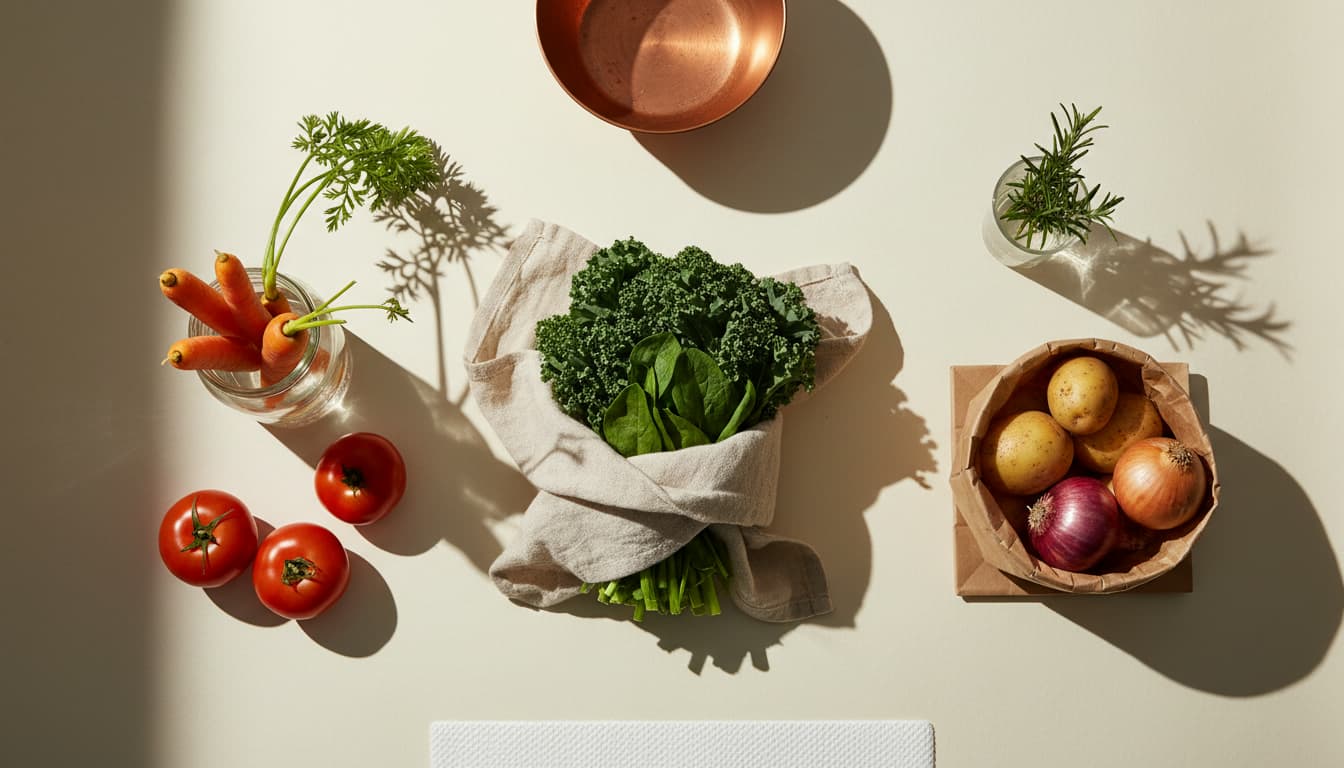
Tomato flavour volatiles are damaged below 12 degrees Celsius and some of the genes never recover. Ethylene accelerates ripening at micromolar concentrations. And 15 days at 4 degrees drastically cut antioxidant activity across 19 items.
- 01
The 12 degree line: chilling damages flavour, partly permanently
Flavour-associated volatiles in tomato are sensitive to temperatures below 12 degrees Celsius and their loss greatly reduces flavour quality, with reduced volatile levels associated with significant reductions in transcripts encoding key volatile synthesis enzymes. Although expression of some genes critical to volatile synthesis recovers after a return to 20 degrees, some do not (Zhang et al. 2016). A domestic fridge at 4 degrees is far below that threshold, and the partial irreversibility is why warming a cold tomato only recovers part of the loss.
- 02
Ethylene works at micromolar concentrations
Ethylene is a two-carbon gaseous plant growth regulator involved in growth, development, ripening and senescence, and it accelerates ripening of sensitive fruits, leafy greens and vegetables at micromolar concentrations, with accumulation leading to decay and waste at the postharvest stage (Cocetta and Natalini 2022). The concentration is the actionable detail: the quantities are so small that a closed drawer or sealed bag containing one ripening item is a sufficient dose for everything stored alongside it.
- 03
Separate and ventilate, rather than seal
Because ethylene acts at micromolar concentrations and accumulates in enclosed space (Cocetta and Natalini 2022), the two structural interventions are physical separation of producers from sensitive items and ventilation instead of sealing. A sealed bag protects against moisture loss and simultaneously concentrates the gas driving senescence, which is why leafy greens stored beside ripening fruit fail faster than a storage chart predicts. Perforated bags and separate drawers address the mechanism directly.
- 04
Potatoes: cold storage creates a cooking problem
Cold storage of potato tubers reduces sprouting and extends shelf life, but cold temperature stimulates accumulation of reducing sugars, which on high-temperature processing react with free amino acids to produce brown, bitter-tasting results and elevated acrylamide, a potential carcinogen. The enzyme responsible is vacuolar invertase, which breaks sucrose into glucose and fructose; full knockout tubers had undetectable reducing sugars and produced lightly coloured chips with reduced acrylamide (Clasen et al. 2016). Cool and dark, not cold.
- 05
Time in the fridge costs more than it appears to
A study of 19 fruits and vegetables stored at 4 degrees Celsius for 15 days found vitamin C decreased with storage and that storage induced a drastic decrease in antioxidant activity, correlating most strongly with total phenolics, while phenolic acids increased during storage (Galani et al. 2017). Refrigeration slows visible spoilage without stopping nutrient loss, which means produce that still looks acceptable after two weeks has already given up a substantial share of what it was bought for.
- 06
The frozen alternative is not a compromise
Comparing refrigerated and frozen storage across corn, carrots, broccoli, spinach, peas, green beans, strawberries and blueberries, ascorbic acid showed no significant difference in five of eight commodities and was higher in frozen for the remaining three, with the overall conclusion that vitamin content of frozen commodities was comparable to and occasionally higher than fresh. Beta-carotene was the exception, lower in frozen peas, carrots and spinach (Bouzari et al. 2015). For anything headed into a cooked dish, frozen is the better-retained option.
- 07
The buying-cycle conclusion
Combining the storage-time losses with the frozen retention data produces a purchasing rule rather than a storage trick. Fresh produce is worth buying on a short cycle sized to actual consumption, because the antioxidant and vitamin C losses over 15 days at 4 degrees are large (Galani et al. 2017). Volume that will not be eaten inside that window is better bought frozen, where retention holds (Bouzari et al. 2015). The bulk-buying analysis on this site covers the point at which quantity stops paying.
What people ask us next.
- Should you refrigerate tomatoes?
- Not if flavour matters. Tomato flavour-associated volatiles are sensitive to temperatures below 12 degrees Celsius and their loss greatly reduces flavour quality, with the reduction tied to significant falls in transcripts encoding key volatile synthesis enzymes. Although expression of some critical genes recovers after a return to 20 degrees, some do not (Zhang et al. 2016). A domestic fridge at 4 degrees is well below the threshold, so warming a chilled tomato recovers only part of the loss.
- Why should some fruit and vegetables be stored separately?
- Ethylene. It is a gaseous plant growth regulator that accelerates the ripening of sensitive fruits, leafy greens and vegetables at micromolar concentrations, and its accumulation can lead to decay and waste during the postharvest stage (Cocetta and Natalini 2022). Because the effective concentrations are so small, a single ripening item in an enclosed drawer or a sealed bag supplies enough to accelerate senescence in everything sharing the space. Separation and ventilation are the countermeasures.
- Why should you not keep potatoes in the fridge?
- Because cold storage changes what happens when you cook them. Cold temperature stimulates the accumulation of reducing sugars in potato tubers, and on high-temperature processing those sugars react with free amino acids to produce brown, bitter-tasting results and elevated levels of acrylamide, a potential carcinogen. The enzyme involved is vacuolar invertase, which splits sucrose into glucose and fructose (Clasen et al. 2016). Cool, dark and ventilated storage avoids both the sprouting and the sugar problem.
- How quickly do refrigerated vegetables lose nutrients?
- Measurably within two weeks. A study of 19 fruits and vegetables stored at 4 degrees Celsius for 15 days found that vitamin C decreased with storage and that storage induced a drastic decrease in antioxidant activity, which correlated most strongly with total phenolics, while phenolic acid levels increased (Galani et al. 2017). Refrigeration slows spoilage without halting nutrient loss, so produce that still looks fine after a fortnight has already lost a meaningful share of its value.
- Are frozen vegetables as good as fresh?
- On water-soluble vitamins, as good or better. A controlled comparison of refrigerated and frozen storage across corn, carrots, broccoli, spinach, peas, green beans, strawberries and blueberries found ascorbic acid showed no significant difference in five of eight commodities and was higher in frozen for three, concluding that vitamin content of frozen commodities was comparable to and occasionally higher than fresh. Beta-carotene was the exception, lower in frozen peas, carrots and spinach (Bouzari et al. 2015).
- Is a sealed bag better than an open one for storing greens?
- It is a trade-off with a mechanism on each side. Sealing reduces moisture loss, which is what makes greens wilt, and simultaneously concentrates ethylene, which accelerates senescence at micromolar concentrations (Cocetta and Natalini 2022). Perforated or loosely closed packaging balances the two by retaining humidity while allowing the gas to disperse. The larger gain is keeping ethylene-producing items out of the same compartment, which removes the source rather than managing it.
Every claim, cited.
- [01]Zhang B, Tieman DM, Jiao C, Xu Y, Chen K, Fei Z, Giovannoni JJ, Klee HJ. 2016. Chilling-induced tomato flavor loss is associated with altered volatile synthesis and transient changes in DNA methylation. Proc Natl Acad Sci USA 113(44):12580-12585. Flavour-associated volatiles are sensitive to temperatures below 12 degrees C; reduced volatiles associated with reduced transcripts for key synthesis enzymes; some genes recover after return to 20 degrees C and some do not; ripening transcription factors RIN, NONRIPENING and COLORLESS NONRIPENING reduced by chilling.
- [02]Cocetta G, Natalini A. 2022. Ethylene: Management and breeding for postharvest quality in vegetable crops. A review. Front Plant Sci 13:968315. Ethylene accelerates ripening of sensitive fruits, leafy greens and vegetables at micromolar concentrations, and its accumulation can lead to fruit decay and waste during the postharvest stage.
- [03]Clasen BM, Stoddard TJ, Luo S, et al. 2016. Improving cold storage and processing traits in potato through targeted gene knockout. Plant Biotechnol J 14(1):169-76. Cold temperature stimulates accumulation of reducing sugars in potato tubers; on high-temperature processing these react with free amino acids to give brown, bitter-tasting products and elevated acrylamide; vacuolar invertase breaks sucrose into glucose and fructose; full knockout tubers had undetectable reducing sugars and reduced acrylamide in processed chips.
- [04]Galani JHY, Patel JS, Patel NJ, Talati JG. 2017. Storage of Fruits and Vegetables in Refrigerator Increases their Phenolic Acids but Decreases the Total Phenolics, Anthocyanins and Vitamin C with Subsequent Loss of their Antioxidant Capacity. Antioxidants 6(3):59. Nineteen fruits and vegetables stored at 4 degrees C for 15 days; vitamin C decreased with storage; phenolic acids increased; storage induced a drastic decrease in antioxidant activity, correlating most strongly with total phenolics.
- [05]Bouzari A, Holstege D, Barrett DM. 2015. Vitamin retention in eight fruits and vegetables: a comparison of refrigerated and frozen storage. J Agric Food Chem 63(3):957-62. Ascorbic acid no significant difference in five of eight commodities and higher in frozen for three; vitamin content of frozen comparable to and occasionally higher than fresh; beta-carotene lower in frozen peas, carrots and spinach.
The Larderlab Team builds evidence-led frameworks for eating, lifting, and stocking a kitchen. We cite every claim. We publish the spreadsheet when possible. We buy what we review at retail price. When new data lands, we revise with a dated note.
Next in this hub.
How to Store Coffee: Temperature, Water Activity and the Grind
Beans held at 20 degrees Celsius aged fastest across a 12-month comparison, while minus 10 and plus 10 performed similarly. Water activity sets the staling rate of ground coffee, and cold beans grind finer and more evenly.
8 min · rev 2026-09-02How to Store Rice: White Keeps Almost Indefinitely, Brown Has About Six Months
Milled white rice keeps almost indefinitely on a pantry shelf; brown rice has roughly six months because of the oil in the bran. Lipase-driven rancidity varies more than fifteenfold between rice genotypes. Boiled rice held warm reached 10 to the 7th cfu per gram and produced emetic toxin.
12 min · rev 2026-09-10How to Store Potatoes: The Cold Sweetening and Greening Trade-off
The FDA says to store potatoes outside the refrigerator, because cold storage raises acrylamide during cooking. Light drives greening and both major glycoalkaloids, and EFSA set 1 mg per kg body weight per day.
12 min · rev 2026-09-03Get the Larderlab Macro Planner.
A Google Sheet that calculates your protein target, splits it across 3-5 meals, and ranks 20 protein sources by $/gram. Free. Copy-and-modify your own version.
By subscribing, you agree to our Privacy Policy. Unsubscribe anytime.