What freezes well, and the mechanism that predicts it
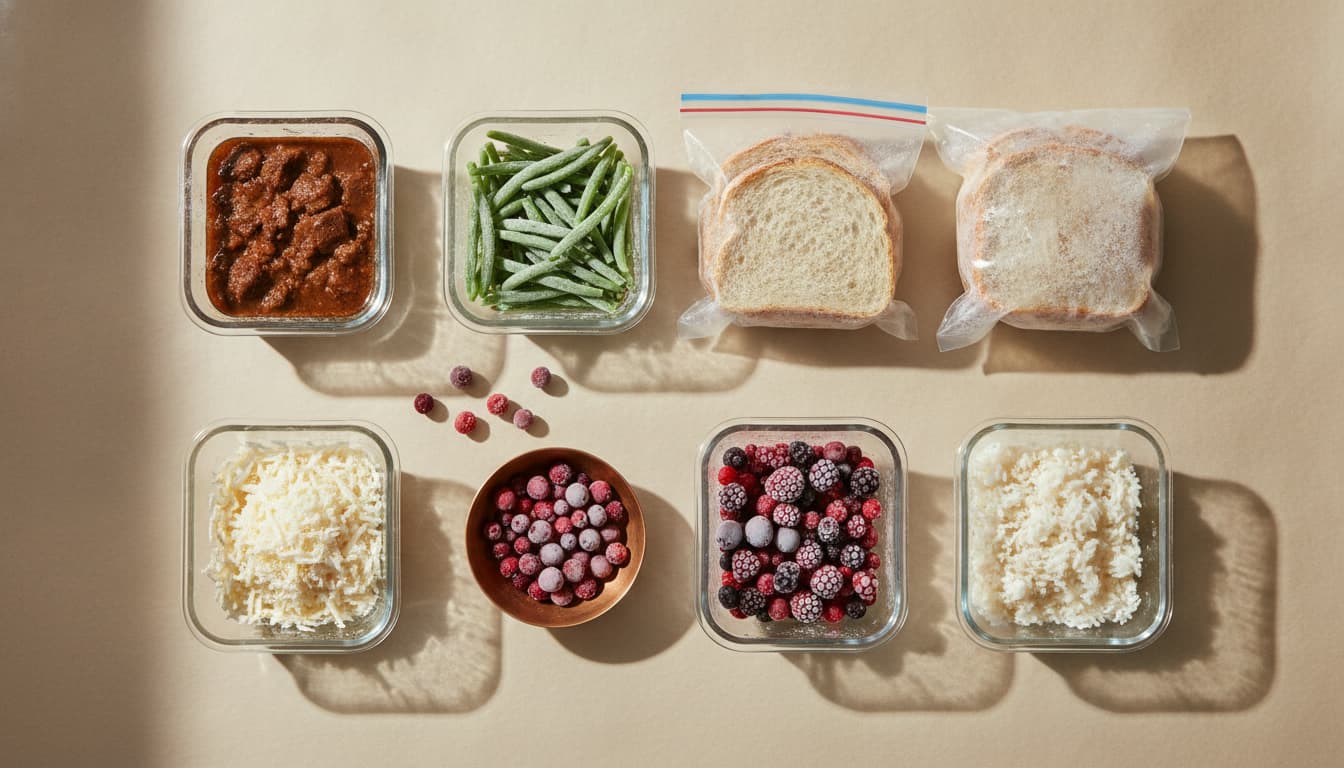
Freezing is settled on safety and unsettled on quality. Ice crystal size and distribution, governed by freezing rate and storage temperature, determines what survives. Vitamin retention holds up; beta-carotene in some vegetables does not.
- 01
The governing variable: ice crystal size and distribution
A review of frozen meat quality states that the extent to which tenderness, water holding capacity, colour and flavour are affected depends on ice crystalline size and distribution, which is governed by freezing rate and storage temperature and duration, and that freezing generally improves tenderness while negatively affecting other attributes (Dang et al. 2021). Large crystals from slow freezing rupture cell structures; small crystals from fast freezing do less damage. Almost every practical freezing rule is a consequence of this one sentence.
- 02
What fails: anything whose appeal is turgor
Salad leaves, cucumber, radish and raw tomato collapse on thawing, and the mechanism explains why. Their entire eating quality depends on intact cell walls holding water under pressure, which is exactly what large ice crystals destroy (Dang et al. 2021). No wrapping technique or freezing speed available in a domestic kitchen rescues them, because the damage is structural rather than oxidative. These are the foods to buy in usable quantities rather than to freeze against waste.
- 03
What survives: structures already broken down
Braises, stews, soups, sauces, cooked grains and legumes, bread, blanched vegetables headed for cooked applications, and raw meat and fish all freeze acceptably, because none of them depends on crisp turgid cells for its eating quality. Freezing even improves meat tenderness in general (Dang et al. 2021), a rare case where the process adds something. Water holding capacity is the attribute to watch in meat, which is why thawed portions can release liquid that a fresh cut would have retained.
- 04
The in-between category: emulsions and high-water dairy
Cream sauces, custards, yoghurt and some soft cheeses tend to separate or turn grainy after freezing. The mechanism follows from the same crystallisation process: as water crystallises out, the remaining solutes concentrate, which destabilises the suspension holding fat and water together. These items are not unsafe and are often usable in a cooked application where the texture is remade anyway; they are simply unreliable if the intended use depends on a smooth emulsion.
- 05
Freeze fast and thin, because rate is controllable
Since crystal size is governed by freezing rate as well as storage temperature (Dang et al. 2021), the freezing speed is the one lever a home kitchen actually controls. Loading a domestic freezer with a large volume of warm food raises compartment temperature and slows freezing across the entire load, growing larger crystals in everything inside. Portioning into shallow containers, cooling before freezing, and freezing in stages rather than all at once addresses this at zero cost.
- 06
Safety is temperature; the printed times are quality
Food held at 0 degrees Fahrenheit stays safe indefinitely, and published freezer storage times are quality recommendations rather than safety deadlines (USDA FSIS). Two consequences follow. A package past its recommended freezer time is a texture and flavour question, not a safety one. And a freezer that has drifted above 0 degrees is a real problem even well inside the recommended window, which makes a freezer thermometer a more useful purchase than a label maker.
- 07
Freezer burn is a packaging failure, not a time failure
Freezer burn is surface dehydration and oxidation caused by moisture sublimating away from exposed food, which is why it appears on the parts of a package in contact with air rather than uniformly. It is a quality defect and not a safety hazard. The fix is mechanical: exclude air, wrap tightly or vacuum-seal, and avoid part-used packages left loosely closed. Wrapping quality does more for a twelve-month freezer item than shortening the storage time does.
- 08
Nutrition: frozen matches fresh, except for beta-carotene
A controlled comparison of refrigerated versus frozen storage across corn, carrots, broccoli, spinach, peas, green beans, strawberries and blueberries found ascorbic acid showed no significant difference in five of eight commodities and was higher in frozen for the other three, and concluded that vitamin content of frozen commodities was comparable to and occasionally higher than fresh. Beta-carotene was the exception, lower in frozen peas, carrots and spinach and decreasing drastically in some commodities (Bouzari et al. 2015).
How this was specified
- 01Inputs measured
- Retail price (dated) · label claim · Certificate of Analysis · third-party test (Informed Sport / NSF / ConsumerLab / Clean Label) · leucine per serving from COA, not marketing.
- 02Protocols tested
- Per-kg target from four literature ranges (IOM RDA, Phillips 2017, Morton 2018, ISSN). Brands scored against Moore 2015 leucine-per-dose threshold (~0.4 g/kg).
- 03Cost-basis verified
- $/gram of protein and $/gram of leucine at warehouse pricing (Costco), mail-order (Amazon), and DTC retail. Re-checked quarterly, flagged when drift exceeds 15%.
- 04Confidence level
- High on ranked order. Medium on absolute $/g (prices drift). Low on serving-size claims where COA is older than 18 months, flagged [VERIFY].
Every claim, cited.
- [01]Dang DS, Bastarrachea LJ, Martini S, Matarneh SK. 2021. Crystallization Behavior and Quality of Frozen Meat. Foods 10(11):2707. Freezing extends shelf life mainly by reducing microbial spoilage and deterioration reactions; quality attributes of concern are tenderness, water holding capacity, colour and flavour; freezing generally improves tenderness but negatively affects the others; the extent depends on ice crystalline size and distribution, governed by freezing rate and storage temperature and duration.
- [02]Bouzari A, Holstege D, Barrett DM. 2015. Vitamin retention in eight fruits and vegetables: a comparison of refrigerated and frozen storage. J Agric Food Chem 63(3):957-62. Corn, carrots, broccoli, spinach, peas, green beans, strawberries, blueberries; ascorbic acid no significant difference in five of eight and higher in frozen for three; riboflavin unchanged apart from broccoli (higher frozen) and peas (lower frozen); vitamin content of frozen comparable to and occasionally higher than fresh; beta-carotene lower in frozen peas, carrots and spinach.
- [03]USDA Food Safety and Inspection Service: Freezing and Food Safety. Food held at 0 degrees Fahrenheit remains safe indefinitely; published freezer storage times are quality recommendations rather than safety deadlines; freezer burn is a quality defect caused by moisture loss from exposed surfaces.
The Larderlab Team builds evidence-led frameworks for eating, lifting, and stocking a kitchen. We cite every claim. We publish the spreadsheet when possible. We buy what we review at retail price. When new data lands, we revise with a dated note.
Next in this hub.
Can You Refreeze Thawed Meat? The Thawing Method Decides
Refrigerator-thawed meat can be refrozen without cooking. Cold-water and microwave-thawed meat has to be cooked first. The safety line is set by how the food thawed, and the quality cost is measured in oxidation.
8 min · rev 2026-09-01High Protein Meal Prep: The 4-Hour Sunday System
Engineered meal prep targeting 30–40 g protein per meal, 4 hours of work for 18–20 servings. Cost-per-gram math, the four base proteins, and the assembly grid that beats recipe sites.
12 min · rev 2026-04-29Does Freezing Kill Bacteria? It Suspends Them, With One Exception
Freezing to 0 degrees Fahrenheit inactivates microbes rather than destroying them, and they resume growth on thawing. Parasites are the exception, and the destruction parameters are written into the Food Code.
8 min · rev 2026-09-01Get the Larderlab Macro Planner.
A Google Sheet that calculates your protein target, splits it across 3-5 meals, and ranks 20 protein sources by $/gram. Free. Copy-and-modify your own version.
By subscribing, you agree to our Privacy Policy. Unsubscribe anytime.