Can you refreeze thawed meat, and why the thawing method sets the answer
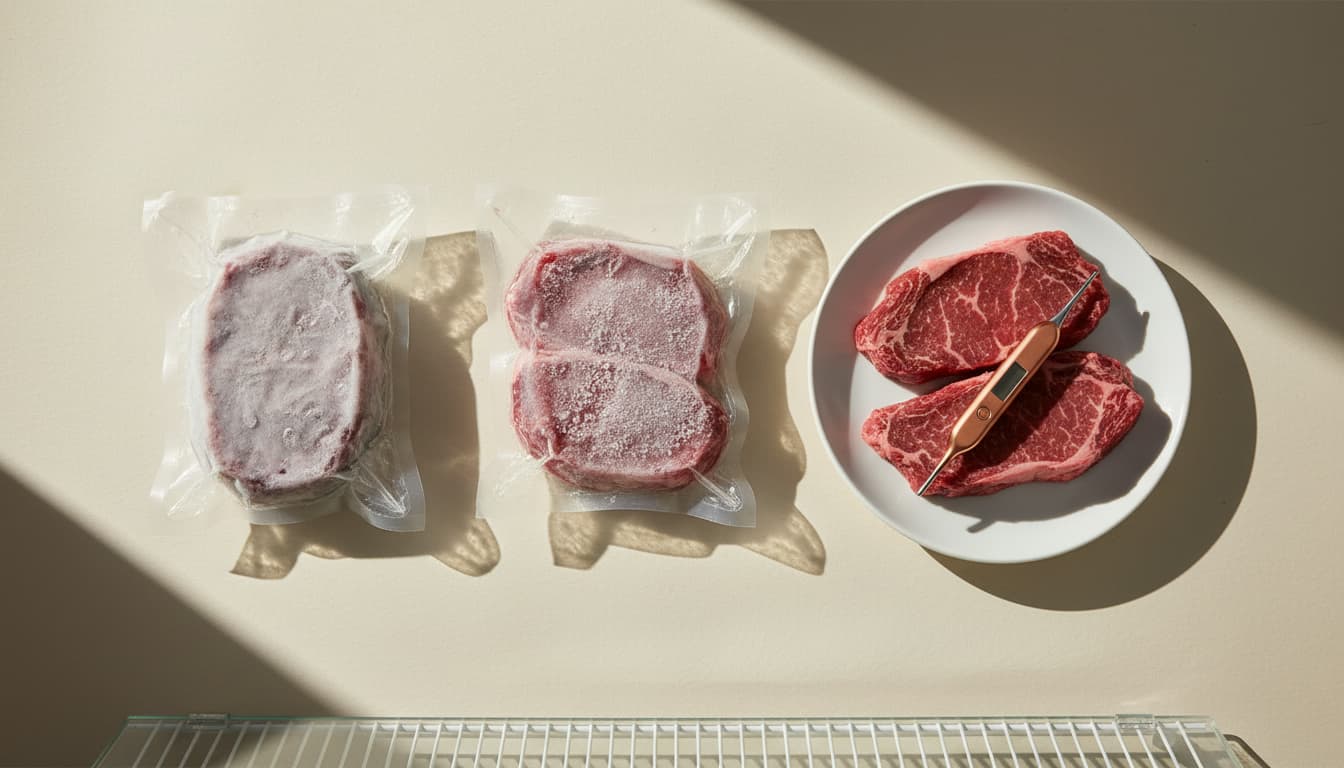
Refrigerator-thawed meat can be refrozen without cooking. Cold-water and microwave-thawed meat has to be cooked first. The safety line is set by how the food thawed, and the quality cost is measured in oxidation.
- 01
Refrigerator-thawed: refreeze without cooking
Once food is thawed in the refrigerator it is safe to refreeze it without cooking, although there may be a loss of quality due to the moisture lost through thawing, and if previously cooked foods are thawed in the refrigerator the unused portion may be refrozen (USDA FSIS). This is the only method that keeps the entire mass below 40 degrees Fahrenheit throughout, which is why it is the only one that skips the cooking condition.
- 02
Cold-water thawed: cook first
Cold water thawing is faster than refrigerator thawing but requires more attention, the food must be in a leak-proof package, the water needs changing every 30 minutes, and foods thawed by the cold water method should be cooked before refreezing (USDA FSIS). The surface of the food spends the process above refrigeration temperature, so cooking is the step that makes the second freeze acceptable.
- 03
Microwave-thawed: cook immediately
When microwave-defrosting food, plan to cook it immediately after thawing because some areas of the food may become warm and begin to cook during microwaving (USDA FSIS). For leftovers thawed in a microwave, continue heating until the food reaches 165 degrees Fahrenheit measured with a food thermometer, after which it can be refrozen (USDA FSIS). Uneven heating is the whole reason for the condition.
- 04
The hard stop is the counter, not the calendar
Do not refreeze any foods left outside the refrigerator longer than 2 hours, or 1 hour in temperatures above 90 degrees Fahrenheit (USDA FSIS). Freezing arrests growth, it does not reverse it, so the population present when the package goes back into the freezer is the population that will be there when it comes out. A package thawed on a worktop across an afternoon is a discard rather than a refreeze.
- 05
Safety and quality are separate ledgers
Food stored constantly at 0 degrees Fahrenheit will always be safe, only the quality suffers with lengthy freezer storage, and the published freezer chart is explicitly labelled as quality guidance with frozen foods remaining safe indefinitely (USDA FSIS). The chart itself gives uncooked ground meat 3 to 4 months, uncooked steaks or chops 4 to 12 months, cooked meat 2 to 3 months and uncooked whole poultry 12 months.
- 06
What a second cycle costs, measured
Beef hind limb held at minus 20 plus or minus 1 degree Celsius for 80 days and put through three successive freeze-thaw cycles showed drip loss decreasing and water holding capacity increasing through two cycles then decreasing, pH decreasing, and peroxide value, free fatty acid value and TBARS value all increasing significantly as the number of cycles increased (Rahman et al. 2015). Lipid oxidation is the marker that keeps climbing.
- 07
Cooking is the reset, so use it
After cooking raw foods which were previously frozen, it is safe to freeze the cooked foods, and it is safe to refreeze any food remaining after reheating previously frozen leftovers to 165 degrees Fahrenheit (USDA FSIS). When plans change mid-week, the low-friction move is to cook the thawed portion and freeze the cooked output, which converts a conditional refreeze into an unconditional one.
- 08
The power-outage rule uses the same threshold
If food is partly frozen, still has ice crystals, or is as cold as if it were in a refrigerator at 40 degrees Fahrenheit, it is safe to refreeze or use, and it is not necessary to cook raw foods before refreezing; discard foods that have been warmer than 40 degrees Fahrenheit for more than 2 hours (USDA FSIS). A full freezer will usually hold about 2 days with the door shut, a half-full freezer about a day.
What people ask us next.
- Is it safe to refreeze meat that thawed in the fridge?
- Yes, and no cooking step is required. Once food is thawed in the refrigerator it is safe to refreeze it without cooking, although there may be a loss of quality due to the moisture lost through thawing (USDA FSIS). The same applies to previously cooked foods thawed in the refrigerator. The reason refrigerator thawing is the exception is that the food never leaves the temperature range that suppresses growth, so nothing has to be reset with heat.
- What if I thawed it in cold water or the microwave?
- Cook it first. Foods thawed by the cold water method should be cooked before refreezing, and food thawed in a microwave should be cooked immediately after thawing, because some areas of the food may become warm and begin to cook during microwaving (USDA FSIS). Both methods leave part of the food above refrigeration temperature for part of the process. Once cooked, the food can be frozen without further conditions.
- Does refreezing make meat unsafe?
- No, provided the food stayed cold. Food stored constantly at 0 degrees Fahrenheit will always be safe, and the published freezer storage times are quality guidance rather than safety deadlines (USDA FSIS). What refreezing costs is quality: across three freeze-thaw cycles, peroxide value, free fatty acid value and TBARS all increased significantly with each additional cycle (Rahman et al. 2015). The failure case is temperature history, not the number of freezes.
- Can I refreeze meat that sat out on the counter?
- No. Do not refreeze any foods left outside the refrigerator longer than 2 hours, or 1 hour in temperatures above 90 degrees Fahrenheit (USDA FSIS). Freezing pauses microbial growth rather than reversing it, so whatever multiplied during the delay is still present and will resume when the food thaws again. Appearance does not help here, because the organisms of concern do not reliably spoil the food.
- How do I avoid the question entirely?
- Portion before the first freeze. A package that gets thawed and refrozen is almost always a package that was too big for one meal, and the fix is a packing decision rather than a thawing decision. Freeze in single-meal units, thaw in the refrigerator, and if plans change, cook the thawed portion and freeze the cooked output, since after cooking raw foods which were previously frozen it is safe to freeze the cooked foods (USDA FSIS).
Every claim, cited.
- [01]USDA Food Safety and Inspection Service. Freezing and Food Safety. Food stored constantly at 0 degrees Fahrenheit will always be safe, only the quality suffers with lengthy freezer storage; freezer storage is for quality only and frozen foods remain safe indefinitely; once food is thawed in the refrigerator it is safe to refreeze it without cooking, although there may be a loss of quality due to the moisture lost through thawing; after cooking raw foods which were previously frozen, it is safe to freeze the cooked foods; if previously cooked foods are thawed in the refrigerator, the unused portion may be refrozen; freeze leftovers within 3 to 4 days; do not refreeze any foods left outside the refrigerator longer than 2 hours, 1 hour in temperatures above 90 degrees Fahrenheit; when microwave-defrosting food, plan to cook it immediately after thawing because some areas of the food may become warm and begin to cook during microwaving; freezer chart at 0 degrees Fahrenheit gives uncooked ground meat 3 to 4 months, uncooked steaks or chops 4 to 12 months, cooked meat 2 to 3 months, uncooked whole poultry 12 months; if food is partly frozen, still has ice crystals, or is as cold as if it were in a refrigerator at 40 degrees Fahrenheit, it is safe to refreeze or use, and it is not necessary to cook raw foods before refreezing; discard foods that have been warmer than 40 degrees Fahrenheit for more than 2 hours; a freezer full of food will usually keep about 2 days if the door is kept shut, a half-full freezer about a day.
- [02]USDA Food Safety and Inspection Service. Leftovers and Food Safety. Leftovers can be kept in the refrigerator for 3 to 4 days or frozen for 3 to 4 months; refrigerator thawing takes the longest but the leftovers stay safe the entire time, and after thawing the food should be used within 3 to 4 days or can be refrozen; the frozen leftovers must be in a leak-proof package for cold water thawing and foods thawed by the cold water method should be cooked before refreezing; when thawing leftovers in a microwave, continue to heat until the food reaches 165 degrees Fahrenheit measured with a food thermometer, and foods thawed in the microwave can be refrozen after heating to this safe temperature; it is safe to refreeze any food remaining after reheating previously frozen leftovers to the safe temperature of 165 degrees Fahrenheit.
- [03]Rahman MH, Hossain MM, Rahman SM, Amin MR, Oh DH. 2015. Evaluation of Physicochemical Deterioration and Lipid Oxidation of Beef Muscle Affected by Freeze-thaw Cycles. Korean J Food Sci Anim Resour 35(6):772-782. Beef hind limb was held at minus 20 plus or minus 1 degree Celsius for 80 days across three successive freeze-thaw cycles compared with unfrozen beef muscle; as the number of repeated freeze-thaw cycles increased, drip loss decreased and water holding capacity increased until two cycles and then decreased; cooking loss increased in cycle one and three but decreased in cycle two; pH value decreased while peroxide value, free fatty acids value and TBARS value increased significantly as the number of repeated freeze-thaw cycles increased.
The Larderlab Team builds evidence-led frameworks for eating, lifting, and stocking a kitchen. We cite every claim. We publish the spreadsheet when possible. We buy what we review at retail price. When new data lands, we revise with a dated note.
Next in this hub.
How Long Can Food Sit Out? Two Hours, One Hour, and Why
Two hours at room temperature, one hour above 90 degrees Fahrenheit. The number comes from a 20-minute doubling time, and the reason it is not negotiable is that some toxins formed during the delay survive cooking.
8 min · rev 2026-08-31What Foods Freeze Well: Ice Crystal Size Decides Everything
Freezing is settled on safety and unsettled on quality. Ice crystal size and distribution, governed by freezing rate and storage temperature, determines what survives. Vitamin retention holds up; beta-carotene in some vegetables does not.
8 min · rev 2026-08-26High Protein Meal Prep: The 4-Hour Sunday System
Engineered meal prep targeting 30–40 g protein per meal, 4 hours of work for 18–20 servings. Cost-per-gram math, the four base proteins, and the assembly grid that beats recipe sites.
12 min · rev 2026-04-29Get the Larderlab Macro Planner.
A Google Sheet that calculates your protein target, splits it across 3-5 meals, and ranks 20 protein sources by $/gram. Free. Copy-and-modify your own version.
By subscribing, you agree to our Privacy Policy. Unsubscribe anytime.