Proteinreiches Meal-Prep: das 4-Stunden-Sonntagssystem
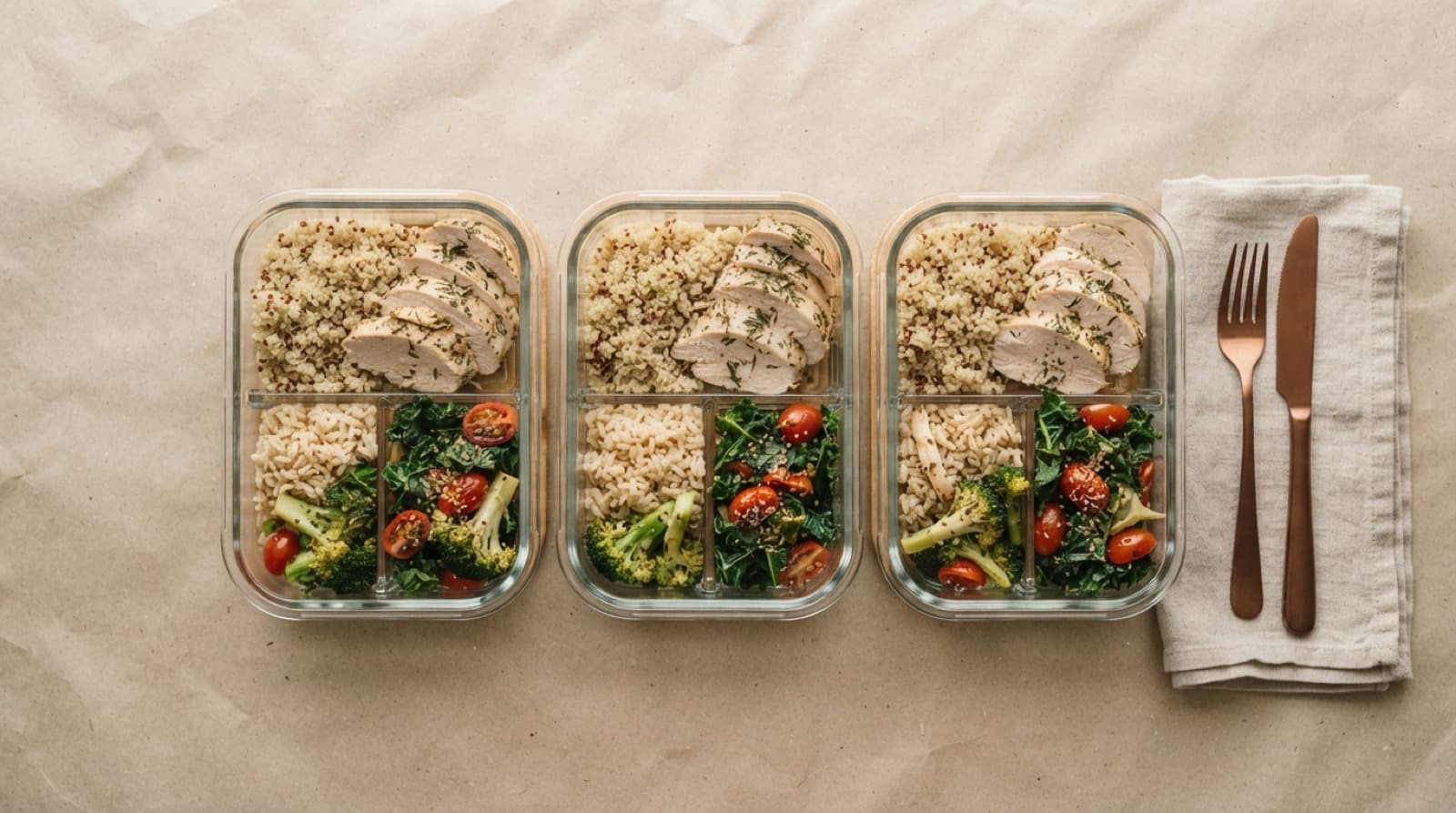
Durchdachtes Meal-Prep mit dem Ziel von 30–40 g Protein pro Mahlzeit, 4 Stunden Arbeit für 18–20 Portionen. Die Rechnung der Kosten pro Gramm, die vier Basisproteine und das Zusammenstellungsraster, das Rezeptseiten schlägt.
Die Fragen, die uns wirklich erreichen.
- Wie lange hält sich vorbereitetes Hähnchen im Kühlschrank?
- Empfehlung von USDA FoodSafety.gov: 3–4 Tage bei ≤40°F. Vakuumversiegelt verlängert sich dies auf 5–7 Tage; Einfrieren verlängert es bei gegartem Hähnchen ohne Qualitätsverlust auf 2–6 Monate (Brown 2008, J Food Sci zur Textur von sous-vide-gefrorenem Geflügel). Das 4-Tage-Fenster ist die praktische Grenze, bevor der Geschmacksabbau das Lebensmittelsicherheitsrisiko überholt. Sonntag vorbereiten → bis Mittwoch essen → zweite Vorbereitung am Mittwoch für Donnerstag/Freitag.
- Wie hoch ist das Protein-pro-Mahlzeit-Ziel?
- 30–40 g pro Mahlzeit über 3–4 Mahlzeiten/Tag für Erwachsene, die dem Rahmenkonzept der Muskelproteinsynthese-pro-Bolus folgen. Die Metaanalyse von Morton et al. 2018 (Br J Sports Med) identifizierte 0,4 g/kg pro Mahlzeit als die Dosis, die die Muskelproteinsynthese bis zu einer Obergrenze von ~1,6 g/kg/Tag insgesamt maximiert. Für einen 70-kg-Erwachsenen: 28 g/Mahlzeit × 4 Mahlzeiten = 112 g/Tag, was sauber bei 1,6 g/kg liegt. Schwerere Personen skalieren proportional; der Schwellenwert pro Mahlzeit ist innerhalb physiologischer Bereiche wichtiger als die Tagesgesamtmenge.
- Sonntagsvorbereitung oder Mittwochs-Auffüllung?
- Beides, für unterschiedliche Kohorten. Warme Proteine (Hähnchen, Lachs) erreichen das 4-Tage-Limit bis Donnerstag; eine zweite Vorbereitung am Mittwochabend verlängert das System bis Freitag/Wochenende. Kalte Proteine (Joghurt, Hüttenkäse, Fisch aus der Dose) halten aus einer einzigen Sonntagsvorbereitung 7+ Tage. Das Hybridsystem: Am Sonntag werden 8 Portionen warmes Protein gekocht + alle kalten Proteine für die Woche portioniert; am Mittwoch werden 4 weitere Portionen warmes Protein gekocht.
- Welche Behälter sind geeignet?
- Glasbehälter mit Silikondichtungen (Pyrex Simply Store, OXO Glass) bewahren den Geschmack und lassen sich ohne Bedenken hinsichtlich Kunststoffauslaugung aufwärmen. Polypropylen (#5-Kunststoff) ist die zweitbeste Option für budgetbewusste Lösungen, hitzestabil, aber für die Langzeitnutzung nicht makellos. Vermeiden Sie #7-Polycarbonat; Bisphenol-A laugt bei Aufwärmtemperaturen aus. Siehe `best-meal-prep-containers-2026` für den geordneten Vergleich mit Kosten pro Einheit.
- Kann ich Meal-Preps einfrieren?
- Ja bei warmen Proteinen + Getreide; nein bei wasserreichem Gemüse und den meisten Milchprodukten. Am Sonntag einfrieren, am Dienstagabend für den Verzehr am Mittwoch in den Kühlschrank umlagern. Der Qualitätsverlust bei gegartem Hähnchen und Reis, die 30 Tage eingefroren waren, ist in Blindverkostungen nicht feststellbar (Stanley et al. 2014, J Food Sci). Joghurt und Hüttenkäse trennen sich nach dem Einfrieren; das Protein bleibt intakt, aber die Textur verschlechtert sich. Salate mit Blattgemüse niemals einfrieren.
- Wie schneidet dies im Vergleich zum intermittierenden Fasten ab?
- Unterschiedliche Timing-Paradigmen, nicht zwangsläufig unvereinbar. Zeitbeschränktes Essen (16:8 usw.) komprimiert das 4-Mahlzeiten-Ziel in ein 6–8-Stunden-Fenster, typischerweise 30–40 g Protein × 3 Mahlzeiten innerhalb dieses Fensters. Das Gesamtprotein und der Schwellenwert pro Mahlzeit bleiben die Ziele; das Vorbereitungssystem unterstützt beide Muster. Die Einschränkung bei längeren Fastenperioden (24+ Stunden wöchentlich) besteht darin, den Schwellenwert von 1,6 g/kg über reduzierte Essensfenster zu erreichen; das Verdoppeln der Portionen während des Essensfensters löst dies.
Wie das spezifiziert wurde
- 01Erfasste Eingangsgrößen
- Verkaufspreis (datiert) · Etikettenangabe · Certificate of Analysis · Test durch Dritte (Informed Sport / NSF / ConsumerLab / Clean Label) · Leucin pro Portion aus dem COA, nicht aus dem Marketing.
- 02Getestete Protokolle
- Zielwert pro kg aus vier Literaturbereichen (IOM RDA, Phillips 2017, Morton 2018, ISSN). Marken bewertet gegen die Leucin-pro-Dosis-Schwelle von Moore 2015 (~0,4 g/kg).
- 03Kostenbasis geprüft
- $/Gramm Protein und $/Gramm Leucin zu Warehouse-Preisen (Costco), Versandhandel (Amazon) und DTC-Einzelhandel. Vierteljährlich neu geprüft, markiert, wenn die Abweichung 15% übersteigt.
- 04Konfidenzniveau
- Hoch bei der Rangfolge. Mittel bei absoluten $/g (Preise wandern). Niedrig bei Portionsgrößenangaben, deren COA älter als 18 Monate ist, markiert mit [VERIFY].
Jede Aussage, belegt.
- [01]Morton RW, Murphy KT, McKellar SR, et al. 2018. A systematic review, meta-analysis and meta-regression of the effect of protein supplementation on resistance training-induced gains in muscle mass and strength in healthy adults. Br J Sports Med 52(6):376-384.
- [02]USDA FoodSafety.gov, Cold Storage Chart for Cooked Foods.
- [03]Schoenfeld BJ, Aragon AA. 2018. How much protein can the body use in a single meal for muscle-building? Implications for daily protein distribution. J Int Soc Sports Nutr 15:10.
- [04]FDA. 2022. Advice About Eating Fish (mercury guidance for tuna and salmon).
- [05]Phillips SM, Van Loon LJC. 2011. Dietary protein for athletes: from requirements to optimum adaptation. J Sports Sci 29 Suppl 1:S29-38.
- [06]Stanley CW, Plante CN, Newton DT. 2014. Sensory and chemical changes in commercially-prepped frozen-thawed cooked chicken across 30-day storage. J Food Sci 79(8):S1573-9.
Das Larderlab-Team entwickelt evidenzbasierte Rahmenwerke fürs Essen, Trainieren und Bestücken einer Küche. Wir belegen jede Aussage. Wir veröffentlichen die Tabelle, wo möglich. Wir kaufen, was wir testen, zum Ladenpreis. Wenn neue Daten erscheinen, überarbeiten wir mit einer datierten Notiz.
Als Nächstes in diesem Ressort.
Beste Meal-Prep-Behälter, 2026: Glas vs. Polypropylen, Stapel-Mathematik
Acht Behältersysteme bewertet nach Stapeldichte, Mikrowellen-/Ofentauglichkeit und Kosten pro Portion über eine 5-jährige Amortisation. Die Auslaugungstemperatur-Daten, die niemand veröffentlicht.
9 Min. · Rev. 2026-04-29Darf man aufgetautes Fleisch wieder einfrieren? Die Auftaumethode entscheidet
Im Kühlschrank aufgetautes Fleisch darf ohne Garen wieder eingefroren werden. In kaltem Wasser oder in der Mikrowelle aufgetautes muss vorher gegart werden. Die Sicherheitsgrenze setzt die Auftaumethode, der Qualitätsverlust zeigt sich in der Fettoxidation.
8 Min. · Rev. 2026-09-01Tötet Einfrieren Bakterien ab? Es legt sie still, mit einer Ausnahme
Einfrieren auf 0 Grad Fahrenheit legt Mikroben still, statt sie zu zerstören, und beim Auftauen wachsen sie weiter. Parasiten sind die Ausnahme, und die Abtötungsparameter stehen im Food Code.
8 Min. · Rev. 2026-09-01Holen Sie sich den Larderlab-Makroplaner.
Ein Google Sheet, das Ihren Proteinbedarf berechnet, ihn auf 3-5 Mahlzeiten verteilt und 20 Proteinquellen nach $/Gramm sortiert. Kostenlos. Kopieren und nach Belieben anpassen.
Mit der Anmeldung stimmen Sie unserer Datenschutzerklärung zu. Jederzeit kündbar.