How to store potatoes, and why the refrigerator is the one place they should not go
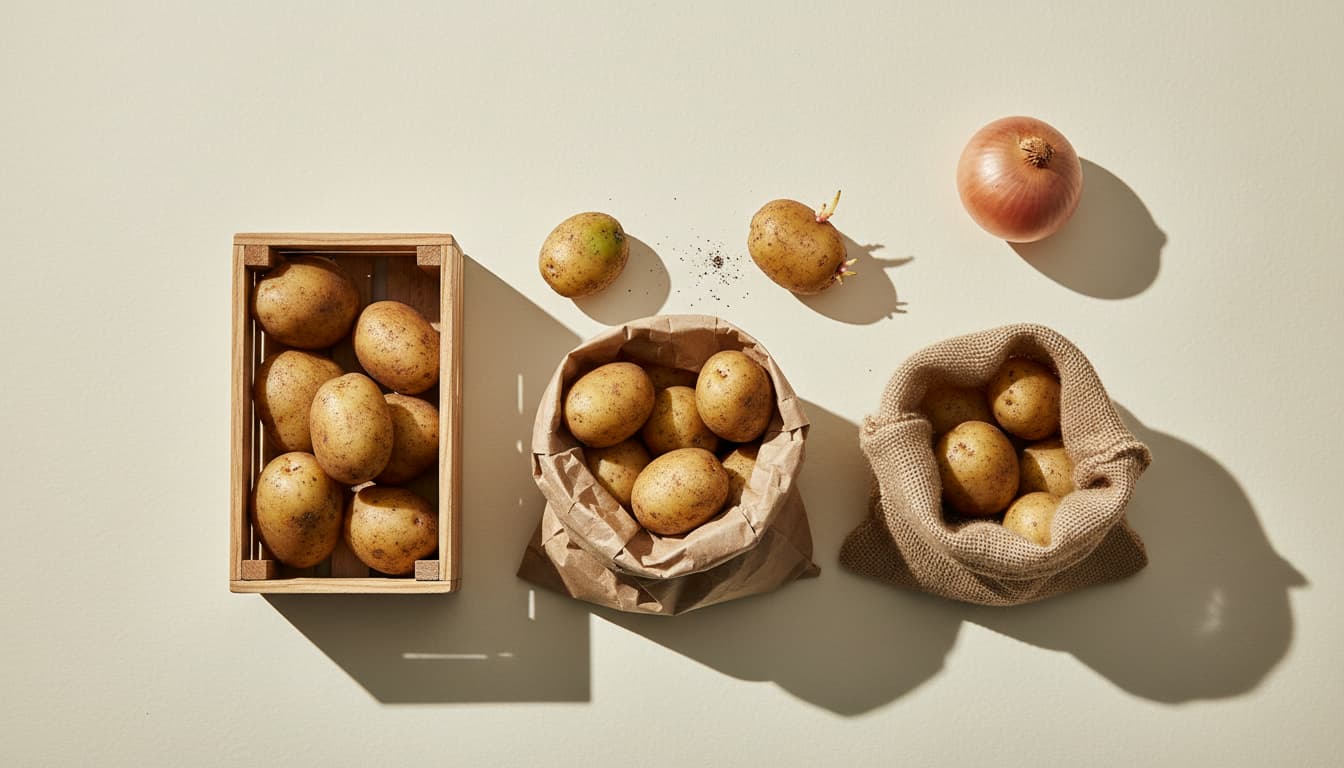
The FDA says to store potatoes outside the refrigerator, because cold storage raises acrylamide during cooking. Light drives greening and both major glycoalkaloids, and EFSA set 1 mg per kg body weight per day.
- 01
The federal storage instruction is the shortest correct answer
Storing potatoes in the refrigerator can result in increased acrylamide during cooking, therefore store potatoes outside the refrigerator, preferably in a dark, cool place, such as a closet or a pantry, to prevent sprouting (FDA). Two details are easy to miss. The stated purpose of the cool place is sprout suppression, the job the refrigerator would otherwise do, and the word preferably marks this as an exposure optimisation rather than a safety line.
- 02
Refrigeration raises acrylamide because cold makes sugar
Below refrigerator temperature a tuber converts starch to reducing sugars, a response known as cold-induced sweetening. Those reducing sugars are one of the two substrates the browning reaction needs, and the agency states the origin without ambiguity: acrylamide forms from natural sugars and the amino acid asparagine in foods (FDA). A refrigerated potato is therefore not the same potato at a lower temperature; it carries more of one of the two ingredients a hot pan requires.
- 03
Acrylamide comes from the food, not from the packaging
Acrylamide forms from natural sugars and the amino acid asparagine in foods, and it does not come from food packaging or the environment (FDA). That single sentence rules out a large amount of circulating advice about wrappers, containers and storage materials. The controllable variables are the sugar concentration in the tuber, which storage temperature sets, and the cooking temperature and time, which the pan sets. Nothing about the bag changes the chemistry.
- 04
Cooking method ranks the exposure, and two methods produce none
Comparing frying, roasting and baking potatoes, frying causes the highest acrylamide formation, roasting potato pieces causes less, followed by baking whole potatoes, while boiling potatoes and microwaving whole potatoes with skin on to make microwaved baked potatoes does not produce acrylamide (FDA). The ranking tracks surface dryness and temperature: the reaction needs a dry surface above the boiling point of water, so any method that keeps the surface wet produces none at all, which makes a boiled potato and a fried one different in kind rather than in degree.
- 05
A 15 to 30 minute soak before frying or roasting
Soaking raw potato slices in water for 15 to 30 minutes before frying or roasting helps reduce acrylamide formation during cooking (FDA). The mechanism is leaching: free sugars and asparagine sit in the cut surface and dissolve out into the water, so the pan meets a surface with less of both substrates. It costs nothing but time, applies to any cut potato product headed for high heat, and matters most when the tuber has been held cold.
- 06
Golden yellow is the endpoint, and brown areas carry more
Generally, more acrylamide accumulates when cooking is done for longer periods or at higher temperatures, and cooking cut potato products such as frozen French fries or potato slices to a golden yellow color rather than a brown color helps reduce acrylamide formation, since brown areas tend to contain more (FDA). Keeping the risk in scale, in laboratory studies acrylamide caused cancer in animals, but at acrylamide levels much higher than those seen in foods (FDA).
- 07
Light drives greening, and darkness prevents it entirely
Under a controlled wavelength comparison, blue and red light were effective for the induction and accumulation of chlorophyll, carotenoids and the two major potato glycoalkaloids, whereas none of these accumulated in darkness or under far-red light (Okamoto et al. 2020). Darkness is not a partial control here, it is a complete one in that experiment, which is why the dark part of cool and dark is the specification rather than a preference.
- 08
The same light induces both major glycoalkaloids
Blue and red wavelengths induced chlorophyll, carotenoids and both alpha-solanine and alpha-chaconine together, and six genes required for glycoalkaloid synthesis were induced under white, blue and red light but not in darkness or far-red; far-red light could also inhibit white-light-induced chlorophyll and glycoalkaloid accumulation (Okamoto et al. 2020). The two responses share an induction signal rather than causing one another, and that shared trigger is what makes the visible one a usable proxy for the invisible one during storage.
- 09
Green is the visible proxy for the invisible compound
Chlorophyll is not toxic and is eaten daily in every green vegetable. Its value on a potato is diagnostic: it is produced by the same light exposure that switches on the glycoalkaloid genes, and the glycoalkaloids themselves are colorless (Okamoto et al. 2020). The asymmetry cuts both ways. A green tuber is not automatically hazardous, and a tuber stored in light can be carrying elevated glycoalkaloids before any green becomes obvious.
- 10
EFSA set an acute reference point of 1 mg per kg body weight per day
The acute toxic effects of potato glycoalkaloids include gastrointestinal symptoms such as nausea, vomiting and diarrhoea, and the Panel identified a lowest-observed-adverse-effect level of 1 mg total potato glycoalkaloids per kg body weight per day as the reference point for acute exposure; no evidence of health problems from repeated or long-term intake via potatoes was identified and no chronic reference point could be derived, so the whole assessment rests on acute exposure alone (EFSA CONTAM Panel 2020).
- 11
The margin of exposure conclusion points at children and the upper tail
Applying a margin of exposure approach, the margins for the younger age groups indicate a health concern for the surveys with the highest mean exposure and for the 95th percentile exposure in all surveys, and for adults only for the surveys with the highest 95th percentile exposures (EFSA CONTAM Panel 2020). Because the reference point is per kg of body weight, a child eating an adult-sized portion takes a proportionally larger dose, which is where storage discipline actually pays.
- 12
What to cut away, and when to stop trimming
Glycoalkaloids concentrate in the peel, the layer immediately beneath it, the eyes and the sprouts, which is the same tissue where the green appears, so peeling generously and cutting out sprouts and green areas removes most of what the light created. A tuber green across most of its surface is not worth trimming. Bitterness is the sensory correlate of high glycoalkaloid content and is the only household signal that maps to the compound rather than to its proxy (EFSA CONTAM Panel 2020).
- 13
Paper beats plastic because the failure mode is condensation
A tuber respires and gives off moisture. A paper sack or an open crate lets that moisture escape, while a sealed plastic bag traps it against the skin, and condensation on the surface is the start of soft rot rather than a preservation strategy. Ventilation is doing the same job here that darkness does for the glycoalkaloids: removing a driver rather than adding a treatment. A cupboard away from the oven and the window is the whole specification.
- 14
Do not store potatoes with onions, and audit by feel rather than by date
Onions are stored dry and potatoes slightly humid, so the two have incompatible optima and each accelerates deterioration in the other. Held cool and dark alongside the rest of the pantry staples but out of the light, a sound tuber holds for several weeks to a few months depending on variety and curing. The audit is sensory rather than calendar-based: firmness, no sprouts, no green, no bitterness, checked whenever the cupboard is opened.
What people ask us next.
- Can potatoes go in the refrigerator?
- The agency instruction is not to. Storing potatoes in the refrigerator can result in increased acrylamide during cooking, therefore store potatoes outside the refrigerator, preferably in a dark, cool place, such as a closet or a pantry, to prevent sprouting (FDA). The mechanism is cold-induced sweetening: chilled tubers accumulate reducing sugars, and acrylamide forms from natural sugars and the amino acid asparagine in foods (FDA). One cold potato harms nobody, but the habit works against the cooking step.
- Are green potatoes safe to eat?
- The green itself is chlorophyll and is harmless. It matters because the same light that produces it also induces the two major glycoalkaloids, alpha-solanine and alpha-chaconine, which are colorless; blue and red light induced chlorophyll, carotenoids and both glycoalkaloids together, while none accumulated in darkness or far-red (Okamoto et al. 2020). Cut away green areas, eyes and sprouts generously, and discard a tuber that is green over most of its surface or tastes bitter.
- How much glycoalkaloid is too much?
- The Panel identified a lowest-observed-adverse-effect level of 1 mg total potato glycoalkaloids per kg body weight per day as the reference point for acute exposure, with acute effects including nausea, vomiting and diarrhoea; no evidence of health problems from repeated or long-term intake via potatoes was identified and no chronic reference point could be derived (EFSA CONTAM Panel 2020). Because the figure is per kg of body weight, children reach it on a smaller portion than adults do.
- Do sprouted potatoes have to be thrown out?
- Not automatically. Sprouts and the eyes they grow from are among the tissues where glycoalkaloids concentrate, along with the peel and the layer just beneath it, so removing them removes most of the load. Firmness is the deciding variable: a firm tuber with a few sprouts can be trimmed and used, while one that has gone soft and shrivelled has spent its stored carbohydrate on the sprouts and is a quality loss regardless of the glycoalkaloid question (EFSA CONTAM Panel 2020).
- Should acrylamide change how potatoes are cooked at home?
- Modestly, and the levers are cheap. Frying causes the highest acrylamide formation, roasting pieces less, then baking whole potatoes, while boiling and microwaving whole potatoes with skin on produce none; soaking raw slices for 15 to 30 minutes before frying or roasting reduces formation; and cooking to a golden yellow rather than a brown color reduces it further, since brown areas tend to contain more (FDA). In laboratory studies acrylamide caused cancer in animals, but at levels much higher than those seen in foods (FDA).
- What temperature should a potato cupboard be?
- Cool rather than cold, and the instruction is defined by exclusion: outside the refrigerator, preferably in a dark, cool place such as a closet or a pantry, to prevent sprouting (FDA). The upper bound is set by sprouting and the lower bound by cold-induced sweetening, so the target is the coolest spot in the house that is not the refrigerator. An unheated interior cupboard, a cellar or a north-facing utility space fits; the cupboard next to the oven does not.
- Why not a plastic bag?
- Because a tuber respires and gives off moisture, and a sealed bag traps it. Condensation sitting on the skin is the start of soft rot rather than a preservation measure, so a paper sack, a crate or a ventilated bin is the better container. The bag also has to be opaque, since light is the single input that induces chlorophyll, carotenoids and both major glycoalkaloids, none of which accumulated in darkness in the controlled comparison (Okamoto et al. 2020).
- How long do stored potatoes actually last?
- Held cool, dark and ventilated, a sound tuber holds for several weeks to a few months, with the range set by variety and by how well it was cured before sale. Calendar figures are less useful here than a sensory audit, because storage conditions dominate: check for firmness, absence of sprouts, absence of green and absence of bitterness. For composition after peeling, boiling or baking, the USDA FoodData Central entries for potatoes are the reference to check rather than a general figure.
Every claim, cited.
- [01]United States Food and Drug Administration. Acrylamide and Diet, Food Storage, and Food Preparation. States that acrylamide forms from natural sugars and the amino acid asparagine in foods and does not come from food packaging or the environment. On cooking method: comparing frying, roasting and baking potatoes, frying causes the highest acrylamide formation, roasting potato pieces causes less acrylamide formation, followed by baking whole potatoes, while boiling potatoes and microwaving whole potatoes with skin on to make microwaved baked potatoes does not produce acrylamide. On preparation: soaking raw potato slices in water for 15 to 30 minutes before frying or roasting helps reduce acrylamide formation during cooking. On storage: storing potatoes in the refrigerator can result in increased acrylamide during cooking, therefore store potatoes outside the refrigerator, preferably in a dark, cool place, such as a closet or a pantry, to prevent sprouting. On cooking endpoint: generally, more acrylamide accumulates when cooking is done for longer periods or at higher temperatures, and cooking cut potato products such as frozen French fries or potato slices to a golden yellow color rather than a brown color helps reduce acrylamide formation, because brown areas tend to contain more acrylamide. On hazard scale: in laboratory studies, acrylamide caused cancer in animals, but at acrylamide levels much higher than those seen in foods.
- [02]Okamoto H, Ducreux LJM, Allwood JW, Hedley PE, Wright A, Gebhardt C, Freitag S, Ross HA, Taylor MA. 2020. Light regulation of chlorophyll and glycoalkaloid biosynthesis during tuber greening of potato. Front Plant Sci 11:753. Tubers were exposed to defined wavelengths to separate the pigment response from the toxin response. Blue and red wavelengths were effective for the induction and accumulation of chlorophyll, carotenoids and the two major potato glycoalkaloids, alpha-solanine and alpha-chaconine, whereas none of these accumulated in darkness or under far-red light. Six genes required for glycoalkaloid synthesis were induced under white, blue and red light but were not induced in darkness or under far-red light. Far-red light was able to inhibit white-light-induced chlorophyll and glycoalkaloid accumulation. The practical consequence for storage is that the visible greening and the invisible glycoalkaloid accumulation share an induction signal, so darkness controls both and the green is a usable proxy for an exposure that is otherwise undetectable by eye.
- [03]EFSA Panel on Contaminants in the Food Chain (CONTAM). 2020. Risk assessment of glycoalkaloids in feed and food, in particular in potatoes and potato-derived products. EFSA J 18(8):e06222. The acute toxic effects of potato glycoalkaloids, alpha-solanine and alpha-chaconine, include gastrointestinal symptoms such as nausea, vomiting and diarrhoea. The Panel identified a lowest-observed-adverse-effect level of 1 mg total potato glycoalkaloids per kg body weight per day as the reference point for acute exposure. No evidence of health problems associated with repeated or long-term intake of glycoalkaloids via potatoes was identified, and no chronic reference point could be derived, so a margin of exposure approach was applied. The margins of exposure for the younger age groups indicate a health concern for the surveys with the highest mean exposure and for the 95th percentile exposure in all surveys, and for adults only for the surveys with the highest 95th percentile exposures.
- [04]United States Department of Agriculture, FoodData Central. Search results for potatoes. The federal composition database covering raw, boiled, baked, microwaved and fried potato entries with and without skin, giving energy, carbohydrate, fiber, potassium, vitamin C and other nutrient values per 100 g and per common household portion. Useful here because peeling and cooking method change the profile materially for the same tuber, so a general figure for a potato is less informative than the entry matching the preparation actually used.
- [05]United States Department of Agriculture, Food Safety and Inspection Service. Refrigeration and Food Safety. Sets the refrigerator standard at 40 degrees Fahrenheit or below and the freezer standard at 0 degrees Fahrenheit or below, explains that refrigeration slows rather than stops bacterial growth, and gives the 2 hour rule for perishable food held above refrigeration temperature, reduced to 1 hour above 90 degrees Fahrenheit. Relevant to potatoes on the cut-product side rather than the whole-tuber side: once peeled or cut, a potato behaves as a perishable prepared food and belongs under the refrigeration rules, whereas the whole tuber is explicitly excluded from the refrigerator by the acrylamide guidance.
The Larderlab Team builds evidence-led frameworks for eating, lifting, and stocking a kitchen. We cite every claim. We publish the spreadsheet when possible. We buy what we review at retail price. When new data lands, we revise with a dated note.
Next in this hub.
How to Store Rice: White Keeps Almost Indefinitely, Brown Has About Six Months
Milled white rice keeps almost indefinitely on a pantry shelf; brown rice has roughly six months because of the oil in the bran. Lipase-driven rancidity varies more than fifteenfold between rice genotypes. Boiled rice held warm reached 10 to the 7th cfu per gram and produced emetic toxin.
12 min · rev 2026-09-10How to Store Coffee: Temperature, Water Activity and the Grind
Beans held at 20 degrees Celsius aged fastest across a 12-month comparison, while minus 10 and plus 10 performed similarly. Water activity sets the staling rate of ground coffee, and cold beans grind finer and more evenly.
8 min · rev 2026-09-02How to Store Eggs: Why the US Refrigerates and the EU Does Not
The United States requires refrigeration at 40 degrees Fahrenheit or below. European rules say Class A eggs shall not be washed and should in general not be refrigerated before sale. One processing step explains the split.
8 min · rev 2026-09-02Get the Larderlab Macro Planner.
A Google Sheet that calculates your protein target, splits it across 3-5 meals, and ranks 20 protein sources by $/gram. Free. Copy-and-modify your own version.
By subscribing, you agree to our Privacy Policy. Unsubscribe anytime.