How to store rice, and why brown and white are two different storage problems
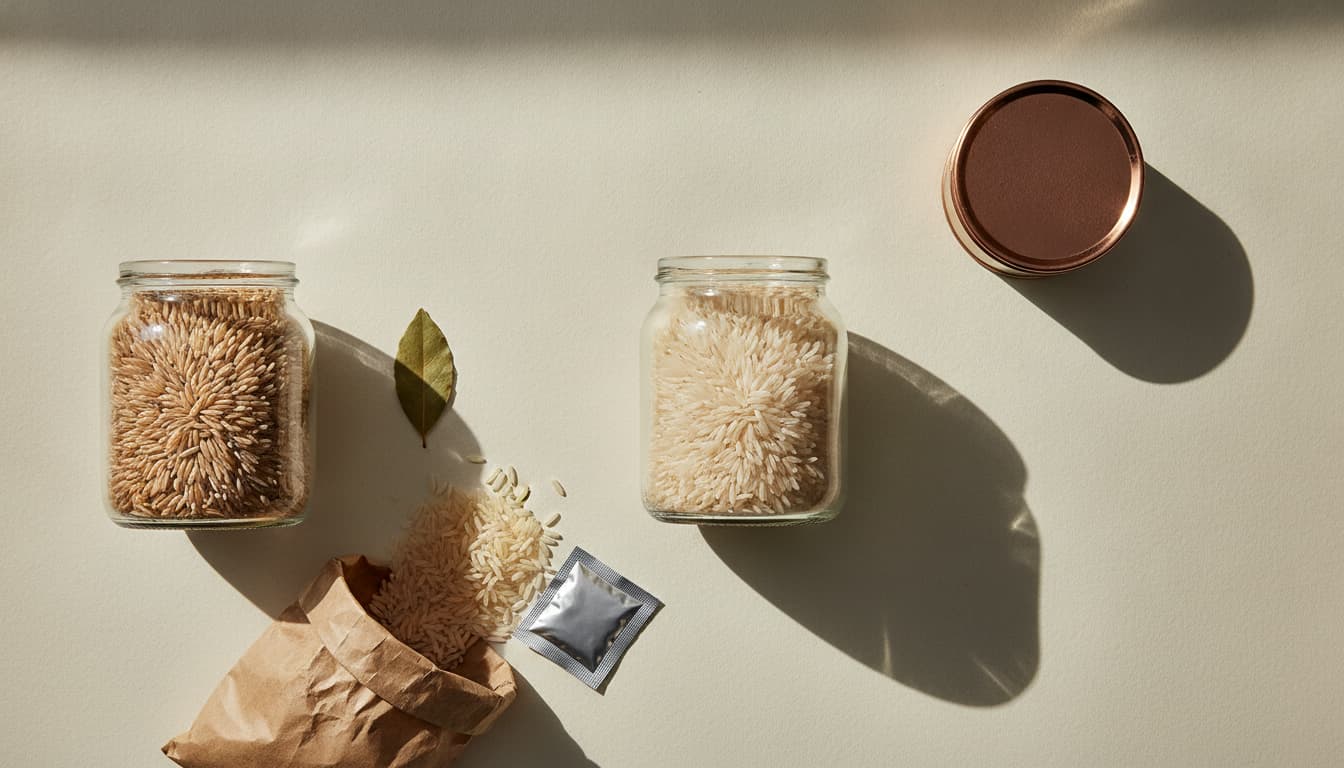
Milled white rice keeps almost indefinitely on a pantry shelf; brown rice has roughly six months because of the oil in the bran. Lipase-driven rancidity varies more than fifteenfold between rice genotypes. Boiled rice held warm reached 10 to the 7th cfu per gram and produced emetic toxin.
- 01
Milled white rice keeps almost indefinitely, and that is a trade-body statement rather than folklore
If stored properly, milled rice will keep almost indefinitely on the pantry shelf (USA Rice Federation). Milling removes the bran and germ and with them most of the lipid and the enzymes that degrade it, leaving a low-moisture starch and protein matrix with nothing to go rancid and no water activity to support microbial growth. The printed date on a bag of white rice is a quality and traceability convention, not a limit.
- 02
Brown rice gets roughly six months because of the oil in the bran
Because of the oil in the bran layer, brown rice has a shelf life of approximately six months, and refrigerator or freezer storage is recommended for longer shelf life (USA Rice Federation). The bran that carries the additional nutrients is the same bran that carries the lipid and the enzymes, so the nutritional advantage and the storage disadvantage are the same anatomical feature and cannot be separated.
- 03
The failure mode is enzymatic rancidity, not spoilage
The bran contains non-starch lipids deposited along with the lipid degrading enzymes lipase and lipoxygenase, resulting in a relatively short shelf life for whole grain rice (Chen et al. 2019). Lipase cleaves free fatty acids from the bran triglycerides, which then oxidise into the aldehydes responsible for the stale smell. Nothing is growing and nothing is unsafe; the grain is chemically converting into something that tastes wrong.
- 04
Rancidity varies more than fifteenfold between rice genotypes
A study of lipase-induced hydrolytic rancidity in the bran of 134 diverse rice genotypes found more than a fifteenfold variation, with red or brown bran types lower than purple, light brown and white brans (Chen et al. 2019). That spread is the reason no single shelf life figure fits every bag of brown rice, and it means one bag can be acceptable at nine months while another is flat at four.
- 05
Phenolics appear to inhibit the enzyme, which links colour to keeping quality
Total phenolic content and anthocyanins were negatively correlated with hydrolytic rancidity in purple brans, suggesting an inhibitory effect on lipase during bran storage, and the authors proposed low-rancidity genotypes as breeding material for improved storage stability (Chen et al. 2019). This is a research direction rather than a shopping rule today, but it explains why pigmented rices do not all behave the same way in a cupboard.
- 06
Cold is the only intervention that changes the brown rice clock
Refrigerator or freezer storage is recommended specifically for brown rice and not for milled rice (USA Rice Federation), because the mechanism being slowed is enzymatic and enzyme rate responds to temperature. Nothing about packaging, container material or antioxidant additions has an equivalent effect in a home setting. The alternative to cold storage is not a better container, it is buying less at a time.
- 07
The purchasing rule matters more than the container
A large sack of brown rice bought on unit price and consumed over 18 months is a false economy, because most of it will pass through the rancidity window before it is eaten. White rice is the opposite and is one of the few genuinely rational bulk purchases in a dry pantry. Splitting the buying rule by type is the single highest-value change, and the reasoning is the same as the standard bulk buying math.
- 08
Moisture is the only route from stable to unsafe
Dry rice sits far below the water activity that supports microbial growth, which is why a sealed bag is inert. Steam from a nearby cooktop, a damp cupboard or a wet scoop changes that, and clumping is the visible signal that water has entered. Visible mould is the one unambiguous discard trigger for a dry staple. An airtight opaque container excludes moisture and light and also excludes the stored product insects responsible for most real pantry losses.
- 09
Boiled rice grew to 10 to the 7th cfu per gram and made toxin within 24 hours
When a vomiting-type Bacillus cereus strain was inoculated into various foods and incubated for 24 hours, boiled rice supported rapid growth to 10 to the 7th through 10 to the 8th cfu per gram with emetic toxin production at both 30 and 35 degrees Celsius, and farinaceous foods generally produced toxin at levels as high as those in samples implicated in real poisoning cases (Agata et al. 2002). Cooked rice at room temperature is an unusually favourable substrate.
- 10
Thirteen of fourteen implicated food samples contained measurable cereulide
Across 14 food samples implicated in vomiting-type food poisoning cases, 13 contained the emetic toxin at 0.01 to 1.28 micrograms per gram (Agata et al. 2002). The concentration range spans two orders of magnitude, which is consistent with the toxin accumulating as a function of time and temperature rather than being present or absent. Every hour a pot of rice spends between refrigeration and serving is time on that curve.
- 11
Cereulide is heat stable, so reheating does not undo the mistake
Bacillus cereus causes a diarrhoeal illness through heat-resistant enterotoxin proteins and an emetic illness through the toxin cereulide (Leong et al. 2023), and the emetic toxin survives cooking temperatures. Reheating rice that spent hours on a counter kills the vegetative cells and leaves what they produced. That is why the intervention has to be rapid cooling and why heating a suspect batch harder is the wrong response.
- 12
Acid inhibited growth and toxin production in the same experiment
Bacterial growth and toxin production were inhibited in foods cooked with vinegar, mayonnaise and catsup, apparently through the decreased pH from acetic acid (Agata et al. 2002). This is a real mechanism rather than a workaround, and it explains why acidified rice dishes behave differently from plain boiled rice. It is not a licence to leave anything out; it is a reason acidified preparations show up less often in the outbreak record.
- 13
The clock that matters starts when the pot comes off the heat
Perishable food should not be left at room temperature for more than 2 hours, or more than 1 hour when the ambient temperature is above 90 degrees Fahrenheit (USDA FSIS). For a large batch the practical obstacle is that a covered pot cools slowly, so spreading rice in a shallow layer or dividing it between containers is what actually gets it through the danger zone in time. Depth of the mass, not the size of the fridge, is the limiting variable.
- 14
Arsenic belongs to the buying decision, not the cupboard
Inorganic arsenic content in rice is determined by variety and growing region and is modified by cooking method, and no storage practice changes it. It is worth deciding once at the point of purchase and then leaving out of the storage system entirely, which keeps the two questions from being conflated. Storage governs rancidity, insects and moisture; procurement and cooking govern arsenic.
What people ask us next.
- How long does uncooked white rice last?
- Effectively as long as it stays dry. If stored properly, milled rice will keep almost indefinitely on the pantry shelf (USA Rice Federation), because milling removes the bran and germ and with them almost all of the lipid available to go rancid, leaving a low-moisture starch matrix that supports no microbial growth. The printed date is a quality and traceability convention. The real discard triggers are visible mould, hard caking or insect activity.
- How long does brown rice last, and why is it so much shorter?
- Approximately six months at room temperature, with refrigerator or freezer storage recommended for longer (USA Rice Federation). The reason is the bran layer, which carries non-starch lipids deposited alongside the lipid degrading enzymes lipase and lipoxygenase, giving whole grain rice a relatively short shelf life (Chen et al. 2019). The nutritional advantage of brown rice and its storage disadvantage are the same anatomical feature.
- Should brown rice go in the fridge or freezer?
- Yes if it will not be eaten within about six months. Refrigerator or freezer storage is recommended specifically for brown rice to extend its shelf life (USA Rice Federation), and it works because the process being slowed is enzymatic. No container upgrade produces an equivalent effect at room temperature. The alternative is buying smaller quantities more often, which achieves the same result without using freezer space.
- How can you tell if brown rice has gone off?
- By smell, before cooking. Hydrolytic rancidity produces free fatty acids that oxidise into aldehydes with a stale, oily, crayon-like odour, and the process varies more than fifteenfold between genotypes (Chen et al. 2019), so no date predicts it reliably. Rancid rice is a palatability problem rather than a safety problem. Mould or hard caking is a different matter and means water got in, which is a discard trigger.
- What actually causes food poisoning from rice?
- Bacillus cereus, and specifically the emetic toxin cereulide produced in cooked rice held warm. Boiled rice inoculated with a vomiting-type strain grew to 10 to the 7th through 10 to the 8th cfu per gram and produced emetic toxin at 30 and 35 degrees Celsius within 24 hours, and 13 of 14 foods implicated in real cases contained 0.01 to 1.28 micrograms per gram of toxin (Agata et al. 2002). The spores survive boiling, so cooking does not prevent it.
- Does reheating rice make it safe?
- No. The emetic illness is caused by cereulide, a heat-stable toxin, while only the diarrhoeal enterotoxins are heat-labile (Leong et al. 2023). Reheating kills the vegetative cells and leaves the toxin they already produced, so a rice that spent four hours on a counter is not rescued by a hotter pan. The only effective intervention is cooling fast enough that the toxin is never produced.
- How quickly does cooked rice need to be refrigerated?
- Within 2 hours, or within 1 hour when the ambient temperature is above 90 degrees Fahrenheit (USDA FSIS). The practical obstacle with a large batch is that a covered pot cools very slowly, so the depth of the mass matters more than the capacity of the refrigerator. Spreading the rice in a shallow layer or dividing it between containers is what gets it through the danger zone inside the window.
- Is it worth buying rice in bulk?
- For white rice yes, for brown rice usually not. White rice keeps almost indefinitely when stored properly, so unit price is the only variable that matters and the standard bulk buying math applies cleanly. Brown rice has roughly a six-month window, so a large sack consumed over 18 months converts a saving into waste unless it is refrigerated or frozen. Split the purchasing rule by type rather than by price per kilogram.
Every claim, cited.
- [01]USA Rice Federation, How To Store Rice. States that if stored properly, milled rice will keep almost indefinitely on the pantry shelf; that because of the oil in the bran layer, brown rice has a shelf life of approximately six months, with refrigerator or freezer storage recommended for longer shelf life; and that cooked rice may be stored in the refrigerator for three to five days or frozen up to six months. Also advises storing rice in a tightly closed container that keeps out dust, moisture and other contaminants once opened.
- [02]Chen MH, Bergman CJ, McClung AM. 2019. Hydrolytic rancidity and its association with phenolics in rice bran. Food Chem 285:485-491. Whole grain rice, which has the bran layer intact, contains more nutrients and health beneficial compounds than its milled equivalent, but the bran contains non-starch lipids deposited along with the lipid degrading enzymes lipase and lipoxygenase, resulting in a relatively short shelf life for whole grain rice. The authors studied the genotypic diversity of lipase-induced hydrolytic rancidity in the bran of 134 diverse genotypes and found more than a 15-fold variation. Genotypes with red or brown bran had lower hydrolytic rancidity than the purple, light brown and white brans. Total phenolic content and anthocyanins were negatively correlated with hydrolytic rancidity in purple brans, suggesting an inhibitory effect on lipase during bran storage. The authors concluded that low-rancidity genotypes could be used as breeding materials to improve the storage stability of whole grain rice.
- [03]Agata N, Ohta M, Yokoyama K. 2002. Production of Bacillus cereus emetic toxin (cereulide) in various foods. Int J Food Microbiol 73(1):23-27. The amount of emetic toxin in 13 of 14 food samples implicated in vomiting-type food poisoning cases ranged from 0.01 to 1.28 micrograms per gram. A vomiting-type strain, B. cereus NC7401, was inoculated into various foods and incubated for 24 hours at 20, 30 and 35 degrees Celsius. In boiled rice, B. cereus rapidly increased to 10 to the 7th through 10 to the 8th cfu per gram and produced emetic toxin at both 30 and 35 degrees Celsius. In farinaceous foods, the production of emetic toxin was as high as that in the food samples implicated in food poisoning. Low levels were detectable in egg and meat products and small quantities in liquid foods such as milk and soymilk when not aerated. Bacterial growth and toxin production were inhibited in foods cooked with vinegar, mayonnaise and catsup, supposedly by the decreased pH of acetic acid.
- [04]Leong SS, Korel F, King JH. 2023. Bacillus cereus: A review of fried rice syndrome causative agents. Microb Pathog 185:106418. Compiles available data on the prevalence of B. cereus outbreak cases occurring between 1984 and 2019. B. cereus causes a self-limiting diarrhoeal illness caused by heat-resistant enterotoxin proteins and an emetic illness caused by the toxin cereulide. The review covers the prevalence of B. cereus in starchy food contamination and reported outbreak cases, the virulence of both enterotoxins and emetic toxins, and the possibility of contamination in protein-rich foods, and notes that constant monitoring during food handling is essential.
- [05]USDA Food Safety and Inspection Service, Refrigeration and Food Safety. Perishable food should not be left at room temperature for more than 2 hours, or more than 1 hour when the ambient temperature is above 90 degrees Fahrenheit, and should be held at 40 degrees Fahrenheit or below. This is the clock that governs cooked rice, and the practical constraint is that a deep covered mass of hot rice cools slowly, so the food must be divided or spread to pass through the danger zone within the stated window.
- [06]USDA Food Safety and Inspection Service, Shelf-Stable Food Safety. Guidance on storing dry staples in a cool, dry place, and specifically not above the stove, under the sink, in a damp garage or basement, or anywhere exposed to temperature extremes. Used here for the moisture and location rules that apply to both white and brown rice, and for the position that visible mould or caking, rather than a printed date, is the discard trigger for a dry product.
- [07]USDA FoodData Central, entries for rice, white, long-grain, regular, raw, and rice, brown, long-grain, raw. Used for the composition contrast underlying the storage difference, in particular the higher total lipid content of the brown entry, which is the fraction subject to the hydrolytic rancidity described by Chen et al.
The Larderlab Team builds evidence-led frameworks for eating, lifting, and stocking a kitchen. We cite every claim. We publish the spreadsheet when possible. We buy what we review at retail price. When new data lands, we revise with a dated note.
Next in this hub.
How to Store Potatoes: The Cold Sweetening and Greening Trade-off
The FDA says to store potatoes outside the refrigerator, because cold storage raises acrylamide during cooking. Light drives greening and both major glycoalkaloids, and EFSA set 1 mg per kg body weight per day.
12 min · rev 2026-09-03How to Store Coffee: Temperature, Water Activity and the Grind
Beans held at 20 degrees Celsius aged fastest across a 12-month comparison, while minus 10 and plus 10 performed similarly. Water activity sets the staling rate of ground coffee, and cold beans grind finer and more evenly.
8 min · rev 2026-09-02How to Store Eggs: Why the US Refrigerates and the EU Does Not
The United States requires refrigeration at 40 degrees Fahrenheit or below. European rules say Class A eggs shall not be washed and should in general not be refrigerated before sale. One processing step explains the split.
8 min · rev 2026-09-02Get the Larderlab Macro Planner.
A Google Sheet that calculates your protein target, splits it across 3-5 meals, and ranks 20 protein sources by $/gram. Free. Copy-and-modify your own version.
By subscribing, you agree to our Privacy Policy. Unsubscribe anytime.