How to store onions and garlic, by the postharvest data
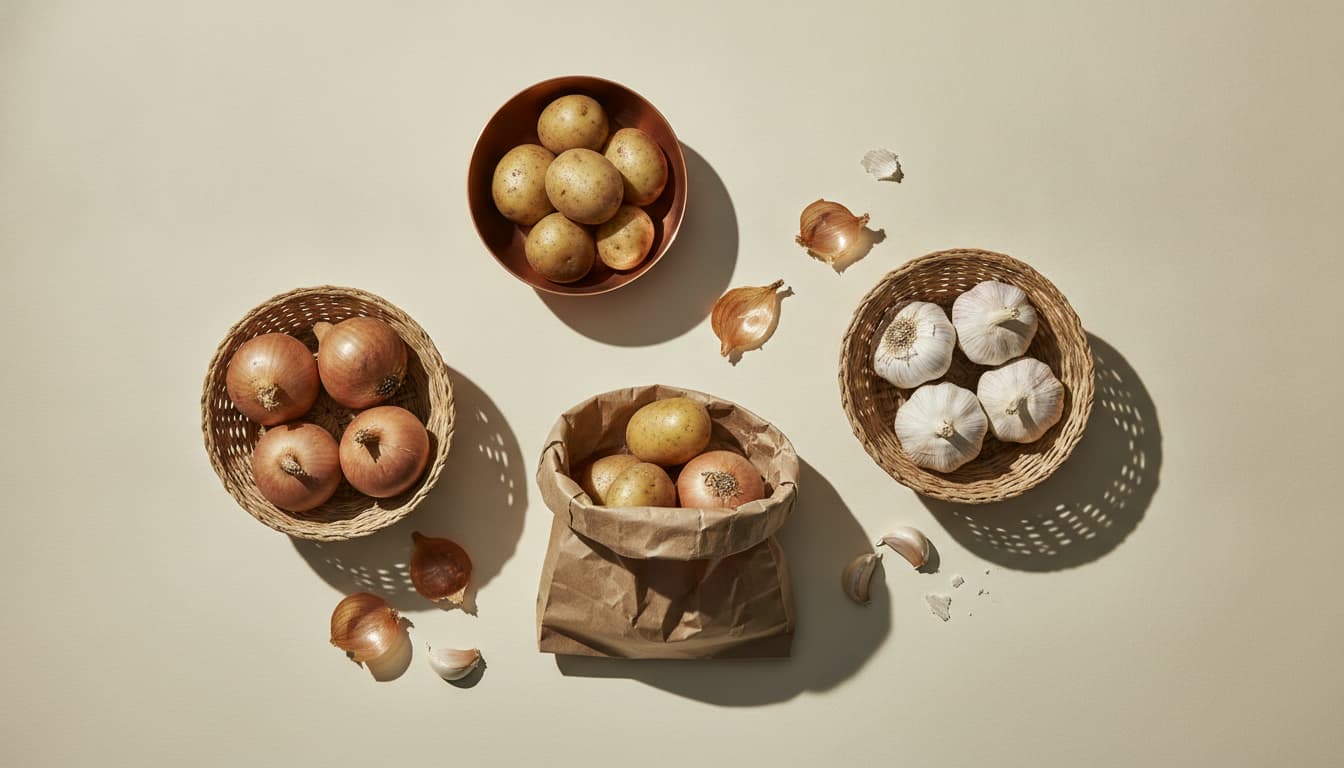
Both are living bulbs running a dormancy programme, and storage either holds it or releases it. Curing temperature, storage temperature and humidity are the three inputs, and the measured outcomes are sprouting, rooting and weight loss.
- 01
Dormancy is short; what follows is suppression
Across three cultivars over three years, transcriptional differences were greater between harvest and pre-sprouting than between pre-sprouting and post-sprouting samples, with significant changes during the short curing period, which the authors read as the transition from endo-dormancy to sprout suppression and as evidence that endo-dormancy is a relatively short period ending just after curing (Chope et al. 2012). After that the storage environment, not the bulb, is doing the work.
- 02
The biochemical signature of a bulb about to sprout
Principal component analysis of biochemical and physiological data identified the ratio of monosaccharides, fructose and glucose, to the disaccharide sucrose, along with the concentration of zeatin riboside, as the important factors discriminating sprouting from pre-sprouting bulbs (Chope et al. 2012). The bulb is remobilising stored carbohydrate before anything green appears, which is why a bulb that looks fine can be past the point of no return.
- 03
Curing hotter buys nothing
Bulbs cured at 20, 24 and 28 degrees Celsius showed no detrimental effect on storage life or quality from curing at the lowest of the three, which the authors noted produces a considerable saving in energy and costs (Chope et al. 2012). For a buyer this is a supply-chain fact rather than an action, but it explains why sacks from different growers behave so differently in the same cupboard: much of the storage outcome was set before purchase.
- 04
Cool extends, but ambient can still reach seven months
Four onion cultivars stored at 5 plus or minus 1 and 25 plus or minus 1 degrees Celsius at 60 to 70 plus or minus 5 percent relative humidity, with storage ending at loss of marketable quality or sprouting, showed that a genuine storage landrace kept at least 7 months at 25 degrees and could be held longer at 5 degrees without significant marketability or quality loss (Petropoulos et al. 2016). Cultivar is doing as much work here as temperature.
- 05
The humidity number is 60 to 70 percent, which is dry
Both storage temperatures in that comparison were run at 60 to 70 plus or minus 5 percent relative humidity (Petropoulos et al. 2016). That is the opposite of the high-humidity conditions that suit leafy produce, and it is the single detail most domestic storage gets wrong. A sealed plastic bag traps respiration moisture against the tunic and invites rot; a paper sack, mesh bag or open basket in a dry cupboard is close to the tested condition.
- 06
At ambient, the loss is water rather than rot
Over 144 days of ambient storage, no rotting appeared up to 24 days and no sprouting up to 84 days, while physiological loss in weight ranged from 28.5 to 63.6 percent across treatments at five months, and ascorbic acid decreased significantly throughout (Sharma et al. 2020). An onion that has gone soft in a warm kitchen after three months has dehydrated on the scale of a third to two-thirds of its mass rather than spoiled.
- 07
Garlic loses allicin at fridge temperature
Peeled garlic cloves in modified atmosphere packaging held at 0 and 5 degrees Celsius for four months lost firmness and vitamin C notably, showed higher weight loss and titratable acidity at 5 degrees than at 0, and allicin content generally decreased at 5 degrees, with the conclusion that cloves keep up to four months at 0 degrees or three months at 5 (Akan et al. 2019). Domestic refrigerators sit in that warmer, worse band.
- 08
The decision rule, in one line each
Whole cured bulbs: cool, dark, dry at roughly 60 to 70 percent relative humidity, in a container that breathes rather than seals (Petropoulos et al. 2016). Not the refrigerator, which is both too humid for the papery skins and, for garlic, warm enough to cost allicin (Akan et al. 2019). Buy in quantities that will be used, because the storage ceiling was largely set by growing and curing (Chope et al. 2012). Treat sprouting as the end of the window and softness as water loss.
What people ask us next.
- Should onions be kept in the refrigerator?
- Whole cured onions should not. The tested storage condition for onion bulbs was 60 to 70 plus or minus 5 percent relative humidity at either 5 or 25 degrees Celsius (Petropoulos et al. 2016), and a domestic fridge is considerably more humid than that, which traps moisture against the papery tunic and invites surface rot. A cool, dark, dry cupboard with air movement matches the tested condition better. A cut onion is a different case and belongs covered in the fridge.
- Why does garlic go rubbery or lose its bite in the fridge?
- Because both its texture and its active chemistry move at those temperatures. Cloves held at 0 and 5 degrees Celsius for four months lost firmness and vitamin C notably, with higher weight loss and titratable acidity at 5 degrees than at 0, and allicin content generally decreased at 5 degrees over the period (Akan et al. 2019). A domestic refrigerator runs near or above 5 degrees, so it is in the worse half of that comparison while also being too humid for the skins.
- How long should onions keep at home?
- Longer than most people assume, and the ceiling is set by the cultivar and the curing rather than by the cupboard. A genuine storage landrace kept at least 7 months at 25 plus or minus 1 degrees Celsius at 60 to 70 percent relative humidity, and could be held longer at 5 degrees without significant quality loss (Petropoulos et al. 2016). A sweet or fresh-market onion will not do that, which is why the same storage conditions produce very different results with different sacks.
- Is a sprouted onion or garlic clove safe to eat?
- Sprouting is the end of the storage window rather than a safety event. It marks the release of sprout suppression, and the bulb has already begun remobilising stored carbohydrate, with the monosaccharide-to-sucrose ratio and zeatin riboside concentration discriminating sprouting from pre-sprouting bulbs before anything is visible (Chope et al. 2012). The texture softens and the flavour changes as the bulb feeds the shoot. Trim and use, or discard on quality grounds.
- Should onions and potatoes be stored together?
- No, and the reasons are separate for each. Onions want dry air at around 60 to 70 percent relative humidity (Petropoulos et al. 2016), while potatoes are the one produce item with a specific chemical reason to be kept cool but not cold, since cold storage raises reducing sugars that generate acrylamide on high-temperature cooking, a case covered in the vegetable storage analysis on this site. Storing them together forces one compromise on humidity and another on temperature.
- Does a soft onion mean it has gone bad?
- Usually it means it has dried out. Across 144 days of ambient storage, physiological loss in weight reached 28.5 to 63.6 percent at five months while no rotting was observed up to 24 days and no sprouting up to 84 days (Sharma et al. 2020). Softness on that scale of water loss is a quality problem, not a spoilage one. Visible mould, a wet or slimy layer under the skin, or an off smell is a different signal and a reason to discard.
Every claim, cited.
- [01]Chope GA, Cools K, Hammond JP, Thompson AJ, Terry LA. 2012. Physiological, biochemical and transcriptional analysis of onion bulbs during storage. Ann Bot 109(4):819-31. Cultivars Wellington, Sherpa and Red Baron grown at different sites over three years, cured at 20, 24 and 28 degrees Celsius and stored at 1, 3, 6 and 6 then 1 degrees; greater transcriptional differences between harvest and pre-sprouting than between pre- and post-sprouting samples, with significant changes during the short curing period; endo-dormancy is a relatively short period ending just after curing; the ratio of monosaccharides (fructose and glucose) to sucrose and the concentration of zeatin riboside discriminate sprouting from pre-sprouting bulbs; no detrimental effect on storage life or quality from curing at 20 degrees.
- [02]Petropoulos SA, Ntatsi G, Fernandes A, et al. 2016. Long-term storage effect on chemical composition, nutritional value and quality of Greek onion landrace Vatikiotiko. Food Chem 201:168-76. Dry bulbs of Vatikiotiko, Sivan F1, Red Cross F1 and Creamgold stored at 5 plus or minus 1 and 25 plus or minus 1 degrees Celsius, both at 60 to 70 plus or minus 5 percent relative humidity; measurements of fresh and dry weight, tunic and flesh colour, firmness, nutritional value and mineral composition at intervals; storage concluded when bulbs lost marketable quality or sprouted; Vatikiotiko stored at least 7 months at 25 plus or minus 1 degrees and could be prolonged at 5 plus or minus 1 degrees without significant marketability or quality loss.
- [03]Sharma P, Sharma SR, Dhall RK, Mittal TC. 2020. Effect of gamma-radiation on post-harvest storage life and quality of onion bulb under ambient condition. J Food Sci Technol 57(7):2534-2544. Onion bulbs stored at ambient temperature for 144 days; no rotting observed up to 24 days and no sprouting up to 84 days in both irradiated and un-irradiated bulbs; physiological loss in weight 28.5 to 63.6 percent across all treatments at five months; ascorbic acid content decreased significantly during storage in all treatments.
- [04]Akan S, Tuna Gunes N, Yanmaz R. 2019. Methyl jasmonate and low temperature can help for keeping some physicochemical quality parameters in garlic (Allium sativum L.) cloves. Food Chem 270:546-553. Modified atmosphere packed peeled garlic cloves stored at 0 and 5 degrees Celsius for four months; firmness and vitamin C notably decreased; higher weight loss and titratable acidity observed at 5 degrees compared with 0 degrees; allicin content generally decreased at 5 degrees during the four months; cloves could be stored at 0 degrees for up to four months or at 5 degrees for up to three months.
The Larderlab Team builds evidence-led frameworks for eating, lifting, and stocking a kitchen. We cite every claim. We publish the spreadsheet when possible. We buy what we review at retail price. When new data lands, we revise with a dated note.
Next in this hub.
How to Store Rice: White Keeps Almost Indefinitely, Brown Has About Six Months
Milled white rice keeps almost indefinitely on a pantry shelf; brown rice has roughly six months because of the oil in the bran. Lipase-driven rancidity varies more than fifteenfold between rice genotypes. Boiled rice held warm reached 10 to the 7th cfu per gram and produced emetic toxin.
12 min · rev 2026-09-10How to Store Potatoes: The Cold Sweetening and Greening Trade-off
The FDA says to store potatoes outside the refrigerator, because cold storage raises acrylamide during cooking. Light drives greening and both major glycoalkaloids, and EFSA set 1 mg per kg body weight per day.
12 min · rev 2026-09-03How to Store Coffee: Temperature, Water Activity and the Grind
Beans held at 20 degrees Celsius aged fastest across a 12-month comparison, while minus 10 and plus 10 performed similarly. Water activity sets the staling rate of ground coffee, and cold beans grind finer and more evenly.
8 min · rev 2026-09-02Get the Larderlab Macro Planner.
A Google Sheet that calculates your protein target, splits it across 3-5 meals, and ranks 20 protein sources by $/gram. Free. Copy-and-modify your own version.
By subscribing, you agree to our Privacy Policy. Unsubscribe anytime.