How to reheat food safely, and the three numbers that define it
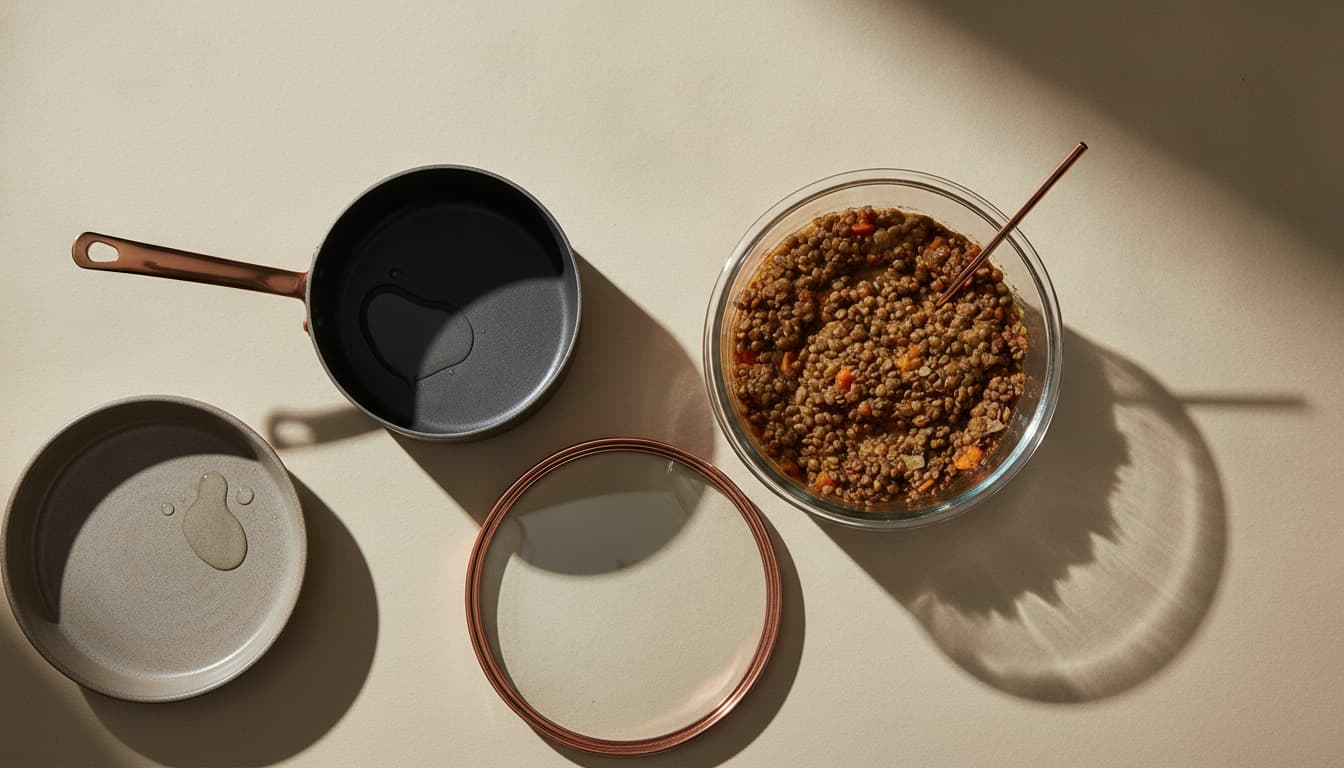
Reheat leftovers to 165 degrees Fahrenheit measured with a thermometer, bring sauces, soups and gravies to a rolling boil, and get through the growth range in under two hours. Microwaves need their own procedure.
- 01
The endpoint is 165 degrees Fahrenheit, measured
When reheating leftovers, be sure they reach 165 degrees Fahrenheit as measured with a food thermometer, and cover leftovers to reheat because this retains moisture and ensures the food will heat all the way through (USDA FSIS). The number is higher than most raw-cooking endpoints because reheated food has already passed through cooling, storage and handling, without the competitive flora raw food carries.
- 02
Liquids get a visible endpoint instead of a probe
Reheat sauces, soups and gravies by bringing them to a rolling boil (USDA FSIS). A single probe reading in a stirred pot is unreliable, so the guidance substitutes an endpoint that can be seen rather than measured, and a rolling boil also guarantees convective circulation through the whole volume rather than a hot layer at the base.
- 03
There is a holding time attached to the number
Time and temperature control for safety food that is cooked, cooled and reheated for hot holding shall be reheated so that all parts of the food reach a temperature of at least 74 degrees Celsius (165 degrees Fahrenheit) for 15 seconds (FDA Food Code 2022, 3-403.11(A)). The consumer chart quotes only the temperature, but the underlying requirement is a temperature held briefly, which is another reason to check more than one spot.
- 04
Reheating has a two-hour transit limit
Reheating shall be done rapidly, and the time the food is between 5 degrees Celsius (41 degrees Fahrenheit) and the reheating temperature may not exceed 2 hours (FDA Food Code 2022, 3-403.11(D)). This is the parameter that rules out warming a large cold mass gently in a low oven or on a slow-cooker warm setting, because the entire slow climb happens inside the growth range.
- 05
Microwaves need four steps, not one
Cover and rotate the food for even heating, arrange items evenly in a covered microwave-safe glass or ceramic dish, add some liquid if needed, vent the lid or wrap to let steam escape, check the temperature in several places with a food thermometer because microwaves have cold spots, and allow a resting time before the final check (USDA FSIS). The regulation adds that the food must stand covered for 2 minutes after reheating.
- 06
One category is allowed a lower number
Ready-to-eat food that has been commercially processed and packaged in a food processing plant inspected by the regulatory authority shall be heated to at least 57 degrees Celsius (135 degrees Fahrenheit) when being reheated for hot holding (FDA Food Code 2022, 3-403.11(C)). The exception exists because that product never passed through an open handling chain, not because the food is inherently safer.
- 07
Frozen leftovers do not have to be thawed first
It is safe to reheat frozen leftovers without thawing, either in a saucepan or microwave for a soup or stew, or in the oven or microwave for casseroles and combination meals; reheating will take longer than if the food is thawed first, but it is safe when time is short (USDA FSIS). Skipping the thaw also removes the thawing window from the temperature budget entirely.
- 08
The storage window bounds everything
Leftovers can be kept in the refrigerator for 3 to 4 days or frozen for 3 to 4 months, and although safe indefinitely, frozen leftovers lose moisture and flavour over longer storage (USDA FSIS). It is safe to refreeze any food remaining after reheating previously frozen leftovers to 165 degrees Fahrenheit, which is what makes a cook-once weekly cadence workable rather than wasteful.
What people ask us next.
- What temperature should leftovers be reheated to?
- 165 degrees Fahrenheit in all parts, measured with a food thermometer, and covered during reheating to retain moisture and ensure the food heats all the way through (USDA FSIS). The regulatory equivalent is at least 74 degrees Celsius for 15 seconds, with the reheating done rapidly and the transit between 41 degrees Fahrenheit and the target taking no more than 2 hours (FDA Food Code 2022, 3-403.11).
- Do soups and sauces need a thermometer too?
- No, they get a different endpoint. Reheat sauces, soups and gravies by bringing them to a rolling boil (USDA FSIS). A probe reading in a pot depends heavily on where the probe goes, whereas a rolling boil is visible and guarantees convection through the whole volume. For solid food the thermometer remains the instruction, checked in several places.
- Why is reheating in a low oven a problem?
- Because of the transit limit. Reheating shall be done rapidly and the time the food is between 5 degrees Celsius (41 degrees Fahrenheit) and the reheating temperature may not exceed 2 hours (FDA Food Code 2022, 3-403.11(D)). A large cold dish warming gently spends that entire climb inside the growth range, so the final temperature can be correct while the path to it was not.
- How many times can food be reheated?
- The published limits are on storage and on temperature, not on a count of reheats. Leftovers can be kept in the refrigerator for 3 to 4 days or frozen for 3 to 4 months, and it is safe to refreeze any food remaining after reheating previously frozen leftovers to 165 degrees Fahrenheit (USDA FSIS). What accumulates with each cycle is time in the growth range on the way up and down, which is the variable worth minimising.
- Does reheating fix food that was left out?
- No. Reheating addresses organisms, not what they produced, and some organisms left unrefrigerated create toxins that survive cooking temperatures that kill the bacteria themselves. Perishable food left at room temperature for more than 2 hours, or 1 hour above 90 degrees Fahrenheit, should be thrown away rather than reheated harder (USDA FSIS). The reheating rules assume the cooling and storage rules were followed.
Every claim, cited.
- [01]USDA Food Safety and Inspection Service. Leftovers and Food Safety. When reheating leftovers, be sure they reach 165 degrees Fahrenheit as measured with a food thermometer; reheat sauces, soups and gravies by bringing them to a rolling boil; cover leftovers to reheat, which retains moisture and ensures that food will heat all the way through; when reheating in the microwave, cover and rotate the food for even heating, arrange food items evenly in a covered microwave safe glass or ceramic dish, add some liquid if needed, vent the lid or wrap to let steam escape, and because microwaves have cold spots check the temperature of the food in several places with a food thermometer and allow a resting time before checking the internal temperature; cooking continues for a longer time in dense foods such as a whole turkey or beef roast than in less dense foods; leftovers can be kept in the refrigerator for 3 to 4 days or frozen for 3 to 4 months, and although safe indefinitely frozen leftovers can lose moisture and flavour when stored for longer times; it is safe to reheat frozen leftovers without thawing, either in a saucepan or microwave or in the oven or microwave; it is safe to refreeze any food remaining after reheating previously frozen leftovers to the safe temperature of 165 degrees Fahrenheit; throw away all perishable foods left at room temperature for more than 2 hours, 1 hour if the temperature is over 90 degrees Fahrenheit.
- [02]US Food and Drug Administration. FDA Food Code 2022, section 3-403.11 Reheating for Hot Holding. Time/temperature control for safety food that is cooked, cooled, and reheated for hot holding shall be reheated so that all parts of the food reach a temperature of at least 74 degrees Celsius (165 degrees Fahrenheit) for 15 seconds. Food reheated in a microwave oven for hot holding shall be reheated so that all parts reach at least 74 degrees Celsius (165 degrees Fahrenheit) and the food is rotated or stirred, covered, and allowed to stand covered for 2 minutes after reheating. Ready-to-eat food that has been commercially processed and packaged in a food processing plant inspected by the regulatory authority shall be heated to a temperature of at least 57 degrees Celsius (135 degrees Fahrenheit) when being reheated for hot holding. Reheating for hot holding shall be done rapidly and the time the food is between 5 degrees Celsius (41 degrees Fahrenheit) and the specified temperatures may not exceed 2 hours.
The Larderlab Team builds evidence-led frameworks for eating, lifting, and stocking a kitchen. We cite every claim. We publish the spreadsheet when possible. We buy what we review at retail price. When new data lands, we revise with a dated note.
Next in this hub.
How Long Can Food Sit Out? Two Hours, One Hour, and Why
Two hours at room temperature, one hour above 90 degrees Fahrenheit. The number comes from a 20-minute doubling time, and the reason it is not negotiable is that some toxins formed during the delay survive cooking.
8 min · rev 2026-08-31High Protein Meal Prep: The 4-Hour Sunday System
Engineered meal prep targeting 30–40 g protein per meal, 4 hours of work for 18–20 servings. Cost-per-gram math, the four base proteins, and the assembly grid that beats recipe sites.
12 min · rev 2026-04-29Can You Refreeze Thawed Meat? The Thawing Method Decides
Refrigerator-thawed meat can be refrozen without cooking. Cold-water and microwave-thawed meat has to be cooked first. The safety line is set by how the food thawed, and the quality cost is measured in oxidation.
8 min · rev 2026-09-01Get the Larderlab Macro Planner.
A Google Sheet that calculates your protein target, splits it across 3-5 meals, and ranks 20 protein sources by $/gram. Free. Copy-and-modify your own version.
By subscribing, you agree to our Privacy Policy. Unsubscribe anytime.