How long flour lasts, and why one of its clocks never runs down
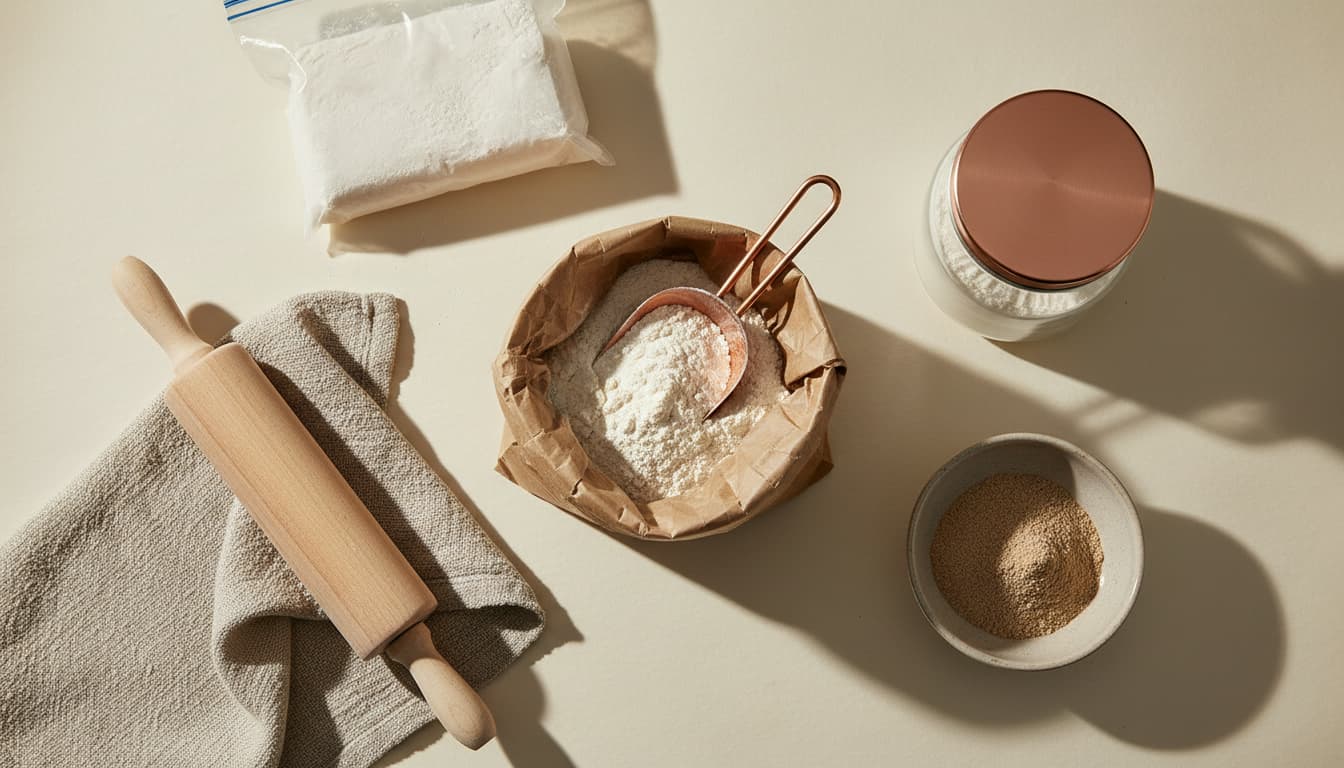
Flour has a quality clock that runs on fat and moisture and a pathogen clock that barely runs at all. Salmonella survived 52 weeks on stored wheat with D-values of 22.9 to 25.2 weeks, which is why raw flour is a cooking rule rather than a date rule.
- 01
The quality clock: fat content sets it
Refined white flour has had the germ and most of the bran milled out, which removes most of the fat and leaves starch and protein at low moisture, a combination that holds baking quality for a long time when sealed. Whole-grain, stoneground and nut or seed flours retain the germ oil, which oxidises and shows up as a stale, paint-like or bitter note. That is a flavour endpoint accelerated by warmth and light, which is why those flours belong in a fridge or freezer if they will sit.
- 02
The two physical limiters: moisture and insects
Flour is hygroscopic, so an open bag in a humid kitchen takes up water, cakes, and eventually supports mould, and flour is also food for pantry insects. Both failure modes are container problems rather than time problems, which makes decanting into a hard, gasketed container the single highest-return intervention on a flour shelf. Neither is captured by a printed date, and both are visible to inspection.
- 03
The pathogen clock barely moves
Hard red spring wheat inoculated with four Salmonella serovars and six EHEC serotypes, sealed to hold water activity and stored at 22 plus or minus 1 degree Celsius, yielded viable Salmonella for the full 52 weeks of the study. EHEC serotypes O45:NM, O111:H8 and O26:H11 were detectable for 44 weeks and O157:H7, O121:H19 and O103:H2 for 40 weeks before falling below 2.0 log CFU per gram (Lauer et al. 2021).
- 04
The D-values put a number on it
In that year-long study, D-values differed significantly between the two pathogen groups: 22.9 plus or minus 2.2 to 25.2 plus or minus 1.0 weeks for Salmonella against 11.4 plus or minus 0.6 to 13.1 plus or minus 1.8 weeks for EHEC, with no significant differences among the four Salmonella strains or among the six EHEC strains (Lauer et al. 2021). Roughly half a year for a single log reduction is not a decay curve worth planning around.
- 05
Retail prevalence is not negligible
Seventy flour samples from different Swiss retailers were screened for stx1 and stx2 after enrichment, and 9, or 12.9 percent, tested positive by PCR, with STEC recovered from 8 of the 9 positives across serogroups including O103:H2, one of the top five human pathogenic STEC serogroups in the European Union. The authors concluded that consuming raw or undercooked flour may constitute a risk for STEC infection (Kindle et al. 2019).
- 06
Why flour has no kill step
Wheat is grown in open fields and milled without a pathogen-inactivation step, so what is on the grain can be in the bag. That is the structural reason flour appeared as one of three novel food-pathogen pairs recorded in the 2016 US multistate outbreak reporting period, alongside frozen vegetables with Listeria monocytogenes and bagged salad with Listeria (Marshall et al. 2020). Milling is a size-reduction process, not a sanitising one.
- 07
Heat is the control, and it has been measured
Wheat flour inoculated at 4.8 to 6.1 log CFU per gram and baked at a depth of about 2 centimetres in a consumer-style convection oven gave linear inactivation with Salmonella D-values of 1.86 to 2.13 minutes at 149 degrees Celsius, 1.66 to 1.92 minutes at 177 degrees and 1.12 to 1.38 minutes at 204 degrees, with water activity falling from 0.30 to 0.06 over 7 minutes (Jung and Schaffner 2022).
- 08
The heat-treating claim, tested and only partly supported
The same study was designed to test a widely circulated claim that 5 minutes at 177 degrees Celsius makes flour safe for raw cookie dough, a claim published with no supporting evidence. Its conclusion was that home oven baking has potential as an inactivation treatment despite the low water activity of flour (Jung and Schaffner 2022). Potential is not a validated 5-minute rule, and a 2-centimetre depth in a controlled oven is not a mixing bowl.
What people ask us next.
- Does old flour become unsafe?
- Not in the way most people expect, and the more important point is that new flour is not sterile either. Salmonella remained viable on stored wheat for the full 52 weeks of a year-long study at room temperature, with D-values of 22.9 to 25.2 weeks, and EHEC serotypes persisted 40 to 44 weeks (Lauer et al. 2021). What ages in flour is baking quality and flavour, driven by fat oxidation, moisture uptake and insects. The pathogen question is answered by cooking, not by the date.
- How long does whole wheat flour last compared with white?
- Less long, and the reason is compositional rather than microbial. Whole-grain flour retains the germ and its oil, and that fat oxidises to a stale, paint-like or bitter character in a way refined white flour, with the germ milled out, largely does not. Warmth and light accelerate it. The practical response is to buy whole-grain flours in sizes that will be used within a few months and to move anything slower-moving into the refrigerator or freezer.
- Can I eat raw cookie dough if the flour is fresh?
- Freshness is the wrong variable. Of 70 retail flour samples, 12.9 percent were positive for stx genes and STEC was recovered from 8 of 9 positives, with the authors concluding that raw or undercooked flour may constitute an STEC risk (Kindle et al. 2019). Storage time does not resolve it either, since Salmonella survived 52 weeks on stored wheat (Lauer et al. 2021). The control is heat: measured Salmonella D-values in flour were 1.66 to 1.92 minutes at 177 degrees Celsius (Jung and Schaffner 2022).
- Does heat-treating flour at home work?
- Partly, and the evidence is narrower than the advice built on it. Baking inoculated flour about 2 centimetres deep in a consumer-style convection oven produced linear inactivation with D-values of 1.86 to 2.13 minutes at 149 degrees Celsius and 1.12 to 1.38 minutes at 204 degrees, and the authors concluded home oven baking has potential as an inactivation treatment despite flour's low water activity (Jung and Schaffner 2022). That is a controlled shallow layer, not a heaped bowl, and the study did not validate a fixed 5-minute rule.
- How should flour be stored?
- In a hard, gasketed, airtight container in a cool dark cupboard, because the quality failure modes are moisture uptake, insect infestation and fat oxidation, and all three are container-and-location problems. Whole-grain and nut flours belong in the refrigerator or freezer if they are slow-moving, because their limiter is germ oil rather than starch. None of this addresses the pathogen question, which is handled at the oven rather than on the shelf.
- How do I tell if flour has gone off?
- By smell and by inspection rather than by date. Fat oxidation reads as stale, paint-like or bitter, most obviously in whole-grain flours. Moisture uptake reads as caking, clumping or visible mould. Insect activity reads as webbing, fine movement or small beetles in the bag. Any of the three is a reason to discard. None of them tells you anything about pathogens, which persist for months regardless of how the flour smells (Lauer et al. 2021).
Every claim, cited.
- [01]Lauer JR, Simsek S, Bergholz TM. 2021. Fate of Salmonella and Enterohemorrhagic Escherichia coli on Wheat Grain. J Food Prot 84(12):2109-2115. Hard red spring wheat inoculated with four Salmonella serovars (Enteritidis, Agona, Tennessee, Montevideo) and six EHEC serotypes (O157:H7, O26:H11, O121:H19, O45:NM, O111:H8, O103:H2), sealed in Mylar bags to maintain water activity, stored at 22 plus or minus 1 degree Celsius; viable Salmonella detected for the full 52 weeks; EHEC O45:NM, O111:H8 and O26:H11 detected for 44 weeks and O157:H7, O121:H19 and O103:H2 for 40 weeks before falling below the 2.0 log CFU/g detection limit; D-values 22.9 plus or minus 2.2 to 25.2 plus or minus 1.0 weeks for Salmonella and 11.4 plus or minus 0.6 to 13.1 plus or minus 1.8 weeks for EHEC.
- [02]Kindle P, Nuesch-Inderbinen M, Cernela N, Stephan R. 2019. Detection, Isolation, and Characterization of Shiga Toxin-Producing Escherichia coli in Flour. J Food Prot 82(1):164-167. Seventy flour samples from different Swiss retailers screened for stx1 and stx2 after enrichment; 9 (12.9 percent) positive by PCR; STEC recovered from 8 (88.9 percent) of the positive samples, including O11:H48, O146:H28 and O103:H2; STEC O103 is among the top five human pathogenic STEC serogroups in the European Union; consumption of raw or undercooked flour may constitute a risk for STEC infection.
- [03]Jung J, Schaffner DW. 2022. Thermal Inactivation of Salmonella enterica and Nonpathogenic Bacterial Surrogates in Wheat Flour by Baking in a Household Oven. J Food Prot 85(10):1431-1438. Flour inoculated at 4.8 to 6.1 log CFU/g, baked at a maximum depth of about 2 cm in a consumer-style convection oven at 149, 177 and 204 degrees Celsius for up to 7 minutes; water activity fell from 0.30 to 0.06 after 7 minutes as oven temperature rose; thermal inactivation kinetics linear; D-values 1.86 to 2.13 minutes at 149 degrees, 1.66 to 1.92 minutes at 177 degrees and 1.12 to 1.38 minutes at 204 degrees; home oven baking has potential as an inactivation treatment despite low water activity.
- [04]Marshall KE, Nguyen TA, Ablan M, et al. 2020. Investigations of Possible Multistate Outbreaks of Salmonella, Shiga Toxin-Producing Escherichia coli, and Listeria monocytogenes Infections, United States, 2016. MMWR Surveill Summ 69(6):1-14. Three outbreaks in the 2016 reporting period involved novel food-pathogen pairs: flour and STEC, frozen vegetables and Listeria monocytogenes, and bagged salad and Listeria monocytogenes.
The Larderlab Team builds evidence-led frameworks for eating, lifting, and stocking a kitchen. We cite every claim. We publish the spreadsheet when possible. We buy what we review at retail price. When new data lands, we revise with a dated note.
Next in this hub.
How Long Do Canned Goods Last: The Date, the Can and the Storage
High-acid cans hold best quality for 12 to 18 months and low-acid cans for 2 to 5 years, while USDA FSIS treats commercially canned food as safe indefinitely below 90 degrees Fahrenheit. The can is the control, not the date.
12 min · rev 2026-09-04How Long Does Food Last? Shelf Life by Staple, with Storage Fixes
USDA-cited shelf life for the pantry, fridge, and freezer staples, plus the storage change that extends each one. The dates that mean quality vs the dates that mean safety.
10 min · rev 2026-06-29How Long Can Food Sit Out? Two Hours, One Hour, and Why
Two hours at room temperature, one hour above 90 degrees Fahrenheit. The number comes from a 20-minute doubling time, and the reason it is not negotiable is that some toxins formed during the delay survive cooking.
8 min · rev 2026-08-31Get the Larderlab Macro Planner.
A Google Sheet that calculates your protein target, splits it across 3-5 meals, and ranks 20 protein sources by $/gram. Free. Copy-and-modify your own version.
By subscribing, you agree to our Privacy Policy. Unsubscribe anytime.