How long canned goods last, and why the date and the safety window are two different questions
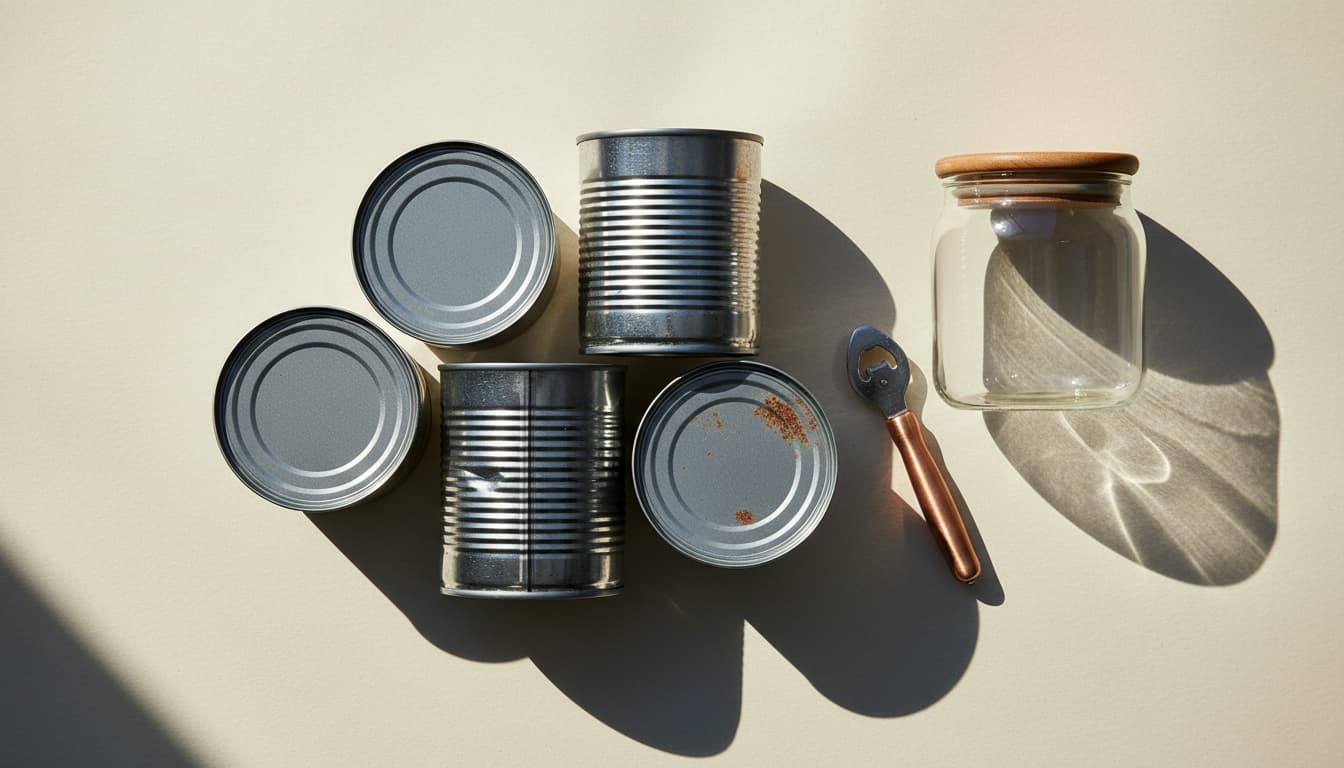
High-acid cans hold best quality for 12 to 18 months and low-acid cans for 2 to 5 years, while USDA FSIS treats commercially canned food as safe indefinitely below 90 degrees Fahrenheit. The can is the control, not the date.
- 01
The printed date is a quality estimate, the can is the safety control
Canned foods are safe indefinitely as long as they are not exposed to freezing temperatures or to temperatures above 90 degrees Fahrenheit (USDA FSIS). The date on the label is measuring something else entirely, namely how long the contents stay at best flavor and texture. Treating the two as one number is what produces both discarded good food and confident use of cans that should have been binned on sight.
- 02
High-acid cans run a 12 to 18 month quality clock
High-acid canned foods, meaning tomatoes, fruits, pickles and sauerkraut, keep their best quality for 12 to 18 months (USDA FSIS). Acid works on the interior lining from the day the can is sealed, which is why the group with the shortest clock is also the group most likely to show metallic or flattened flavor first. For a household this is a purchasing constraint, not a safety one: buy the quantity that gets used inside a year.
- 03
Low-acid cans run a 2 to 5 year clock
Low-acid canned foods, meaning meat, poultry, fish and most vegetables, keep their best quality for 2 to 5 years (USDA FSIS). That is roughly three to four times the high-acid window in the same cupboard at the same temperature. Canned tuna, canned salmon and canned beans therefore tolerate a far deeper buffer than canned tomatoes, and the depth of the buffer should be set from this split rather than uniformly.
- 04
Indefinitely is a conditional claim and the conditions are temperatures
The safety claim carries exactly two exclusions: freezing temperatures and temperatures above 90 degrees Fahrenheit, with temperatures above 100 degrees Fahrenheit described as harmful to canned goods (USDA FSIS). Commercial canning is a retort process inside a hermetically sealed container, so with the seal intact and the temperature in range there is no biological clock running. Break either condition and the guarantee is void, which is why an unheated garage and a cupboard over the oven are both disqualifying.
- 05
Four storage locations void the window
Store canned foods in a cool, dry place and never above the stove, under the sink, in a damp garage or basement, or anywhere exposed to temperature extremes (USDA FSIS). Each entry maps to a failure mode. Above the stove crosses the 90 degree Fahrenheit line every time the oven runs, under the sink supplies the condensation that starts rust, an unheated garage crosses the freezing condition, and a damp basement corrodes seams from the outside.
- 06
Five visible signs end the discussion
Discard cans that are leaking, bulging, badly dented, rusted or cracked, and never taste food from a can with those signs (USDA FSIS). The tasting prohibition is the part people skip, and it is the part with the strongest justification: often there is no visible sign that food is contaminated, and the infective dose of botulinum toxin is a few nanograms (FDA Bad Bug Book). A taste test is not a test.
- 07
Bulging is the one sign with a named organism behind it
Clostridium botulinum is an anaerobic, spore-forming rod whose heat-resistant spores can survive in foods that are incorrectly or minimally processed, and a sealed can is a textbook anaerobic space (FDA Bad Bug Book). Gas production accompanies growth, which is what pushes a can end outward. Adult onset of foodborne botulism is usually 18 to 36 hours, with a documented range of 4 hours to 8 days, and the disease is generally fatal in 5 to 10 percent of cases (FDA Bad Bug Book).
- 08
A dent on a panel and a dent on a seam are different objects
The seam is the folded, sealed joint where the can body meets the end, and it is the component actually holding the sterile barrier; a flat side panel is not sealing anything. A sharp dent that crosses the top or side seam can work that seal open, while a shallow panel dent deforms metal with no barrier function. FSIS does not ask consumers to adjudicate the difference and simply says badly dented cans are discarded (USDA FSIS), which is the right rule when the two are hard to tell apart.
- 09
Home-canned low-acid food is the real botulism category
Foodborne botulism most often develops after consumption of improperly processed and inadequately cooked home-preserved foods, with home-canned or, occasionally, commercially produced foods involved in United States outbreaks (FDA Bad Bug Book). The mechanism is pH: almost any food that is not very acidic, meaning a pH above 4.6, can support growth and toxin production, which is why green beans, corn, beets, asparagus, mushrooms and spinach recur in the outbreak list and why they need pressure canning at home.
- 10
Boiling for 10 minutes is the stated household mitigation
The consumer guidance in the botulism chapter is to follow canning instructions and good hygiene when making home-canned foods, and to boil canned foods for 10 minutes before eating them, whether home-made or store-bought (FDA Bad Bug Book). The instruction covers both categories because the toxin, unlike the spore, is heat-labile. It is a cheap insurance step for home-preserved low-acid food and an unnecessary one for a can of tuna eaten cold.
- 11
Once opened, the can stops being shelf-stable
Every shelf-life number above applies to an unopened, hermetically sealed container. The moment the seal is cut the contents become an ordinary perishable food and belong in the refrigerator at 40 degrees Fahrenheit or below, with the usual limit of no more than 2 hours at room temperature, or 1 hour when the ambient temperature is above 90 degrees Fahrenheit (USDA FSIS). Transferring leftovers out of the opened can into a covered container is the standard practice and avoids metallic off-flavor.
- 12
Date-mark on receipt, then load the shelf from the back
Printed codes are frequently lot codes rather than readable dates, so the reliable date is the one written on the can lid in marker on the day it comes home. First in first out only functions if new stock is loaded behind old stock, which requires a shelf deep enough to rotate and a habit that survives a full grocery run. This is an architecture problem, not a knowledge problem, and it is the single highest-yield change in most pantries.
- 13
Heat-labile vitamins take the loss, protein and minerals do not
One cup of black beans cooked at home from dry carries 256 mcg DFE of folate and 120 mg of magnesium, against 146 mcg DFE and 84 mg for one cup of canned low-sodium black beans, while protein holds at 15.2 g versus 14.5 g and fiber is slightly higher in the can at 16.6 g versus 15.0 g (USDA FoodData Central). In retorted mango and pineapple, vitamin C, beta-carotene, polyphenols and flavonoids were present at substantially lower concentrations than in the fresh fruit, with measurable leaching into the syrup (Arampath and Dekker 2020).
- 14
EFSA and FDA read the same BPA evidence differently
EFSA's 2023 re-evaluation set a tolerable daily intake of 0.2 nanograms per kg body weight per day, down from a 2015 temporary TDI of 4 micrograms per kg body weight per day, and concluded that mean and 95th percentile dietary exposures in all age groups exceed it by two to three orders of magnitude (EFSA CEP Panel 2023). FDA's current perspective, based on its most recent safety assessment, is that BPA is safe at the current levels occurring in foods (FDA). Both positions are on the record and neither has withdrawn.
What people ask us next.
- Are canned goods still safe after the date on the label has passed?
- In almost every case yes, because the date is a quality date. Canned foods are safe indefinitely as long as they are not exposed to freezing temperatures or to temperatures above 90 degrees Fahrenheit (USDA FSIS). What changes past the date is flavor, color and texture, by 12 to 18 months for high-acid contents and 2 to 5 years for low-acid ones (USDA FSIS). The condition of the can overrides the date in both directions.
- Why do canned tomatoes have a shorter shelf life than canned tuna?
- Acidity. High-acid canned foods including tomatoes, fruits, pickles and sauerkraut keep their best quality for 12 to 18 months, while low-acid canned foods including meat, poultry, fish and most vegetables keep theirs for 2 to 5 years (USDA FSIS). The acid works on the interior lining from the moment the can is sealed, so acidic contents show flavor drift and sometimes a metallic note first. The practical consequence is that tomatoes should be bought to a one-year turnover and tuna can be stocked several years deep.
- Is it safe to use food from a dented can?
- It depends where the dent is, and the safe default is to discard. FSIS instructs consumers to discard cans that are leaking, bulging, badly dented, rusted or cracked, and never to taste food from a can with those signs (USDA FSIS). The reason the seam matters is that the folded joint where the body meets the end is the component holding the sterile barrier, while a flat side panel is not sealing anything. A sharp dent crossing a seam can open that barrier, and the resulting contamination is not visible or detectable by smell.
- What does a bulging can actually mean?
- It means gas is being produced inside a sealed anaerobic container, and the organism that makes that dangerous is Clostridium botulinum, an anaerobic spore-forming rod whose heat-resistant spores can survive foods that are incorrectly or minimally processed (FDA Bad Bug Book). An extremely small amount of the toxin, a few nanograms, can cause illness, adult onset is usually 18 to 36 hours with a range of 4 hours to 8 days, and the disease is generally fatal in 5 to 10 percent of cases if untreated (FDA Bad Bug Book). Discard without opening.
- Does freezing ruin canned food?
- It voids the safety guarantee, which is why freezing appears alongside heat in the exclusion. Canned foods are safe indefinitely only as long as they are not exposed to freezing temperatures or to temperatures above 90 degrees Fahrenheit (USDA FSIS). Water expands as it freezes, and the expansion can distort the can and break the seam seal, which is the same failure mode as a seam dent. A can that has frozen in an unheated garage should be treated as a can of unknown integrity rather than as a can with a cosmetic problem.
- How much nutrition is lost in canning?
- Less than the reputation suggests, and the loss is selective. Per cup, folate falls from 256 mcg DFE cooked at home from dry to 146 mcg DFE canned, and magnesium from 120 mg to 84 mg, while protein is essentially unchanged at 15.2 g against 14.5 g and fiber is slightly higher in the canned product (USDA FoodData Central). In retorted mango and pineapple, vitamin C, beta-carotene, polyphenols and flavonoids were substantially lower than in the fresh fruit, partly through leaching into the syrup rather than destruction (Arampath and Dekker 2020).
- Should the BPA in can linings change what gets bought?
- That depends on which regulator is treated as decisive, because they disagree. EFSA's 2023 re-evaluation set a tolerable daily intake of 0.2 nanograms per kg body weight per day, down from a 2015 temporary TDI of 4 micrograms, and found mean and 95th percentile dietary exposures in all age groups exceeding it by two to three orders of magnitude (EFSA CEP Panel 2023). FDA's current perspective is that BPA is safe at the current levels occurring in foods, since oral BPA is rapidly metabolised to an inactive form (FDA).
- How long does food keep once the can is open?
- The shelf-stable clock ends at the seal. An opened can holds ordinary perishable food, so it belongs in the refrigerator at 40 degrees Fahrenheit or below and should not sit at room temperature for more than 2 hours, or more than 1 hour when the ambient temperature is above 90 degrees Fahrenheit (USDA FSIS). Transfer the contents to a covered container rather than refrigerating in the open can, which limits metallic off-flavor and makes the leftover legible on the shelf.
Every claim, cited.
- [01]USDA Food Safety and Inspection Service, Shelf-Stable Food Safety. Canned foods are safe indefinitely as long as they are not exposed to freezing temperatures or temperatures above 90 degrees Fahrenheit; high-acid canned foods such as tomatoes, fruits, pickles and sauerkraut keep their best quality for 12 to 18 months, while low-acid canned foods such as meat, poultry, fish and most vegetables keep their best quality for 2 to 5 years. Store canned foods in a cool, dry place and never above the stove, under the sink, in a damp garage or basement, or anywhere exposed to temperature extremes; temperatures above 100 degrees Fahrenheit are harmful to canned goods. Discard cans that are leaking, bulging, badly dented, rusted or cracked, and never taste food from a can with those signs.
- [02]FoodSafety.gov FoodKeeper, the joint USDA, FDA and Cornell University storage database. FoodKeeper gives product-level pantry, refrigerator and freezer timelines for individual foods and beverages rather than category rules, which is the reference to use when a specific canned product does not fall cleanly into the high-acid or low-acid split. All of its storage windows are quality windows, consistent with the position that product dating is not a safety indicator.
- [03]FDA Bad Bug Book, Second Edition, Clostridium botulinum chapter. C. botulinum is an anaerobic, Gram-positive, spore-forming rod producing a potent neurotoxin; the spores are heat-resistant and can survive in foods that are incorrectly or minimally processed. Foodborne botulism most often develops after consumption of improperly processed and inadequately cooked home-preserved foods, with home-canned or occasionally commercially produced foods involved in United States outbreaks. Almost any food that is not very acidic (pH above 4.6) can support growth and toxin production. The infective dose is an extremely small amount, a few nanograms. Adult onset is usually 18 to 36 hours after ingestion, with times varying from 4 hours to 8 days. The disease is generally fatal in 5 to 10 percent of cases. Consumer guidance: follow canning instructions and good hygiene for home-canned foods, and boil canned foods for 10 minutes before eating them, whether home-made or store-bought.
- [04]EFSA CEP Panel 2023, re-evaluation of the risks to public health related to the presence of bisphenol A in foodstuffs, EFSA J 21(4):e06857. In 2015 EFSA established a temporary tolerable daily intake for BPA of 4 micrograms per kg body weight per day. The 2023 re-evaluation identified the immune system as the most sensitive target, with an effect on Th17 cells in mice as the critical effect, a reference point of 8.2 nanograms per kg body weight per day as human equivalent dose, and an overall uncertainty factor of 50, giving a TDI of 0.2 nanograms BPA per kg body weight per day. Both mean and 95th percentile dietary exposures in all age groups exceeded that TDI by two to three orders of magnitude, and the Panel concluded there is a health concern from dietary BPA exposure.
- [05]FDA, Bisphenol A (BPA): Use in Food Contact Application. BPA is a component in metal can coatings, which protect the food from directly contacting metal surfaces, and has been used in food packaging since the 1960s. FDA's current perspective, based on its most recent safety assessment, is that BPA is safe at the current levels occurring in foods, and the available information continues to support the safety of BPA for the currently approved uses in food containers and packaging. A four-year review completed in 2014 covered more than 300 studies published or available between November 2009 and July 2013 and found nothing to prompt a revision. Research at FDA's National Center for Toxicological Research found that oral BPA is rapidly metabolised to an inactive form, that internal exposure to the active form after oral administration is predicted to be below 1 percent of the total administered, and that primates including humans metabolise and excrete BPA far more rapidly than rodents. FDA amended its regulations in 2012 and 2013 to remove BPA-based materials from baby bottles, sippy cups and infant formula packaging on the ground of abandonment, which the agency states explicitly is not a safety determination.
- [06]USDA Food Safety and Inspection Service, Refrigeration and Food Safety. Once a hermetically sealed container is opened its contents are an ordinary perishable food and require refrigeration at 40 degrees Fahrenheit or below; perishable food should not be left at room temperature for more than 2 hours, or more than 1 hour when the ambient temperature is above 90 degrees Fahrenheit.
- [07]USDA FoodData Central, SR Legacy entries for black beans, mature seeds, cooked, boiled, without salt, and for black beans, mature seeds, canned, low sodium. Per one cup, the home-cooked entry gives 172 g weight, 15.24 g protein, 14.96 g fiber, 256 mcg DFE folate, 120 mg magnesium, 611 mg potassium and 1.7 mg sodium; the canned low-sodium entry gives 240 g weight, 14.47 g protein, 16.56 g fiber, 146 mcg DFE folate, 84 mg magnesium, 739 mg potassium and 331 mg sodium.
- [08]Arampath PC, Dekker M. 2020. Thermal effect, diffusion, and leaching of health-promoting phytochemicals in commercial canning process of mango (Mangifera indica L.) and pineapple (Ananas comosus L.). Foods 10(1):46. Cans were retorted at four different temperatures for varying times and vitamin C, beta-carotene, polyphenols, flavonoid content and antioxidant capacity were measured in both the fruit pieces and the sugar syrup, with diffusion and leaching modelled mathematically. Retention of vitamin C in canned pineapple pieces was higher than in canned mango pieces. Trolox equivalent antioxidant capacity at 130 degrees Celsius for 40 minutes was 3.1 and 1.9 micromol Trolox per g fresh weight in mango pieces and syrups respectively, indicating that antioxidant leaching had occurred. The investigated health-promoting phytochemicals in the canned products were present at substantially lower concentrations than in the fresh fruit.
The Larderlab Team builds evidence-led frameworks for eating, lifting, and stocking a kitchen. We cite every claim. We publish the spreadsheet when possible. We buy what we review at retail price. When new data lands, we revise with a dated note.
Next in this hub.
How Long Does Food Last? Shelf Life by Staple, with Storage Fixes
USDA-cited shelf life for the pantry, fridge, and freezer staples, plus the storage change that extends each one. The dates that mean quality vs the dates that mean safety.
10 min · rev 2026-06-29How Long Does Flour Last? Two Clocks, Only One of Them Ticking
Flour has a quality clock that runs on fat and moisture and a pathogen clock that barely runs at all. Salmonella survived 52 weeks on stored wheat with D-values of 22.9 to 25.2 weeks, which is why raw flour is a cooking rule rather than a date rule.
8 min · rev 2026-08-30Dried Beans vs Canned Beans: Cost, Sodium, Time and One Real Hazard
One pound of dry beans yields about 6 cups cooked and replaces roughly 4 cans at 2.5 to 5 times lower cost per cup. Canned beans carry 331 to 655 mg sodium per cup against 1.7 mg home-cooked.
13 min · rev 2026-09-09Get the Larderlab Macro Planner.
A Google Sheet that calculates your protein target, splits it across 3-5 meals, and ranks 20 protein sources by $/gram. Free. Copy-and-modify your own version.
By subscribing, you agree to our Privacy Policy. Unsubscribe anytime.