How long cooked rice lasts, and why reheating is not the control
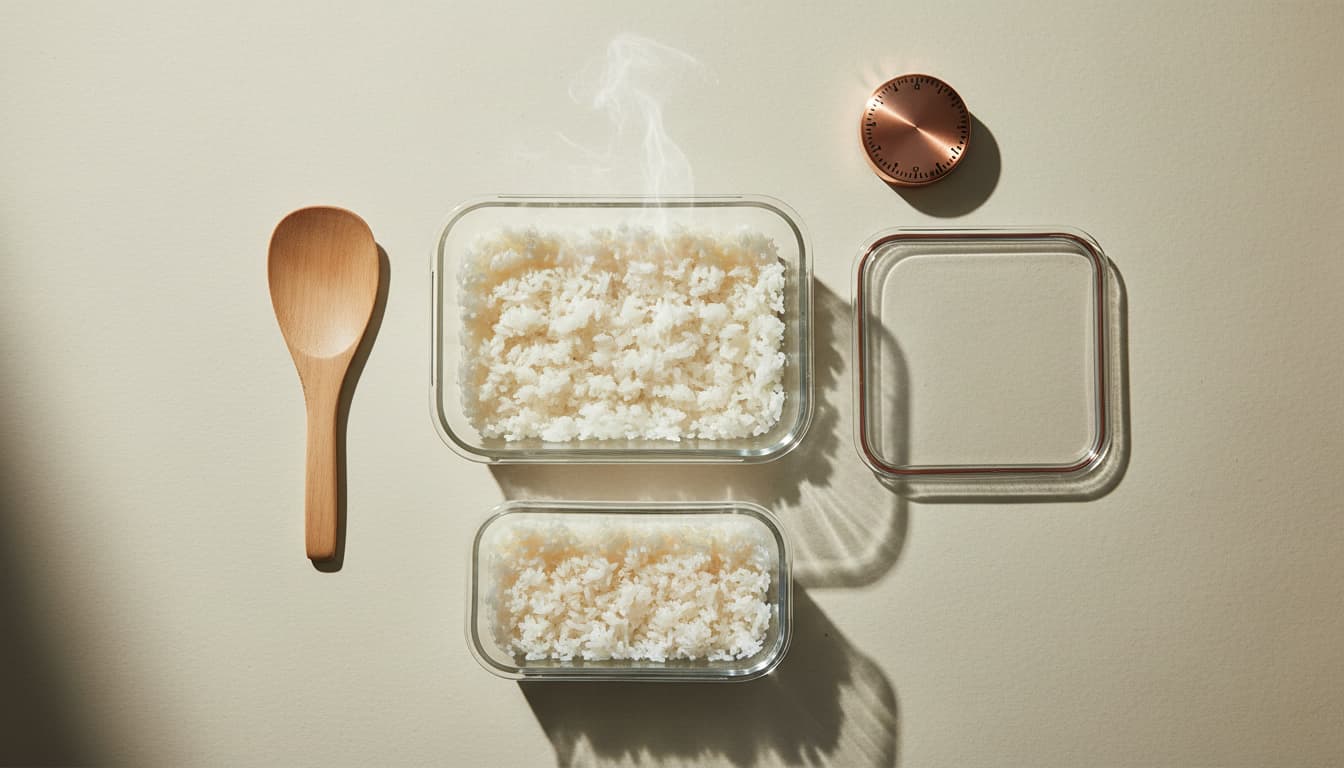
Cooked rice is the classic Bacillus cereus vehicle because spores survive cooking and the toxin they later produce is heat stable. Cooling speed, not reheating, is the control point, and surveillance data shows precooked stored rice is measurably worse than fresh.
- 01
The chain has four links and cooking only breaks nothing
Bacillus cereus is a spore former, and spores are heat resistant, so cooking does not eliminate them. Cooling out of cooking temperature lets surviving spores germinate, growth in emetic strains produces cereulide, and cereulide is heat stable. A review from 1974 to 2023 identified the primary etiology as improper handling and storage temperature during the cooking, cooling and reheating stages, and named heat-resistant spores and intoxication as what makes the organism hard to control (Woh and Ng 2024).
- 02
Why reheating is not the answer
Cereulide is a heat-stable cyclic dodecadepsipeptide and potassium-selective ionophore that collapses mitochondrial membrane potential, uncouples oxidative phosphorylation, depletes ATP and triggers apoptosis at nanomolar concentrations, with in vitro EC50 values of 98 to 127 nanomolar for suppression of oxygen consumption, and its heat stability means thermal treatments are unlikely to reduce levels once it has formed (Sonji et al. 2026). Heat kills cells; it does not undo the toxin they made.
- 03
The surveillance baseline: 94 percent acceptable at point of sale
Of 4,162 samples of cooked rice from restaurants and take-away premises, 1,855 of 1,972 point-of-sale samples, or 94 percent, were of acceptable microbiological quality, and 15, or 1 percent, were unacceptable at Bacillus species and B. cereus of 10 to the fifth colony-forming units per gram or more or E. coli at 10 to the fourth or more, indicating a potential risk to health (Nichols et al. 1999). Most rice is fine; the tail is where the risk lives.
- 04
Precooked stored rice tested significantly worse than fresh
In the same survey, prevalence of Bacillus species, B. cereus and E. coli was significantly greater in precooked stored rice than in point-of-sale rice. Bacillus species at 10 to the fourth per gram or above, B. cereus at 10 to the fourth or above and E. coli at 10 to the second or above were present in 7, 2 and 9 percent of precooked stored samples against 2, 0.5 and 1 percent of point-of-sale samples (Nichols et al. 1999). Holding cooked rice is the step that degrades it.
- 05
The explicit warning about final heating
The survey authors stated the limitation of the obvious remedy directly: although final heating at the point of sale reduces the levels of microorganisms present in rice, it will not inactivate the B. cereus emetic toxin if present (Nichols et al. 1999). That single sentence is the reason the control point for rice is the cooling step rather than the reheating step, and it applies identically in a domestic kitchen.
- 06
What the failure looks like in the field
A hazard analysis of cooked food vending operations found that cooking generally gave time-temperature exposures lethal to vegetative pathogens, but holding often provided exposures conducive to growth, particularly in foods held overnight, with B. cereus populations above 10 to the seventh per gram isolated from leftover rice, and noted that heat-stable toxins would not have been inactivated during reheating (Jermini et al. 1997). Overnight holding at ambient is the recognisable domestic version.
- 07
The control: two hours, shallow containers, 40 degrees Fahrenheit
Leftovers need to be refrigerated or frozen within 2 hours, and dividing them into smaller containers before refrigerating helps them cool faster; putting hot food in the refrigerator does not harm the appliance, which should be held at 40 degrees Fahrenheit or below (FDA). For rice this is the entire intervention: a deep pot cooling slowly on a hob is the condition every piece of the microbiology argues against.
- 08
The refrigerated window and when to freeze instead
Cooked foods hold three to four days at 40 degrees Fahrenheit or below, and freezer storage is indefinite for safety at 0 degrees Fahrenheit (USDA FSIS). The practical split for a rice batch is to portion what will be eaten within that window into the fridge and freeze the rest immediately after cooling rather than at the end of the window, since freezing arrests growth but does nothing about a toxin already produced.
What people ask us next.
- How long is cooked rice safe in the refrigerator?
- Three to four days at 40 degrees Fahrenheit or below, the same window as other cooked foods (USDA FSIS). The window only applies if the rice reached that temperature quickly, because leftovers need to be refrigerated or frozen within 2 hours and dividing them into smaller containers is what makes rapid cooling achievable (FDA). Rice that cooled slowly in a deep pot has already spent part of its window in the range where Bacillus cereus grows.
- Can you reheat rice safely?
- Reheating is fine and is not the safeguard people take it for. Final heating reduces the levels of microorganisms present in rice but will not inactivate the Bacillus cereus emetic toxin if present (Nichols et al. 1999), because cereulide is heat stable and thermal treatment is unlikely to reduce levels once it has formed (Sonji et al. 2026). Reheat for palatability and to knock down vegetative cells, and rely on fast cooling for the safety part.
- Why is rice singled out when other leftovers are not?
- Because it combines three things: a cereal substrate that commonly carries Bacillus cereus spores, a cooking step that does not destroy spores, and a habit of being cooked in large batches and held. Surveillance found the prevalence of Bacillus species, B. cereus and E. coli significantly greater in precooked stored rice than in point-of-sale rice, with B. cereus at 10 to the fourth per gram or above in 2 percent against 0.5 percent (Nichols et al. 1999).
- Does freezing cooked rice make it safe?
- Freezing stops growth, and freezer storage is indefinite for safety at 0 degrees Fahrenheit (USDA FSIS), but it does nothing to a toxin already produced, since cereulide's heat stability and chemical nature mean it is not removed by processing (Sonji et al. 2026). Freezing is therefore a way to extend a safe window that was created by cooling fast, not a way to repair rice that sat out. Cool it quickly, then freeze promptly rather than at day three.
- What actually happens if the rice was left out overnight?
- It falls into the condition that field hazard analyses identify as the worst case. Holding of foods often provided time-temperature exposures conducive to microbial growth, particularly in foods held overnight, and populations of Bacillus cereus above 10 to the seventh per gram were isolated from leftover rice in one such study, with the authors noting reheating would not have inactivated heat-stable toxins (Jermini et al. 1997). Rice held overnight at ambient temperature is a discard rather than a reheat.
- How do I cool a big batch of rice quickly?
- Spread it rather than stacking it. Portion the hot rice into shallow containers so the depth of the mass is small, because the constraint is heat leaving the centre; dividing leftovers into smaller containers before refrigerating is the specific measure recommended to speed cooling, and putting hot food in the refrigerator does not harm the appliance (FDA). The target is to be inside the 2-hour limit with the appliance holding 40 degrees Fahrenheit or below.
Every claim, cited.
- [01]Nichols GL, Little CL, Mithani V, de Louvois J. 1999. The microbiological quality of cooked rice from restaurants and take-away premises in the United Kingdom. J Food Prot 62(8):877-82. 4,162 samples examined; 1,855 of 1,972 point-of-sale samples (94 percent) of acceptable microbiological quality; 15 (1 percent) unacceptable (Bacillus spp. and B. cereus at or above 10 to the fifth CFU/g, E. coli at or above 10 to the fourth CFU/g); prevalence of Bacillus spp., B. cereus and E. coli significantly greater in precooked stored rice than point-of-sale rice; Bacillus spp. at or above 10 to the fourth CFU/g, B. cereus at or above 10 to the fourth CFU/g and E. coli at or above 10 to the second CFU/g present in 7, 2 and 9 percent of precooked stored samples versus 2, 0.5 and 1 percent of point-of-sale samples; final heating at point of sale reduces microorganism levels but will not inactivate the B. cereus emetic toxin if present.
- [02]Woh PY, Ng C. 2024. Bacillus cereus in rice: A review on food poisoning, antimicrobial resistance, and control measures. Trop Biomed 41(3):298-309. Literature from 1974 to October 2023, 117 articles collected and 29 included; B. cereus can grow and multiply in food to cause emetic vomiting or diarrheal syndrome; the primary etiology of contamination is improper food handling and storage temperature during the cooking, cooling and reheating stages of rice; heat-resistant spores and intoxication properties make effective interventions and hygienic protocols necessary.
- [03]Sonji G, Sonji N, El Katerji A. 2026. Cereulide-mediated emetic toxicity of Bacillus cereus: mitochondrial mechanisms, analytical methods, and risk assessment. Toxicol Mech Methods. Cereulide is a heat-stable cyclic dodecadepsipeptide and potassium-selective ionophore recognised as the causative agent of emetic food poisoning; it collapses mitochondrial membrane potential, uncouples oxidative phosphorylation, depletes ATP and triggers apoptosis at nanomolar concentrations; in vitro dose-dependent suppression of oxygen consumption rate at EC50 98 to 127 nanomolar; heat stability means thermal treatments are unlikely to reduce levels once formed; LC-MS/MS is the accepted reference method.
- [04]Jermini M, Bryan FL, Schmitt R, et al. 1997. Hazards and Critical Control Points of Food Vending Operations in a City in Zambia. J Food Prot 60(3):288-299. Cooking usually gave time-temperature exposures that would have been lethal for vegetative forms of foodborne pathogens; holding of foods often provided time-temperature exposures conducive to microbial growth, particularly in foods held overnight; large populations of B. cereus above 10 to the seventh per gram were isolated from leftover rice; time-temperature exposures during reheating had variable effects on organisms germinating from surviving spores, and heat-stable toxins would not have been inactivated.
- [05]FDA. Refrigerator Thermometers: Cold Facts about Food Safety. Leftovers need to be refrigerated or frozen within 2 hours; putting hot food in the refrigerator does not harm the appliance; dividing leftovers into smaller containers before refrigerating helps them cool faster; keep the refrigerator at 40 degrees Fahrenheit or below and the freezer at 0 degrees Fahrenheit; at room temperature the bacteria that cause foodborne sickness can double every 20 minutes.
- [06]USDA Food Safety and Inspection Service. Refrigeration and Food Safety. Cooked foods hold three to four days at 40 degrees Fahrenheit or below; freezer storage is indefinite for safety at 0 degrees Fahrenheit.
The Larderlab Team builds evidence-led frameworks for eating, lifting, and stocking a kitchen. We cite every claim. We publish the spreadsheet when possible. We buy what we review at retail price. When new data lands, we revise with a dated note.
Next in this hub.
How Long Can Food Sit Out? Two Hours, One Hour, and Why
Two hours at room temperature, one hour above 90 degrees Fahrenheit. The number comes from a 20-minute doubling time, and the reason it is not negotiable is that some toxins formed during the delay survive cooking.
8 min · rev 2026-08-31How Long Do Canned Goods Last: The Date, the Can and the Storage
High-acid cans hold best quality for 12 to 18 months and low-acid cans for 2 to 5 years, while USDA FSIS treats commercially canned food as safe indefinitely below 90 degrees Fahrenheit. The can is the control, not the date.
12 min · rev 2026-09-04How Long Does Flour Last? Two Clocks, Only One of Them Ticking
Flour has a quality clock that runs on fat and moisture and a pathogen clock that barely runs at all. Salmonella survived 52 weeks on stored wheat with D-values of 22.9 to 25.2 weeks, which is why raw flour is a cooking rule rather than a date rule.
8 min · rev 2026-08-30Get the Larderlab Macro Planner.
A Google Sheet that calculates your protein target, splits it across 3-5 meals, and ranks 20 protein sources by $/gram. Free. Copy-and-modify your own version.
By subscribing, you agree to our Privacy Policy. Unsubscribe anytime.