Dried beans vs canned beans, and the four axes that do not agree
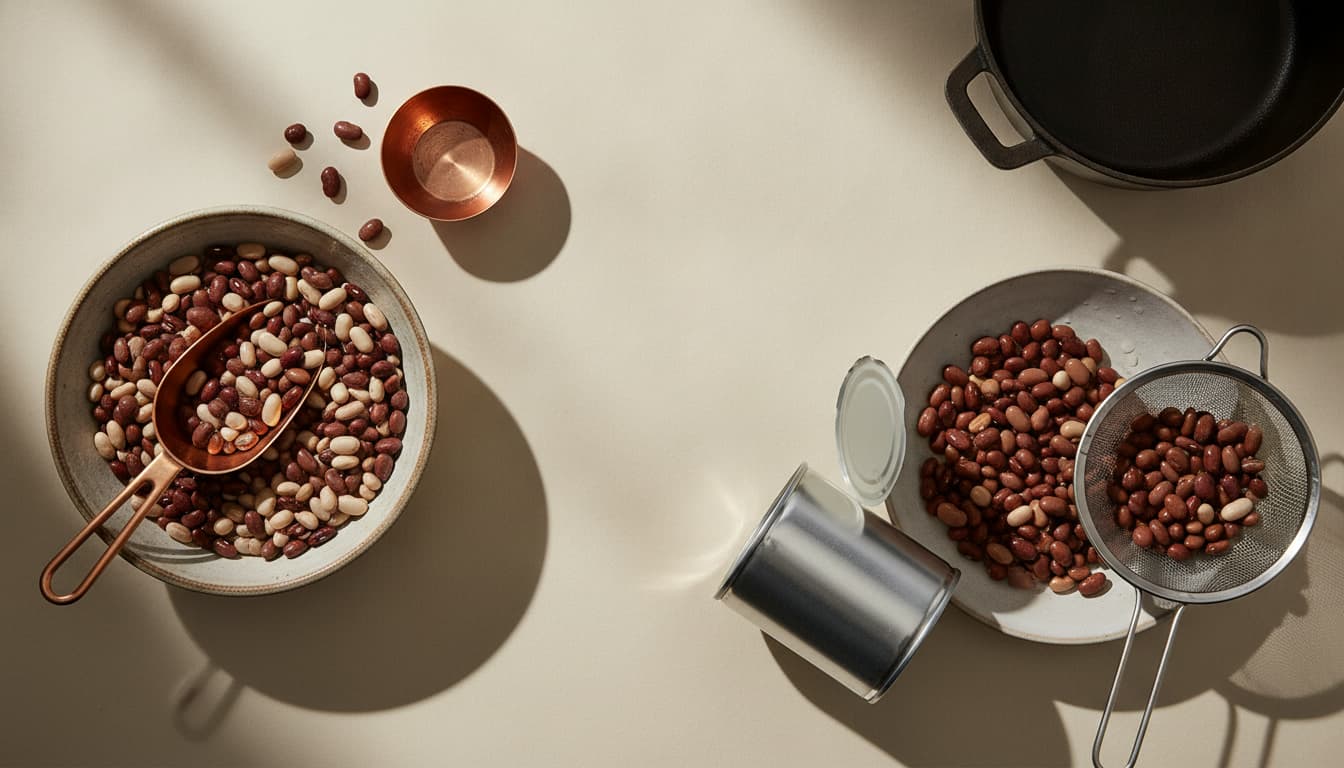
One pound of dry beans yields about 6 cups cooked and replaces roughly 4 cans at 2.5 to 5 times lower cost per cup. Canned beans carry 331 to 655 mg sodium per cup against 1.7 mg home-cooked.
This decision has four axes and they do not point the same way, which is why the argument never resolves. On cost, the arithmetic is fixed by two physical constants: 1 pound of dry beans absorbs water to roughly 2.5 times its dry weight and yields about 6 cups cooked, while a standard 15 to 15.5 ounce can yields about 1.5 cups drained, so one pound replaces roughly 4 cans. Independent confirmation of the can figure comes from a lectin assay that quantified an entire can as 1.5 cups equivalent to 94 g dry matter (Thompson et al. 2025). At the prices in the table that is a 2.5 to 5 times cost advantage per cup for the dry route. On nutrition, the gap is much smaller than the cost gap and it is not uniform. Per cup, home-cooked black beans give 15.24 g protein, 14.96 g fiber, 256 mcg DFE folate and 1.7 mg sodium, while canned low-sodium black beans give 14.47 g protein, 16.56 g fiber, 146 mcg DFE folate and 331 mg sodium (USDA FoodData Central). Protein is a near tie, fiber slightly favours the can, and the heat-labile fraction is where the can loses. Sodium is the one axis with a large one-sided gap: a cup of ordinary canned kidney beans in their liquid carries 655 mg (USDA FoodData Central) against 1.7 mg for the same volume cooked from dry without salt. On time, the honest accounting separates active from elapsed minutes; a pound of dry beans costs perhaps 10 active minutes spread across a 12-hour soak and a 90-minute simmer, and a can costs 2 active minutes with no elapsed time at all. On safety, the asymmetry runs the other way, and it is the only axis where one route carries a hazard the other does not. As few as four or five raw beans can trigger symptoms, onset is usually extreme nausea and vomiting within 1 to 3 hours, raw kidney beans contain 20,000 to 70,000 hemagglutinating units against 200 to 400 in fully cooked beans, and in the seven documented United Kingdom outbreaks the attack rate was 100 percent (FDA Bad Bug Book). Commercially canned beans have that problem solved and measured: a greater than 99 percent reduction in phytohemagglutinin, with a whole can amounting to 0.46 mg, roughly 1000-fold below the amount associated with food poisoning (Thompson et al. 2025).
Start with the unit economics, where the difference is large enough to change a grocery budget. Two constants do all the work. Dry beans absorb water to roughly 2.5 times their dry weight, so 1 pound yields about 6 cups cooked, and a standard 15 to 15.5 ounce can yields about 1.5 cups drained. One pound therefore replaces roughly 4 cans, and any comparison that puts a bag next to a can without applying that factor of 4 is comparing the wrong things. The 1.5 cup figure is not a kitchen estimate; a laboratory quantifying lectin content per can defined an entire can as 1.5 cups equivalent to 94 g dry matter (Thompson et al. 2025), and a 454 g bag holds about 404 g of dry matter. Applied to the table, cost per cup runs about $0.19, $0.36 and $0.95 across the three tiers, or roughly $0.013, $0.024 and $0.074 per gram of protein. Those absolute figures will not survive the year; the ratio will. Nutrition is where the popular claim is much stronger than the data. Per one cup, the USDA SR Legacy entries give 15.24 g protein, 14.96 g fiber, 256 mcg DFE folate, 120 mg magnesium and 1.7 mg sodium for black beans cooked at home from dry without salt, against 14.47 g protein, 16.56 g fiber, 146 mcg DFE folate, 84 mg magnesium and 331 mg sodium for canned low-sodium black beans (USDA FoodData Central). Protein differs by about 5 percent, inside the noise of how tightly a cup is packed, and fiber is higher in the canned entry because that cup weighs 240 g against 172 g. Folate falls 43 percent and magnesium 30 percent, the expected signature: heat-labile, water-soluble nutrients leach into the canning liquid and degrade under retort, while protein and most minerals do not, which is why a can of beans still counts as whole-food protein. Population data points the same way. In an NHANES 2001 to 2018 cluster analysis, four of the five bean-consumption patterns included both canned and dry beans, and all four scored significantly higher on the Healthy Eating Index 2015 than the no-bean pattern, 55.2 to 61.2 against 48.8 (Papanikolaou et al. 2024). Nobody there separated the routes, and the benefit appeared anyway. Sodium is the exception and the only nutrition axis where the gap is large and one-directional. One cup of ordinary canned red kidney beans in their liquid carries 655 mg (USDA FoodData Central), against a limit of less than 2,300 mg per day for ages 14 and older (Dietary Guidelines for Americans), so one undrained cup is roughly 28 percent of a day. Rinsing helps less than the folklore claims: per 100 g, canned red kidney beans as drained solids carry 231 mg and the same product drained and rinsed carries 208 mg (USDA FoodData Central). Older laboratory work found the same: a 3-minute rinse cut sodium 80 percent in canned tuna but had a minimal effect on canned beans, while replacing the brine before heating lowered salt content by 33 percent (Vermeulen et al. 1983). The sodium has equilibrated into the bean, not just the liquid, so the efficient move is the no-salt-added version, which takes the product from 256 mg to 117 mg per 100 g at source (USDA FoodData Central). Soaking is the most over-claimed step on the dried side. In a controlled comparison using a 16-hour soak at a 3:1 water to bean ratio, soaking cut phytate by 85 percent, cooking cut tannins by 84 percent, and the treatment discarding the unabsorbed soaking water cut raffinose 25.0 percent, stachyose 24.8 percent, verbascose 41.7 percent and starch 26.8 percent (de Oliveira et al. 2001). What soaking does not do is rescue an old bean. Inositol hexakisphosphate in cotyledons decreased significantly during adverse postharvest storage with a rise in InsP5, and the textural defect was predominated by that storage-induced degradation rather than by phytate interconversions during soaking (Chen et al. 2023). A bean that has spent two summers in a warm cupboard has already cross-linked its cell walls. Buy dry beans with turnover in mind, keep them cool and dry alongside the rest of the pantry staples, and treat a bag older than about a year as stew material. Phytohemagglutinin is the one place where the dried route carries a hazard the canned route does not. As few as four or five raw beans can trigger symptoms; onset is usually extreme nausea and vomiting within 1 to 3 hours; raw kidney beans contain 20,000 to 70,000 hemagglutinating units against 200 to 400 in fully cooked beans; and across seven United Kingdom outbreaks the attack rate was 100 percent (FDA Bad Bug Book). The destruction condition is short: Bender and Readi found that boiling for 10 minutes at 100 degrees Celsius completely destroyed the toxin, with at least 30 minutes advised for consumers (FDA Bad Bug Book). The slow cooker is the documented failure case: several outbreaks were associated with beans cooked in them, and studies of slow-cooker casseroles found internal temperatures of only 75 degrees Celsius or less, inadequate for destruction (FDA Bad Bug Book). That source documents inadequacy at that temperature and does not quantify an increase in toxicity, so the honest statement is failure to destroy. The canned route has this solved and measured: commercially cooked canned beans showed a greater than 99 percent reduction in active lectin at 4.9 micrograms per g dry weight, so an entire can delivers 0.46 mg, approximately 1000-fold below the amount associated with food poisoning (Thompson et al. 2025). Time is the axis compared badly, because active minutes and elapsed minutes are budgets on different accounts. A can costs about 2 active minutes and zero elapsed. A pound of dry beans costs perhaps 10 active minutes across a 5 to 12 hour soak and a 60 to 120 minute simmer, but occupies 14 hours of calendar. Someone deciding at 6 pm what to eat at 7 pm cannot buy the dried route at any price. That is a scheduling constraint, and batch cooking removes it: cook 2 pounds at once for about 12 cups, portion into 1.5 cup units so each substitutes for one can, cool and freeze, at roughly 20 active minutes a month. The can still wins in real cases: unplanned meals, kidney beans for anyone without a reliable rolling boil, small households where a pound of cooked beans would spoil, and shelf-stable stock, where low-acid cans hold best quality for 2 to 5 years (USDA FSIS). And where the alternative to a can is no legume at all, beans in either form are among the best whole-food protein sources per dollar in a supermarket, so bag versus can is a second-order optimisation on a decision already made correctly.
The differences that are measurable.
- 01
Two yield constants fix the whole comparison
Dry beans absorb water to roughly 2.5 times their dry weight, so 1 pound yields about 6 cups cooked, and a standard 15 to 15.5 ounce can yields about 1.5 cups drained. One pound therefore replaces roughly 4 cans. The can figure is independently confirmed by a lectin assay that defined an entire can as 1.5 cups equivalent to 94 g dry matter (Thompson et al. 2025); a 454 g bag holds about 404 g of dry matter, which is a little over four times that.
- 02
Cost per cup runs 2.5 to 5 times apart, and per gram of protein 3 to 6 times
Applying the yield constants to shelf prices gives about $0.19 per cup for store-brand dry pinto from a 4 pound bag, about $0.36 for a 1 pound bag of dry black beans and about $0.95 for a can of organic no-salt-added black beans. Dividing by protein per cup gives roughly $0.013, $0.024 and $0.074 per gram (USDA FoodData Central). The absolute figures are a dated snapshot; the ratio is the finding that survives a price cycle.
- 03
Protein and fiber per cup are close to a tie
One cup of black beans cooked at home from dry gives 15.24 g of protein and 14.96 g of fiber at a 172 g cup weight, against 14.47 g and 16.56 g for one cup of canned low-sodium black beans at a 240 g cup weight, and 12.83 g of protein for one cup of canned kidney beans drained and rinsed at 158 g (USDA FoodData Central). Fiber is higher in the can, contradicting the common assumption, and most of the spread is cup weight rather than the process.
- 04
Sodium is the one large one-sided gap
One cup of ordinary canned red kidney beans in their liquid carries 655 mg of sodium, against 1.7 mg for one cup of black beans cooked at home from dry without salt (USDA FoodData Central). With a limit of less than 2,300 mg per day for ages 14 and older (Dietary Guidelines for Americans), that single undrained cup is about 28 percent of a day. This is the axis where the routes genuinely differ, and it is also the one that is easiest to fix without changing routes.
- 05
Rinsing helps less than claimed, no-salt-added cans do the real work
Per 100 g, canned red kidney beans as drained solids carry 231 mg of sodium and the same product drained and rinsed in tap water carries 208 mg (USDA FoodData Central). Older laboratory work found a 3-minute rinse cut sodium 80 percent in canned tuna but had a minimal effect on canned beans, while replacing the brine before heating cut salt 33 percent (Vermeulen et al. 1983). Buying no-salt-added takes the product from 256 mg to 117 mg per 100 g at source.
- 06
Folate and magnesium are where the can actually loses
Per cup, folate falls from 256 mcg DFE cooked at home from dry to 146 mcg DFE canned, and magnesium from 120 mg to 84 mg, drops of 43 and 30 percent (USDA FoodData Central). Both are consistent with the mechanism: water-soluble and heat-labile nutrients leach into the canning liquid and degrade under retort, while protein and structural minerals hold. If the diet is otherwise short on folate, that gap is the one argument with real nutritional weight behind the dried route.
- 07
Soaking does what it has been measured to do
In a controlled comparison using a 16-hour soak at a 3:1 water to bean ratio, soaking reduced phytate by 85 percent and cooking reduced tannins by 84 percent, while the treatment discarding the unabsorbed soaking water reduced raffinose 25.0 percent, stachyose 24.8 percent, verbascose 41.7 percent and starch 26.8 percent (de Oliveira et al. 2001). The oligosaccharide reduction is the gas argument and it is real, but only when the soaking water is thrown away rather than cooked in.
- 08
Soaking does not rescue an old bean
The hard-to-cook defect is set during storage, not during preparation. Inositol hexakisphosphate in cotyledons fell significantly during adverse postharvest storage with a rise in InsP5, and the textural defect was predominated by storage-induced InsP6 degradation rather than phytate interconversions during soaking, with calcium released in storage binding to cell wall pectin and failing to leach out in the subsequent soak (Chen et al. 2023). A bag older than about a year should be treated as stew material.
- 09
Phytohemagglutinin is the asymmetry, and it is quantified
As few as four or five raw beans can trigger symptoms, onset is usually extreme nausea and vomiting within 1 to 3 hours with diarrhea developing later, and recovery is usually rapid within 3 to 4 hours of onset, although some cases have required hospitalization. Raw kidney beans contain 20,000 to 70,000 hemagglutinating units against 200 to 400 in fully cooked beans, and across seven United Kingdom outbreaks the attack rate was 100 percent (FDA Bad Bug Book).
- 10
Ten minutes at 100 degrees Celsius, and why the slow cooker fails
Bender and Readi found that boiling the beans for 10 minutes at 100 degrees Celsius completely destroyed the toxin, and consumers are advised to boil for at least 30 minutes to be sure the product reaches sufficient temperature for sufficient time (FDA Bad Bug Book). Several outbreaks were associated with slow cookers, and studies of slow-cooker casseroles found internal temperatures of only 75 degrees Celsius or less, inadequate for destruction. The documented finding is failure to destroy, not a measured increase in toxicity.
- 11
The canned route has this problem solved, and the reduction is measured
Commercially cooked canned beans showed a greater than 99 percent reduction in active lectin at 4.9 micrograms per g dry weight, so consuming an entire can, defined as 1.5 cups equivalent to 94 g dry matter, delivers 0.46 mg of phytohemagglutinin, approximately 1000-fold lower than the amount associated with food poisoning, which the same assay put at 544 mg across four dark red kidney bean seeds (Thompson et al. 2025). This is the strongest single argument for the can and it applies specifically to kidney beans.
- 12
Batch-cook-and-freeze resolves the time axis
A can costs about 2 active minutes and zero elapsed minutes, while a pound of dry beans costs perhaps 10 active minutes spread across a 5 to 12 hour soak and a 60 to 120 minute simmer, occupying roughly 14 hours of calendar. Those are separate budgets. Cooking 2 pounds at once for about 12 cups, portioned into 1.5 cup units so each portion substitutes for one can, then cooled and frozen, costs roughly 20 active minutes a month and removes the only axis on which the can was clearly ahead.
How this was specified
- 01Inputs measured
- Retail price (dated) · label claim · Certificate of Analysis · third-party test (Informed Sport / NSF / ConsumerLab / Clean Label) · leucine per serving from COA, not marketing.
- 02Protocols tested
- Per-kg target from four literature ranges (IOM RDA, Phillips 2017, Morton 2018, ISSN). Brands scored against Moore 2015 leucine-per-dose threshold (~0.4 g/kg).
- 03Cost-basis verified
- $/gram of protein and $/gram of leucine at warehouse pricing (Costco), mail-order (Amazon), and DTC retail. Re-checked quarterly, flagged when drift exceeds 15%.
- 04Confidence level
- High on ranked order. Medium on absolute $/g (prices drift). Low on serving-size claims where COA is older than 18 months, flagged [VERIFY].
What people ask us most.
- Are canned beans as nutritious as dried beans?
- On protein and fiber, effectively yes. Per cup, home-cooked black beans give 15.24 g of protein and 14.96 g of fiber against 14.47 g and 16.56 g for canned low-sodium black beans (USDA FoodData Central). The real gaps are folate, down 43 percent from 256 to 146 mcg DFE, magnesium, down 30 percent from 120 to 84 mg, and sodium, which runs from 1.7 mg home-cooked to 331 mg in a low-sodium can and 655 mg in an ordinary undrained one.
- How many cans does a pound of dried beans replace?
- About four. One pound of dry beans absorbs water to roughly 2.5 times its dry weight and yields about 6 cups cooked, while a standard 15 to 15.5 ounce can yields about 1.5 cups drained. The can figure is confirmed independently by a lectin assay that defined an entire can as 1.5 cups equivalent to 94 g dry matter (Thompson et al. 2025), and a 454 g bag at about 11 percent moisture holds roughly 404 g of dry matter, a little over four times that.
- Does rinsing canned beans really remove the sodium?
- Partly, and less than most guidance implies. Per 100 g, canned red kidney beans as drained solids carry 231 mg of sodium and the same product drained and rinsed carries 208 mg, a further 10 percent (USDA FoodData Central). Laboratory work found a 3-minute rinse cut sodium 80 percent in canned tuna but had a minimal effect on canned beans, while replacing the brine before heating cut salt content 33 percent (Vermeulen et al. 1983). The sodium has equilibrated into the bean, not only the liquid, so buying no-salt-added is the more effective move.
- Do dried beans have to be soaked?
- Not for safety in most cases, but soaking is measured to do specific things. With a 16-hour soak at a 3:1 water to bean ratio, phytate fell 85 percent, and in the treatment where the unabsorbed soaking water was discarded, raffinose fell 25.0 percent, stachyose 24.8 percent, verbascose 41.7 percent and starch 26.8 percent (de Oliveira et al. 2001). For red kidney beans specifically, the guidance cited in the Bad Bug Book is to soak at least 5 hours, discard the water and boil in fresh water for at least 30 minutes (FDA Bad Bug Book).
- Is it dangerous to cook kidney beans in a slow cooker?
- Yes, and it is the documented failure case. Several outbreaks have been associated with beans cooked in slow cookers or in casseroles that never reached a high enough internal temperature, and studies of slow-cooker casseroles found internal temperatures of only 75 degrees Celsius or less, inadequate for destruction of the lectin (FDA Bad Bug Book). Boiling for 10 minutes at 100 degrees Celsius completely destroyed the toxin in the cited work, with 30 minutes advised for consumers.
- Why will old dried beans not soften no matter how long they cook?
- Because the hard-to-cook defect develops during storage, not during preparation. In adversely stored beans, inositol hexakisphosphate in the cotyledons decreased significantly with a corresponding rise in InsP5, and the textural defect was predominated by that storage-induced degradation rather than by phytate changes during soaking; calcium released during storage bound to cell wall pectin and did not leach out during the later soak (Chen et al. 2023). Buy to a turnover of about a year and store cool and dry.
- How much money does switching to dried beans actually save?
- Roughly 2.5 to 5 times per cup, depending on which shelf items are compared. Using the yield constants, the routes price at about $0.19 per cup for store-brand dry pinto from a 4 pound bag, $0.36 for a 1 pound bag of dry black beans and $0.95 for a can of organic no-salt-added black beans, which is about $0.013, $0.024 and $0.074 per gram of protein. A household eating one cup of beans a day saves roughly $200 a year at the widest spread and about $60 at the narrowest.
- Is there any way to get the dried price without the dried schedule?
- Batch cooking, and it closes the gap almost entirely. Cook 2 pounds of dry beans at once for about 12 cups, portion into 1.5 cup units so each portion substitutes directly for one can, then cool and freeze. That is roughly 20 active minutes once a month in exchange for eight cans' worth of beans at the dry price, and retrieval is as fast as opening a can. No equipment is needed beyond a large pot and freezer containers.
A published Certificate of Analysis from a ranked brand that contradicts the label claim we scored against. An independent lab result (Clean Label, ConsumerLab) finding heavy-metal or amino-spiking failures on a current top pick. A peer-reviewed meta-analysis that shifts the leucine-per-dose threshold. Any of those triggers a dated revision within a week.
Every claim, cited.
- [01]FDA Bad Bug Book, Second Edition, Phytohaemagglutinin (kidney bean lectin) chapter. Toxic dose: as few as four or five raw beans can trigger symptoms. Onset: usually begins with extreme nausea and vomiting within 1 to 3 hours of ingestion, with diarrhea developing later within that timeframe. Duration: recovery usually is rapid, within 3 to 4 hours after onset, and spontaneous, although some cases have required hospitalization. The unit of toxin measure is the hemagglutinating unit (hau); raw kidney beans contain from 20,000 to 70,000 hau while fully cooked beans contain from 200 to 400 hau; white kidney beans contain about one-third the amount of the red variety and broad beans 5 percent to 10 percent. Bender and Readi found that boiling the beans for 10 minutes (100 degrees Celsius) completely destroyed the toxin, and consumers should boil for at least 30 minutes. Slow cookers should not be used; studies of casseroles cooked in slow cookers revealed internal temperatures of only 75 degrees Celsius or less, which is inadequate for destruction of the toxin. Seven outbreaks occurred in the United Kingdom between 1976 and 1979, with an attack rate of 100 percent. Consumer guidance in the same chapter: soak the beans in water for at least 5 hours, pour the water away, and boil in fresh water for at least 30 minutes.
- [02]Thompson HJ, Neil ES, McGinley JN, Lutsiv T. 2025. Toward standardized measurement of active phytohemagglutinin in common bean, Phaseolus vulgaris L. Foods 14(24):4247. Given reports that ingestion of four to five soaked raw dark red kidney bean seeds can induce food poisoning, the authors focused on that market class. By ELISA the estimated concentration of active lectin in dark red kidney beans was 223 mg per g dry weight and the total amount of phytohemagglutinin contained in four seeds was 544 mg. Commercially cooked canned beans had a greater than 99 percent reduction in phytohemagglutinin at 4.9 micrograms per g dry weight. Consumption of an entire can, 1.5 cups equivalent to 94 g dry matter, would equal 0.46 mg of phytohemagglutinin, approximately 1000-fold lower than the amount estimated to be associated with food poisoning.
- [03]USDA FoodData Central, SR Legacy entries for cooked and canned beans. Black beans, mature seeds, cooked, boiled, without salt: 1 cup weighs 172 g and gives 15.24 g protein, 14.96 g fiber, 256 mcg DFE folate, 120 mg magnesium, 611 mg potassium and 1.7 mg sodium. Black beans, canned, low sodium: 1 cup weighs 240 g and gives 14.47 g protein, 16.56 g fiber, 146 mcg DFE folate, 84 mg magnesium, 739 mg potassium and 331 mg sodium. Red kidney beans, canned, solids and liquids: 1 cup weighs 256 g and gives 13.36 g protein, 11.01 g fiber and 655 mg sodium, at 256 mg sodium per 100 g. Red kidney beans, canned, drained solids: 231 mg sodium per 100 g. Red kidney beans, canned, drained solids, rinsed in tap water: 208 mg sodium per 100 g, with 1 cup of rinsed solids weighing 158 g and giving 12.83 g protein and 9.48 g fiber. Red kidney beans, canned, solids and liquid, low sodium: 117 mg sodium per 100 g.
- [04]de Oliveira AC, Queiroz KS, Helbig E, Reis SM, Carraro F. 2001. The domestic processing of the common bean resulted in a reduction in the phytates and tannins antinutritional factors, in the starch content and in the raffinose, stachiose and verbascose flatulence factors. Arch Latinoam Nutr 51(3):276-83. Beans were soaked for 16 hours at a 3:1 water to beans ratio at room temperature and compared across raw, cooked unsoaked, cooked with the unabsorbed soaking water discarded, and cooked with the soaking water retained. A decrease in phytate content of 85 percent was observed with soaking. Cooking promoted an 84 percent decomposition of tannins. In the treatment where the unabsorbed soaking water was discarded, raffinose fell 25.0 percent, stachyose 24.8 percent, verbascose 41.7 percent and starch 26.8 percent. Reduction of phytates, tannin, starch and flatulence factors was most effective when the unabsorbed soaking water was discarded.
- [05]Chen D, Ding A, Zhu L, Grauwet T, Van Loey A, Hendrickx M, Kyomugasho C. 2023. Phytate and mineral profile evolutions to explain the textural hardening of common beans (Phaseolus vulgaris L.) during postharvest storage and soaking. Food Chem 404(Pt A):134531. During adverse postharvest storage of red haricot beans the inositol phosphate content, particularly InsP6, decreased significantly along with a significant increase in InsP5. Using a texture-based classification approach, cotyledon InsP6 content was shown to be an indicator of the extent of hard-to-cook development during bean ageing. The textural defect was predominated by storage-induced InsP6 degradation rather than by phytate interconversions during soaking. Calcium cations released during storage did not leach out significantly during subsequent soaking, suggesting binding with cell wall pectin in the cotyledons, while magnesium cations were mostly leached into the soaking water.
- [06]USDA Food Safety and Inspection Service, Shelf-Stable Food Safety. Low-acid canned foods such as meat, poultry, fish and most vegetables keep their best quality for 2 to 5 years, and high-acid canned foods such as tomatoes, fruits, pickles and sauerkraut for 12 to 18 months. Canned foods are safe indefinitely as long as they are not exposed to freezing temperatures or temperatures above 90 degrees Fahrenheit; temperatures above 100 degrees Fahrenheit are harmful. Store in a cool, dry place and never above the stove, under the sink, in a damp garage or basement, or anywhere exposed to temperature extremes. Discard cans that are leaking, bulging, badly dented, rusted or cracked, and never taste food from a can with those signs.
- [07]Dietary Guidelines for Americans, 2020 to 2025. Sodium intake is to be limited to less than 2,300 mg per day for people aged 14 years and older, with lower limits for younger age groups. Beans, peas and lentils are recommended in both the vegetable and the protein foods groups, and the guidance treats canned and dry forms as interchangeable contributors to those recommendations, subject to the sodium limit.
- [08]FoodSafety.gov FoodKeeper, the joint USDA, FDA and Cornell University storage database. FoodKeeper gives product-level pantry, refrigerator and freezer timelines for individual foods rather than category rules, including separate entries for dry legumes and for canned legumes, which is the reference to use when setting a turnover target for a specific bag or can.
The Larderlab Team builds evidence-led frameworks for eating, lifting, and stocking a kitchen. We cite every claim. We publish the spreadsheet when possible. We buy what we review at retail price. When new data lands, we revise with a dated note.
Next in this hub.
Do Spices Expire? They Fade, and the Real Hazard Runs the Other Way
FoodKeeper gives whole spices 3 to 4 years and ground spices 2 to 3, yet its own named entries run from 6 months to 4 years. The genuine safety issue is 6.6 percent Salmonella prevalence in imported shipments, not age in a cupboard (FDA).
14 min · rev 2026-09-09Pantry Staples: How to Stock a Kitchen by Cost-Per-Use
The shelf-stable short list that covers most meals, ranked by cost-per-use and shelf life. The buy-in-bulk rules, the storage gear that pays off, and what not to stockpile.
12 min · rev 2026-06-29How Long Do Canned Goods Last: The Date, the Can and the Storage
High-acid cans hold best quality for 12 to 18 months and low-acid cans for 2 to 5 years, while USDA FSIS treats commercially canned food as safe indefinitely below 90 degrees Fahrenheit. The can is the control, not the date.
12 min · rev 2026-09-04Get the Larderlab Macro Planner.
A Google Sheet that calculates your protein target, splits it across 3-5 meals, and ranks 20 protein sources by $/gram. Free. Copy-and-modify your own version.
By subscribing, you agree to our Privacy Policy. Unsubscribe anytime.