BPA in canned food, and why two food-safety agencies cannot agree on the dose
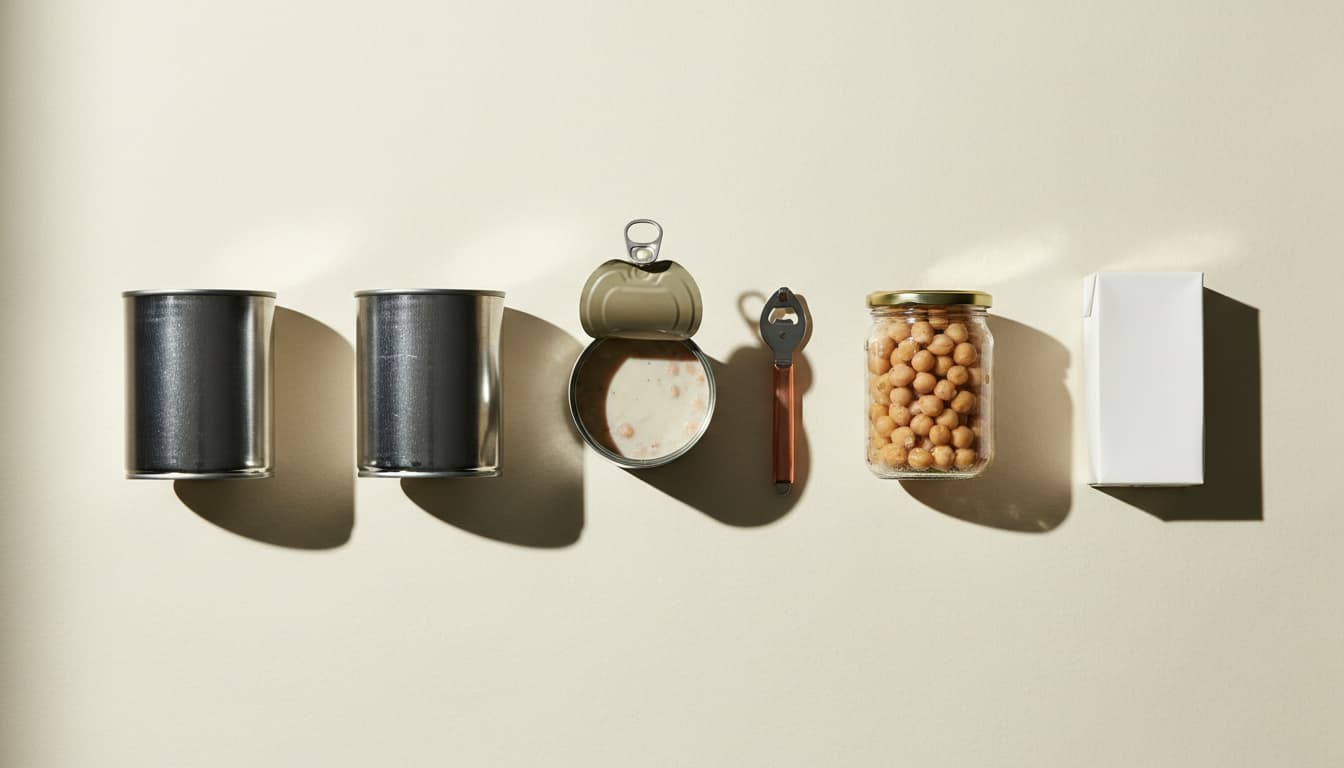
Five days of canned soup raised urinary BPA from 1.1 to 20.8 micrograms per litre, a 1,221 percent increase. EFSA cut its tolerable daily intake 20,000-fold in 2023 while FDA holds that current levels are safe. The EU banned BPA in food contact materials from January 2025.
- 01
Five days of canned soup moved urinary BPA nearly twentyfold
A randomized single-blind two-by-two crossover trial gave 75 participants one 12-ounce serving of canned or freshly prepared soup daily for 5 days with a 2-day washout. Urinary BPA came out at a geometric mean of 1.1 micrograms per litre, 95 percent CI 0.9 to 1.4, after the fresh arm and 20.8 micrograms per litre, 95 percent CI 17.9 to 24.1, after the canned arm, a 1,221 percent increase and a mean difference of 22.5 micrograms per litre, p below 0.001 (Carwile et al. 2011).
- 02
In a normal diet the effect is 24 percent, not 1,221 percent
Across 7,669 NHANES 2003 to 2008 participants aged 6 and over, eating one canned food in the previous 24 hours was associated with 24 percent higher urinary BPA, 95 percent CI 1.11 to 1.38, and two or more canned foods with 54 percent, 95 percent CI 1.27 to 1.88 (Hartle et al. 2016). The trial figure is what a daily soup habit does; the survey figure is what a normal week does. Both matter, and quoting only the first overstates the ordinary case by a factor of about fifty.
- 03
Canned soup is the outlier and canned beverages are not a source
By category, one or more servings against none was associated with 41 percent higher urinary BPA for canned vegetables and fruit, 95 percent CI 1.23 to 1.63, 70 percent for canned pasta, 95 percent CI 1.18 to 2.44, and 229 percent for canned soup, 95 percent CI 1.22 to 4.30. Canned beverages showed no association (Hartle et al. 2016). Soup is hot-filled, liquid and long-contact; beverage cans use a different coating with cold contents. The ranking is a contact-conditions ranking, not a brand ranking.
- 04
EFSA cut its tolerable daily intake 20,000-fold in one revision
The 2015 temporary tolerable daily intake was 4 micrograms per kg body weight per day. The 2023 re-evaluation identified an effect on Th17 immune cells in mice as the critical effect, set a human equivalent reference point of 8.2 nanograms per kg body weight per day, applied an overall uncertainty factor of 50, and published a TDI of 0.2 nanograms per kg body weight per day (EFSA CEP Panel 2023). Both mean and 95th percentile exposures in all age groups exceeded the new figure by two to three orders of magnitude.
- 05
FDA holds the opposite position, and its reasoning is toxicokinetic
FDA's stated current perspective is that BPA is safe at the current levels occurring in foods. A four-year review completed in 2014 covered more than 300 studies published between November 2009 and July 2013 without prompting a revision, and work at the National Center for Toxicological Research found oral BPA is rapidly metabolised to an inactive form, with internal exposure to the active form predicted below 1 percent of the administered dose and far faster clearance in primates than rodents (FDA).
- 06
The 2012 and 2013 FDA amendments were not safety findings
FDA removed BPA-based materials from baby bottles, sippy cups and infant formula packaging in 2012 and 2013, and states explicitly that those regulatory amendments were made on the ground of abandonment by industry rather than as a safety determination (FDA). This distinction gets lost constantly, because the action reads like a warning and the agency's own description of it does not. Anyone citing the baby bottle rule as proof that FDA considers BPA unsafe is citing the wrong document.
- 07
The EU stopped arguing and banned it, coatings included
Regulation (EU) 2024/3190 prohibits BPA in food contact materials and articles including plastics, coatings, inks and adhesives, and entered into force on 20 January 2025. Transition periods run 18 months for most single-use packaging, to 20 July 2026, and 36 months, to 20 January 2028, for categories including items with BPA-based coatings, which is the can-lining case. Cans on an EU shelf are therefore mid-transition through 2027 rather than already changed.
- 08
The EU rule covers other bisphenols, which closes the substitution loophole
Earlier BPA-free labelling created a well-documented substitution problem: the coating was reformulated with bisphenol S or bisphenol F, the label became accurate, and the structural class did not change. The EU regulation is written against bisphenols as a group rather than BPA alone, so a compliant EU can cannot simply have swapped one letter. A US can labelled BPA-free carries no equivalent guarantee, and the useful question to a manufacturer is which resin replaced the epoxy, not whether BPA is present.
- 09
Exposure tracks yesterday, not a lifetime of accumulation
BPA is glucuronidated rapidly and excreted in urine on a timescale of hours, which is why a 2-day washout was sufficient to reset the crossover trial (Carwile et al. 2011) and why FDA emphasises that internal exposure to the active form is predicted below 1 percent of an oral dose (FDA). The practical consequence is that habitual frequency is the variable worth changing. One can of soup does not enter a long-term body burden; a can a day sustains a twentyfold elevated biomarker for as long as it continues.
- 10
Contact conditions decide migration, so format substitution works
Migration rises with temperature, fat content, acidity and storage duration, which is why hot-filled liquid soup sits at the top of the NHANES category table and cold canned beverages sit at zero (Hartle et al. 2016). It also means a glass jar, a carton or a frozen bag is a genuine substitute rather than a symbolic one. Acidic contents are the highest-value swap, so tomatoes in a jar are worth more than tuna in a pouch if only one change is going to be made.
- 11
Rinsing canned food does not remove BPA
Rinsing removes surface salt and the packing liquid, which is a legitimate sodium intervention and is often confused with a BPA intervention. It is not one. Migration occurs into the food matrix during retort processing and subsequent storage, so the bisphenol is distributed through the contents rather than deposited on them. Draining and rinsing beans is worth doing for the sodium figure on the label, and it should not be counted as reducing bisphenol exposure.
- 12
The cheapest fix was already the cheapest option
The highest-frequency canned item in most kitchens is beans, and the dry version of the same bean costs a fraction of the canned version per cooked cup before any contaminant argument is made. Buying dry, cooking in batch and freezing in portions removes the most frequent exposure and lowers the grocery line at the same time, which is the only intervention here with a positive return. Everything else on the list is a preference, and the rest of the pantry staples argument is unchanged.
- 13
Keep canned fish, and be specific about why
Canned fish is a smaller, less frequent serving than soup and it is doing nutritional work that is genuinely hard to replace at the price, particularly canned wild salmon and sardines for omega-3 and calcium from the softened bones. Nothing in the NHANES category breakdown singles out canned fish, and the format substitutes are poor. Where a canned item is both infrequent and nutritionally load-bearing, the exposure argument does not carry enough weight to displace it.
What people ask us next.
- How much does eating canned food raise BPA exposure?
- Two figures apply to two different patterns. A controlled trial feeding one 12-ounce serving of canned soup daily for 5 days raised urinary BPA from a geometric mean of 1.1 to 20.8 micrograms per litre, a 1,221 percent increase (Carwile et al. 2011). Ordinary consumption is far smaller: one canned food in the previous 24 hours was associated with 24 percent higher urinary BPA across 7,669 NHANES participants, and two or more with 54 percent (Hartle et al. 2016).
- Why do EFSA and FDA disagree so badly?
- They weighted different evidence. EFSA's 2023 re-evaluation treated an immune effect on Th17 cells in mice as the critical endpoint, set a human equivalent reference point of 8.2 nanograms per kg body weight per day, applied an uncertainty factor of 50 and published a tolerable daily intake of 0.2 nanograms per kg body weight per day (EFSA CEP Panel 2023). FDA weighted toxicokinetics, finding oral BPA rapidly inactivated with under 1 percent reaching the active form internally, and holds that current dietary levels are safe (FDA).
- Is BPA still legal in food cans?
- It depends on the market. In the EU, Regulation (EU) 2024/3190 prohibits BPA in food contact materials including coatings and entered into force on 20 January 2025, with transition periods to 20 July 2026 for most single-use packaging and to 20 January 2028 for categories including BPA-coated products. In the United States it remains permitted for can coatings, with FDA maintaining that the current levels in food are safe (FDA).
- Does a BPA-free label mean the can is safe?
- It means one specific molecule is absent. The documented substitution pattern replaced BPA with bisphenol S or bisphenol F, structurally similar compounds with far less regulatory scrutiny, which made the label accurate without necessarily changing much. The EU rule is written against bisphenols as a class rather than BPA alone, so EU compliance carries more information than a US marketing claim. The useful question to a manufacturer is which resin system replaced the epoxy.
- Should canned beverages be avoided too?
- The data say no. Across 7,669 NHANES participants, canned beverages showed no association with urinary BPA concentrations while canned foods showed clear ones (Hartle et al. 2016). Beverage cans use a different coating system and the contents are cold rather than hot-filled, and migration is strongly temperature-dependent. Extending a canned-food concern to canned drinks costs effort and buys nothing measurable.
- Does rinsing canned beans reduce BPA?
- No. Migration happens into the food matrix during retort processing and storage rather than onto its surface, so rinsing cannot remove what has already partitioned into the beans. Rinsing is still worth doing for a different reason, since it removes a meaningful share of the added sodium in the packing liquid. Treat it as a sodium measure and not as a contaminant measure.
- Which canned foods are worth replacing first?
- Rank by frequency and by contact conditions. Soup ranks worst on both, at 229 percent higher urinary BPA in the NHANES category breakdown, and it is easy to make in batch. Beans are next by frequency and are the only swap that saves money, since dry beans cost a fraction of canned per cooked cup. Acidic contents such as tomatoes are high-extraction and move well to glass jars. Canned fish is infrequent and nutritionally hard to replace, so it stays.
- Does BPA build up in the body over time?
- Not in the way persistent contaminants do. BPA is rapidly glucuronidated and cleared in urine within roughly a day, which is why a 2-day washout was enough to reset the arms of the crossover trial (Carwile et al. 2011) and why FDA emphasises that internal exposure to the active form is predicted to be under 1 percent of an oral dose (FDA). Exposure therefore reflects recent intake, so changing a habit changes the biomarker within days rather than years.
Every claim, cited.
- [01]Carwile JL, Ye X, Zhou X, Calafat AM, Michels KB. 2011. Canned soup consumption and urinary bisphenol A: a randomized crossover trial. JAMA 306(20):2218-2220. Randomized single-blinded two-by-two crossover design in 75 participants, who consumed one 12-ounce serving of either fresh or canned soup daily for 5 days, separated by a 2-day washout period. Urinary BPA geometric mean was 1.1 micrograms per litre, 95 percent CI 0.9 to 1.4, after the fresh soup arm and 20.8 micrograms per litre, 95 percent CI 17.9 to 24.1, after the canned soup arm. The canned arm was on average 22.5 micrograms per litre higher, 95 percent CI 19.6 to 25.5, a 1,221 percent increase, p below 0.001.
- [02]Hartle JC, Navas-Acien A, Lawrence RS. 2016. The consumption of canned food and beverages and urinary Bisphenol A concentrations in NHANES 2003-2008. Environ Res 150:375-382. Analysis of 7,669 NHANES participants aged 6 years and older with 24-hour dietary recall and urinary BPA. Nine percent had consumed one canned food in the past 24 hours and 2 percent two or more. One canned food versus none was associated with 24 percent higher urinary BPA, 95 percent CI 1.11 to 1.38; two or more with 54 percent, 95 percent CI 1.27 to 1.88. By category: 41 percent higher for canned vegetable and fruit, 95 percent CI 1.23 to 1.63; 70 percent for canned pasta, 95 percent CI 1.18 to 2.44; 229 percent for canned soup, 95 percent CI 1.22 to 4.30. Canned beverages were not associated with urinary BPA concentrations.
- [03]EFSA CEP Panel. 2023. Re-evaluation of the risks to public health related to the presence of bisphenol A in foodstuffs. EFSA Journal 21(4):e06857. In 2015 EFSA established a temporary tolerable daily intake for BPA of 4 micrograms per kg body weight per day. The 2023 re-evaluation identified the immune system as the most sensitive target, with an effect on Th17 cells in mice as the critical effect, a reference point of 8.2 nanograms per kg body weight per day as human equivalent dose, and an overall uncertainty factor of 50, giving a TDI of 0.2 nanograms per kg body weight per day. Both mean and 95th percentile dietary exposures in all age groups exceeded that TDI by two to three orders of magnitude, and the Panel concluded there is a health concern from dietary BPA exposure.
- [04]FDA. Bisphenol A (BPA): Use in Food Contact Application. BPA is a component in metal can coatings, which protect the food from directly contacting metal surfaces, and has been used in food packaging since the 1960s. FDA's current perspective, based on its most recent safety assessment, is that BPA is safe at the current levels occurring in foods. A four-year review completed in 2014 covered more than 300 studies published or available between November 2009 and July 2013 and found nothing to prompt a revision. Research at FDA's National Center for Toxicological Research found that oral BPA is rapidly metabolised to an inactive form, that internal exposure to the active form after oral administration is predicted to be below 1 percent of the total administered, and that primates including humans metabolise and excrete BPA far more rapidly than rodents. FDA amended its regulations in 2012 and 2013 to remove BPA-based materials from baby bottles, sippy cups and infant formula packaging on the ground of abandonment, which the agency states explicitly is not a safety determination.
- [05]Commission Regulation (EU) 2024/3190 of 19 December 2024 on the use of bisphenol A and other bisphenols and bisphenol derivatives with harmonised classification for specific hazardous properties in certain materials and articles intended to come into contact with food. The regulation prohibits the use of BPA in food contact materials and articles including plastics, coatings, printing inks and adhesives, subject to limited derogations, and entered into force on 20 January 2025. Transition periods allow first placing on the market for 18 months for most single-use food contact materials and 36 months, to 20 January 2028, for specified categories including articles with BPA-based coatings, with additional periods for transfer, filling and sale of stock.
- [06]USDA Food Safety and Inspection Service, Shelf-Stable Food Safety. Canned foods are safe indefinitely as long as they are not exposed to freezing temperatures or temperatures above 90 degrees Fahrenheit; high-acid canned foods such as tomatoes, fruits, pickles and sauerkraut keep their best quality for 12 to 18 months, while low-acid canned foods such as meat, poultry, fish and most vegetables keep their best quality for 2 to 5 years. Storage duration is relevant here because migration from a coating into the contents continues throughout storage.
- [07]USDA FoodData Central, entries for black beans, mature seeds, cooked, boiled, without salt, and black beans, mature seeds, canned. Used for the dry-versus-canned comparison on cost per cooked cup and for the sodium difference between the home-cooked and canned entries, which is the measure that rinsing actually affects.
The Larderlab Team builds evidence-led frameworks for eating, lifting, and stocking a kitchen. We cite every claim. We publish the spreadsheet when possible. We buy what we review at retail price. When new data lands, we revise with a dated note.
Next in this hub.
Microplastics in Food: The Exposure Is Real, and Two Sources Carry Most of It
The best particle-count estimate is 39,000 to 52,000 particles a year from food, and drinking only bottled water adds 90,000 against 4,000 for tap. One plastic teabag at 95 degrees Celsius releases 11.6 billion particles. The mass estimate spans 0.1 to 5 g a week, a fiftyfold range.
14 min · rev 2026-09-10How Long Can Food Sit Out? Two Hours, One Hour, and Why
Two hours at room temperature, one hour above 90 degrees Fahrenheit. The number comes from a 20-minute doubling time, and the reason it is not negotiable is that some toxins formed during the delay survive cooking.
8 min · rev 2026-08-31How to Evaluate a Food Claim: The Larderlab Methodology
The seven-step method we run on every ingredient deep-dive: separate the layers of a claim, weigh the evidence tier, check the dose, and find the number that actually settles it.
11 min · rev 2026-06-29Get the Larderlab Macro Planner.
A Google Sheet that calculates your protein target, splits it across 3-5 meals, and ranks 20 protein sources by $/gram. Free. Copy-and-modify your own version.
By subscribing, you agree to our Privacy Policy. Unsubscribe anytime.