Freezer burn, and why the fix is a constant temperature rather than a better bag
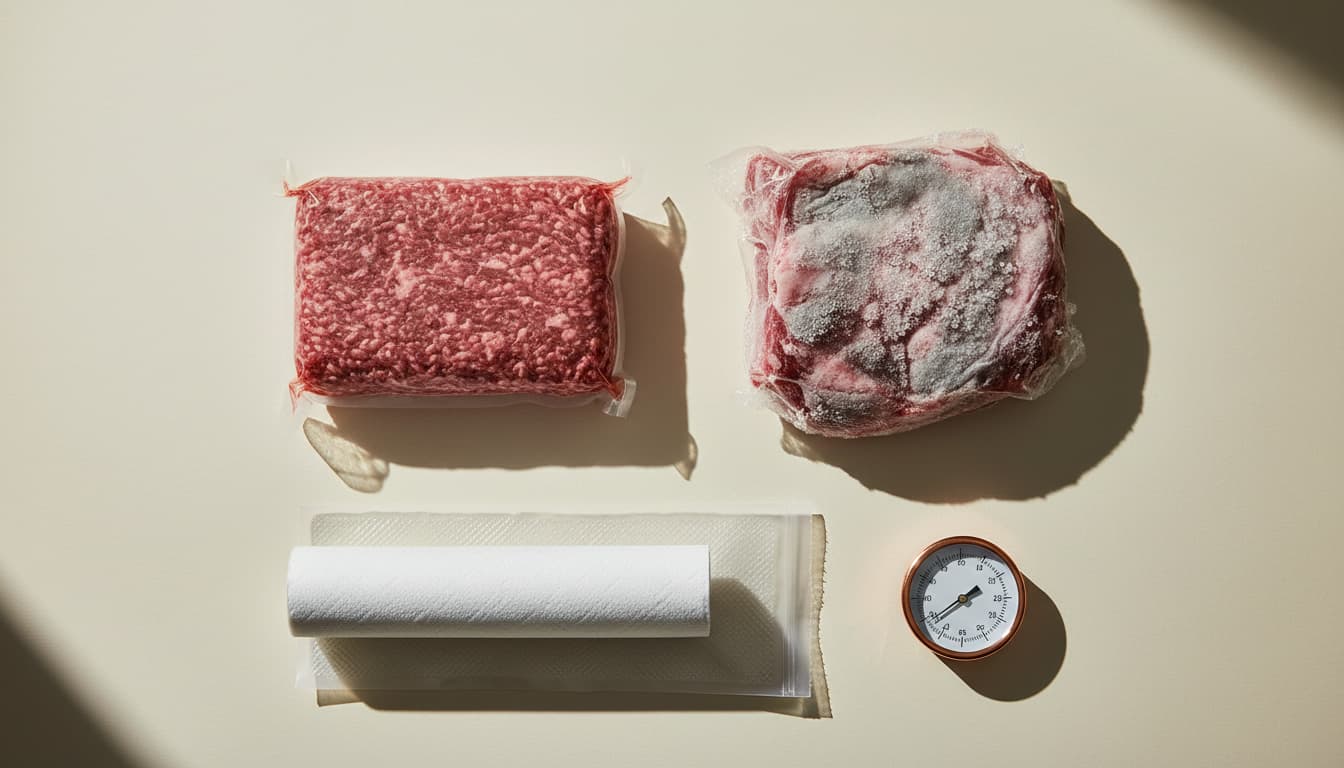
Freezer burn is moisture loss at the surface, not spoilage. Food held constantly at 0 degrees Fahrenheit stays safe indefinitely, and the 3 to 4 month and 4 to 12 month windows are quality windows only.
- 01
Freezer burn is surface dehydration, not spoilage
The agency statement is unambiguous: freezer burn does not make food unsafe, it is moisture loss at the surface, it appears as grayish-brown leathery spots, and it is caused by air reaching the surface of the food (USDA FSIS). Because freezing to 0 degrees Fahrenheit inactivates the microbes present in food rather than killing them, the safety clock stops entirely while the quality clock keeps running. Treating a gray patch as spoilage leads to discarding food that only needs trimming.
- 02
Zero degrees Fahrenheit held constant is the whole specification
Food stored constantly at 0 degrees Fahrenheit will always be safe and only the quality suffers with lengthy freezer storage (USDA FSIS). The operative word is constantly. Every published freezer window, from 3 to 4 months for ground meat to 12 months for whole poultry, is measured against that steady state, so a cabinet that spends part of each day at 10 or 15 degrees Fahrenheit is not running the same experiment the table describes and will not deliver the table's results.
- 03
The water moves to the coldest surface, which is never the food
Ice at the food surface has a vapor pressure that rises with temperature. Warm the cabinet and that ice sublimes into the headspace inside the package; cool it and the vapor deposits on the packaging film or the cabinet wall. Over dozens of cycles the transfer is one-way, because the food never recovers the water. The frost sheet above a burned roast and the leathery patch on it are the same water in two places, which is why sealing matters more than sealing tightly once.
- 04
Auto-defrost cycles are a designed temperature swing
A frost-free freezer periodically warms its evaporator coil on a timer to melt accumulated frost, which is the feature that keeps the cabinet ice-free and the same feature that cycles the food. Since food held constantly at 0 degrees Fahrenheit loses quality only slowly (USDA FSIS), the defrost schedule is the single largest quality cost most households never see. It does not make the appliance defective; it means the packaging and portioning discipline has to be better than it would be in a chest freezer.
- 05
Door openings and thermal mass set the swing size
A freezer full of food will usually keep about 2 days if the door is kept shut, while a half-full freezer keeps about a day (USDA FSIS). That is a power-outage figure, but it also quantifies thermal mass in normal use: a full cabinet resists the temperature swing from an open door, and a half-empty one swings with every opening. Filling dead space with sealed water containers costs nothing and buys back part of the stability the storage tables assume.
- 06
Freezing rate sets ice crystal size and later drip loss
Rapid freezing prevents large ice crystals from forming, while slow freezing creates large disruptive crystals that rupture cells and increase drip loss on thaw (USDA FSIS). In a controlled pork loin comparison spanning freezing rates of 0,26 to 1,42 cm per hour across three temperatures and three air flow rates, freezing rate affected both ice crystal size and shear force, and product frozen at 0,96 cm per hour or faster showed fresh meat-like qualities clearly distinct from conventionally frozen product (Yun et al. 2021).
- 07
Add no more than 2 to 3 pounds per cubic foot at a time
Do not overload the freezer with unfrozen food; add no more than 2 to 3 pounds of food per cubic foot of freezer capacity at a time (USDA FSIS). A bulk box of beef pushed in all at once does two things at the same time: the new food freezes slowly, forming the large disruptive crystals, and the latent heat it dumps raises the cabinet temperature for hours, cycling everything already stored. Freeze in tranches and space the packages until they are solid.
- 08
Moisture-vapor resistance and air exclusion are two different jobs
The instruction is to use moisture-vapor resistant packaging and press out the air (USDA FSIS), and those are separate properties. Vapor resistance is a film property: thin storage bags and butcher paper perform poorly, while heavy freezer bags, laminated pouches and rigid containers perform well. Air exclusion is a technique rather than a purchase. Water displacement in a zip-top bag or simply flattening and rolling the package removes most of the headspace at zero cost, and a vacuum sealer only automates it.
- 09
Portion to single-meal units so a pack is opened once
A single large pack opened five times has been through five warm humid air exchanges, while five single-meal packs have each been through one. That ratio, not the brand of bag, is usually the difference between chicken that lasts its 9 month window and chicken burned by month three. Flat bags freeze fastest because thickness sets freezing rate; rigid containers are the better answer for stews and sauces where a flat bag is impractical.
- 10
The FoodSafety.gov chart is a quality table, not a discard table
At 0 degrees Fahrenheit the consumer chart gives bacon 1 month, raw sausage 1 to 2 months, hamburger and other ground meats 3 to 4 months, steaks, chops and roasts 4 to 12 months, whole chicken or turkey 1 year, poultry pieces 9 months, cooked poultry 4 months, soups and stews 2 to 3 months, cooked meat leftovers 2 to 6 months, lean fish such as cod or flounder 6 to 8 months, fatty fish such as wild salmon 2 to 3 months, cooked fish 4 to 6 months, and raw egg whites and yolks 12 months (FoodSafety.gov).
- 11
Safe indefinitely and 3 to 4 months are not in conflict
Freezing keeps food safe indefinitely, and freezer storage times are for quality only (USDA FSIS). The two statements describe different variables measured on the same package. Read the pattern inside the table rather than the individual numbers: ground meat beats out faster than whole cuts because grinding multiplies exposed surface area, and fatty fish beats out faster than lean fish because unsaturated fat oxidises. Surface area and fat, not price per pound, tell you which items deserve the best packaging.
- 12
Cut freezer-burned portions away before or after cooking
Freezer-burned portions can be cut away either before or after cooking, and heavily freezer-burned food may have to be discarded for quality (USDA FSIS). The correct response to a gray patch on an otherwise sound roast is a knife, and the correct response to a bag of vegetables that is uniformly leathery is the bin, on quality grounds alone. Trimming before cooking is easier on raw meat; trimming after cooking works better where the burned layer is thin and hard to find raw.
- 13
Audit the cabinet with a thermometer, not the dial
Appliance thermometers are the way to confirm that a refrigerator is at 40 degrees Fahrenheit or below and a freezer at 0 degrees Fahrenheit or below (FDA). A dial marked 1 to 7 reports a setting, not a temperature. Leave a thermometer in the cabinet, read it after a heavy shopping load and again after an untouched week, and the gap between those two readings is the number that predicts how fast the contents of that freezer will burn.
- 14
Refreezing costs quality, and within limits costs no safety
If food is partly frozen, still has ice crystals, or is as cold as if it were in a refrigerator at 40 degrees Fahrenheit, it is safe to refreeze or use, while food that has been warmer than 40 degrees Fahrenheit for more than 2 hours should be discarded (USDA FSIS). Refreezing does cost quality, because a thaw and refreeze is the crystal-growth cycle in concentrated form and increases drip loss on the second thaw, but the safety line and the quality line sit in different places.
What people ask us next.
- Is freezer-burned food safe to eat?
- Yes. Freezer burn does not make food unsafe; it is moisture loss at the surface caused by air reaching the food, and it shows as grayish-brown leathery spots (USDA FSIS). Because food stored constantly at 0 degrees Fahrenheit will always be safe and only the quality suffers with lengthy storage, the decision is entirely about eating quality. Freezer-burned portions can be cut away either before or after cooking, and only heavily burned food has to be discarded, on quality grounds.
- Does freezer burn mean the freezer is broken?
- Usually not. The most common causes are packaging that is not moisture-vapor resistant, air left in the package, and normal temperature cycling from automatic defrost and door openings. Confirm the appliance separately with a thermometer, since appliance thermometers are the way to verify that a freezer is at 0 degrees Fahrenheit or below (FDA). If the reading holds at 0 degrees Fahrenheit through a normal week, the appliance is doing its job and the packaging is the variable to change.
- Why is there ice inside the bag and on the freezer wall?
- That frost is the water the food lost. Ice at the food surface sublimes into the headspace when the cabinet warms slightly, then deposits on the coldest available surface when it cools, which is the packaging film or the cabinet wall rather than the food. The process repeats with every defrost cycle and every door opening, and it is one-way, which is why heavy frost inside a package is a reliable early signal of freezer burn under it.
- How long can meat actually stay in the freezer?
- Indefinitely for safety, and for a defined window for quality. At 0 degrees Fahrenheit the charts give uncooked ground meat 3 to 4 months, uncooked steaks, chops and roasts 4 to 12 months, whole chicken or turkey 1 year, poultry pieces 9 months and cooked meat 2 to 3 months (USDA FSIS; FoodSafety.gov). Freezing keeps food safe indefinitely and freezer storage times are for quality only, so passing a window is a reason to check eating quality rather than to discard.
- Does vacuum sealing prevent freezer burn?
- It addresses one of the two causes well. The instruction is to use moisture-vapor resistant packaging and press out the air (USDA FSIS), and a vacuum sealer automates the air-exclusion half while the film handles the vapor half. It does not stop temperature cycling, so a vacuum-sealed pack in a frost-free cabinet still loses surface moisture, only more slowly. Water displacement in a zip-top bag captures a large share of the same benefit at no equipment cost.
- Can food be refrozen after it has thawed?
- Within a defined limit. If the food is partly frozen, still has ice crystals, or is as cold as if it were in a refrigerator at 40 degrees Fahrenheit, it is safe to refreeze or to use, and food warmer than 40 degrees Fahrenheit for more than 2 hours should be discarded (USDA FSIS). Expect a quality cost either way, since a thaw and refreeze grows ice crystals and raises drip loss on the second thaw (Yun et al. 2021).
- Does freezing destroy nutrients?
- No. The freezing process itself does not destroy nutrients, and in meat and poultry products there is little change in nutrient value during freezer storage (USDA FSIS). The losses that do occur are mostly mechanical rather than chemical: large ice crystals rupture cells and the resulting drip loss on thaw carries away water-soluble compounds, which is a further argument for freezing fast in thin packages rather than slowly in thick ones (Yun et al. 2021).
- Is a chest freezer better than the freezer on a refrigerator?
- For burn resistance, generally yes, and it is a trade rather than an upgrade. A manual-defrost chest freezer holds a flatter temperature because it has no scheduled defrost warming and loses less cold air when opened from the top, and thermal stability is what the storage tables assume (USDA FSIS). The costs are an annual defrosting job, a larger footprint and worse access. A frost-free upright is more convenient and requires stricter packaging and portioning to match it.
Every claim, cited.
- [01]United States Department of Agriculture, Food Safety and Inspection Service. Freezing and Food Safety. Food stored constantly at 0 degrees Fahrenheit will always be safe, and only the quality suffers with lengthy freezer storage; freezing keeps food safe indefinitely and freezer storage times are for quality only. Freezing to 0 degrees Fahrenheit inactivates microbes, bacteria, yeasts and molds, present in food, and once thawed those microbes can again become active. Freezer burn does not make food unsafe; it is moisture loss at the surface caused by air reaching the food and appears as grayish-brown leathery spots, freezer-burned portions can be cut away either before or after cooking, and heavily freezer-burned food may have to be discarded for quality. Rapid freezing prevents large ice crystals from forming while slow freezing creates large disruptive crystals that rupture cells and increase drip loss on thaw. Do not overload the freezer with unfrozen food and add no more than 2 to 3 pounds of food per cubic foot of freezer capacity at a time; use moisture-vapor resistant packaging and press out the air. Food that is partly frozen, still has ice crystals, or is as cold as if it were in a refrigerator at 40 degrees Fahrenheit is safe to refreeze or use, and food warmer than 40 degrees Fahrenheit for more than 2 hours should be discarded. A freezer full of food will usually keep about 2 days if the door is kept shut and a half-full freezer about a day. The freezing process does not destroy nutrients and there is little change in nutrient value during freezer storage of meat and poultry. The freezer chart at 0 degrees Fahrenheit gives uncooked ground meat 3 to 4 months, uncooked steaks or chops 4 to 12 months, cooked meat 2 to 3 months and uncooked whole poultry 12 months.
- [02]FoodSafety.gov, Cold Food Storage Charts. Freezer figures at 0 degrees Fahrenheit: bacon 1 month; raw sausage 1 to 2 months; hamburger and other ground meats 3 to 4 months; fresh beef steaks 4 to 12 months; chops 4 to 12 months; roasts 4 to 12 months; whole chicken or turkey 1 year; poultry pieces 9 months; cooked poultry 4 months; soups and stews 2 to 3 months; cooked meat leftovers 2 to 6 months; hot dogs, opened, 1 to 2 months; lunch meat 1 to 2 months; lean fish such as cod or flounder 6 to 8 months; fatty fish such as salmon 2 to 3 months; cooked fish 4 to 6 months; raw egg whites and yolks 12 months. The chart states these as quality windows for food held at 0 degrees Fahrenheit, not as safety limits, and the pattern across the list tracks surface area and fat content rather than price or perceived perishability.
- [03]FoodSafety.gov, FoodKeeper. The federal reference application listing storage windows for refrigerator, freezer and pantry for several hundred foods and beverages, maintained with the USDA Food Safety and Inspection Service, Cornell University and the Food Marketing Institute. It is the searchable per-item form of the cold storage charts and is the appropriate place to check a specific product against a general category window, for example distinguishing lean from fatty fish or opened from unopened cured meats, both of which carry materially different freezer quality windows at the same 0 degrees Fahrenheit holding temperature.
- [04]United States Department of Agriculture, Food Safety and Inspection Service. Refrigeration and Food Safety. Sets the refrigerator standard at 40 degrees Fahrenheit or below and the freezer standard at 0 degrees Fahrenheit or below, explains that refrigeration slows but does not stop bacterial growth while freezing at 0 degrees Fahrenheit halts it, and gives the 2 hour rule for perishable food held above refrigeration temperature, reduced to 1 hour when the ambient temperature is above 90 degrees Fahrenheit. It also covers appliance placement, loading and the use of an appliance thermometer to verify holding temperature rather than relying on a numbered control dial.
- [05]United States Food and Drug Administration. Refrigerator Thermometers, Cold Facts about Food Safety. States that appliance thermometers are the best way of knowing refrigerator and freezer temperatures, that the refrigerator should be kept at 40 degrees Fahrenheit or below and the freezer at 0 degrees Fahrenheit or below, and that the thermometer should be checked regularly rather than the control dial, since a dial reports a setting rather than a measured cabinet temperature. It also covers keeping the appliance loaded appropriately for airflow and verifying temperature recovery after heavy loading or a period of frequent door openings.
- [06]Yun YC, Kim H, Ramachandraiah K, Hong GP. 2021. Evaluation of the Relationship between Freezing Rate and Quality Characteristics to Establish a New Standard for the Rapid Freezing of Pork. Food Sci Anim Resour 41(6):1012-1021. Three air flow rates (0, 1.5 and 3.0 m per second) were applied under three freezing temperatures (minus 20, minus 30 and minus 40 degrees Celsius) to pork loin, producing freezing rates from 0.26 to 1.42 cm per hour, graded as slow, intermediate and rapid. Both temperature and air flow rate influenced the freezing rate, and the freezing rate affected ice crystal size and shear force, although air flow rate itself did not affect thawing loss, drip loss or color. Intermediate-rate pork did not differ clearly from slow-frozen pork on quality parameters, while rapidly frozen pork showed fresh meat-like qualities clearly distinct from slow freezing. Against a prevailing 0.5 cm per hour standard, the authors proposed 0.96 cm per hour as the lowest freezing rate achieving meat quality distinguishable from conventional freezing, and found no further advantage from increasing the rate beyond that on an energy consumption basis.
The Larderlab Team builds evidence-led frameworks for eating, lifting, and stocking a kitchen. We cite every claim. We publish the spreadsheet when possible. We buy what we review at retail price. When new data lands, we revise with a dated note.
Next in this hub.
How to Store Eggs: Why the US Refrigerates and the EU Does Not
The United States requires refrigeration at 40 degrees Fahrenheit or below. European rules say Class A eggs shall not be washed and should in general not be refrigerated before sale. One processing step explains the split.
8 min · rev 2026-09-02Dried Beans vs Canned Beans: Cost, Sodium, Time and One Real Hazard
One pound of dry beans yields about 6 cups cooked and replaces roughly 4 cans at 2.5 to 5 times lower cost per cup. Canned beans carry 331 to 655 mg sodium per cup against 1.7 mg home-cooked.
13 min · rev 2026-09-09Best Meal Prep Containers, 2026: Glass vs Polypropylene, Stack Math
Eight container systems ranked on stack-density, microwave/oven safety, and cost-per-serving over a 5-year amortization. The leaching-temperature data nobody publishes.
9 min · rev 2026-04-29Get the Larderlab Macro Planner.
A Google Sheet that calculates your protein target, splits it across 3-5 meals, and ranks 20 protein sources by $/gram. Free. Copy-and-modify your own version.
By subscribing, you agree to our Privacy Policy. Unsubscribe anytime.