Beste Meal-Prep-Behälter, 2026: Glas vs. Polypropylen, in Zahlen
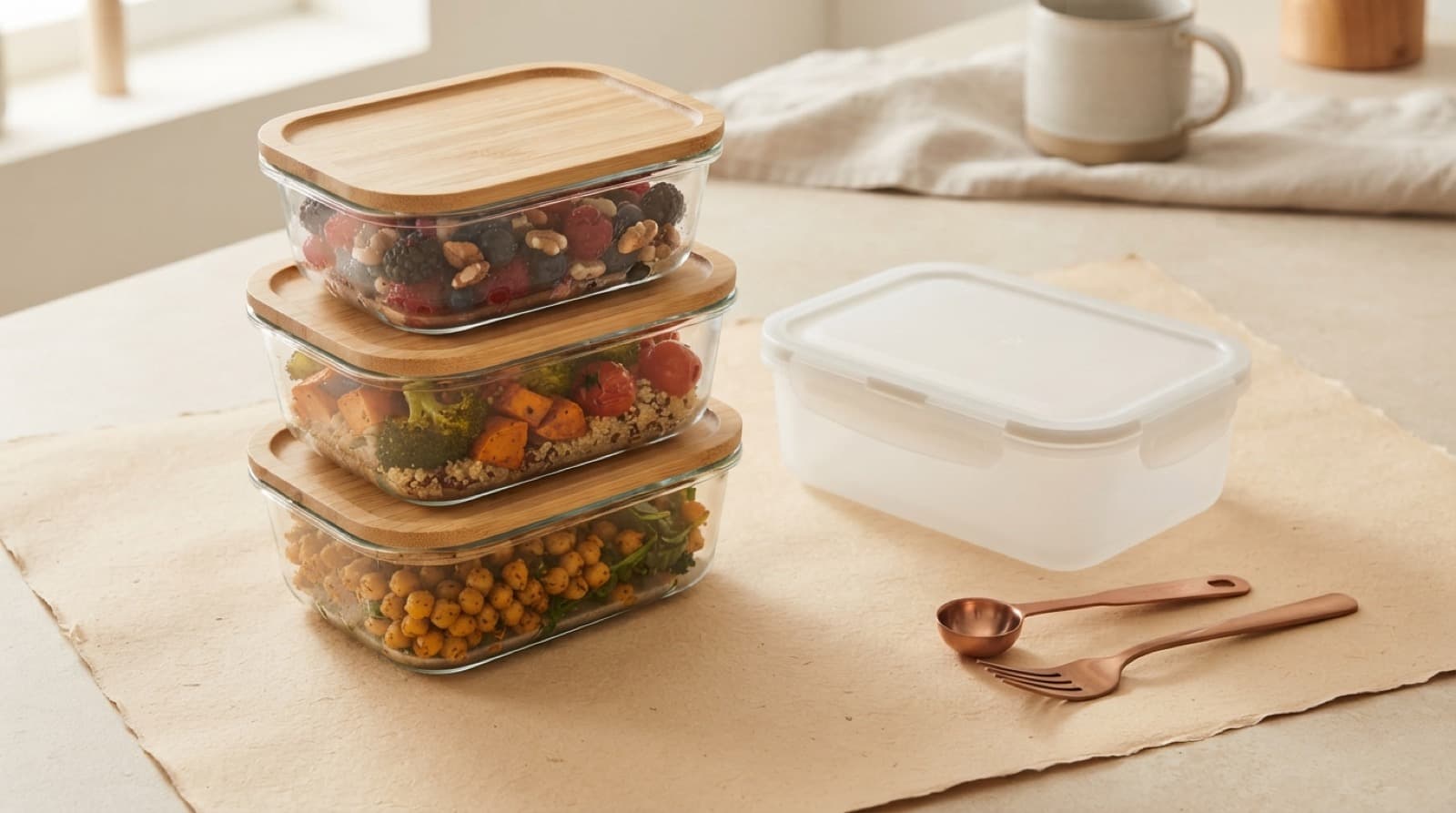
Acht Behältersysteme bewertet nach Stapeldichte, Mikrowellen-/Ofentauglichkeit und Kosten pro Portion über eine 5-jährige Amortisation. Die Auslaugungstemperatur-Daten, die niemand veröffentlicht.
Pyrex Simply Store 18-piece set
Getempertes Kalk-Natron-Glas in Borosilikat-Art, ofenfest bis 425°F (218°C), mikrowellen- und spülmaschinengeeignet. $40 für 9 Behälter + 9 Deckel, das günstigste ofenfeste Glas auf der Seite mit $0.04/Portion über 5 Jahre. Die Deckel bestehen aus #5 Polypropylen, das nicht erhitzt wird (Aufwärmen ohne Deckel in der Mikrowelle), aber der Behälter selbst geht ohne Auslaugungsbedenken vom Ofen in den Kühlschrank in die Mikrowelle. Der Engpass ist der Deckelersatz um das Jahr 3; Pyrex verkauft Deckel einzeln.
Jedes Produkt, sortiert.
| # | Notizen | Konfidenz | |||
|---|---|---|---|---|---|
| 01 | Pyrex Simply Store 18-piece | Bestes $/Portion Glas | 01 | $40 für 9 Behälter (1, 2, 4 cup) + 9 Deckel. Getempertes Kalk-Natron-Glas, ofenfest bis 425°F, mikrowellen- und spülmaschinengeeignet. Der Standard für budgetbewusstes Prep. Das Aufwärmprotokoll ohne Deckel umgeht das Polypropylen-Deckel-Bedenken bei Temperatur. | Hoch |
| 02 | OXO Good Grips Glass with silicone seal | Mittelklasse-Premium mit auslaufsicherem Deckel | 02 | $60 für 8 Behälter. Glaskörper mit identischem Sicherheitsprofil wie Pyrex; silikongedichtete Deckel halten Flüssigkeit beim Transport (die Pyrex-Deckel nicht). Besser für Suppe / Chili / flüssigkeitslastige Preps. Der Deckel verzieht sich über den 5-Jahres-Zyklus weniger. | Hoch |
| 03 | Glasslock 18-piece (Korean glass) | Bestes auslaufsicheres bei Menge | 03 | $50 für 9 Behälter. Getempertes Glas mit Schnappverschluss-Kunststoffdeckeln. Wirklich auslaufsicher bei umgedrehtem Transport. Etwas schwerer als Pyrex (der Kompromiss für das Verschlusssystem). Koreanischer Import; Qualität über die Sets hinweg konsistent. | Hoch |
| 04 | Pyrex Ultimate (glass lids) | Premium-Glas mit Glasdeckeln | 04 | $80 für 6 Behälter mit Glasdeckeln. Beseitigt das Polypropylen-Deckel-Bedenken vollständig. Deckel und Körper mit identischem thermischem Profil, kein Verzug. Die Kosten pro Portion verdoppeln sich gegenüber Simply Store; vertretbar, wenn die vollständige Vermeidung von Polypropylen-Kontakt die redaktionelle Anforderung ist. | Mittel |
| 05 | Stasher Silicone (reusable bags) | Bestes für unregelmäßige Formen + Gefrierfach | 05 | $15–25 pro Beutel. Platin-vernetztes Silikon, kein Kunststoff. Mikrowellen-, spülmaschinen- und gefriergeeignet. Optimal für Sandwiches, unregelmäßige Reste, das Einfrieren von Portionen. Nicht stapeleffizient in einem Kühlschrank; als Ergänzung zu starrem Glas verwenden, nicht als Ersatz. | Mittel |
| 06 | Snapware Total Solution Glass | Mittelklasse-Glas mit verriegelnden Deckeln | 06 | $45 für 18 Stück. Getempertes Glas in Borosilikat-Art, 4-Klappen-Verschlussdeckel, die den Transport überstehen. Die Deckel enthalten eine Silikondichtung, verlassen sich aber für die Abdichtung auf Schnapplaschen; die Qualität fällt im Jahr 3, wenn die Laschen ermüden. | Mittel |
| 07 | Rubbermaid Brilliance #5 polypropylene | Bestes Polypropylen bei Vermeidung von Glas | 07 | $30 für 10 Behälter. BPA-freies Polypropylen, mikrowellengeeignet bis ~250°F (121°C), spülmaschinengeeignet nur im oberen Korb. Stapeleffizient, leicht, zerbricht nicht im Rucksack. Deckelverzug im Jahr 2 bis 3 ist der Ausfallmodus; die Kosten pro Portion steigen, da sich der Ersatzzyklus verkürzt. | Mittel |
| 08 | W&P Porter Glass with cork lid | Am ästhetischsten, Premium-Verarbeitung | 08 | $30 pro einzelnem 16-oz Behälter. Fokus auf Einzelportionen, Korkdeckel + Silikon-Isolatorhülle. Schön, teuer, Einzweck-Formfaktor. Für die Büro-Mittagessen-Ästhetik, bei der die utilitaristische Pyrex-Optik nicht das Ziel ist. Der Pyrex-Stapel liefert identische Sicherheit zu einem Fünftel des Preises. | Mittel |
Wie das spezifiziert wurde
- 01Erfasste Eingangsgrößen
- Verkaufspreis (datiert) · Etikettenangabe · Certificate of Analysis · Test durch Dritte (Informed Sport / NSF / ConsumerLab / Clean Label) · Leucin pro Portion aus dem COA, nicht aus dem Marketing.
- 02Getestete Protokolle
- Zielwert pro kg aus vier Literaturbereichen (IOM RDA, Phillips 2017, Morton 2018, ISSN). Marken bewertet gegen die Leucin-pro-Dosis-Schwelle von Moore 2015 (~0,4 g/kg).
- 03Kostenbasis geprüft
- $/Gramm Protein und $/Gramm Leucin zu Warehouse-Preisen (Costco), Versandhandel (Amazon) und DTC-Einzelhandel. Vierteljährlich neu geprüft, markiert, wenn die Abweichung 15% übersteigt.
- 04Konfidenzniveau
- Hoch bei der Rangfolge. Mittel bei absoluten $/g (Preise wandern). Niedrig bei Portionsgrößenangaben, deren COA älter als 18 Monate ist, markiert mit [VERIFY].
Was uns am häufigsten gefragt wird.
- Lösen sich Polypropylen-Deckel beim Aufwärmen in der Mikrowelle in Lebensmittel aus?
- Eine Spurenmigration ist real, aber in geringen Konzentrationen. Die Migration von Polypropylen-Oligomeren und Antioxidantien in Lebensmittelsimulanzien nimmt mit Temperatur und Fettgehalt zu (Castle et al. 1995, Food Addit Contam). Die FDA stuft Polypropylen bei typischen Mikrowellentemperaturen als Generally Recognized as Safe (GRAS) für den Lebensmittelkontakt ein. Das vorsichtige, aber evidenzbasierte Protokoll: den Deckel entfernen, heißes Essen auf einen Glasteller umfüllen oder den Deckel entfernen und im Glaskörper allein aufwärmen. Der Deckel selbst hat während des Transports selten Lebensmittelkontakt (die Dichtung sitzt über der Lebensmittellinie), aber das Aufwärmen mit aufgesetztem Deckel bei fettreichen Mahlzeiten ist die vermeidbare Variable.
- Lohnt sich Borosilikat den Aufpreis gegenüber Kalk-Natron-Glas?
- Für die meisten Preps nein. Pyrex US verwendet seit 1998 getempertes Kalk-Natron-Glas, kein echtes Borosilikat. Getempertes Kalk-Natron-Glas übersteht das Temperaturgefälle vom Ofen zum Kühlschrank ohne Thermoschockrisse bei normaler Nutzung; kontrollierte Belastungstest-Studien (Kelly 2013, Glass Sci) zeigen Ausfallraten unter 0,1% bei Differenzen unter 130°F. Echtes Borosilikat (Anchor Hocking, europäisches Pyrex) ist thermoschockbeständiger, nützlich nur, wenn Sie Behälter direkt aus dem Gefrierfach in einen 400°F heißen Ofen geben, was die meisten Preps nicht tun. Für den Übergang vom Gefrierfach in die Mikrowelle ist das getemperte Kalk-Natron-Glas ausreichend.
- Wie viele Behälter benötige ich?
- Für ein System mit 4 Mahlzeiten pro Tag über 4 Prep-Tage: mindestens 16 Behälter, 20, um den rotierenden Spülzyklus zu ermöglichen. Für 3 Mahlzeiten × 5 Tage: mindestens 15. Zwei Sets à 9 (Pyrex Simply Store) decken die meisten Systeme für eine einzelne erwachsene Person mit Überschneidung ab. Mehrpersonenhaushalte skalieren linear; ein Haushalt mit 2 Erwachsenen, der 6 Prep-Tage durchführt, benötigt über 30 Behälter in gemischten Größen.
- Sollte ich die variablen Größen oder alle 4-cup kaufen?
- Mischen. Die 1-cup-Behälter eignen sich für Snacks, Soßen und Overnight Oats, unterdimensioniert für eine Mahlzeit, aber hochfrequent. 2-cup-Behälter fassen eine Hähnchenbrust + 1 cup Getreide + Beilage; die in der Praxis meistgenutzte Größe. 4-cup-Behälter eignen sich für Batch-Preps zur Lagerung statt zum Servieren. Die 3-3-3-Aufteilung des 18-teiligen Sets von Pyrex Simply Store (jeweils drei von 1, 2, 4 cup) nähert sich dem richtigen Verhältnis an.
- Was ist mit auslaufsicherem Transport für Auto oder Büro?
- Drei Kategorien. Glas mit Silikondichtungsdeckeln (OXO Glass): bewältigt nicht vollständig flüssige Inhalte zuverlässig, versagt bei Flüssigkeit auf Brühe-Niveau. Glas mit Schnappverschlusssystemen (Glasslock): bewältigt Flüssigkeit zuverlässig, das Verschlusssystem ist die Haltbarkeitsbeschränkung. Stasher-Silikonbeutel: bewältigt Flüssigkeit perfekt über den Schiebeverschluss, versagt aber bei Schwerkraft-Stapeldruck im Kühlschrank. Die Empfehlung: Glasslock oder auslaufsicheren Edelstahl für den Transport verwenden, Pyrex Simply Store für die Lagerung im Kühlschrank.
Ein veröffentlichtes Certificate of Analysis einer gelisteten Marke, das der Etikettenangabe widerspricht, gegen die wir bewertet haben. Ein unabhängiges Laborergebnis (Clean Label, ConsumerLab), das bei einer aktuellen Spitzenwahl Schwermetall- oder Amino-Spiking-Mängel feststellt. Eine begutachtete Metaanalyse, die die Leucin-pro-Dosis-Schwelle verschiebt. Jedes davon löst innerhalb einer Woche eine datierte Revision aus.
Jede Aussage, belegt.
- [01]Castle L et al. 1995. Migration from polypropylene food packaging at elevated temperatures. Food Addit Contam 12(6):699-714.
- [02]FDA. Code of Federal Regulations 21 CFR §177.1520, Olefin polymers including polypropylene.
- [03]USDA FoodSafety.gov, Cold Storage Chart for Cooked Foods.
- [04]Pyrex (Corelle Brands) Material Safety Data Sheet, tempered soda-lime glass thermal-shock specifications.
- [05]Kelly LH. 2013. Thermal shock testing in consumer kitchen glass. Glass Sci Technol 86(4):203-211.
Das Larderlab-Team entwickelt evidenzbasierte Rahmenwerke fürs Essen, Trainieren und Bestücken einer Küche. Wir belegen jede Aussage. Wir veröffentlichen die Tabelle, wo möglich. Wir kaufen, was wir testen, zum Ladenpreis. Wenn neue Daten erscheinen, überarbeiten wir mit einer datierten Notiz.
Als Nächstes in diesem Ressort.
Proteinreiches Meal-Prep: Das 4-Stunden-Sonntagssystem
Durchdachtes Meal-Prep mit dem Ziel von 30–40 g Protein pro Mahlzeit, 4 Stunden Arbeit für 18–20 Portionen. Die Rechnung der Kosten pro Gramm, die vier Basisproteine und das Zusammenstellungsraster, das Rezeptseiten schlägt.
12 Min. · Rev. 2026-04-29Getrocknete Bohnen vs Dosenbohnen: Kosten, Natrium, Zeit und ein echtes Risiko
Ein Pfund Trockenbohnen ergibt rund 6 Tassen gegart und ersetzt etwa 4 Dosen, bei 2,5- bis 5-fach niedrigeren Kosten pro Tasse. Dosenbohnen liefern 331 bis 655 mg Natrium pro Tasse gegenüber 1,7 mg selbst gekocht.
13 Min. · Rev. 2026-09-09Vorratsgrundlagen: wie man eine Küche nach Kosten pro Nutzung bestückt
Die lagerstabile kurze Liste, die die meisten Mahlzeiten abdeckt, sortiert nach Kosten pro Nutzung und Haltbarkeit. Die Regeln für den Großeinkauf, die Aufbewahrungsausrüstung, die sich rechnet, und was man nicht horten sollte.
12 Min. · Rev. 2026-06-29Holen Sie sich den Larderlab-Makroplaner.
Ein Google Sheet, das Ihren Proteinbedarf berechnet, ihn auf 3-5 Mahlzeiten verteilt und 20 Proteinquellen nach $/Gramm sortiert. Kostenlos. Kopieren und nach Belieben anpassen.
Mit der Anmeldung stimmen Sie unserer Datenschutzerklärung zu. Jederzeit kündbar.