Does protein powder expire, and why the real clock is chemical rather than microbial
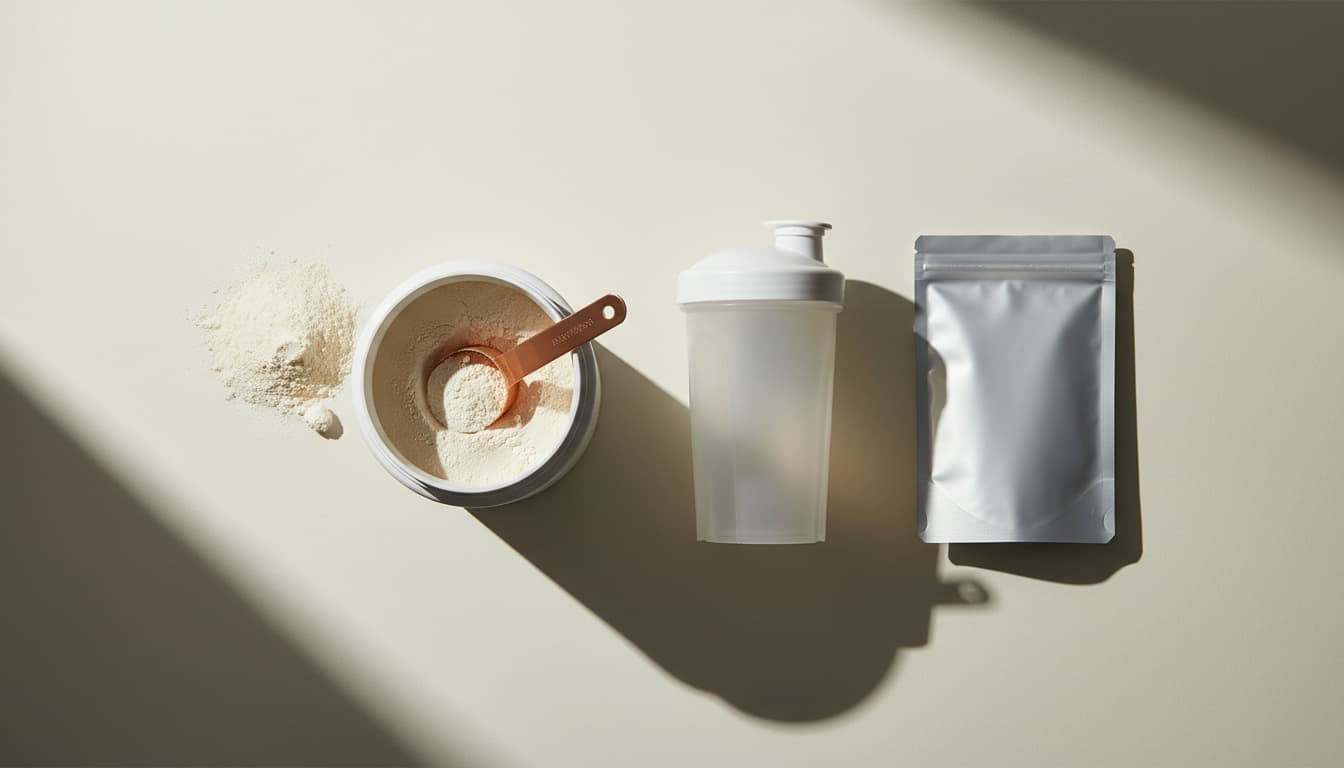
Spray-dried protein powders sit at a water activity of 0.23 to 0.27, far below the roughly 0.93 that Clostridium botulinum needs to grow. The clock that does run is the Maillard reaction, which attaches lactose to lysine residues at 324 mass units apiece.
- 01
The expiration date is optional, not regulatory
Asked whether the dietary supplement current good manufacturing practice rule requires a manufacturer to establish an expiration date, a shelf date or a best if used by date, the agency's compliance guide answers no, citing 21 CFR 111.70(e). Asked whether a firm should have data to support any such date it places on a label, the same guide answers yes (FDA Small Entity Compliance Guide). A manufacturer may print no date at all and remain compliant, so the date on the tub is a company decision.
- 02
The date is measured against a quality specification, not a safety endpoint
Because the supporting data has to justify the date against the manufacturer's own specification, and that specification typically covers protein content, solubility, microbial limits and sensory acceptability, the printed date is a prediction about when the product stops meeting a company standard. It is not a regulator's statement about when the product becomes unsafe, and the two are routinely confused in exactly the way they are with canned goods and packaged foods.
- 03
The tub sits at a water activity of about 0.25
Spray-dried powders built on whey protein isolate were characterised at water activity 0.23 to 0.27 with moisture content of 4.45 to 5.19 percent (Ferraz et al. 2022). Water activity measures available rather than total water on a scale where pure water is 1.0, and it is the variable that governs microbial growth. A quarter of the scale is a long way below anything of microbiological concern, which is the reason a dry tub does not spoil the way a liquid does.
- 04
Nothing of public health significance grows below 0.85
The agency puts the minimum water activity for growth of Clostridium botulinum at approximately 0.93, rising as high as 0.96 depending on product characteristics, and treats water activity above 0.85 as the level at which a food contains enough available moisture that microorganisms of public health significance must be destroyed by heat treatment; most foods sit above 0.95 (FDA). A powder at 0.25 is roughly a third of the 0.85 threshold and nowhere near the botulinum figure.
- 05
The clock that does run is the Maillard reaction
In milk protein concentrate at 80 percent protein stored across 25 to 40 degrees Celsius and 44 to 84 percent relative humidity, furosine, free hydroxymethylfurfural and visible browning all increased over storage while solubility decreased. Adding glucose to accelerate the reaction produced more furosine and more brown pigment with correspondingly lower solubility, which the authors read as evidence that the Maillard reaction may be a cause of solubility loss (Le et al. 2011).
- 06
What the reaction consumes is lysine, at 324 mass units apiece
Two-dimensional gel electrophoresis and mass spectrometry on stored milk protein concentrate showed lactosylated whey proteins separating into vertical stacks of spots whose masses varied by multiples of 324, indicating the attachment of lactose to lysine residues in the proteins, with multiple lactosylation sites confirmed on alpha-lactalbumin (Le et al. 2012). Each step is one lactose molecule bound to one lysine side chain, and a lysine carrying a sugar is not available as lysine.
- 07
That is a loss of the specific thing the powder was bought for
Lysine is an indispensable amino acid and one of the residues that makes dairy protein score well against plant sources. The tub does not lose protein mass as it ages, it loses a fraction of one of the amino acids that justified the purchase, and the loss is temperature-, humidity- and time-dependent (Le et al. 2012). That is a sharper and more useful statement than saying the powder goes off, and it is the reason storage conditions matter more than the printed date.
- 08
Deamidation and cross-linking run alongside it
The same proteomic analysis found lactosylation, deamidation and protein cross-linking in stored milk protein concentrate, each of them storage temperature-, humidity- and time-dependent (Le et al. 2012). Cross-linking in particular is the structural counterpart of the solubility problem: proteins bonded to each other are harder to disperse in water. The three modifications share a driver, which is why one set of storage rules addresses all of them.
- 09
Clumping is a moisture readout, not a cosmetic defect
In spray-dried milk protein powders from 40 to 80 percent protein, glass transition temperatures, alpha-relaxation temperatures and structural strength all decreased significantly with water uptake, crystallised lactose appeared in low protein powders at high water activities, and high protein powders absorbed higher levels of water under high humidity (Maidannyk et al. 2020). A powder that has taken up moisture softens at a lower temperature and cakes, and the same moisture accelerates the browning chemistry.
- 10
High protein powders are the hungrier ones for water
The same study found that while the rate of water diffusion was higher for low protein powders, high protein powders absorbed higher levels of water under high humidity conditions (Maidannyk et al. 2020). An isolate at 90 percent protein is therefore not automatically the more stable choice in a humid kitchen, and the practical consequence is that lid discipline and a dry storage location matter more for the expensive tub than for the cheap one.
- 11
Plant and high-fat powders run a second, faster clock
Gas chromatography mass spectrometry olfactometry of pea protein found 24 odour-active compounds with a prevalence of carbonyls from fat oxidation, including nine known major off-flavour contributors: hexanal, nonanal, 2-undecanone, (E)-2-octenal, (E,Z)-3,5-octadiene-2-one, (E,E)-2,4-decadienal, 2-pentyl-furan, 2-pentyl-pyridine and gamma-nonalactone (Ebert et al. 2022). Any powder with meaningful residual fat develops that profile before it develops a browning problem.
- 12
The nose distinguishes the two failure modes
Hexanal is a characteristic green odorant and a standard marker of lipid oxidation (Ebert et al. 2022), so a stale, cardboard or painty smell in a plant blend is oxidation. A flat, faintly caramel smell combined with poor mixing in a dairy powder is browning and solubility loss (Le et al. 2011). Both are detectable long before an assay would be run, which makes a deliberate sniff a more informative test than reading the date on the lid.
- 13
Storage rules follow from the two drivers, temperature and humidity
Both clocks are driven by heat and by moisture, and the browning study covered exactly the 25 to 40 degrees Celsius and 44 to 84 percent relative humidity range where kitchens and garages sit (Le et al. 2011). Keep the tub cool, dry and closed, never return a wet scoop, and do not store it in a garage, a car or a cupboard above the stove, for the same reason the rest of the pantry staples do not belong in those places.
- 14
The discard triggers are narrow and none of them is a date
Visible mould means water got in and the water activity rose far enough to support growth, which is a different situation from a dry tub past its date. Insect activity, a tub that has been wet, and an odour that is rancid rather than merely stale are the others. A dry, sealed, correctly stored tub a few months past its printed date is a quality question, and the rational response for anyone tracking cost per gram of protein is usually to finish it.
What people ask us next.
- Does protein powder expire?
- It has a date, but the date is neither required nor a safety line. The dietary supplement current good manufacturing practice rule does not require a manufacturer to establish an expiration date, a shelf date or a best if used by date, per the agency's compliance guide citing 21 CFR 111.70(e), while a firm that does print one should have data to support it (FDA Small Entity Compliance Guide). The supporting data is measured against the manufacturer's own quality specification, so the date predicts when the product stops meeting a company standard.
- Is it safe to use expired protein powder?
- In a dry, sealed, correctly stored tub, usually yes, and the reason is water activity. Spray-dried powders built on whey protein isolate measure 0.23 to 0.27 water activity (Ferraz et al. 2022), while the minimum water activity for growth of Clostridium botulinum is approximately 0.93 and 0.85 is the level above which microorganisms of public health significance must be destroyed by heat treatment (FDA). There is not enough available water for anything to grow. The exceptions are visible mould, insect activity, a tub that got wet, or a rancid odour.
- What actually degrades in an old tub of protein powder?
- Lysine, specifically, along with solubility. In stored milk protein concentrate, furosine, free hydroxymethylfurfural and browning increased while solubility decreased across 25 to 40 degrees Celsius and 44 to 84 percent relative humidity (Le et al. 2011), and proteomic analysis showed gel spot masses varying by multiples of 324, indicating attachment of lactose to lysine residues, with multiple lactosylation sites on alpha-lactalbumin (Le et al. 2012). Each 324 step is a sugar bound to a lysine side chain, and that lysine is no longer available as lysine.
- Why has my protein powder gone clumpy?
- It has taken up moisture, and the clumping is the readout rather than the problem. In spray-dried milk protein powders, glass transition temperatures, alpha-relaxation temperatures and structural strength all decreased significantly with water uptake, and high protein powders absorbed higher levels of water under high humidity conditions (Maidannyk et al. 2020). A powder that has softened sticks to itself and cakes. The same moisture accelerates the browning chemistry, so a caked tub and a poorly dissolving tub are usually the same tub.
- Does old protein powder still have the protein on the label?
- The protein mass does not disappear, but part of the amino acid profile becomes unavailable. The Maillard reaction attaches lactose to lysine residues, confirmed by mass shifts in multiples of 324 in stored milk protein concentrate, and the modification is storage temperature-, humidity- and time-dependent (Le et al. 2012). Lysine is an indispensable amino acid and one of the residues that makes dairy protein score well, so a warm, humid two-year-old tub delivers less of what the label promised even though the nitrogen is still there.
- How long does protein powder last after opening?
- There is no published number that applies to every product, because the rate depends on temperature and humidity rather than on whether the seal is broken. The controlled storage work that quantified the browning ran at 25 to 40 degrees Celsius and 44 to 84 percent relative humidity (Le et al. 2011), which is the range covering a kitchen cupboard through to a garage. The useful practice is to buy the tub size a household clears within a few months, keep the lid closed, and judge by smell and mixing behaviour rather than by elapsed days.
- Do plant protein powders go off faster than whey?
- They fail differently and often sooner, because they carry a lipid oxidation clock that whey isolate largely does not. Analysis of pea protein found 24 odour-active compounds with a prevalence of carbonyls from fat oxidation, including hexanal, nonanal, (E)-2-octenal, (E,E)-2,4-decadienal and 2-pentyl-furan (Ebert et al. 2022). Hexanal is a characteristic green odorant and a standard oxidation marker. A stale, cardboard or painty smell in a plant blend is oxidation; a flat, faintly caramel smell in a dairy powder is browning.
- Where should protein powder be stored?
- Cool, dry and closed, because temperature and humidity are the two drivers of both degradation pathways and the browning study covered exactly the range that kitchens and garages occupy (Le et al. 2011). Never return a wet scoop, since the powder is hygroscopic and high protein powders take up more water under high humidity than low protein ones (Maidannyk et al. 2020). A garage, a car boot or a cupboard above the stove are the three worst locations, for the same reason they are wrong for the rest of the pantry staples.
Every claim, cited.
- [01]US Food and Drug Administration, Small Entity Compliance Guide: Current Good Manufacturing Practice in Manufacturing, Packaging, Labeling, or Holding Operations for Dietary Supplements. In the question and answer format of the guide, the question of whether the dietary supplement current good manufacturing practice rule requires a firm to establish an expiration date, a shelf date or a best if used by date is answered no, with reference to 21 CFR 111.70(e) and 72 FR 34752 at 34855. The subsequent question of whether a firm should have data to support any expiration date, shelf date or best if used by date it places on a product label is answered yes, again with reference to 72 FR 34752 at 34855. Taken together, a dietary supplement may carry no date at all and remain compliant, while any date that is printed must be substantiated against the manufacturer's own quality specification rather than against a regulatory safety endpoint.
- [02]US Food and Drug Administration, Inspection Technical Guide: Water Activity (aw) in Foods. Water activity measures the availability of water rather than total water content, on a scale where pure water equals 1.0. The guide states that the minimum water activity level for the growth of Clostridium botulinum is approximately 0.93 and that depending on various product characteristics this minimum level can be as high as 0.96. It identifies water activity above 0.85 as the level at which a food contains enough available moisture that microorganisms of public health significance, including staphylococci, must be destroyed by heat treatment. It notes that most foods have a water activity above 0.95, which provides sufficient moisture to support the growth of bacteria, yeasts and mould.
- [03]Le TT, Bhandari B, Deeth HC. 2011. Chemical and physical changes in milk protein concentrate (MPC80) powder during storage. J Agric Food Chem 59(10):5465-73. Solubility and chemical changes due to the Maillard reaction were investigated in milk protein concentrate powder containing 80 percent protein during storage at temperatures of 25 to 40 degrees Celsius and relative humidities of 44 to 84 percent. The Maillard reaction was tracked by measuring furosine, a product of lactosylated protein after digestion with acid, and free hydroxymethylfurfural by HPLC, together with L*, a* and b* colour values. Furosine, free hydroxymethylfurfural and browning all increased during storage while solubility decreased. In modified powder to which glucose was added to enhance the rate of the reaction, more furosine and more brown pigment were observed than in powder with added lactose, with the opposite trend for solubility, suggesting that the Maillard reaction may be a cause of solubility loss in these powders.
- [04]Le TT, Deeth HC, Bhandari B, Alewood PF, Holland JW. 2012. A proteomic approach to detect lactosylation and other chemical changes in stored milk protein concentrate. Food Chem 132(1):655-62. Two-dimensional gel electrophoresis combined with mass spectrometry was used to investigate chemical modifications to proteins in milk protein concentrate at 80 percent protein during storage. Lactosylation, deamidation and protein cross-linking were observed, and all were storage temperature-, humidity- and time-dependent. Lactosylated whey proteins separated on the gels into vertical stacks of spots whose masses varied by multiples of 324, indicating the attachment of lactose to lysine residues in the proteins. Trypsin-digested spots of alpha-lactalbumin analysed by MALDI-TOF mass spectrometry indicated multiple lactosylation sites. Lactose adducts were quantified by image analysis, allowing the development of adducts over time to be monitored.
- [05]Maidannyk V, McSweeney DJ, Hogan SA, Miao S, Montgomery S, Auty MAE, McCarthy NA. 2020. Water sorption and hydration in spray-dried milk protein powders: selected physicochemical properties. Food Chem 304:125418. The study examined bulk and surface properties of anhydrous and humidified spray-dried milk protein concentrate powders at protein contents of approximately 40, 50, 60, 70 and 80 percent by weight. Water sorption isotherms together with polarised light and scanning electron micrographs showed crystallised lactose in low protein powders at high water activities. Glass transition temperatures, alpha-relaxation temperatures and structural strength all decreased significantly with water uptake. High protein systems demonstrated increased bulk diffusion coefficients compared with low protein systems, and while the rate of water diffusion was higher for low protein powders, high protein powders absorbed higher levels of water under high humidity conditions. The paper notes that low and high protein dairy powders are prone to caking and sticking and can also be highly insoluble, with storage conditions an important factor.
- [06]Ebert S, Michel W, Nedele AK, Baune MC, Terjung N, Zhang Y, Gibis M, Weiss J. 2022. Influence of protein extraction and texturization on odor-active compounds of pea proteins. J Sci Food Agric 102(3):1021-1029. Using gas chromatography mass spectrometry olfactometry after direct immersion stir bar sorptive extraction, 24 odour-active compounds were identified in pea protein preparations, with a prevalence of carbonyls arising from fat oxidation. Nine of these are known major off-flavour contributors in peas: hexanal, nonanal, 2-undecanone, (E)-2-octenal, (E,Z)-3,5-octadiene-2-one, (E,E)-2,4-decadienal, 2-pentyl-furan, 2-pentyl-pyridine and gamma-nonalactone. Hexanal is described as a characteristic green odorant and was reduced by up to sixfold by wet texturization, from 3.29 plus or minus 1.05 percent to 0.52 plus or minus 0.02 percent. Cited here as the basis for treating lipid oxidation as the dominant degradation pathway in plant and higher-fat protein powders.
- [07]Ferraz MC, Procopio FR, Furtado GF, Hubinger MD. 2022. Co-encapsulation of paprika and cinnamon oleoresin by spray drying using whey protein isolate and maltodextrin as wall material: development, characterization and storage stability. Food Res Int 162(Pt B):112164. Spray-dried microparticles produced with whey protein isolate, maltodextrin and their combinations were characterised physicochemically. The resulting powders had low water activity values of 0.23 to 0.27 and moisture values in the range of 4.45 to 5.19 percent, with high solubility and encapsulation efficiency above 83 percent for all formulations except the one using maltodextrin alone. Storage at 25 and 45 degrees Celsius over 90 days produced significant degradation of active compounds at 45 degrees Celsius, with colour change and increases in moisture, water activity and particle size. Cited here for the measured water activity range of spray-dried whey protein isolate powders.
The Larderlab Team builds evidence-led frameworks for eating, lifting, and stocking a kitchen. We cite every claim. We publish the spreadsheet when possible. We buy what we review at retail price. When new data lands, we revise with a dated note.
Next in this hub.
Do Spices Expire? They Fade, and the Real Hazard Runs the Other Way
FoodKeeper gives whole spices 3 to 4 years and ground spices 2 to 3, yet its own named entries run from 6 months to 4 years. The genuine safety issue is 6.6 percent Salmonella prevalence in imported shipments, not age in a cupboard (FDA).
14 min · rev 2026-09-09Dried Beans vs Canned Beans: Cost, Sodium, Time and One Real Hazard
One pound of dry beans yields about 6 cups cooked and replaces roughly 4 cans at 2.5 to 5 times lower cost per cup. Canned beans carry 331 to 655 mg sodium per cup against 1.7 mg home-cooked.
13 min · rev 2026-09-09Best Meal Prep Containers, 2026: Glass vs Polypropylene, Stack Math
Eight container systems ranked on stack-density, microwave/oven safety, and cost-per-serving over a 5-year amortization. The leaching-temperature data nobody publishes.
9 min · rev 2026-04-29Get the Larderlab Macro Planner.
A Google Sheet that calculates your protein target, splits it across 3-5 meals, and ranks 20 protein sources by $/gram. Free. Copy-and-modify your own version.
By subscribing, you agree to our Privacy Policy. Unsubscribe anytime.