Do spices expire, and why the printed date measures the wrong variable
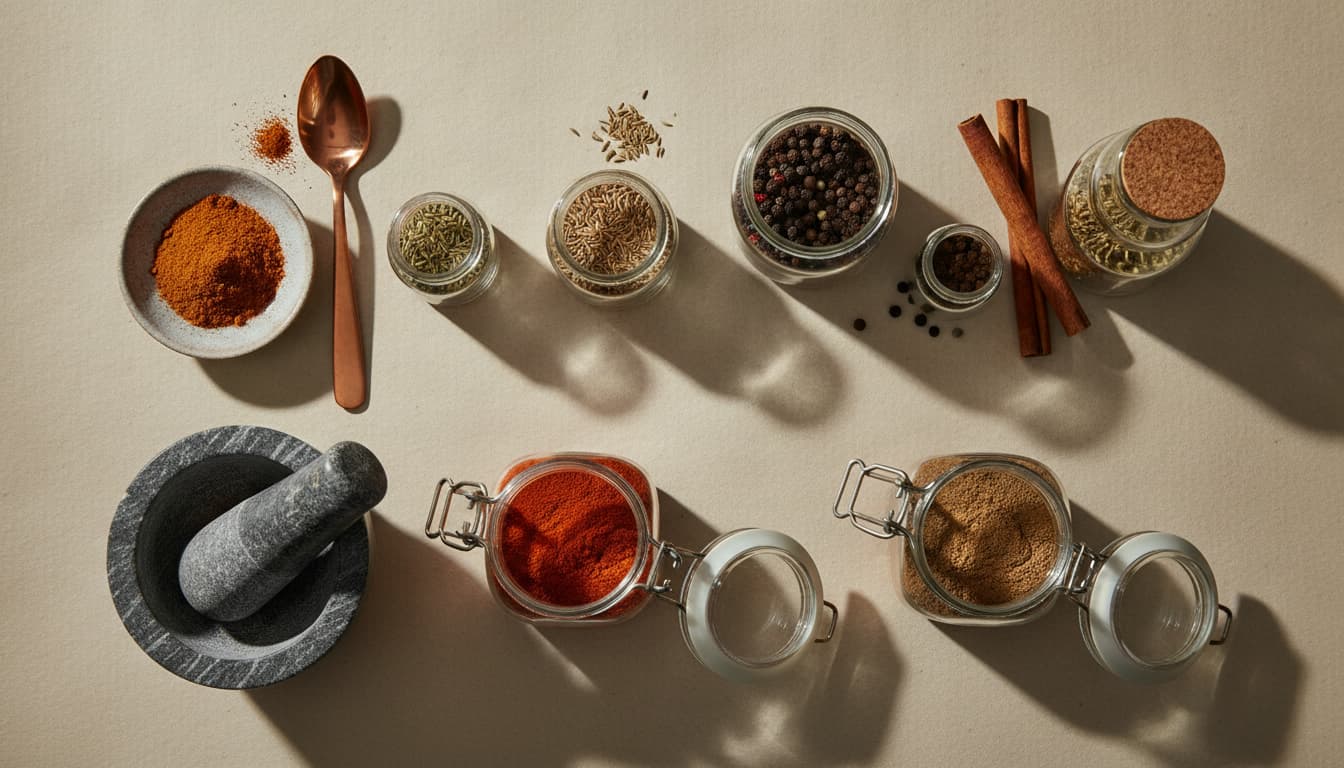
FoodKeeper gives whole spices 3 to 4 years and ground spices 2 to 3, yet its own named entries run from 6 months to 4 years. The genuine safety issue is 6.6 percent Salmonella prevalence in imported shipments, not age in a cupboard (FDA).
- 01
FoodKeeper contradicts its own category rule by a factor of ten
The category entries give whole spices 3 to 4 years, ground spices 2 to 3 years and dried herbs 1 to 2 years, but the named product entries in the same database run from 6 months for dried ground mustard to 5 years for whole sesame seeds. Ground cumin, ground nutmeg, garlic powder and onion powder each get 3 to 4 years, identical to a whole spice, while ground black pepper gets 2 years and cracked black pepper 2 to 3 (FSIS FoodKeeper). The spread is the finding: no category rule survives contact with individual products.
- 02
None of these dates is a safety line
Every FoodKeeper spice window is identical before and after opening, the signature of a quality metric rather than a hazard metric (FSIS FoodKeeper). A dried spice sits at a water activity the trade keeps at 0.75 or below, and Salmonella needs 0.94 in food generally and 0.979 plus or minus 0.003 in ground black pepper at 35 degrees Celsius before it will grow (FDA). Nothing multiplies in a dry jar. What the timeline predicts is the point at which the aroma fraction has fallen far enough that the spice stops working.
- 03
Grinding multiplies surface area roughly twentyfold
Volatile loss happens at the solid-air interface, so the rate scales with exposed area. A 4 mm peppercorn carries a surface-to-volume ratio near 1.5 per mm; ground to a 200 micrometre powder the same material sits near 30 per mm, about twenty times the area for evaporation and oxygen ingress, and grinding also ruptures the oil cells that were holding the fraction inside intact tissue. That geometry is the physical content of FoodKeeper's split between 3 to 4 years whole and 2 to 3 years ground (FSIS FoodKeeper).
- 04
The measured five-month loss is 12.7 percent, not the collapse people assume
Dry whole hot pepper pods stored in jute or low-density polyethylene at 20, 25 or 30 degrees Celsius and sampled every 50 days to day 150 lost, on average, 22.6 percent of ascorbic acid, 19.0 percent of phenolic compounds, 17 percent of carotenoids and 12.7 percent of capsaicinoids, retaining between 77.4 and 87.3 percent of initial amounts (Iqbal et al. 2015). Losses were steeper at the higher storage temperatures and steeper in jute than in polyethylene, which states the temperature and barrier argument as data.
- 05
A year in a glass jar converts terpenes rather than simply losing them
Essential oils from black, green and white pepper stored for 1 year in a glass vessel at room temperature yielded less oil overall, a lower terpene content and a higher proportion of oxygenated terpenoids (Orav et al. 2004). The composition shifts rather than thinning out, which is why an old jar smells flat and slightly resinous instead of weaker. The same study found sublimation-dried green peppercorns at 12.1 mg oil per g against 0.8 mg per g air-dried, a fifteenfold processing effect that dwarfs storage.
- 06
Light does something heat does not, and darkness is nearly free
Coriander seed essential oil stored for one year in the dark showed only minor compositional changes and organoleptic properties that were virtually unchanged, while the same oil stored in the light underwent significant chemical transformation of its monoterpenes (Misharina 2001). Same molecule, same duration, different outcome, decided entirely by exposure to light rather than by time or temperature. That is the argument against decorative clear glass on an open rack, and the argument for the opaque tin that commercial spice packers already use as standard.
- 07
Piperine and capsaicin are the stable actives because they are not volatile
Both are high molecular weight non-volatile alkaloids sitting outside the essential oil fraction, and capsaicin melts near 62 degrees Celsius with no meaningful vapour pressure at cupboard temperature. Capsaicinoids were the most stable class measured over 150 days at 20 to 30 degrees Celsius, at 12.7 percent loss (Iqbal et al. 2015). For piperine the mechanism is identical but the measurement is missing: a controlled series tracking piperine and volatile oil in the same ground pepper over 24 to 36 months at a stated temperature is what would settle it.
- 08
Curcumin is the light-sensitive extreme, with a 9.9 hour half-life under a white LED
Turmeric oleoresin exposed to fluorescent light or a white LED at 10 W per square metre degraded with curcumin half-lives of 15.1 hours under fluorescent light and 9.9 hours under white LED, against 18.1 and 11.7 hours for demethoxycurcumin and 18.4 and 13.2 hours for bisdemethoxycurcumin, while the dark control at 25 degrees Celsius held (Kim et al. 2025). Curcumin, the most abundant curcuminoid, went fastest. Those are laboratory irradiances rather than shelf conditions, but the direction applies to any transparent container in the open.
- 09
Paprika and chilli are the only real case for the refrigerator
Paprika stored at 4 degrees Celsius and 70 percent relative humidity, with no reconstitution of its antioxidants, showed carotenoid autoxidation occurring only minimally and coloring capacity maintained, with peroxide values starting at 1 milliequivalent per kg and reaching only 3 at the end of storage (Perez-Galvez et al. 2009). Ambient storage does not manage this: carotenoids fell 17 percent over 150 days at 20 to 30 degrees Celsius (Iqbal et al. 2015). A paprika that has turned brown is reporting its own condition accurately.
- 10
The rack above the stove fails on heat, light and water at the same time
Convection puts the burner plume onto whatever is mounted above it, task lighting makes that spot the brightest in the room, and a pot at a rolling boil is a steam generator. FDA states the third mechanism directly: ground black pepper can become wet during food preparation in a home or restaurant when exposed to steam or humid air (FDA). What would make the case quantitative is a headspace temperature and humidity trace from a jar above a working range across a real cooking session, against a control in a closed drawer.
- 11
The measured hazard is 6.6 percent Salmonella and 12 percent filth at import
FDA sampling of imported spice shipments across FY2007 to FY2009 found an average Salmonella shipment prevalence of 6.6 percent on a 750 g sample, 95 percent CI 5.7 to 7.6 percent, 1.9 times the rate for other FDA-regulated imported foods and 4.4 times under a matched protocol, with 79 countries examined and 37 producing contaminated shipments. Filth adulteration ran at 12 percent, 95 percent CI 10 to 15 percent, mostly insect fragments, whole insects and animal hair, nearly all of them stored product pests (FDA).
- 12
Cooking solves it, and 70 percent of the illnesses came from where it does not
Fourteen outbreaks were attributed to pathogen-contaminated spice from 1973 to 2010, producing 1,946 illnesses, 128 hospitalizations and two deaths, with Salmonella responsible for ten outbreaks and 87 percent of illnesses. Consumption of ready-to-eat foods prepared with spices applied after the final manufacturing pathogen reduction step accounted for at least 70 percent of the illnesses, and in three of four outbreaks with process data, no pathogen reduction treatment had been applied (FDA). Finishing blends, dusting and uncooked dips are the exposure, not the simmering pot.
- 13
Clumping means water got in, and mould is the only real discard trigger
Salmonella survives in low-moisture material for periods exceeding one year without growing, and needs a water activity of 0.94 in food generally, or 0.979 plus or minus 0.003 in ground black pepper at 35 degrees Celsius, before it multiplies; the spice trade stores at 0.75 or below (FDA). Pepper sitting near the growth threshold may not be noticeably wet (FDA). Caking is the visible sign that particles bridged because water entered. Visible mould means water activity stayed high long enough to support growth, and that jar goes out.
What people ask us next.
- Do spices actually expire?
- Not in the sense of becoming unsafe. FoodKeeper gives whole spices 3 to 4 years, ground spices 2 to 3 years and dried herbs 1 to 2 years, and the window is identical before and after opening, which marks it as a quality figure (FSIS FoodKeeper). What degrades is the volatile oil fraction: after 1 year in glass at room temperature, pepper samples yielded less oil, less terpene content and more oxygenated terpenoids (Orav et al. 2004). Nothing grows in a dry jar, because Salmonella needs a water activity of 0.94 and the trade stores spice at 0.75 or below (FDA).
- How long do spices really last?
- It depends on the product, and FoodKeeper's own entries prove it. Whole sesame seeds are listed at 5 years, ground cumin, ground nutmeg, garlic powder and onion powder at 3 to 4 years, cracked black pepper at 2 to 3 years, ground black pepper and chili powder at 2 years, seasoning blends at 1 to 2 years and dried ground mustard at 6 months (FSIS FoodKeeper). That is a tenfold range inside one dataset. Use the named entry where one exists, buy whole and grind to order for high-terpene seeds, and treat blends as the shortest-lived items in the rack.
- Is it safe to use spices past the date on the jar?
- Yes, absent mould or caking. The date is a quality estimate and dried spice does not support microbial growth: the water activity threshold for Salmonella is 0.94 in food generally and 0.979 plus or minus 0.003 in ground black pepper at 35 degrees Celsius, while trade storage guidance sits at 0.75 or below (FDA). Salmonella can survive over a year in low-moisture material without multiplying, so an old contaminated jar is no more contaminated than a new one (FDA). The failure mode of an old spice is that a recipe written for a fresh one underdelivers.
- Should spices be kept in the refrigerator?
- Only the carotenoid-pigmented ones, and paprika is the clear case. Paprika held at 4 degrees Celsius and 70 percent relative humidity without antioxidant reconstitution showed carotenoid autoxidation occurring only minimally and coloring capacity maintained, with peroxide values of 1 milliequivalent per kg rising to only 3 by the end of storage (Perez-Galvez et al. 2009), against a 17 percent carotenoid loss over 150 days at 20 to 30 degrees Celsius in ambient storage (Iqbal et al. 2015). For everything else the fridge adds condensation risk on every door opening, and moisture is the variable that matters (FDA).
- Is the spice rack above the stove really that bad?
- It is the worst position in the kitchen because it fails on three variables simultaneously. It receives the burner convection plume, so it runs hottest, and losses in the storage trial were steeper at 30 degrees Celsius than at 20 (Iqbal et al. 2015). It is usually the brightest spot, and coriander oil stored in the light underwent significant monoterpene transformation while the same oil in the dark was virtually unchanged after a year (Misharina 2001). And FDA states that ground black pepper can become wet during home or restaurant food preparation when exposed to steam or humid air (FDA).
- Do whole spices really last longer than ground?
- Yes, and the mechanism is geometry. Volatile loss occurs at the solid-air interface, so the rate scales with exposed surface area. A 4 mm peppercorn has a surface-to-volume ratio near 1.5 per mm; ground to a 200 micrometre powder that rises to about 30 per mm, roughly twenty times the area, and grinding ruptures the oil cells that were retaining the volatile fraction. FoodKeeper reflects this at 3 to 4 years whole against 2 to 3 years ground, and puts cracked black pepper at 2 to 3 years against 2 years for fully ground (FSIS FoodKeeper).
- Can old spices make you sick?
- Age is not the risk factor; contamination at source is, and it does not increase with time in a dry cupboard. FDA found an average Salmonella prevalence of 6.6 percent in imported spice shipments across FY2007 to FY2009 on a 750 g sample, against under 1 percent for all 11 spice types tested at US retail on a 125 g sample between 2013 and 2015, with no positives for cumin, whole sesame seed or ground white pepper (FDA). Fourteen outbreaks were recorded from 1973 to 2010, and at least 70 percent of those illnesses came from ready-to-eat foods spiced after the final pathogen reduction step.
- When should a spice actually be thrown out?
- On evidence of water, not on a date. Visible mould is the only genuine discard trigger, because it means water activity stayed above the growth threshold long enough to support a colony; the reference thresholds are 0.94 for Salmonella in food generally and 0.979 plus or minus 0.003 in ground black pepper at 35 degrees Celsius, against trade storage at 0.75 or below (FDA). Hard caking is the earlier warning that water entered, and pepper near the growth threshold may not look wet at all (FDA). Everything else is a potency judgement: crush a pinch and smell it immediately.
Every claim, cited.
- [01]FDA Risk Profile: Pathogens and Filth in Spices, 2017 update incorporating the 2013 FDA Draft Risk Profile. Analysis of FDA sampling and testing data for shipments of imported spice offered for entry to the United States during FY2007 to FY2009 revealed an average shipment prevalence for Salmonella of 6.6 percent on a 750 g sample size, 95 percent CI 5.7 to 7.6 percent, which was 1.9 times, 95 percent CI 1.6 to 2.3, the average prevalence determined for shipments of all other FDA-regulated foods sampled in that period, and 4.4 times, 95 percent CI 3.4 to 5.8, when restricted to other imported foods sampled under the same FDA Category II protocol. Shipments from 79 different countries were examined and contaminated shipments came from 37; country-specific prevalence ranged from 0.9 percent for Canada, 95 percent CI 0 to 5 percent, to 14 percent for Mexico, 95 percent CI 8.6 to 21 percent. More than 80 different Salmonella serotypes were isolated and 6.8 percent of isolates exhibited antimicrobial-resistant properties. Average prevalence of filth adulteration of imported spice shipments was 12 percent, 95 percent CI 10 to 15 percent, which was 1.8 times, 95 percent CI 1.4 to 2.2, the value for other imported FDA-regulated food shipments; the most common adulterants were insect fragments, whole or equivalent insects and animal hair, and nearly all insects found were stored product pests, indicating inadequate packing or storage conditions. During 1973 to 2010, fourteen reported illness outbreaks were attributed to consumption of pathogen-contaminated spice, together resulting in 1,946 reported human illnesses, 128 hospitalizations and two deaths; Salmonella enterica subspecies enterica was the causative agent in ten outbreaks accounting for 87 percent of reported illnesses and Bacillus species in four accounting for 13 percent. Consumption of ready-to-eat foods prepared with spices applied after the final food manufacturing pathogen reduction step accounted for at least 70 percent of the illnesses, and in three of four outbreaks for which spice process treatment information was recorded, no pathogen reduction treatment had been applied. The 2017 update reports a retail survey of 7,250 packaged spice samples across 11 spice types collected November 2013 to September 2014 or October 2014 to March 2015: for each of the 11 types the estimated prevalence on 125 g analysed was less than 1 percent with all upper 95 percent confidence limits less than 2 percent, no positive samples were found for cumin, whole sesame seed or ground white pepper, and the decreases observed were consistent with more than 90 percent of contaminated shipments having been treated with an efficient pathogen reduction treatment before retail sale, the change factor ranging from 0.33 for dehydrated garlic, not significant, to 0.015 for oregano. On moisture, the threshold water activity for growth of Salmonella is reported as 0.94 in food generally while the spice industry recommends storage at 0.75 or below and the European trade body at 0.65; FDA scientists determined the growth threshold in ground black pepper at 35 degrees Celsius to be 0.979 plus or minus 0.003, noted that pepper at water activities near the threshold may not be noticeably wet, and stated that ground black pepper could become wet during food preparation in a home or restaurant when exposed to steam or humid air. Estimated per capita spice consumption in 2010 was 3.47 pounds, 1,575 g, per year excluding dehydrated onion and garlic, or roughly 1.4 g per eating occasion.
- [02]FDA landing page for the Risk Profile on Pathogens and Filth in Spices, which hosts both the 2013 FDA Draft Risk Profile issued on November 4, 2013 and the 2017 update. The draft risk profile identified Salmonella as the pathogen most commonly associated with human illness from spice consumption, and one of the important data gaps it identified was the lack of data on the prevalence of Salmonella in spices at retail in the United States; the 2017 update was issued specifically to fill that gap with a survey of packaged spices offered for sale at US retail establishments, and it adds information about the lower Salmonella prevalence found in retail products relative to shipments offered for entry.
- [03]USDA Food Safety and Inspection Service FoodKeeper dataset, catalogued on Data.gov, the joint FSIS, FDA and Cornell University food storage database that gives product-level pantry, refrigerator and freezer timelines rather than category rules. Category entries: spices whole, 3 to 4 years pantry from date of purchase and 3 to 4 years after opening; spices ground, 2 to 3 years and 2 to 3 years after opening; herbs dried, 1 to 2 years and 1 to 2 years after opening; seasoning blends, 1 to 2 years and 1 to 2 years after opening; flavored or herb mixes, 6 months. Named product entries in the same dataset do not follow the category rule: cumin ground, dried, commercially bottled or purchased in bulk, opened or unopened, 3 to 4 years; cinnamon ground, dried, 3 to 4 years; nutmeg ground, dried, 3 to 4 years; garlic powder dried, 3 to 4 years; onion powder dried, 3 to 4 years; black pepper ground, dried, 2 years; black pepper cracked, dried, 2 to 3 years; chili powder, 2 years pantry from date of purchase and 2 years after opening; Cajun seasoning blend ground, dried, 1 to 2 years; sesame seeds, 5 years pantry; mustard dried ground, 6 months pantry and 1 to 2 years frozen. Nut entries in the same dataset: nuts in jars or cans, 1 year pantry from date of purchase, 2 to 9 months pantry after opening, 4 to 6 months refrigerated after opening and 6 to 12 months frozen; roasted nuts, peanuts, cashews and almonds, package use-by date in the pantry unopened, 1 to 2 weeks pantry after opening and 4 weeks refrigerated after opening; pine nuts, 2 to 3 weeks pantry, 3 months refrigerated and 9 months frozen; nut oils, 6 to 12 months pantry unopened, 3 to 8 months pantry after opening and 6 to 8 months refrigerated after opening.
- [04]Iqbal Q, Amjad M, Asi MR, Arino A, Ziaf K, Nawaz A, Ahmad T. 2015. Stability of capsaicinoids and antioxidants in dry hot peppers under different packaging and storage temperatures. Foods 4(2):51-64. Dry whole pods of three commercially cultivated hot pepper hybrids were packed in jute bags and in low-density polyethylene bags, stored for five months under controlled conditions at 20, 25 or 30 degrees Celsius, and analysed on day 0 and at 50-day intervals until day 150. Overall mean concentrations after five months were significantly reduced by 22.6 percent for ascorbic acid, 19.0 percent for phenolic compounds, 17 percent for carotenoids and 12.7 percent for capsaicinoids. The decreasing trend continued gradually until day 150 and the effect was more pronounced at higher temperature, and disappearance rates were higher in jute bags than in low-density polyethylene. Packaging in either material at ambient temperature preserved between 77.4 percent and 87.3 percent of the initial amounts over five months. The ranking is the useful result: capsaicinoids were the most stable class measured and carotenoids among the least.
- [05]Orav A, Stulova I, Kailas T, Muurisepp M. 2004. Effect of storage on the essential oil composition of Piper nigrum L. fruits of different ripening states. J Agric Food Chem 52(9):2582-6. Essential oil composition from black, green and white pepper was determined by simultaneous distillation and extraction with GC/FID and GC/MS. After 1 year of storage of the pepper samples in a glass vessel at room temperature, the amount of oil isolated decreased, the content of terpenes decreased, and the amount of oxygenated terpenoids increased, so the change is compositional conversion rather than simple thinning. Green peppercorns obtained by sublimation drying gave 12.1 mg of oil per g with 84.2 percent monoterpenes in the oil, against 0.8 mg per g and 26.8 percent for air-dried green peppercorns, a fifteenfold difference in recoverable oil created by processing before storage begins. Oil from ground black pepper contained more monoterpenes and fewer sesquiterpenes and oxygenated terpenoids than green and white pepper oils.
- [06]Misharina TA. 2001. Effect of conditions and duration of storage on composition of essential oil from coriander seeds. Prikl Biokhim Mikrobiol 37(6):726-32, article in Russian. Volatile components of essential oil extracted from Coriandrum sativum L. seeds grown in different years in Russia and Georgia were analysed by capillary gas chromatography. Climatic conditions had a weaker effect on essential oil composition than the region of growth. After one-year storage in the dark, only minor changes were observed in the oil composition and its organoleptic properties were virtually unchanged; however, the essential oil underwent significant chemical transformation of monoterpenes when stored in the light. The comparison isolates light as an independent variable from duration and temperature, and it is the direct argument against transparent containers on open shelving.
- [07]Perez-Galvez A, Hornero-Mendez D, Minguez-Mosquera MI. 2009. Stability of paprika without supplementary antioxidants during storage under industrial controlled conditions. J Agric Food Chem 57(11):4718-23. Paprika samples were stored under controlled conditions at 4 degrees Celsius and 70 percent relative humidity without reconstitution of antioxidant levels, and carotenoid composition, ASTA values as specified by the American Spice Trade Association, fatty acid composition and peroxide index were tracked to correlate loss of the carotenoid fraction with the development of prooxidative processes. Evolution of carotenoid content indicated that autoxidative reactions minimally took place and that coloring capacity was maintained. Peroxide values were very low at 1 milliequivalent per kg and reached 3 milliequivalents per kg at the end of the storage period, and microbial flora was held at levels similar to the start. Controlled cold storage was sufficient to preserve overall paprika quality without adding antioxidants.
- [08]Kim H, Oh J, Hong J. 2025. Photodegradation of turmeric oleoresin under fluorescent light and white LED: impacts on the chemical stability, bioactivity, and photosensitizing property of curcuminoids. Molecules 30(15):3187. Turmeric oleoresin was exposed to fluorescent light and to white LED, both at 10 W per square metre, over 24 hours against a dark control at 25 degrees Celsius. Both light sources significantly reduced colour and fluorescence intensity, with white LED causing greater instability. HPLC confirmed a decrease in individual curcuminoid levels with curcumin degrading most rapidly under both conditions: half-lives were 15.1 hours for curcumin under fluorescent light and 9.9 hours under white LED, 18.1 and 11.7 hours for demethoxycurcumin, and 18.4 and 13.2 hours for bisdemethoxycurcumin. DPPH radical scavenging activity of irradiated oleoresin decreased relative to fresh or dark-stored turmeric while ABTS activity increased. The authors state the instability of turmeric pigment under common lighting should be a crucial consideration when processing, storing and distributing turmeric-containing products.
The Larderlab Team builds evidence-led frameworks for eating, lifting, and stocking a kitchen. We cite every claim. We publish the spreadsheet when possible. We buy what we review at retail price. When new data lands, we revise with a dated note.
Next in this hub.
Dried Beans vs Canned Beans: Cost, Sodium, Time and One Real Hazard
One pound of dry beans yields about 6 cups cooked and replaces roughly 4 cans at 2.5 to 5 times lower cost per cup. Canned beans carry 331 to 655 mg sodium per cup against 1.7 mg home-cooked.
13 min · rev 2026-09-09Does Protein Powder Expire? The Tub Stays Safe and Quietly Loses Its Lysine
Spray-dried protein powders sit at a water activity of 0.23 to 0.27, far below the roughly 0.93 that Clostridium botulinum needs to grow. The clock that does run is the Maillard reaction, which attaches lactose to lysine residues at 324 mass units apiece.
13 min · rev 2026-09-07Best Meal Prep Containers, 2026: Glass vs Polypropylene, Stack Math
Eight container systems ranked on stack-density, microwave/oven safety, and cost-per-serving over a 5-year amortization. The leaching-temperature data nobody publishes.
9 min · rev 2026-04-29Get the Larderlab Macro Planner.
A Google Sheet that calculates your protein target, splits it across 3-5 meals, and ranks 20 protein sources by $/gram. Free. Copy-and-modify your own version.
By subscribing, you agree to our Privacy Policy. Unsubscribe anytime.