Does honey go bad, and which of its numbers actually move
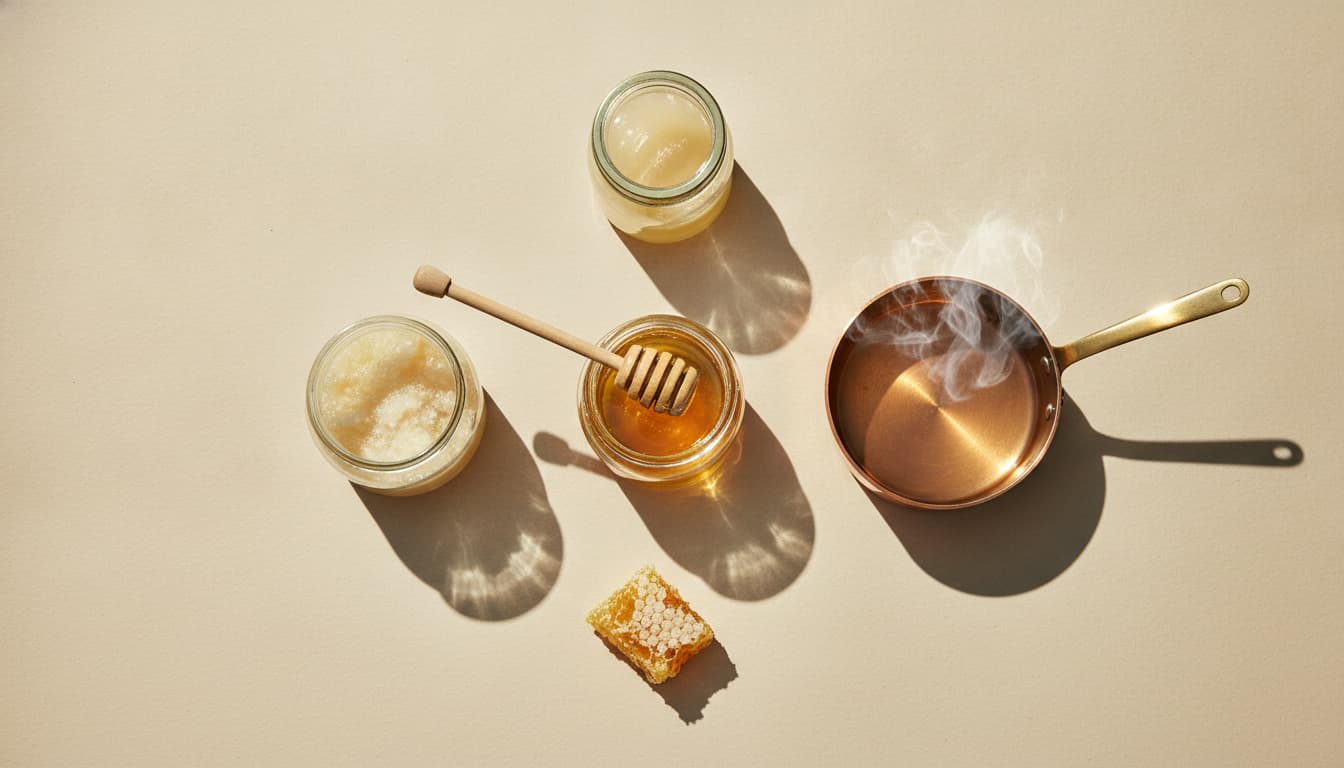
Honey does not spoil, but it does age, and the ageing is measurable. Moisture, HMF, diastase and free acidity have published limits, and storage temperature decides how fast three of the four drift out of range.
- 01
Why it does not spoil: the composition, in numbers
The standard caps moisture at 20 percent for most honeys and 23 percent for heather, requires fructose plus glucose of at least 60 grams per 100 grams, caps sucrose at 5 grams per 100 grams, and allows free acidity up to 50 milliequivalents per kilogram (Codex Alimentarius CXS 12-1981). A sugar solution that concentrated, that acidic and that dry leaves almost no water available to microbes, which is the entire reason honey outlasts every other sweetener in the pantry.
- 02
Three numbers in the same standard are freshness measures
Diastase activity must generally be at least 8 Schade units, or at least 3 for honeys with naturally low enzyme content. Hydroxymethylfurfural must not exceed 40 milligrams per kilogram, or 80 for honeys of declared tropical origin. Free acidity must not exceed 50 milliequivalents per kilogram (Codex Alimentarius). These three move with heat and time in a consistent direction: enzymes down, HMF up, acidity up. They are how a laboratory dates a jar.
- 03
The temperature series: 45 degrees breaks the HMF limit in a month
Talh honey held at 0, 25, 35 and 45 degrees Celsius and analysed monthly for eight months exceeded the HMF limit after one month at 45 degrees, at 127 plus or minus 9.6 milligrams per kilogram, and after two months at 35 degrees, at 90 plus or minus 23.5 (Raweh et al. 2022). Nothing about the honey looked different at that point. The limit is an analytical one, which is why heat damage is invisible without a laboratory.
- 04
Enzymes fall on the same schedule
In the same series, diastase activity fell below the standard limit after two months at 45 degrees, at 5 plus or minus 1 units, and after the seventh month at 35 degrees, at 7 plus or minus 2. Reducing sugars fell below 60 percent after two months at 45 degrees and after six months at 35. Storage at 0 and 25 degrees for the full eight months produced the least change of all, and the authors recommended not exceeding 25 degrees (Raweh et al. 2022).
- 05
What is stable: moisture, pH, colour and sucrose
Across all four storage temperatures over eight months, moisture content, pH, colour and sucrose were the least affected parameters and stayed within the acceptable range throughout (Raweh et al. 2022). That is the useful half of the finding: the compositional properties that make honey shelf-stable are also the ones that do not drift, so the safety case holds even when the freshness indices have moved a long way.
- 06
Eighteen months at room temperature: a 543 percent HMF rise
Raw rapeseed honey stored 18 months at room temperature showed HMF up 543.0 percent and diastase activity down 24.4 percent, against fresh control values of 3.07 milligrams per kilogram and 28.37 units, with a negative correlation between the two. Colour shifted far more at room temperature than in a freezer, at a colour difference of 20.37 against 8.07, and viscosity roughly doubled relative to the fresh control (Kedzierska-Matysek et al. 2016).
- 07
Crystallisation is not spoilage, and how it is reversed matters
Setting is glucose leaving a supersaturated solution, driven by the glucose-to-water ratio and by nucleation sites, so honeys high in glucose set fastest. Gentle warming redissolves it. The reason to be gentle is in the same data that dates a jar: heat is the variable that drives HMF up and diastase down, breaking the freshness limits after one to two months at 45 degrees (Raweh et al. 2022). A warm water bath undoes crystallisation without paying that cost.
- 08
The one safety caveat is present from day one
Of 150 honey samples collected from apiaries, retail shops, open markets and supermarkets, 4, or 2.6 percent, tested positive for botulinum neurotoxin genes by multiplex PCR, with three isolates of type A and one of type B (Gucukoglu et al. 2014). Spores are not inactivated by honey's acidity or by gentle warming, which is why honey is withheld from children under twelve months. Age has nothing to do with it; a fresh jar carries the same risk as an old one.
What people ask us next.
- Does honey ever expire?
- Not in the spoilage sense. Its composition, capped at 20 percent moisture with at least 60 grams per 100 grams of fructose plus glucose and free acidity up to 50 milliequivalents per kilogram, leaves too little available water and too low a pH for microbial growth (Codex Alimentarius). What does change are the freshness indices: hydroxymethylfurfural rose 543.0 percent and diastase activity fell 24.4 percent over 18 months at room temperature (Kedzierska-Matysek et al. 2016). An old jar is aged, not spoiled.
- Why has my honey turned solid?
- It has crystallised, which is glucose coming out of a supersaturated solution rather than any form of spoilage. The rate depends on the glucose-to-water ratio and on nucleation sites, so high-glucose honeys set fastest. Warming in a water bath reverses it. Keep the warming gentle: heat is the variable that pushed HMF past the standard limit within one month at 45 degrees Celsius and within two months at 35 degrees in a controlled series (Raweh et al. 2022).
- Should honey be refrigerated?
- There is no safety reason to and it accelerates crystallisation. The controlled evidence favours cool but not cold: storage at 0 and 25 degrees Celsius for up to eight months produced the least change in composition, while 35 and 45 degrees produced significant changes, and the recommendation was not to exceed 25 degrees (Raweh et al. 2022). A sealed jar in a cupboard away from the hob satisfies that, and a sealed jar matters because honey takes up moisture from humid air.
- Why can babies not have honey?
- Because a small proportion of honey carries Clostridium botulinum spores, and an infant gut has not yet developed the flora that outcompetes them. Of 150 samples from apiaries, shops, markets and supermarkets, 4, or 2.6 percent, were positive for botulinum neurotoxin genes, three type A and one type B (Gucukoglu et al. 2014). The spores are not inactivated by honey's own acidity or by warming a jar, so the restriction applies to raw and processed honey alike, under twelve months of age.
- Does dark honey mean old honey?
- Often, but not always, because floral source sets the starting colour. What is established is that storage darkens it: colour shifted significantly more at room temperature over 18 months than in a freezer, at a colour difference of 20.37 against 8.07, alongside the HMF rise and diastase fall in the same samples (Kedzierska-Matysek et al. 2016). Darkening on a jar you have watched for two years is an ageing signal; darkness in a jar you have just bought is usually the flower.
- Is raw honey more perishable than filtered honey?
- Not on the compositional criteria, which are set by moisture, sugars and acidity rather than by filtration. The difference shows in the enzyme measure: diastase activity is specified after processing and blending, generally at not less than 8 Schade units, because heating during processing lowers it (Codex Alimentarius). Raw honey typically starts higher on that measure, which means it has more to lose in warm storage but not that it becomes unsafe faster.
Every claim, cited.
- [01]Codex Alimentarius. Standard for Honey, CXS 12-1981 (revised 1987, 2001). Moisture not more than 20 percent, heather honey not more than 23 percent; fructose plus glucose not less than 60 g per 100 g; sucrose not more than 5 g per 100 g (10 g for listed floral sources); free acidity not more than 50 milliequivalents acid per 1000 g; diastase activity generally not less than 8 Schade units and not less than 3 for honeys with low natural enzyme content; hydroxymethylfurfural not more than 40 mg/kg, or 80 mg/kg for honeys of declared tropical origin; electrical conductivity not more than 0.8 mS/cm for most honeys.
- [02]Raweh HSA, Badjah-Hadj-Ahmed AY, Iqbal J, Alqarni AS. 2022. Impact of Different Storage Regimes on the Levels of Physicochemical Characteristics, Especially Free Acidity in Talh (Acacia gerrardii Benth.) Honey. Molecules 27(18):5959. Samples held at 0, 25, 35 and 45 degrees Celsius and analysed monthly for eight months; HMF exceeded standard limits after the first month at 45 degrees (127 plus or minus 9.6 mg/kg) and after the second month at 35 degrees (90 plus or minus 23.5 mg/kg); diastase fell below limits after the second month at 45 degrees (5 plus or minus 1 DN) and after the seventh month at 35 degrees (7 plus or minus 2 DN); reducing sugars fell below 60 percent after two months at 45 degrees and six months at 35 degrees; free acidity rose from 93 plus or minus 0.3 to 159 plus or minus 0.5 meq/kg at 45 degrees by month eight, and to 94 plus or minus 0.3 at 0 degrees; moisture, pH, colour and sucrose least affected and within range at all temperatures; storage at 0 and 25 degrees produced the least change.
- [03]Kedzierska-Matysek M, Florek M, Wolanciuk A, Skalecki P. 2016. Effect of freezing and room temperatures storage for 18 months on quality of raw rapeseed honey (Brassica napus). J Food Sci Technol 53(8):3349-3355. Room-temperature storage increased hydroxymethylfurfural by 543.0 percent and decreased diastase activity by 24.4 percent against fresh control values of 3.07 mg/kg and 28.37 units; negative correlation between HMF content and diastase activity; colour difference 20.37 at room temperature versus 8.07 frozen; viscosity at room temperature roughly double the fresh control.
- [04]Gucukoglu A, Terzi G, Cadirci O, Alisarli M, Kevenk O, Uyanik T. 2014. Detection of C. botulinum types in honey by mPCR. J Food Sci 79(4):M600-3. Of 150 honey samples collected from apiaries, retail shops, weekly open bazaars and supermarkets, 4 (2.6 percent) were positive for the botulinum neurotoxin gene by multiplex PCR; three isolates were type A and one type B; no samples positive for type E or F.
The Larderlab Team builds evidence-led frameworks for eating, lifting, and stocking a kitchen. We cite every claim. We publish the spreadsheet when possible. We buy what we review at retail price. When new data lands, we revise with a dated note.
Next in this hub.
Do Nuts Go Bad? Rancidity Is a Chemical Clock Set by the Polyunsaturated Fraction
Polyunsaturated fat runs from 47.2 g per 100 g in walnuts to 1.5 g in macadamias, a 31-fold spread that sets the oxidation clock (USDA FoodData Central). Rancidity is chemistry, not microbiology, and aflatoxin is the separate hazard at 20 ppb (FDA).
14 min · rev 2026-09-09Does Olive Oil Go Bad? The Four Numbers That Decide It
Extra virgin is a chemical grade with numeric limits, not a marketing word. Peroxide value, free acidity and the two ultraviolet indices all track storage time, and the bottle plus the initial phenolic content decide how fast.
9 min · rev 2026-08-30Dried Beans vs Canned Beans: Cost, Sodium, Time and One Real Hazard
One pound of dry beans yields about 6 cups cooked and replaces roughly 4 cans at 2.5 to 5 times lower cost per cup. Canned beans carry 331 to 655 mg sodium per cup against 1.7 mg home-cooked.
13 min · rev 2026-09-09Get the Larderlab Macro Planner.
A Google Sheet that calculates your protein target, splits it across 3-5 meals, and ranks 20 protein sources by $/gram. Free. Copy-and-modify your own version.
By subscribing, you agree to our Privacy Policy. Unsubscribe anytime.