Does olive oil go bad, and what the four grading numbers measure
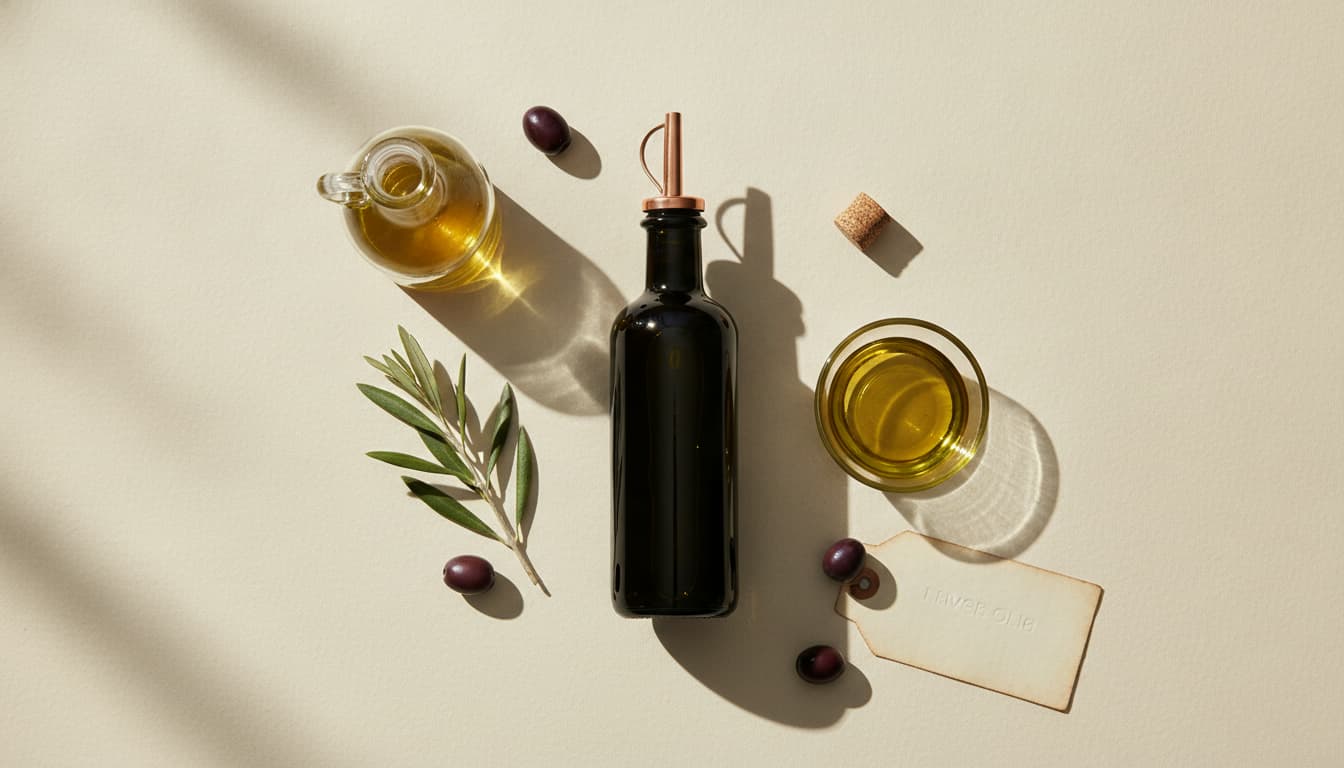
Extra virgin is a chemical grade with numeric limits, not a marketing word. Peroxide value, free acidity and the two ultraviolet indices all track storage time, and the bottle plus the initial phenolic content decide how fast.
- 01
Extra virgin is a chemical grade with published ceilings
The trade standard sets free acidity at not more than 0.80 grams per 100 grams expressed as oleic acid, peroxide value under 20.0 milliequivalents of peroxide oxygen per kilogram, ultraviolet absorbency under 0.22 at 270 nm and under 2.50 at 232 nm, delta-K under 0.01, and moisture and volatile matter under 0.2 percent, alongside a sensory median of defect of 0.0 and a median fruity attribute above 0.0 (International Olive Council). Fail any one and the oil is not extra virgin, whatever the front label says.
- 02
The four numbers measure four different stages
Free acidity counts free fatty acids released by hydrolysis and is largely fixed before bottling, by fruit condition and milling. Peroxide value counts the hydroperoxides that form first when oxygen attacks unsaturated bonds. K232 tracks the conjugated dienes those hydroperoxides rearrange into, and K270 tracks the later conjugated trienes and carbonyls (International Olive Council). An oil high on peroxide value is early in oxidation; one high on K270 is late in it.
- 03
All three oxidation indices track the calendar
Fourteen extra virgin oils with oleic acid contents of 64.6 to 77.7 percent were stored in the dark at room temperature for 22 months, and peroxide value, K232 and K270 all correlated highly with storage time (Esposto et al. 2020). Dark storage at room temperature is the gentle case, which makes this the floor rather than the ceiling for how fast the numbers move. Light and heat only accelerate the same reactions.
- 04
The phenolic budget is set at the mill and then spent
Over the same 22 months, oleuropein derivatives fell by 98 percent in oils that started with low phenolic levels, 89 percent in the medium group and 85 percent in the high group, with the steepest depletion in those that began with the least. High-phenolic oils also carried more alpha-tocopherol protection, accumulated fewer off-flavour volatiles in the headspace, and held sensory quality best, leading the authors to propose predicting shelf life from initial oleuropein derivative content (Esposto et al. 2020).
- 05
The container changes the outcome within six months
Extra virgin oil held under light at room temperature for six months in clear glass, dark glass, polyethylene and tin ended in measurably different condition. Tin and dark glass recorded the lowest oxidation values and better physicochemical and organoleptic characteristics, while clear glass and polyethylene showed a significant decrease in carotenes, chlorophylls and total phenols (Gargouri et al. 2015). Polyethylene was the worst of the four.
- 06
Bottle size is a chemistry decision, not only a price one
Headspace above the oil refills with oxygen at every opening, so a large container used slowly is a large container oxidising slowly to the bottom. Since peroxide value and both ultraviolet indices rise with storage time even in the dark (Esposto et al. 2020), the cost-per-litre saving on a large tin is only real if the oil is finished while it still meets the grade it was bought as. Decanting a working amount into a small dark bottle keeps the bulk unit sealed.
- 07
Harvest date beats best-before date
The standard's limits describe a chemical state, not an age, and the state depends on fruit quality, milling, packaging and storage rather than on months since bottling. A harvest or pressing date tells the buyer where in the antioxidant budget the oil starts; a best-before date twenty-four months out tells them only what the bottler is willing to underwrite. Where both appear, the harvest date is the informative one.
- 08
What rancid actually smells like
The sensory limit is a panel median of defect of exactly 0.0, and the defects the panels name are specific: rancid, fusty, musty, winey and metallic (International Olive Council). Rancidity at home reads as crayon, putty or old nuts, and the loss of the peppery bitterness at the back of the throat is the phenolic depletion showing up on the palate. An oil that smells of nothing has usually already spent its phenolics.
What people ask us next.
- Is rancid olive oil dangerous to eat?
- It is a quality problem rather than a safety one in the pathogen sense. Olive oil has essentially no free water, so it does not support the organisms that cause foodborne illness, and the trade standard's limits are grading criteria rather than toxicity thresholds (International Olive Council). What has been lost is measurable: peroxide value and the ultraviolet indices rise with storage time, and oleuropein derivatives fall by 85 to 98 percent over 22 months depending on the starting level (Esposto et al. 2020).
- How long does olive oil last once opened?
- There is no single number, because the clock is set by the oil's initial phenolic content and then run by light, heat and oxygen. Oils that started with 750 to 1,400 milligrams per kilogram of phenolics retained sensory quality best over 22 months of dark room-temperature storage, while those starting under 200 lost 98 percent of their oleuropein derivatives (Esposto et al. 2020). A bottle finished within a few months of opening, kept dark and cool, is inside the range every test condition tolerated.
- Does the bottle really matter?
- Measurably, within six months. Oil stored under light at room temperature in tin containers and dark glass recorded the lowest oxidation values and the best physicochemical and organoleptic scores, while clear glass and polyethylene showed significant losses of carotenes, chlorophylls and total phenols, with polyethylene worst (Gargouri et al. 2015). Buying in clear plastic and storing it on a lit counter combines the two worst variables in that experiment.
- Should olive oil go in the refrigerator?
- It is unnecessary and creates a practical problem. Cold pushes the oil towards a cloudy, semi-solid state that has to be rewarmed before use, and the failure mode the grading numbers track is oxidation, which a dark cupboard at ordinary room temperature already slows. The controlled comparison that separated storage outcomes did so on light exposure and container material rather than on refrigeration (Gargouri et al. 2015). A closed cupboard away from the hob is the intervention that pays.
- What does 'extra virgin' guarantee at the moment of purchase?
- That the oil met eight criteria when it was graded: free acidity not more than 0.80 grams per 100 grams as oleic acid, peroxide value under 20.0 milliequivalents per kilogram, K270 under 0.22, K232 under 2.50, delta-K under 0.01, moisture and volatile matter under 0.2 percent, insoluble impurities under 0.10 percent, and a sensory median of defect of 0.0 with a median fruity attribute above 0.0 (International Olive Council). It guarantees nothing about the state of the oil after a year on a warm, lit shelf.
- Can old olive oil still be used for cooking?
- It can, and that is the reasonable destination for a bottle past its best. What degrades first is the phenolic and volatile fraction that carries aroma and the peppery finish, which is exactly the part that matters in uncooked applications and matters least in a hot pan. An oil showing frank rancid or metallic character will carry that flavour into the dish, so the honest test is the smell rather than the date on the label.
Every claim, cited.
- [01]International Olive Council. Trade Standard Applying to Olive Oils and Olive-Pomace Oils, COI/T.15/NC No 3. Extra virgin olive oil: free acidity not more than 0.80 g per 100 g expressed as oleic acid; peroxide value under 20.0 milliequivalents peroxide oxygen per kg; absorbency under 0.22 at 270 nm and under 2.50 at 232 nm; delta-K under 0.01; moisture and volatile matter under 0.2 percent; insoluble impurities under 0.10 percent; median of defect 0.0 and median of the fruity attribute above 0.0. Virgin olive oil free acidity up to 2.0 and K270 up to 0.25; lampante above 3.3 free acidity, intended for refining.
- [02]Esposto S, Selvaggini R, Taticchi A, Veneziani G, Sordini B, Servili M. 2020. Quality evolution of extra-virgin olive oils according to their chemical composition during 22 months of storage under dark conditions. Food Chem 311:126044. Fourteen extra virgin oils, oleic acid 64.6 to 77.7 percent, phenolic levels under 20 to 1,400 mg/kg, real-time dark storage at room temperature for 22 months; high correlations among peroxide values, K232, K270 and storage time; oleuropein derivatives decreased by 98, 89 and 85 percent in low, medium and high phenolic oils; high-phenolic oils showed lower headspace accumulation of off-flavour volatiles and best retention of sensory quality.
- [03]Gargouri B, Zribi A, Bouaziz M. 2015. Effect of containers on the quality of Chemlali olive oil during storage. J Food Sci Technol 52(4):1948-59. Extra virgin oil stored under light at room temperature for six months in clear glass, dark glass, polyethylene and tin; tin containers and dark glass recorded the lowest oxidation values and better physicochemical and organoleptic characteristics; significant decrease in carotenes, chlorophylls and total phenols in clear glass and polyethylene.
The Larderlab Team builds evidence-led frameworks for eating, lifting, and stocking a kitchen. We cite every claim. We publish the spreadsheet when possible. We buy what we review at retail price. When new data lands, we revise with a dated note.
Next in this hub.
Do Nuts Go Bad? Rancidity Is a Chemical Clock Set by the Polyunsaturated Fraction
Polyunsaturated fat runs from 47.2 g per 100 g in walnuts to 1.5 g in macadamias, a 31-fold spread that sets the oxidation clock (USDA FoodData Central). Rancidity is chemistry, not microbiology, and aflatoxin is the separate hazard at 20 ppb (FDA).
14 min · rev 2026-09-09Does Honey Go Bad? What the Compositional Standard Measures
Honey does not spoil, but it does age, and the ageing is measurable. Moisture, HMF, diastase and free acidity have published limits, and storage temperature decides how fast three of the four drift out of range.
9 min · rev 2026-08-27Seed Oil vs Butter vs Olive Oil: The Data-Backed Answer
Three claims conflated into one debate, we separate the linoleic-acid, oxidation, and inflammation questions and state our position.
14 min · rev 2026-04-21Get the Larderlab Macro Planner.
A Google Sheet that calculates your protein target, splits it across 3-5 meals, and ranks 20 protein sources by $/gram. Free. Copy-and-modify your own version.
By subscribing, you agree to our Privacy Policy. Unsubscribe anytime.