Do nuts go bad, and why a single shelf-life number is meaningless
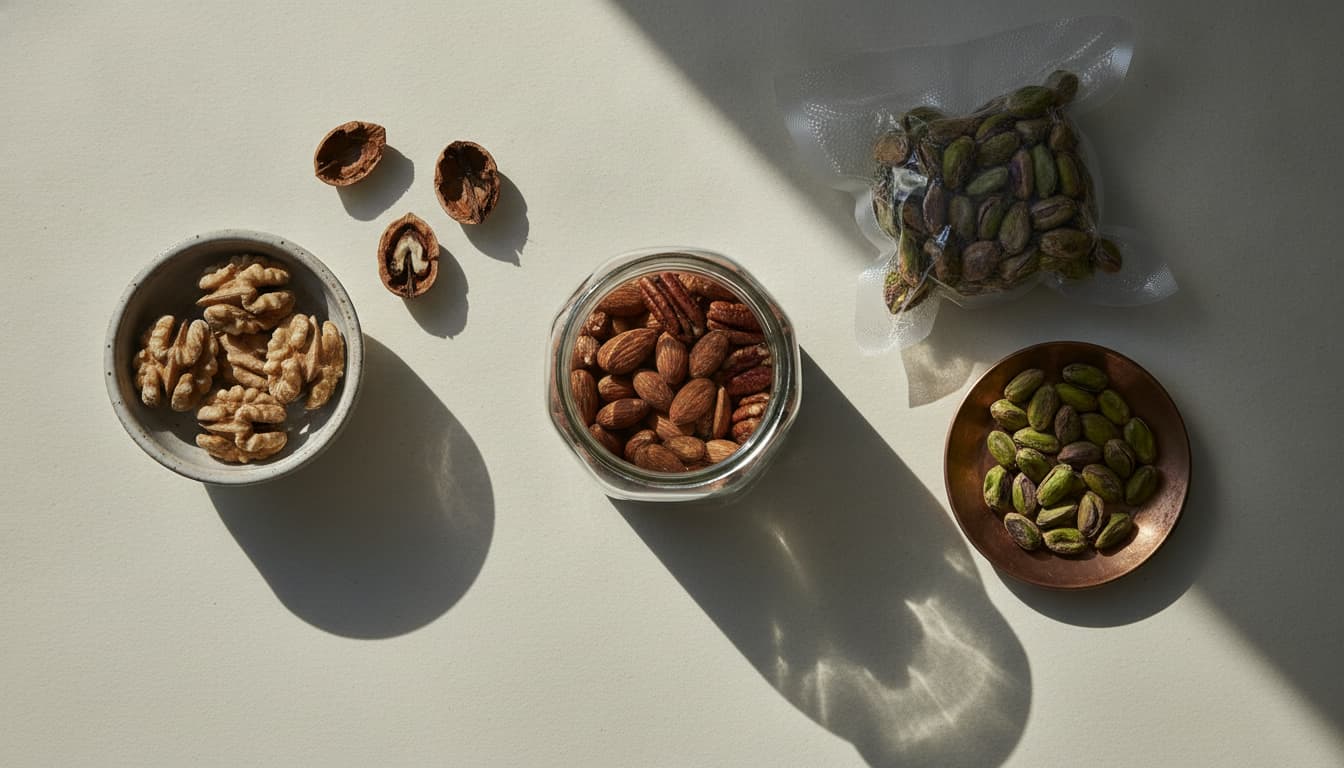
Polyunsaturated fat runs from 47.2 g per 100 g in walnuts to 1.5 g in macadamias, a 31-fold spread that sets the oxidation clock (USDA FoodData Central). Rancidity is chemistry, not microbiology, and aflatoxin is the separate hazard at 20 ppb (FDA).
- 01
Polyunsaturated fat varies 31-fold across tree nuts, and that spread is the answer
Per 100 g, polyunsaturated fat runs 47.2 g in English walnuts, 24.4 g in Brazil nuts, 21.6 g in pecans, 15.6 g in raw peanuts, 14.4 g in raw pistachios, 12.3 g in almonds, 7.92 g in hazelnuts, 7.84 g in raw cashews and 1.5 g in raw macadamias (USDA FoodData Central). Autoxidation attacks the bis-allylic carbons that only polyunsaturated chains possess, so that column and not total fat sets the clock. Any single shelf-life figure has to average across a 31-fold range, so it is wrong for most nuts.
- 02
Macadamia carries the most fat and the least oxidisable fat
Raw macadamias hold 75.8 g of total fat per 100 g, the highest of the nine nuts examined, of which 58.9 g is monounsaturated, 12.1 g saturated and only 1.5 g polyunsaturated (USDA FoodData Central). English walnuts hold less total fat at 65.2 g but 47.2 g of it is polyunsaturated. As a share of the fat that is 2 percent against 72 percent, a 36-fold difference in the reactive fraction running opposite to total fat. Sorting a nut shelf by fat content produces the wrong storage priority.
- 03
Walnut is the worst case twice, on quantity and on grade
Walnut's 47.2 g of polyunsaturated fat per 100 g splits into 38.1 g of linoleic acid with two double bonds and 9.08 g of alpha-linolenic acid with three, the least stable common dietary fatty acid (USDA FoodData Central). More double bonds means more bis-allylic positions and a steeper rate constant, so a walnut carries a more reactive grade of substrate as well as more of it. That is why walnuts taste stale first in a mixed bowl and why the walnut oxidation literature is larger than that for any other nut.
- 04
Vitamin E runs 140 to 1 in the wrong direction against the substrate it protects
Alpha-tocopherol per 100 g is 25.6 mg in almonds, 15.0 mg in hazelnuts, 8.33 mg in raw peanuts, 5.65 mg in Brazil nuts, 2.86 mg in raw pistachios, 1.4 mg in pecans, 0.9 mg in raw cashews, 0.7 mg in English walnuts and 0.54 mg in raw macadamias (USDA FoodData Central). Normalised per gram of polyunsaturated fat that is about 2.1 mg for an almond and 0.015 mg for a walnut, roughly 140 to 1. The chain-breaking antioxidant is most abundant where the substrate is scarcest.
- 05
Oxidation is autocatalytic, which is why one bad nut matters
Initiation strips a hydrogen from a bis-allylic carbon under light, heat or trace iron and copper. Propagation adds oxygen to form a peroxyl radical, which pulls a hydrogen from the next fatty acid and regenerates the chain, so one initiation event consumes many substrate molecules. The hydroperoxides accumulating in that phase are themselves unstable and decompose into alkoxyl and hydroxyl radicals that start fresh chains. A kernel that has already accumulated hydroperoxides is therefore a radical source in contact with fresh substrate.
- 06
Peroxide value is the early marker and 3 milliequivalents is the industry line
In shelled walnuts stored at 25 plus or minus 2 degrees Celsius and 50 percent relative humidity under fluorescent light for 28 weeks, peroxide value rose from 1.0 to 4.4 milliequivalents of oxygen per kg in Chandler and from 1.8 to 6.4 in Howard, against a stated industry maximum of 3 for acceptable shelled walnut quality (Grilo and Wang 2021). Peroxide value tracks the intermediate rather than the endpoint, so it rises early and can fall again as hydroperoxides decompose.
- 07
Hexanal is what the nose detects, and it rose 43 to 145 fold in 28 weeks
The same walnut storage trial identified thirteen volatiles as oxidation markers, including pentanal, hexanal, octanal, 1-octen-3-ol and 2,4-nonadienal, and found hexanal present at the highest concentration among stored samples, rising 43-fold in Chandler and 145-fold in Howard over 28 weeks (Grilo and Wang 2021). Hexanal is a decomposition product of linoleic acid hydroperoxides specifically, which closes the loop back to the composition table: the nut carrying 38.1 g of linoleic acid per 100 g generates the detectable marker fastest, on a timescale of months.
- 08
Every 10 degrees Celsius roughly halves the induction time
Walnut kernels stored at 25 degrees Celsius and 60 percent relative humidity for 6 months and assayed by oxidative stability index gave induction times averaging 13.9 hours at 110 degrees Celsius, 5.3 hours at 120 and 2.6 hours at 130, so induction time was about halved with each 10 degrees Celsius increase, and kernel stability correlated with peroxide value at r equals minus 0.813 to minus 0.874 (Grilo et al. 2020). Extrapolating across an 85 degree gap deserves scepticism, but the direction explains why 4 and minus 18 degree storage work.
- 09
FoodKeeper puts roasted nuts at 1 to 2 weeks against 2 to 9 months for the jar
FoodKeeper lists roasted peanuts, cashews and almonds at the package use-by date unopened, then 1 to 2 weeks in the pantry after opening and 4 weeks refrigerated, while nuts in jars or cans get 1 year unopened, 2 to 9 months in the pantry after opening, 4 to 6 months refrigerated and 6 to 12 months frozen (FSIS FoodKeeper). That is roughly an eight to eighteen fold shorter opened-pantry window. Roasting ruptures the cell walls and oil bodies sequestering the lipid and generates the first radicals directly.
- 10
Refrigeration buys about 4 to 6 times and freezing about 13 to 19
Pine nuts are the only FoodKeeper nut entry with pantry, refrigerator and freezer times populated for the same unopened product: 2 to 3 weeks in the pantry, 3 months refrigerated and 9 months frozen (FSIS FoodKeeper). That is a multiple of roughly 4 to 6 for the refrigerator and roughly 13 to 19 for the freezer. The jars-and-cans row contradicts itself at the upper bound, giving 9 months opened in the pantry against 6 months refrigerated, which shows these ranges are conservative envelopes across mixed products.
- 11
Rancid nuts are degraded rather than acutely dangerous, and the reviews disagree
Esterbauer concluded that the oral toxicity of oxidized lipids is unexpectedly low, that chronic uptake of large amounts raises tumour frequency and atherosclerosis in animals, and that although 4-hydroxynonenal is genotoxic at concentrations expected in vivo, the pathological significance is far from clear (Esterbauer 1993). Kanner concluded that dietary advanced lipid oxidation endproducts are partly cytotoxic and genotoxic, are absorbed after digestion, and that repeated consumption poses a chronic threat, framed as a belief (Kanner 2007). No human trial has dosed rancid nuts and measured a clinical endpoint.
- 12
Aflatoxin is a mould problem capped at 20 ppb, and it is heat stable
Aflatoxins B1, B2, G1 and G2 are metabolites of Aspergillus flavus, Aspergillus nomius and Aspergillus parasiticus, and FDA may consider human food containing total aflatoxins greater than 20 micrograms per kilogram adulterated under section 402(a)(1) of the FD&C Act, listing peanuts, corn, Brazil nuts and pistachios as most susceptible (FDA). They remain stable above 100 degrees Celsius, cooking and freezing have little effect, and decontamination has been reported only at 150 degrees Celsius or higher (Kutasi et al. 2021), so roasting is not a fix.
What people ask us next.
- Do nuts go bad, and how would you know?
- They go rancid rather than spoil, and the marker is smell. Rancidity is oxidation of the polyunsaturated fat rather than microbial growth, and the volatile the nose registers is hexanal, which rose 43-fold in one walnut cultivar and 145-fold in another over 28 weeks at 25 degrees Celsius under fluorescent light (Grilo and Wang 2021). The descriptors are paint, crayon or cardboard, not sourness. Peroxide value tracks the earlier intermediate and rose from 1.0 to 4.4 and 1.8 to 6.4 milliequivalents of oxygen per kg in the same trial, against an industry maximum of 3.
- How long do nuts last?
- The question has to be asked per species, because polyunsaturated fat per 100 g runs from 47.2 g in walnuts to 1.5 g in macadamias, a 31-fold spread that sets the oxidation rate (USDA FoodData Central). FoodKeeper gives nuts in jars or cans 1 year unopened in the pantry, then 2 to 9 months opened, 4 to 6 months refrigerated and 6 to 12 months frozen, while pine nuts get only 2 to 3 weeks in the pantry, and roasted peanuts, cashews and almonds get 1 to 2 weeks after opening (FSIS FoodKeeper). Use the species row.
- Which nuts need to go in the refrigerator or freezer?
- Sort on the polyunsaturated column. Macadamias at 1.5 g per 100 g and cashews and hazelnuts at 7.84 and 7.92 g tolerate a sealed cupboard, with hazelnuts further protected by 15.0 mg of alpha-tocopherol. Almonds at 12.3 g are the best-defended nut on the shelf because of 25.6 mg of alpha-tocopherol. Pistachios and peanuts at 14.4 and 15.6 g belong in the refrigerator once opened. Pecans and Brazil nuts at 21.6 and 24.4 g default to the refrigerator and go to the freezer beyond a couple of months. Walnuts and pine nuts belong in the freezer.
- Does freezing ruin the texture of nuts?
- No, because there is almost no free water to freeze. Ice crystal damage in high-moisture foods comes from water expanding and rupturing cell walls, and a shelled nut kernel sits at roughly 4 percent moisture, far below the point where that mechanism operates. FoodKeeper lists 6 to 12 months frozen for nuts in jars or cans and 9 months for pine nuts against 2 to 3 weeks in the pantry, a multiple of roughly 13 to 19 (FSIS FoodKeeper). The real failure mode is condensation on thawing, so remove only what is needed and reseal.
- Are roasted nuts really worse to store than raw?
- Yes, by a wide margin in the authoritative timelines, and the mechanism is clear even where the exact multiple is not. FoodKeeper gives roasted peanuts, cashews and almonds 1 to 2 weeks in the pantry after opening and 4 weeks refrigerated, against 2 to 9 months and 4 to 6 months for the jars-and-cans row (FSIS FoodKeeper). Roasting ruptures the cell walls and oil bodies that were sequestering the lipid, exposes oil throughout the kernel to air, consumes part of the endogenous tocopherol and generates initiating radicals. A matched raw-against-roasted series would fix the magnitude.
- Is eating rancid nuts dangerous?
- The evidence supports neither alarm nor dismissal, and the two most-cited reviews disagree. Esterbauer found the oral toxicity of oxidized lipids unexpectedly low, with chronic uptake of large amounts raising tumour frequency and atherosclerosis in animals and the pathological significance of 4-hydroxynonenal far from clear (Esterbauer 1993). Kanner concluded that dietary advanced lipid oxidation endproducts are partly cytotoxic and genotoxic, are absorbed after digestion, and that repeated consumption poses a chronic threat, stated as a belief (Kanner 2007). Discard on quality: the vitamin E and the polyunsaturated fat are the molecules being destroyed.
- What is aflatoxin and which nuts carry the risk?
- Aflatoxins B1, B2, G1 and G2 are toxic metabolites of Aspergillus flavus, Aspergillus nomius and Aspergillus parasiticus, and they are a mould problem rather than an oxidation problem. FDA lists peanuts, corn, some tree nuts including Brazil nuts and pistachios, and some small grains such as rice as the most susceptible foods, and may consider human food containing total aflatoxins greater than 20 micrograms per kilogram, equivalently 20 parts per billion, adulterated under section 402(a)(1) of the FD&C Act, with dedicated compliance policy guides at CPG 570.200 for Brazil nuts, 570.375 for peanuts and 570.500 for pistachios (FDA).
- Does roasting or cooking destroy aflatoxin?
- No. Aflatoxins have strong thermal stability and remain stable even above 100 degrees Celsius, cooking, freezing and pressurizing have little effect, and significant decontamination has been reported only at heating or roasting temperatures of 150 degrees Celsius or higher (Kutasi et al. 2021). Picking the visibly mouldy kernels out of a bag does not work either, because the toxin diffuses beyond the colony that produced it, so the remainder cannot be assumed to sit under the 20 ppb figure FDA applies to human food (FDA). Discard the whole bag rather than salvaging it.
Every claim, cited.
- [01]USDA FoodData Central, SR Legacy entries for tree nuts and peanuts, per 100 g. Nuts, walnuts, english: 65.2 g total fat comprising 6.13 g saturated, 8.93 g monounsaturated and 47.2 g polyunsaturated, of which 38.1 g is 18:2 linoleic acid and 9.08 g is 18:3 alpha-linolenic acid; 15.2 g protein, 0.7 mg alpha-tocopherol, 4.9 mcg selenium, 654 kcal. Nuts, brazilnuts, dried, unblanched: 67.1 g fat comprising 16.1 g saturated, 23.9 g monounsaturated and 24.4 g polyunsaturated; 14.3 g protein, 5.65 mg alpha-tocopherol, 1,920 mcg selenium. Nuts, pecans: 72.0 g fat comprising 6.18 g saturated, 40.8 g monounsaturated and 21.6 g polyunsaturated; 9.17 g protein, 1.4 mg alpha-tocopherol. Peanuts, all types, raw: 49.2 g fat comprising 6.28 g saturated, 24.4 g monounsaturated and 15.6 g polyunsaturated; 25.8 g protein, 8.33 mg alpha-tocopherol. Nuts, pistachio nuts, raw: 45.3 g fat comprising 5.91 g saturated, 23.3 g monounsaturated and 14.4 g polyunsaturated; 20.2 g protein, 2.86 mg alpha-tocopherol. Nuts, almonds: 49.9 g fat comprising 3.8 g saturated, 31.6 g monounsaturated and 12.3 g polyunsaturated; 21.2 g protein, 25.6 mg alpha-tocopherol. Nuts, hazelnuts or filberts: 60.8 g fat comprising 4.46 g saturated, 45.7 g monounsaturated and 7.92 g polyunsaturated; 15.0 g protein, 15.0 mg alpha-tocopherol. Nuts, cashew nuts, raw: 43.8 g fat comprising 7.78 g saturated, 23.8 g monounsaturated and 7.84 g polyunsaturated; 18.2 g protein, 0.9 mg alpha-tocopherol. Nuts, macadamia nuts, raw: 75.8 g fat comprising 12.1 g saturated, 58.9 g monounsaturated and 1.5 g polyunsaturated; 7.91 g protein, 0.54 mg alpha-tocopherol, 718 kcal. The polyunsaturated column spans 47.2 g to 1.5 g, a 31-fold range, and as a share of total fat 72 percent to 2 percent. Normalised per gram of polyunsaturated fat, alpha-tocopherol runs about 2.1 mg in almonds against about 0.015 mg in walnuts.
- [02]USDA Food Safety and Inspection Service FoodKeeper dataset, catalogued on Data.gov, the joint FSIS, FDA and Cornell University storage database giving product-level pantry, refrigerator and freezer timelines. Nut entries: nuts in jars or cans, 1 year in the pantry from date of purchase unopened, 2 to 9 months in the pantry after opening, 4 to 6 months refrigerated after opening, 6 to 12 months frozen. Roasted nuts, peanuts, cashews and almonds, package use-by date in the pantry unopened, 1 to 2 weeks in the pantry after opening, 4 weeks refrigerated after opening. Pine nuts, 2 to 3 weeks pantry, 3 months refrigerated, 9 months frozen, stored in a plastic bag within an airtight container. Nut oils, 6 to 12 months in the pantry unopened, 3 to 8 months in the pantry after opening, 6 to 8 months refrigerated after opening. Almond butter, 1 year pantry, with a note that the natural oil separating and floating to the top is normal. Cashew butter, 3 months pantry, and it does not need to be refrigerated. Peanut butter, commercially produced containing hydrogenated fat or other stabilizers, 6 to 9 months pantry unopened and 2 to 3 months pantry after opening; natural peanut butter, 12 months refrigerated from date of purchase or the package use-by date, whichever comes first, and 3 to 4 months refrigerated after opening.
- [03]Grilo FS, Wang SC. 2021. Walnut (Juglans regia L.) volatile compounds indicate kernel and oil oxidation. Foods 10(2):329. Shelled kernels of the Chandler and Howard cultivars were stored at 25 plus or minus 2 degrees Celsius and 50 percent relative humidity under fluorescent light for 28 weeks. Thirteen volatiles were identified as oxidation markers: 2-methylpropanal, pentanal, hexanal, (E)-2-pentenal, 3-octanone, octanal, (Z)-2-penten-1-ol, hexanol, (E)-2-octenal, 1-octen-3-ol, benzaldehyde, (E,E)-2,4-nonadienal and hexanoic acid. Hexanal was the volatile present at the highest concentration among stored samples and increased 43-fold in Chandler kernels and 145-fold in Howard kernels over the storage period. Peroxide value ranged from 1.0 to 4.4 milliequivalents of oxygen per kg in Chandler and from 1.8 to 6.4 in Howard, against a stated industry maximum of 3 milliequivalents per kg for acceptable shelled walnut quality. Multivariate classification separated samples into two clusters by oxidation level with 97 percent cross-validated accuracy, 64 of 66 samples correctly grouped.
- [04]Grilo FS, Srisaard Y, Wang SC. 2020. Prediction of walnut deterioration using kernel oxidative stability. Foods 9(9):1207. Chandler and Howard kernels were stored at 25 degrees Celsius and 60 percent relative humidity for 6 months with measurements taken initially, at four months and after six months. Kernel oxidative stability index induction times averaged 13.9 hours at 110 degrees Celsius, 5.3 hours at 120 degrees Celsius and 2.6 hours at 130 degrees Celsius, so induction time was about halved with each 10 degrees Celsius increase in temperature. Kernel oxidative stability index showed strong negative correlations with peroxide value, r equals minus 0.813 to minus 0.874 across the optimal parameters, and oxidative stability index measured at 110 degrees Celsius with 20 and 25 litres per hour airflow correlated significantly with rancidity at minus 0.7 to minus 0.8. Measurement at 110 degrees Celsius with 25 litres per hour airflow gave the lowest coefficient of variance at 4.4.
- [05]FDA Compliance Policy Guide Sec. 555.400, Aflatoxins in Human Food: Guidance for FDA Staff, issued 10/1/80 and revised most recently 06/01/2021. Aflatoxins B1, B2, G1 and G2 are toxic metabolites produced by the molds Aspergillus flavus, Aspergillus nomius and Aspergillus parasiticus; toxicological manifestations include teratogenicity, mutagenicity and carcinogenicity in susceptible animal species, and consumption of food with high levels of aflatoxins is associated with liver cancer in humans. Foods most susceptible to the molds that produce aflatoxins include peanuts, corn, some tree nuts including Brazil nuts and pistachios, and some small grains such as rice. The policy statement is that FDA may consider human food containing total aflatoxins greater than 20 micrograms per kilogram, equivalently parts per billion, to be adulterated within the meaning of section 402(a)(1) of the Federal Food, Drug, and Cosmetic Act, 21 U.S.C. 342(a)(1). The regulatory action criteria require that both original and check analyses show total aflatoxins greater than 20 ppb and that the identity of any aflatoxin present is confirmed. Separate compliance policy guides cover CPG Sec. 570.200 Aflatoxins in Brazil Nuts, CPG Sec. 570.375 Aflatoxins in Peanuts and Peanut Products, and CPG Sec. 570.500 Aflatoxins in Pistachio Nuts. The guidance also states that because aflatoxins are known carcinogens to humans, their presence in foods should be reduced to the lowest levels attainable using modern agricultural and processing techniques.
- [06]Kutasi K, Recek N, Zaplotnik R, Mozetic M, Krajnc M, Gselman P, Primc G. 2021. Approaches to inactivating aflatoxins, a review and challenges. International Journal of Molecular Sciences 22(24):13322. The review states that aflatoxins have strong thermal stability and remain stable even at temperatures above 100 degrees Celsius, which prevents them from thermally degrading during ordinary food manufacturing steps such as the pasteurization of milk and dairy products. Cooking, freezing and pressurizing are described as having little effect on aflatoxins. Significant decontamination was reported only when heating or roasting at temperatures of 150 degrees Celsius or higher, and even aggressive roasting does not achieve complete destruction. The practical consequence for a household is that thermal processing is not a control measure for aflatoxin, so contamination has to be prevented at the storage and supply-chain stage rather than corrected in the kitchen.
- [07]Esterbauer H. 1993. Cytotoxicity and genotoxicity of lipid-oxidation products. American Journal of Clinical Nutrition 57(5 Suppl):779S-785S. The autoxidation of unsaturated lipids in oils, fats and food, and the endogenous oxidative degradation of membrane lipids, result in a complex mixture of lipid hydroperoxides, chain-cleavage products and polymeric material. Animal studies and biochemical investigations support the hypothesis that lipid-oxidation products ingested with food or produced endogenously represent a health risk, but the review states directly that the oral toxicity of oxidized lipids is unexpectedly low. Chronic uptake of large amounts increases tumor frequency and the incidence of atherosclerosis in animals. 4-Hydroxynonenal, a chain-cleavage product of omega-6 fatty acids, disturbs gap-junction communication in cultured endothelial cells and induces genotoxic effects in hepatocytes and lymphocytes, and although the concentrations needed are in the range expected to occur in vivo, their pathological significance is far from clear. Proteins modified by 4-hydroxynonenal and malonaldehyde have been detected immunologically in atherosclerotic lesions.
- [08]Kanner J. 2007. Dietary advanced lipid oxidation endproducts are risk factors to human health. Molecular Nutrition and Food Research 51(9):1094-101. The oxidation of unsaturated fatty acids generates dietary advanced lipid oxidation endproducts which are in part cytotoxic and genotoxic. The gastrointestinal tract is constantly exposed to dietary oxidized food compounds and, after digestion, a portion is absorbed into the lymph or directly into the blood stream. After ingestion of oxidized fats, animals and humans have been shown to excrete increased amounts of malondialdehyde and lipophilic carbonyl compounds in urine, and oxidized cholesterol in the diet was found to be a source of oxidized lipoproteins in human serum. Some absorbed endproducts appear to act as injurious chemicals that activate an inflammatory response affecting the circulatory system, liver, kidney, lung and gut. The author states as a belief that repeated consumption of oxidized fat in the diet poses a chronic threat to human health, and argues that high concentrations of dietary antioxidants could prevent lipid oxidation in foods and under stomach conditions. Set against Esterbauer 1993, which found oral toxicity unexpectedly low and pathological significance far from clear, this is the live disagreement in the field.
The Larderlab Team builds evidence-led frameworks for eating, lifting, and stocking a kitchen. We cite every claim. We publish the spreadsheet when possible. We buy what we review at retail price. When new data lands, we revise with a dated note.
Next in this hub.
Does Olive Oil Go Bad? The Four Numbers That Decide It
Extra virgin is a chemical grade with numeric limits, not a marketing word. Peroxide value, free acidity and the two ultraviolet indices all track storage time, and the bottle plus the initial phenolic content decide how fast.
9 min · rev 2026-08-30Does Honey Go Bad? What the Compositional Standard Measures
Honey does not spoil, but it does age, and the ageing is measurable. Moisture, HMF, diastase and free acidity have published limits, and storage temperature decides how fast three of the four drift out of range.
9 min · rev 2026-08-27Dried Beans vs Canned Beans: Cost, Sodium, Time and One Real Hazard
One pound of dry beans yields about 6 cups cooked and replaces roughly 4 cans at 2.5 to 5 times lower cost per cup. Canned beans carry 331 to 655 mg sodium per cup against 1.7 mg home-cooked.
13 min · rev 2026-09-09Get the Larderlab Macro Planner.
A Google Sheet that calculates your protein target, splits it across 3-5 meals, and ranks 20 protein sources by $/gram. Free. Copy-and-modify your own version.
By subscribing, you agree to our Privacy Policy. Unsubscribe anytime.