EAA and BCAA supplements, against the whole-protein baseline
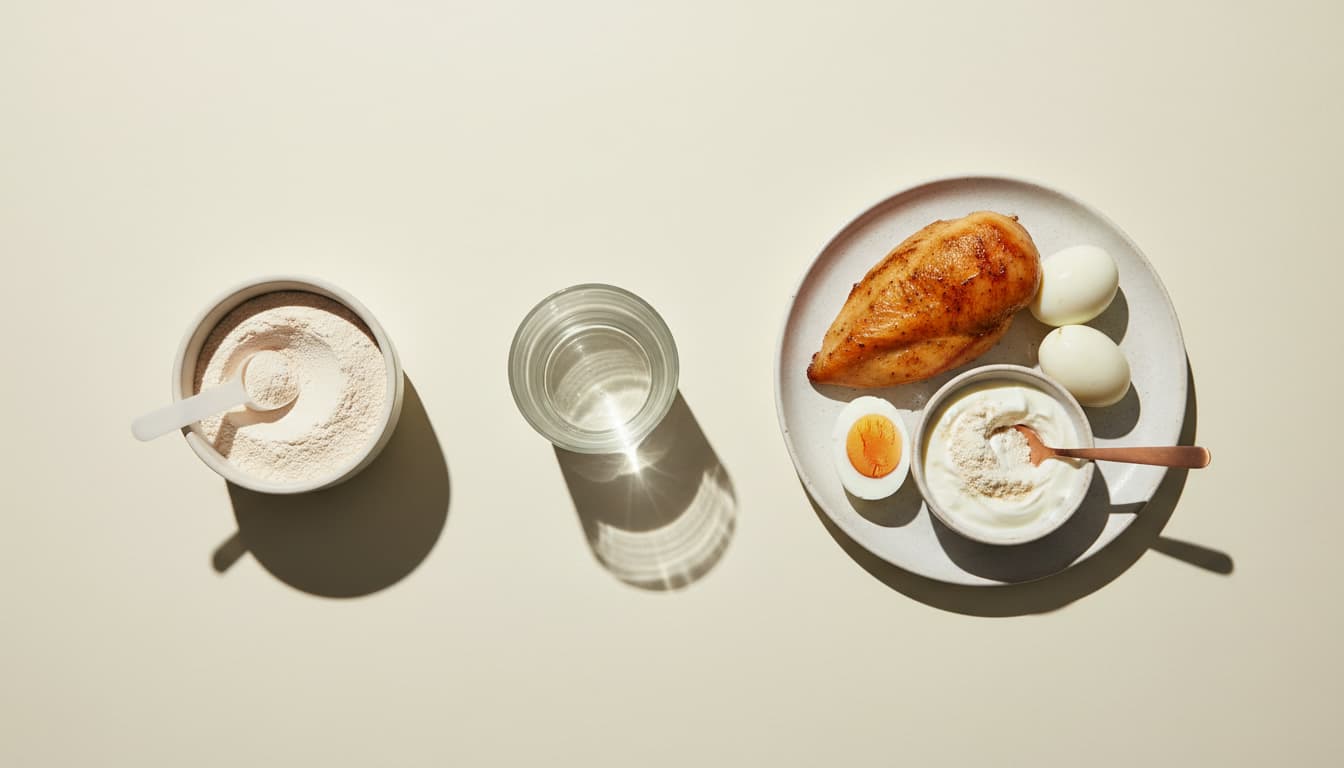
Twenty grams of whole egg protein maximally stimulated muscle protein synthesis in a five-dose trial. BCAAs alone raised it 22 percent over placebo, against a theoretical ceiling of 30 percent, because the other six amino acids have to come from somewhere.
- 01
The benchmark: 20 g of whole protein maximally stimulates synthesis
Six healthy young men consumed 0, 5, 10, 20 or 40 g of whole egg protein in randomised order after intense leg resistance exercise, with synthesis measured over four hours by labelled leucine infusion. Muscle protein synthesis showed a dose response and was maximally stimulated at 20 g, albumin synthesis also plateaued at 20 g, and leucine oxidation rose significantly at 20 and 40 g (Moore et al. 2009). Once a response is maximal, no supplement can raise it further; it can only be reached more expensively.
- 02
Why BCAAs have a hard ceiling of about 30 percent
Building muscle protein requires all nine essential amino acids, and BCAAs supply three. In the post-absorptive state the other six can only come from breaking down existing muscle, so the maximum possible stimulation from BCAAs alone equals the gap between breakdown and synthesis, about 30 percent above synthesis, and realistically less because obligatory amino acid oxidation cannot be fully suppressed (Wolfe 2017). This is an arithmetic limit rather than an experimental one, which is why no formulation can engineer around it.
- 03
The measured BCAA result: 22 percent above placebo
Ten young resistance-trained men ingested 5.6 g of BCAAs or placebo after resistance exercise. Plasma leucine rose 300 percent, isoleucine 300 percent and valine 144 percent, peaking 30 minutes post-drink, with greater S6K1 and PRAS40 phosphorylation at one hour. Myofibrillar protein synthesis was 22 percent higher than placebo, 0.110 versus 0.090 percent per hour (Jackman et al. 2017). That is a real effect sitting just under the theoretical ceiling, measured against a flavoured drink rather than against 20 g of whey.
- 04
What the infusion studies found: reduced turnover, not anabolism
A review found no human studies quantifying the muscle protein synthesis response to orally ingested BCAAs alone, and only two using intravenous infusion. Both found that BCAAs decreased muscle protein synthesis as well as protein breakdown, meaning a decrease in muscle protein turnover, with the catabolic state persisting throughout infusion. The review concluded the claim that dietary BCAAs stimulate muscle protein synthesis or produce an anabolic response in humans is unwarranted (Wolfe 2017).
- 05
Full EAA blends: the effect scales with quantity delivered
An analysis compiling four labelled-infusion studies found maximum peripheral EAA concentration and the change in EAA concentration to be the strongest predictors of postprandial fractional synthetic rate, with a 100 percent increase in peripheral EAA concentrations raising fractional synthetic rate by about 34 percent within their dataset, concluding that large increases in peripheral EAA concentrations are required for a robust response (Church et al. 2020). Several authors disclosed patents and shareholdings in amino acid products, so read it as the favourable case.
- 06
The oxidation penalty on overshooting
The dose-response trial found leucine oxidation significantly increased after both 20 and 40 g of protein, and concluded that dietary protein consumed in excess of the rate at which it can be incorporated into tissue protein stimulates irreversible oxidation (Moore et al. 2009). This applies to amino acid supplements as much as to food: pushing peripheral concentrations high enough to matter also pushes past the incorporation rate, so a portion of an expensive free-form dose is burned rather than built into tissue.
- 07
Where free-form amino acids have a genuine use
The case for EAAs is not zero, it is narrow. Where whole protein is impractical because of appetite loss, restricted volume, impaired digestion, or a clinical feeding constraint, a complete EAA blend delivers the required amino acids in a much smaller mass with no digestion burden. That is a real advantage in a real population. It is a different situation from a trainee eating three complete-protein meals a day, for whom the synthesis response is already saturated at each feeding and the supplement adds cost rather than signal.
What people ask us next.
- Are EAA supplements worth taking?
- Not for anyone already eating adequate complete protein. A dose-response trial found muscle protein synthesis maximally stimulated by 20 g of whole egg protein after resistance exercise, with albumin synthesis also plateauing at 20 g (Moore et al. 2009). A supplement cannot raise a maximal response; it can only reach it at higher cost. Free-form EAAs have a defensible niche where whole protein is impractical because of appetite, volume, digestion or a clinical constraint.
- Do BCAAs build muscle?
- The pooled theoretical and experimental picture says barely, and only in the absence of protein. Because BCAAs supply three of nine essential amino acids, the maximum possible stimulation from BCAAs alone is bounded by muscle protein breakdown at about 30 percent, realistically less (Wolfe 2017). The best trial found 5.6 g of BCAAs raised myofibrillar protein synthesis 22 percent above placebo (Jackman et al. 2017). Against 20 g of complete protein rather than placebo, there is no advantage to claim.
- Are EAA supplements better than whey protein?
- Not on the evidence, and not on cost per effective dose. Whey is a complete protein supplying all nine essential amino acids, and 20 g of intact protein maximally stimulates muscle protein synthesis (Moore et al. 2009). The analysis most favourable to free-form EAAs concluded that large increases in peripheral EAA concentrations are needed for a robust response (Church et al. 2020), which is a quantity argument that a 20 g whey serving satisfies at a far lower price per gram of amino acid delivered.
- How many grams of EAAs do you need per serving?
- The useful way to frame it is in complete protein rather than free amino acids, because that is what the dose-response data measure: 20 g of intact protein per feeding is the point of maximal muscle protein synthesis stimulation (Moore et al. 2009). A 20 g serving of a complete protein such as whey supplies roughly half its mass as essential amino acids. There is no established free-form EAA dose that outperforms that, and pushing past the incorporation rate increases oxidation.
- Do BCAAs help during fasted training?
- This is the strongest version of the BCAA argument and it still runs into the same ceiling. In a genuinely post-absorptive state, the six essential amino acids that BCAAs do not supply can only come from breaking down existing muscle protein, which caps the possible stimulation at roughly 30 percent and does not reverse the underlying catabolic state; both intravenous infusion studies found reduced turnover rather than net anabolism (Wolfe 2017). A small amount of complete protein addresses the same situation without the ceiling.
- Is there any situation where free-form amino acids are the right choice?
- Yes, where the constraint is mass or digestion rather than money. A complete EAA blend delivers the required amino acids in a much smaller quantity with minimal digestive load, which matters in appetite loss, restricted intake volume, impaired digestion, and clinical feeding contexts. The analysis showing that fractional synthetic rate scales with peripheral EAA concentration supports the mechanism (Church et al. 2020). It does not support the product for a healthy trainee eating complete protein at each meal.
Every claim, cited.
- [01]Moore DR, Robinson MJ, Fry JL, Tang JE, Glover EI, Wilkinson SB, Prior T, Tarnopolsky MA, Phillips SM. 2009. Ingested protein dose response of muscle and albumin protein synthesis after resistance exercise in young men. Am J Clin Nutr 89(1):161-8. Six men, five occasions, 0/5/10/20/40 g whole egg protein; muscle protein synthesis maximally stimulated at 20 g; albumin synthesis plateaued at 20 g; leucine oxidation significantly increased after 20 and 40 g.
- [02]Wolfe RR. 2017. Branched-chain amino acids and muscle protein synthesis in humans: myth or reality? J Int Soc Sports Nutr 14:30. Maximal stimulation from BCAAs alone bounded by muscle protein breakdown at about 30 percent above synthesis, and realistically less; no human studies quantifying the response to orally ingested BCAAs alone; two intravenous infusion studies found decreased synthesis and breakdown, meaning reduced turnover, with the catabolic state persisting.
- [03]Jackman SR, Witard OC, Philp A, Wallis GA, Baar K, Tipton KD. 2017. Branched-Chain Amino Acid Ingestion Stimulates Muscle Myofibrillar Protein Synthesis following Resistance Exercise in Humans. Front Physiol 8:390. Ten resistance-trained men, 5.6 g BCAA versus placebo; plasma leucine +300%, isoleucine +300%, valine +144% peaking 0.5 h post-drink; myofibrillar protein synthesis 22% higher than placebo (P=0.012), 0.110 versus 0.090 percent per hour.
- [04]Church DD, Hirsch KR, Park S, Kim IY, Gwin JA, Pasiakos SM, Wolfe RR, Ferrando AA. 2020. Essential Amino Acids and Protein Synthesis: Insights into Maximizing the Muscle and Whole-Body Response to Feeding. Nutrients 12(12):3717. Maximum peripheral EAA concentration and change in EAA were the strongest predictors of postprandial fractional synthetic rate; a 100% increase in peripheral EAA raised fractional synthetic rate by about 34% within the dataset; large increases required for a robust response. Several authors disclosed patents and shareholdings in amino acid products.
The Larderlab Team builds evidence-led frameworks for eating, lifting, and stocking a kitchen. We cite every claim. We publish the spreadsheet when possible. We buy what we review at retail price. When new data lands, we revise with a dated note.
Next in this hub.
What Is Protein? Amino Acids, Function, and How Much You Need
Protein is chains of amino acids that build muscle, enzymes, and hormones. What it does, why leucine and completeness matter, and the evidence-backed daily target.
9 min · rev 2026-06-28How Much Protein to Build Muscle: Per-Meal Dose, Leucine, and Timing
The hypertrophy levers are the per-meal dose (~0.4 g/kg for the leucine trigger), distribution across 3-4 meals, pre/post-training, and the ~1.6 up to ~2.2 g/kg ceiling. For your daily total by bodyweight, see our daily protein guide.
8 min · rev 2026-07-02Casein vs Whey Protein: Whey Wins the Hour, Casein Wins the Night
Whey raised muscle protein synthesis about 93 percent above casein at rest and 122 percent after exercise, yet casein produced the more positive 7-hour net leucine balance. Pre-sleep casein added 3.6 square centimetres of quadriceps growth over 12 weeks against a noncaloric placebo.
14 min · rev 2026-09-10Get the Larderlab Macro Planner.
A Google Sheet that calculates your protein target, splits it across 3-5 meals, and ranks 20 protein sources by $/gram. Free. Copy-and-modify your own version.
By subscribing, you agree to our Privacy Policy. Unsubscribe anytime.