How much protein to build muscle: the per-meal mechanics
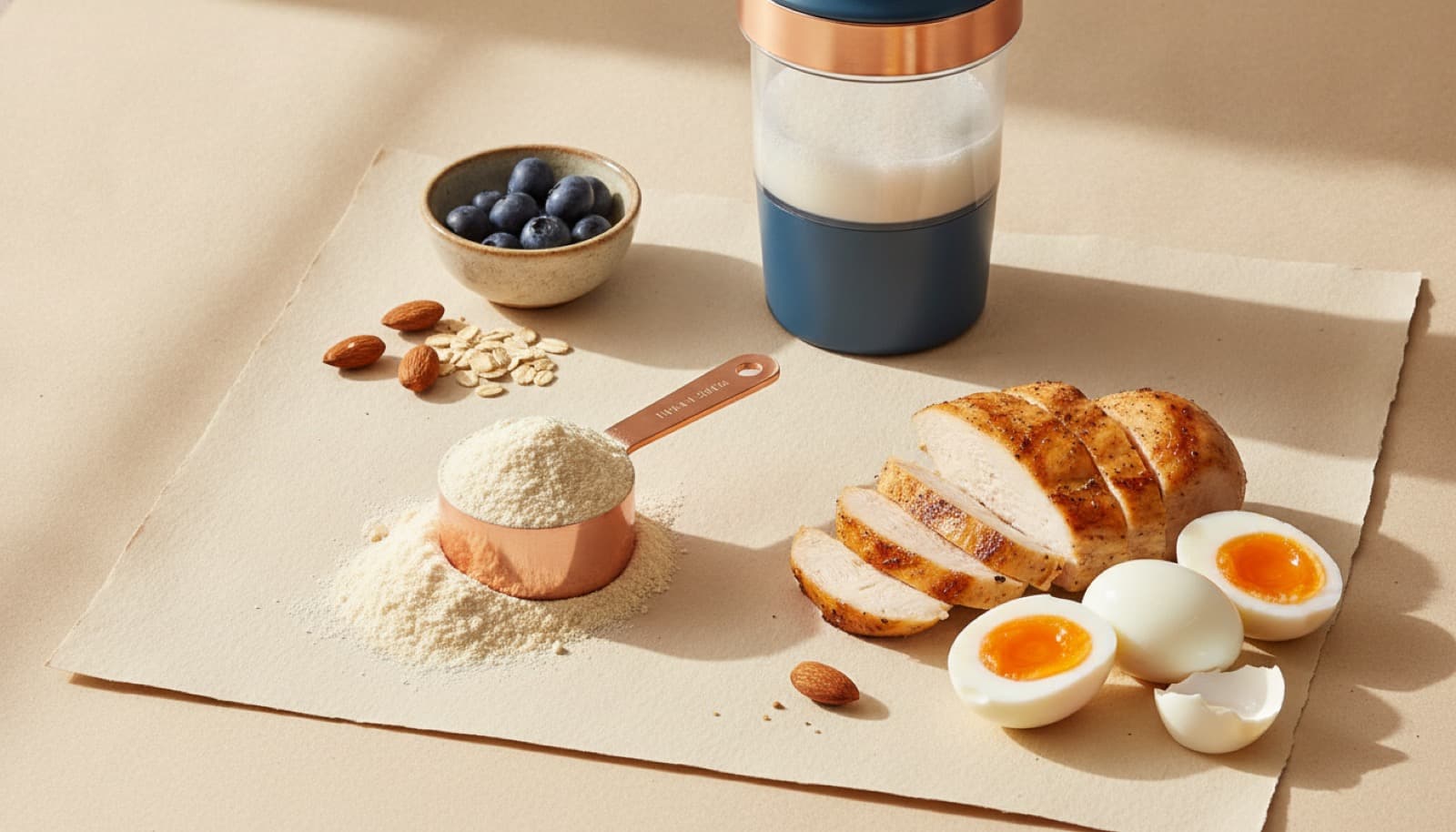
The hypertrophy levers are the per-meal dose (~0.4 g/kg for the leucine trigger), distribution across 3-4 meals, pre/post-training, and the ~1.6 up to ~2.2 g/kg ceiling. For your daily total by bodyweight, see our daily protein guide.
- 01
Per meal: ~0.4 g/kg to clear the leucine threshold
The lever most people miss is the per-meal dose. Muscle protein synthesis is switched on per feeding by the amino acid leucine, and a meal needs ~2.5-3 g of leucine, roughly ~0.4 g/kg of protein or ~25-40 g for most adults, to maximally trigger it (Moore et al. 2015). Below that threshold the anabolic response is muted; a small snack of 10-15 g barely moves the needle for a lifter. Build each main meal around a dose that clears it: a chicken breast, a large Greek yogurt, or a whey scoop plus a food source.
- 02
Distribution: spread it across 3-4 feedings
Because each qualifying meal restimulates synthesis, how you distribute protein across the day matters. Areta et al. 2013 gave the same total protein as either 2 large, 4 moderate, or 8 small feedings after training and found the 4-moderate pattern (~20 g every 3 hours) produced the highest sustained synthesis. Practically, aim for 3-4 meals that each clear the ~0.4 g/kg per-meal dose rather than backloading most of your protein into dinner. An 80 g single hit does not outbuild an optimal per-meal dose; the surplus is largely oxidized.
- 03
Pre and post-training: the window is hours, not minutes
The idea that protein must be eaten within 30-60 minutes of training is overstated. Schoenfeld et al. 2013 found that once total daily protein is adequate, the post-workout window spans several hours and precise timing has little independent effect on muscle gain. Because a pre-training meal is still elevating blood amino acids during and after the session, eating a protein-containing meal within a few hours either side of training covers the window comfortably. Hit your per-meal doses across the day; the total is the lever, not the stopwatch.
- 04
The hypertrophy ceiling: ~1.6 up to ~2.2 g/kg/day
The per-meal doses stack into a daily total, and for muscle that total has a ceiling. Morton et al. 2018 pooled 49 studies (n=1,863) and found gains in muscle and strength plateaued around ~1.6 g/kg/day, with a plausible individual upper bound to ~2.2 g/kg. Higher intakes to 4.4 g/kg/day add no muscle and cause no harm in healthy adults (Antonio et al. 2015), so the range is efficient, not a floor to fear exceeding. For the full per-kg breakdown and a bodyweight table, this is the daily-total question answered in our daily protein guide.
- 05
Training and calories are prerequisites
Protein builds muscle only alongside a progressive resistance-training stimulus and enough total energy. Hitting your per-meal doses without training adds little muscle; the protein supplies raw material, but training provides the signal that directs it. In a steep calorie deficit, muscle protein synthesis is suppressed, so protein toward the top of the range (~2.2 g/kg) helps preserve muscle while cutting, but building new tissue is hardest without at least maintenance calories.
- 06
Source quality: leucine density per dose
What clears the per-meal leucine threshold most efficiently is a fast, complete protein. Whey is the reference (~10-11% leucine, rapidly digested); dairy, eggs, and lean meat clear it at typical portions too. Plant sources are lower in leucine and often lower in one essential amino acid, so a plant-based lifter should aim for a slightly larger per-meal dose or combine sources within the meal. The distribution and dosing rules stay the same; the portion needed to hit ~2.5-3 g leucine simply shifts with the source.
What people ask us next.
- What actually drives muscle growth from protein?
- How you dose and distribute it, more than the exact daily total. Each meal needs ~0.4 g/kg (about 25-40 g) to clear the leucine threshold that switches on muscle protein synthesis (Moore et al. 2015), and spreading protein across 3-4 such meals sustains synthesis better than backloading it (Areta et al. 2013). Those doses stack into a daily total with a hypertrophy ceiling of ~1.6 up to ~2.2 g/kg. Progressive resistance training and adequate calories are required for any of it to become muscle. For your daily total by bodyweight, see our daily protein guide.
- Is more protein better for muscle growth?
- Only up to a point. Gains plateau at ~1.6 g/kg/day and show no further benefit up to ~2.2 g/kg. Antonio et al. 2015 fed trained men up to 4.4 g/kg/day with no extra muscle and no harm, so very high intake is safe but wasteful. Past the ceiling, the limiting factor becomes training and total calories, not more protein. Hit ~1.6 g/kg and put the effort elsewhere.
- How much protein per meal to build muscle?
- Roughly 0.4 g/kg per meal, about 25-40 g for most people, which supplies the ~2.5-3 g of leucine needed to maximally trigger muscle protein synthesis (Moore et al. 2015). Because each meal restimulates synthesis, spread your daily total across 3-4 meals rather than one or two. A single very large dose does not build more muscle than an optimal per-meal amount; the excess is oxidized.
- Does protein timing around workouts matter for muscle?
- Far less than total daily intake. The post-workout anabolic window is several hours wide, not 30 minutes, so once your daily protein is adequate, precise timing has little independent effect on muscle gain (Schoenfeld et al. 2013). Eat a protein meal within a few hours of training and, above all, hit your daily target. Total protein is the lever that drives growth, not stopwatch timing.
- Can I build muscle with protein alone, without training?
- No. Protein supplies the building blocks, but progressive resistance training provides the signal that directs those amino acids into new muscle. Eating 1.6 g/kg without training adds little muscle mass. You also need enough total energy; a steep calorie deficit suppresses muscle protein synthesis, so building muscle is hardest without at least maintenance calories plus a training stimulus.
- How should I split my protein across the day for muscle?
- Aim for 3-4 meals that each clear the ~0.4 g/kg per-meal dose, roughly 25-40 g, rather than backloading most of it into one meal (Areta et al. 2013). Anchor each on a dense source: a cooked chicken breast (~46 g), Greek yogurt, eggs, or a whey scoop (~30 g). Keep one of those feedings within a few hours of training. To set the daily total those meals should add up to, use the bodyweight table in our daily protein guide and the Macro Calculator.
Every claim, cited.
- [01]Morton RW, Murphy KT, McKellar SR, et al. 2018. A systematic review, meta-analysis and meta-regression of the effect of protein supplementation on resistance training-induced gains in muscle mass and strength. Br J Sports Med 52(6):376-384. Plateau at ~1.6 g/kg/day, n=1,863.
- [02]Moore DR, Churchward-Venne TA, Witard O, et al. 2015. Protein ingestion to stimulate myofibrillar protein synthesis. J Gerontol A 70(1):57-62. Per-meal leucine threshold (~0.4 g/kg protein).
- [03]Areta JL, Burke LM, Ross ML, et al. 2013. Timing and distribution of protein ingestion during prolonged recovery from resistance exercise alters myofibrillar protein synthesis. J Physiol 591(9):2319-2331. 4 x 20 g every 3 h beat 2 large or 8 small feedings.
- [04]Schoenfeld BJ, Aragon AA, Krieger JW. 2013. The effect of protein timing on muscle strength and hypertrophy: a meta-analysis. J Int Soc Sports Nutr 10(1):53. Total daily protein outweighs timing.
- [05]Antonio J, Ellerbroek A, Silver T, et al. 2015. A high protein diet (3.4 g/kg/d) in resistance-trained individuals. J Int Soc Sports Nutr 12:39. Up to 4.4 g/kg/day no added muscle, no harm.
The Larderlab Team builds evidence-led frameworks for eating, lifting, and stocking a kitchen. We cite every claim. We publish the spreadsheet when possible. We buy what we review at retail price. When new data lands, we revise with a dated note.
Next in this hub.
Best Protein Powders Ranked by $/gram of Leucine
We ranked 14 protein powders by the metric that actually matters, cost per gram of leucine delivered, with third-party testing filters.
14 min · rev 2026-04-21How Much Protein Per Meal? The Per-Sitting Number, by the Evidence
The muscle-building response peaks at about 0.4 g of protein per kg of body weight per meal, roughly 25-40 g for most adults. The per-meal number, why splitting protein across the day beats one large dose, and how to hit it.
8 min · rev 2026-07-21Whey vs Plant Protein: Which Builds Muscle Better?
Whey wins per gram on completeness, leucine, and digestibility, but soy and blended plant proteins close most of the gap at a higher dose. What separates them, when it matters, and how to choose.
8 min · rev 2026-07-16Get the Larderlab Macro Planner.
A Google Sheet that calculates your protein target, splits it across 3-5 meals, and ranks 20 protein sources by $/gram. Free. Copy-and-modify your own version.
By subscribing, you agree to our Privacy Policy. Unsubscribe anytime.