Casein vs whey protein, judged on absorption kinetics and 12-week outcomes
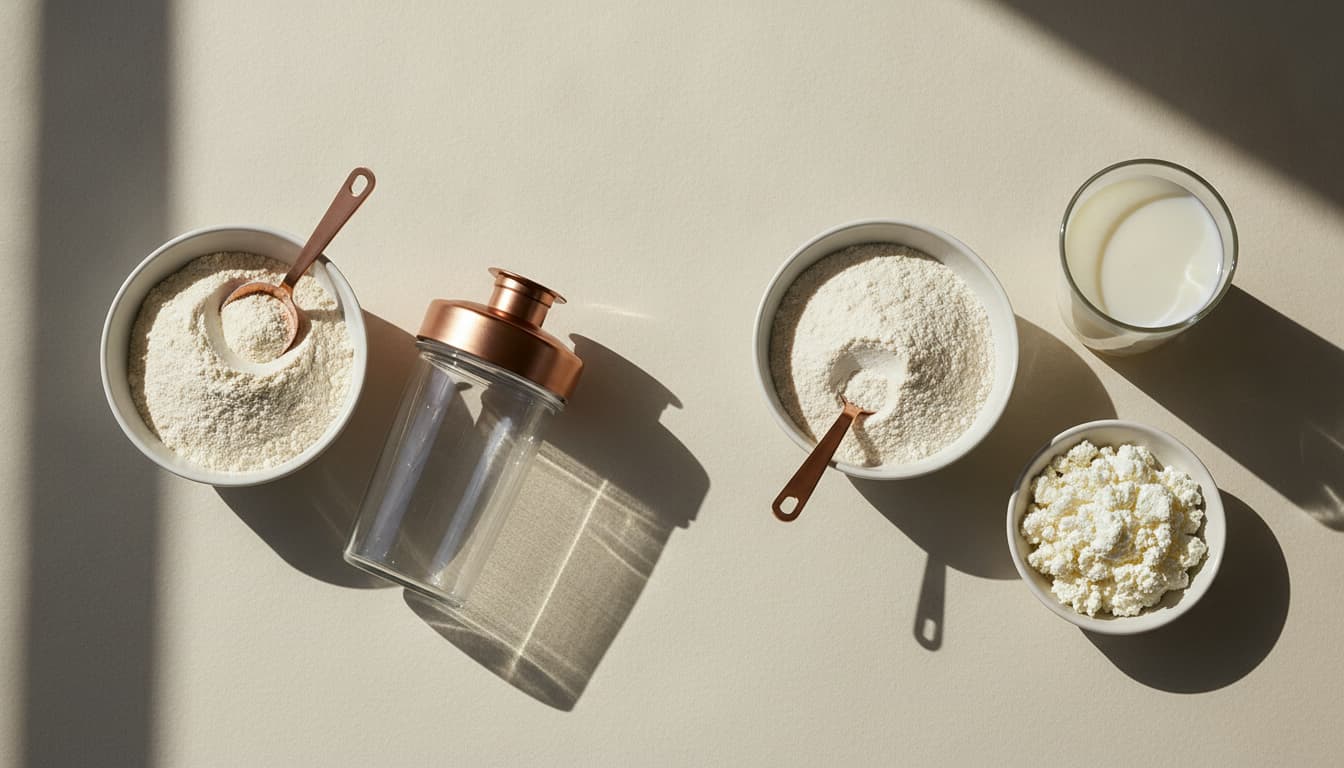
Whey raised muscle protein synthesis about 93 percent above casein at rest and 122 percent after exercise, yet casein produced the more positive 7-hour net leucine balance. Pre-sleep casein added 3.6 square centimetres of quadriceps growth over 12 weeks against a noncaloric placebo.
Casein and whey are the two protein fractions of milk, roughly 80 percent and 20 percent respectively, and they differ in one property that drives every downstream result: how fast the amino acids arrive. Feeding intrinsically labelled casein or whey as a single meal to healthy adults produced a dramatic but short rise in plasma amino acids with whey and a prolonged plateau of moderate hyperaminoacidemia with casein, attributed to slow gastric emptying. Whole-body protein breakdown was inhibited by 34 percent after casein and not after whey; postprandial protein synthesis was stimulated 68 percent by whey against 31 percent by casein; leucine oxidation over 7 hours was lower with casein at 272 plus or minus 91 micromol per kg than with whey at 373 plus or minus 56, on identical leucine intakes of 380 micromol per kg; and net leucine balance over the 7 hours was more positive with casein, p below 0.05 (Boirie et al. 1997). Measured at the muscle rather than the whole body, the ordering flips. With drinks matched for 10 g of essential amino acids, mixed muscle protein synthesis at rest ran 0.091 plus or minus 0.015 percent per hour for whey hydrolysate, 0.078 plus or minus 0.014 for soy and 0.047 plus or minus 0.008 for micellar casein, making whey approximately 93 percent greater than casein at rest and approximately 122 percent greater after resistance exercise, both p below 0.01 (Tang et al. 2009). Both results are correct and they answer different questions: whey maximises the acute synthetic response, casein maximises the balance across a long unfed window by suppressing breakdown. The training data follow that logic. Forty grams of casein 30 minutes before sleep raised overnight whole-body protein synthesis to 311 plus or minus 8 against 246 plus or minus 9 micromol per kg per 7.5 hours and turned net protein balance from negative 11 plus or minus 6 to positive 61 plus or minus 5, p below 0.01 (Res et al. 2012), and over 12 weeks of resistance training a 27.5 g pre-sleep protein supplement produced greater strength gains, plus 164 plus or minus 11 kg against plus 130 plus or minus 9 kg, p below 0.001, and greater quadriceps cross-sectional area, plus 8.4 plus or minus 1.1 against plus 4.8 plus or minus 0.8 square centimetres, p below 0.05 (Snijders et al. 2015). That trial used a noncaloric placebo, so the groups differed in total protein as well as in timing, which is the standard and legitimate objection. Against all of it stands the meta-analysis showing that total daily protein intake is the dominant variable in resistance training outcomes (Morton et al. 2018). Whey after training, casein before sleep, and neither choice worth more than a few percent if the daily total is not already met.
The mechanism is gastric, not molecular. Casein coagulates in the acid environment of the stomach and forms a clot that empties slowly; whey stays soluble and passes through. Boirie and colleagues demonstrated this with intrinsically labelled proteins, feeding 13C-leucine casein or whey as a single meal to healthy adults and tracking whole-body leucine kinetics with a dual-tracer method. Whey produced a dramatic but short increase in plasma amino acids. Casein produced a prolonged plateau of moderate hyperaminoacidemia, which the authors attributed to slow gastric emptying. The functional consequences separated cleanly: whole-body protein breakdown was inhibited by 34 percent after casein and not measurably after whey, postprandial protein synthesis rose 68 percent with whey and 31 percent with casein, and 7-hour leucine oxidation was 272 plus or minus 91 micromol per kg with casein against 373 plus or minus 56 with whey. Leucine intake was identical at 380 micromol per kg in both meals, so the difference in oxidation is a difference in how the body handled the same load. Net leucine balance over the 7 hours was more positive with casein, p below 0.05 (Boirie et al. 1997). Read that as a single sentence: whey builds faster, casein wastes less. Now measure at the muscle instead of the whole body, and whey takes the lead by a wide margin. Tang and colleagues gave three groups of six healthy young men drinks matched for 10 g of essential amino acids, as whey hydrolysate, micellar casein or soy protein isolate, after unilateral leg resistance exercise. Mixed muscle protein synthesis at rest was 0.091 plus or minus 0.015 percent per hour for whey, 0.078 plus or minus 0.014 for soy and 0.047 plus or minus 0.008 for casein; whey was approximately 93 percent greater than casein at rest, p below 0.01, and approximately 18 percent greater than soy, p equal to 0.067. After exercise whey was approximately 122 percent greater than casein, p below 0.01, and 31 percent greater than soy, p below 0.05. Soy also beat casein by 64 percent at rest and 69 percent after exercise (Tang et al. 2009). Six per group is small, and the doses were matched on essential amino acids rather than on total protein, but the ranking has held up. Two factors explain it: leucine concentration, which is higher in whey at roughly 10 to 11 percent of protein against roughly 8 to 9 percent in casein, and delivery rate, which determines whether the leucine peak clears the threshold that switches synthesis on. The practical translation is that casein does not lose because it is a worse protein. It loses the sprint because it is not trying to run one. Where the slow profile earns its place is the overnight window, which is the longest unfed period most people have and the one where a whole-body balance measure matters more than a peak. Res and colleagues had 16 healthy young males perform resistance exercise at 2000 hours, provided 20 g of protein and 60 g of carbohydrate at 2100 hours, then gave 40 g of intrinsically labelled casein or a placebo 30 minutes before sleep at 2330 hours. The casein was effectively digested and absorbed during sleep, producing a rapid rise in circulating amino acids that was sustained through the night. Whole-body protein synthesis over 7.5 hours was 311 plus or minus 8 against 246 plus or minus 9 micromol per kg, and net protein balance moved from negative 11 plus or minus 6 to positive 61 plus or minus 5, both p below 0.01. Mixed muscle protein synthesis was approximately 22 percent higher, reaching borderline significance (Res et al. 2012). That is an acute mechanism study, and the question it raises is whether the mechanism produces an outcome. Snijders and colleagues ran that test: 44 young men, mean age 22 plus or minus 1 years, on a progressive 12-week resistance training programme, with one group taking a nightly supplement of 27.5 g protein, 15 g carbohydrate and 0.1 g fat before sleep and the other a noncaloric placebo. Strength increased more in the protein group, plus 164 plus or minus 11 kg against plus 130 plus or minus 9 kg, p below 0.001. Quadriceps cross-sectional area increased in both groups, with a greater increase in the protein group, plus 8.4 plus or minus 1.1 against plus 4.8 plus or minus 0.8 square centimetres, p below 0.05, and type II fibre size increased more in the protein group (Snijders et al. 2015). The design flaw is important and is not a reason to dismiss the result. Because the placebo was noncaloric, the protein group ate 27.5 g more protein per day, so the trial cannot separate the effect of timing from the effect of dose. What it does establish is that adding protein before sleep works, which is a useful finding even if the mechanism is simply more protein. Dose sets the ceiling for both proteins, and the ceiling is lower than most labels suggest. Witard and colleagues gave 48 resistance-trained young men a standardised high-protein breakfast at 0.54 g per kg body mass, then 0, 10, 20 or 40 g of whey protein isolate after unilateral exercise. Myofibrillar synthesis rose above the 0 g rate of 0.041 plus or minus 0.015 percent per hour by 49 percent with 20 g and 56 percent with 40 g, with no additional stimulation from 10 g, while 40 g increased phenylalanine oxidation and urea production. The conclusion was that 20 g is sufficient for maximal stimulation in approximately 80 kg resistance-trained young men (Witard et al. 2014). A later trial found that after whole-body rather than single-limb resistance exercise, 40 g produced a greater response than 20 g (Macnaughton et al. 2016), which is the sensible qualification: more muscle worked raises the useful dose. Neither result supports 50 g scoops. And all of it sits underneath the finding that dominates the category. The meta-analysis, meta-regression and systematic review of protein supplementation and resistance training found that protein supplementation augments gains in muscle mass and strength, with total protein intake the variable driving the effect (Morton et al. 2018). Distribution and timing operate at the margin of a total that has to be hit first. For a household making an actual buying decision, the ordering is simple. If only one tub is bought, buy whey: it wins the post-exercise comparison outright, it is cheaper to manufacture because it is a byproduct of cheese making rather than a separately filtered fraction, and it mixes into anything. Add casein only if the overnight window is a real gap, which usually means training in the evening or eating an early dinner. Note that food already supplies both: milk is roughly 80 percent casein, Greek yogurt and cottage cheese are casein-dominant by construction, and a bowl of either before bed delivers the same slow profile without a second tub. Judge any specific tub on cost per gram of protein and on third-party testing rather than on the fraction named on the front, and let the protein powder comparison do the ranking. The fraction is worth a few percent. The total is worth everything else.
The differences that are measurable.
- 01
The entire difference is gastric emptying speed
Casein coagulates in stomach acid and empties slowly; whey stays soluble and passes straight through. Feeding intrinsically labelled versions of each as a single meal produced a dramatic but short rise in plasma amino acids with whey and a prolonged plateau of moderate hyperaminoacidemia with casein, which the authors attributed directly to slow gastric emptying (Boirie et al. 1997). Every other difference between the two proteins is downstream of this one physical property.
- 02
Casein suppresses breakdown by 34 percent, whey does not
In the same single-meal comparison, whole-body protein breakdown was inhibited by 34 percent after casein ingestion and not after whey, while postprandial protein synthesis rose 68 percent with whey and 31 percent with casein (Boirie et al. 1997). Two different levers on the same balance sheet. Whey pushes the synthesis side, casein holds down the breakdown side, and which one matters depends entirely on the length of the window being measured.
- 03
Over 7 hours, casein produced the better net balance
Leucine oxidation across the 7 hours after the meal was 272 plus or minus 91 micromol per kg with casein against 373 plus or minus 56 with whey, on identical leucine intakes of 380 micromol per kg, and net leucine balance over the same period was more positive with casein, p below 0.05 (Boirie et al. 1997). Same amino acid load, less of it burned. This is the strongest single result in casein's favour and it is routinely left out of comparisons that stop at the 3-hour mark.
- 04
At the muscle, whey beats casein by 93 to 122 percent
With drinks matched for 10 g of essential amino acids, mixed muscle protein synthesis at rest was 0.091 plus or minus 0.015 percent per hour for whey hydrolysate, 0.078 plus or minus 0.014 for soy and 0.047 plus or minus 0.008 for micellar casein. Whey exceeded casein by approximately 93 percent at rest and approximately 122 percent after resistance exercise, both p below 0.01 (Tang et al. 2009). Six subjects per group is a small trial, and the ranking has been reproduced repeatedly.
- 05
Soy beat casein too, which rules out the plant-versus-animal framing
In the same study soy protein isolate produced 64 percent higher mixed muscle protein synthesis than casein at rest and 69 percent higher after resistance exercise, both p below 0.01, while whey still exceeded soy by 31 percent after exercise (Tang et al. 2009). The variable separating the three is digestion speed and leucine content, not animal versus plant origin. Any comparison that sorts proteins by source rather than by kinetics will get this ordering wrong.
- 06
Leucine content is the second variable, at roughly 11 versus 9 percent
Whey carries approximately 10 to 11 percent of its protein as leucine against approximately 8 to 9 percent for casein, and leucine is the amino acid that triggers the synthetic response rather than merely supplying substrate. Combined with faster delivery, that is why an equal gram of whey clears the activation threshold and an equal gram of casein arrives below it. It also explains why hydrolysates and isolates behave more like each other than either behaves like a slow protein.
- 07
Forty grams of pre-sleep casein flipped overnight balance from negative to positive
Sixteen healthy young males trained at 2000 hours, received 20 g of protein and 60 g of carbohydrate at 2100 hours, then 40 g of intrinsically labelled casein or placebo at 2330 hours. Overnight whole-body protein synthesis was 311 plus or minus 8 against 246 plus or minus 9 micromol per kg per 7.5 hours, and net protein balance moved from negative 11 plus or minus 6 to positive 61 plus or minus 5, both p below 0.01. Mixed muscle protein synthesis was approximately 22 percent higher at borderline significance (Res et al. 2012).
- 08
Over 12 weeks that mechanism produced measurable extra growth
Forty-four young men on a progressive 12-week resistance training programme took either 27.5 g of protein with 15 g of carbohydrate before sleep or a noncaloric placebo. Strength gains were greater in the protein group, plus 164 plus or minus 11 kg against plus 130 plus or minus 9 kg, p below 0.001, as was quadriceps cross-sectional area, plus 8.4 plus or minus 1.1 against plus 4.8 plus or minus 0.8 square centimetres, p below 0.05, with greater type II fibre growth (Snijders et al. 2015).
- 09
That trial cannot separate timing from total intake
The comparator in the 12-week study was a noncaloric placebo, so the supplemented group also ate 27.5 g more protein every day than the control group. The result therefore demonstrates that adding protein before sleep works, and it does not demonstrate that the timing is what made it work (Snijders et al. 2015). This is the correct reading and it is neither a dismissal nor a full endorsement. A protein-matched control fed at a different time is the trial that would settle it.
- 10
Twenty grams saturates the response after single-limb work
Forty-eight resistance-trained young men ate a 0.54 g per kg protein breakfast, exercised one leg, then took 0, 10, 20 or 40 g of whey isolate. Myofibrillar synthesis rose above the 0 g rate of 0.041 plus or minus 0.015 percent per hour by 49 percent with 20 g and 56 percent with 40 g, with no stimulation at all from 10 g, while 40 g raised phenylalanine oxidation and urea production (Witard et al. 2014). Twenty grams was sufficient for maximal stimulation in approximately 80 kg men.
- 11
After whole-body training the useful dose rises to 40 g
The 20 g ceiling was established after unilateral leg exercise. When the same question was asked after whole-body resistance exercise, 40 g of whey produced a greater synthetic response than 20 g (Macnaughton et al. 2016). The reconciliation is straightforward: more muscle worked means more tissue competing for the same amino acid pool. Neither result supports the 50 g and larger servings that appear on many labels, and the difference between 20 and 40 is smaller than the difference between hitting and missing the daily total.
- 12
Total daily protein dominates both of them
The systematic review, meta-analysis and meta-regression of protein supplementation in resistance training found that supplementation augments gains in muscle mass and strength and that total protein intake is the variable driving the effect (Morton et al. 2018). Fraction choice and timing operate at the margin of a total that has to be met first. A person hitting 1.6 g per kg with whey alone will outperform a person at 1.1 g per kg running a perfectly periodised whey and casein schedule.
- 13
Food already delivers the slow fraction, and often cheaper
Milk protein is roughly 80 percent casein and 20 percent whey, so Greek yogurt, cottage cheese and milk are casein-dominant by construction and produce the same slow release profile without a second tub. A pre-sleep serving of cottage cheese is a direct substitute for the intervention tested in the overnight trials, and the whole-food protein route is usually the cheaper one on a per gram basis once the powder premium is counted.
- 14
The buying rule collapses to one tub for most people
Buy whey first: it wins the post-exercise comparison outright, and as a byproduct of cheese making it is structurally cheaper than a separately filtered micellar casein. Add casein only when the overnight window is a genuine gap, which usually means evening training or an early dinner. Rank any specific tub on cost per gram of protein and on third-party testing rather than on the fraction printed on the front, and let the protein powder comparison do that work.
How this was specified
- 01Inputs measured
- Retail price (dated) · label claim · Certificate of Analysis · third-party test (Informed Sport / NSF / ConsumerLab / Clean Label) · leucine per serving from COA, not marketing.
- 02Protocols tested
- Per-kg target from four literature ranges (IOM RDA, Phillips 2017, Morton 2018, ISSN). Brands scored against Moore 2015 leucine-per-dose threshold (~0.4 g/kg).
- 03Cost-basis verified
- $/gram of protein and $/gram of leucine at warehouse pricing (Costco), mail-order (Amazon), and DTC retail. Re-checked quarterly, flagged when drift exceeds 15%.
- 04Confidence level
- High on ranked order. Medium on absolute $/g (prices drift). Low on serving-size claims where COA is older than 18 months, flagged [VERIFY].
What people ask us most.
- Which builds more muscle, casein or whey?
- Whey, measured acutely at the muscle. With drinks matched for 10 g of essential amino acids, whey hydrolysate produced approximately 93 percent higher mixed muscle protein synthesis than micellar casein at rest and approximately 122 percent higher after resistance exercise, both p below 0.01 (Tang et al. 2009). Measured as whole-body net balance across 7 hours the ordering reverses, because casein inhibits breakdown by 34 percent where whey does not (Boirie et al. 1997).
- Why does casein win on net balance if whey wins on synthesis?
- They act on opposite sides of the same equation. Whey delivers a fast, high amino acid peak that stimulates synthesis, at the cost of oxidising more of the load: 373 plus or minus 56 against 272 plus or minus 91 micromol per kg of leucine burned over 7 hours on identical intakes. Casein delivers a low sustained plateau that suppresses breakdown by 34 percent. Over a long unfed window the suppression term wins, which is why net leucine balance was more positive with casein (Boirie et al. 1997).
- Is casein before bed actually worth doing?
- The mechanism is solid and the outcome trial has a caveat. Forty grams of casein before sleep raised overnight whole-body protein synthesis to 311 plus or minus 8 against 246 plus or minus 9 micromol per kg per 7.5 hours and turned net balance positive (Res et al. 2012). Over 12 weeks, a 27.5 g pre-sleep supplement produced greater strength and quadriceps growth than placebo (Snijders et al. 2015), but the placebo was noncaloric, so the extra protein and the timing cannot be separated.
- How much whey should be taken after training?
- Twenty grams after single-limb work and around 40 g after whole-body work. Myofibrillar synthesis rose 49 percent with 20 g and 56 percent with 40 g against 0 g, with nothing from 10 g, and 40 g increased amino acid oxidation and urea production in that setting (Witard et al. 2014). After whole-body resistance exercise, 40 g outperformed 20 g (Macnaughton et al. 2016). Larger servings raise oxidation rather than synthesis.
- Is casein worth buying if only one protein powder is affordable?
- No. Whey wins the post-exercise comparison outright, is usable at any time of day, and is structurally cheaper because it is a byproduct of cheese making rather than a separately filtered fraction. The overnight function that casein performs is also available from food: milk protein is roughly 80 percent casein, so Greek yogurt or cottage cheese before bed delivers the same slow release profile without a second purchase.
- Does casein beat plant protein?
- Not in the acute comparison. Soy protein isolate produced 64 percent higher mixed muscle protein synthesis than micellar casein at rest and 69 percent higher after resistance exercise, both p below 0.01, while whey exceeded soy by 31 percent after exercise (Tang et al. 2009). The variable is digestion speed and leucine content, not animal against plant origin, so sorting proteins by source rather than by kinetics produces the wrong ranking.
- Does the whey versus casein choice matter more than total intake?
- No, and not by a wide margin. The meta-analysis and meta-regression of protein supplementation during resistance training found supplementation augments muscle mass and strength gains with total protein intake as the driving variable (Morton et al. 2018). Fraction and timing are margin adjustments on a total that has to be met first. Reaching 1.6 g per kg with whey alone beats an elaborate schedule at 1.1 g per kg.
- Are whey concentrate, isolate and hydrolysate different in this comparison?
- Less than the price gap suggests. All three are fast proteins with the same leucine-rich profile; the differences are lactose content, fat content and protein percentage by weight, which matter for tolerance and for cost per gram of protein rather than for the synthetic response. The trials that established whey's advantage over casein used a hydrolysate (Tang et al. 2009) and an isolate (Witard et al. 2014) and produced the same direction of effect.
A published Certificate of Analysis from a ranked brand that contradicts the label claim we scored against. An independent lab result (Clean Label, ConsumerLab) finding heavy-metal or amino-spiking failures on a current top pick. A peer-reviewed meta-analysis that shifts the leucine-per-dose threshold. Any of those triggers a dated revision within a week.
Every claim, cited.
- [01]Boirie Y, Dangin M, Gachon P, Vasson MP, Maubois JL, Beaufrere B. 1997. Slow and fast dietary proteins differently modulate postprandial protein accretion. Proc Natl Acad Sci USA 94(26):14930-14935. Two intrinsically 13C-leucine-labelled milk proteins, casein and whey protein, were ingested as one single meal by healthy adults and postprandial whole-body leucine kinetics were assessed by dual tracer methodology. Whey induced a dramatic but short increase of plasma amino acids; casein induced a prolonged plateau of moderate hyperaminoacidemia, probably because of slow gastric emptying. Whole-body protein breakdown was inhibited by 34 percent after casein and not after whey. Postprandial protein synthesis was stimulated by 68 percent with whey and by 31 percent with casein. Postprandial whole-body leucine oxidation over 7 hours was lower with casein at 272 plus or minus 91 micromol per kg than with whey at 373 plus or minus 56 micromol per kg, on identical leucine intakes of 380 micromol per kg. Net leucine balance over the 7 hours after the meal was more positive with casein than with whey, p below 0.05.
- [02]Tang JE, Moore DR, Kujbida GW, Tarnopolsky MA, Phillips SM. 2009. Ingestion of whey hydrolysate, casein, or soy protein isolate: effects on mixed muscle protein synthesis at rest and following resistance exercise in young men. J Appl Physiol 107(3):987-992. Three groups of six healthy young men performed unilateral leg resistance exercise then consumed a drink containing an equivalent content of essential amino acids, 10 g, as whey hydrolysate, micellar casein or soy protein isolate. Mixed muscle protein synthesis at rest was 0.091 plus or minus 0.015 percent per hour for whey, 0.078 plus or minus 0.014 for soy and 0.047 plus or minus 0.008 for casein; whey was approximately 93 percent greater than casein, p below 0.01, and approximately 18 percent greater than soy, p equal to 0.067. Following exercise whey was approximately 122 percent greater than casein, p below 0.01, and 31 percent greater than soy, p below 0.05. Soy exceeded casein by 64 percent at rest and 69 percent after resistance exercise, both p below 0.01.
- [03]Res PT, Groen B, Pennings B, Beelen M, Wallis GA, Gijsen AP, Senden JM, van Loon LJ. 2012. Protein ingestion before sleep improves postexercise overnight recovery. Med Sci Sports Exerc 44(8):1560-1569. Sixteen healthy young males performed resistance-type exercise at 2000 hours after a day of dietary standardisation, received 20 g of protein and 60 g of carbohydrate at 2100 hours, then 30 minutes before sleep at 2330 hours ingested a beverage with or without 40 g of intrinsically labelled casein. Casein was effectively digested and absorbed during sleep, producing a rapid rise in circulating amino acids sustained through the night. Whole-body protein synthesis rates were 311 plus or minus 8 against 246 plus or minus 9 micromol per kg per 7.5 hours and net protein balance 61 plus or minus 5 against negative 11 plus or minus 6 micromol per kg per 7.5 hours, both p below 0.01. Mixed muscle protein synthesis rates were approximately 22 percent higher, reaching borderline significance.
- [04]Snijders T, Res PT, Smeets JS, van Vliet S, van Kranenburg J, Maase K, Kies AK, Verdijk LB, van Loon LJ. 2015. Protein Ingestion before Sleep Increases Muscle Mass and Strength Gains during Prolonged Resistance-Type Exercise Training in Healthy Young Men. J Nutr 145(6):1178-1184. Forty-four young men, mean age 22 plus or minus 1 years, were randomly assigned to a progressive 12-week resistance exercise training programme. One group consumed a supplement containing 27.5 g of protein, 15 g of carbohydrate and 0.1 g of fat every night before sleep; the other received a noncaloric placebo. Strength increased more in the protein group, plus 164 plus or minus 11 kg against plus 130 plus or minus 9 kg, p below 0.001. Quadriceps cross-sectional area increased in both groups, with a greater increase in the protein group, plus 8.4 plus or minus 1.1 against plus 4.8 plus or minus 0.8 square centimetres, p below 0.05. Both type I and type II fibre size increased, with a greater increase in type II fibre size in the protein group. Registered as NCT02222415.
- [05]Witard OC, Jackman SR, Breen L, Smith K, Selby A, Tipton KD. 2014. Myofibrillar muscle protein synthesis rates subsequent to a meal in response to increasing doses of whey protein at rest and after resistance exercise. Am J Clin Nutr 99(1):86-95. Forty-eight resistance-trained young men consumed a standardised high-protein breakfast at 0.54 g per kg body mass, performed unilateral leg press and leg extension at 80 percent of one-repetition maximum three hours later, then ingested 0, 10, 20 or 40 g of whey protein isolate. Myofibrillar muscle protein synthesis increased above the 0 g rate of 0.041 plus or minus 0.015 percent per hour by 49 percent with 20 g and 56 percent with 40 g, with no additional stimulation from 10 g. Rates of phenylalanine oxidation and urea production increased with 40 g. The authors concluded that a 20 g dose is sufficient for maximal stimulation of postabsorptive myofibrillar synthesis in rested and exercised muscle of approximately 80 kg resistance-trained young men.
- [06]Macnaughton LS, Wardle SL, Witard OC, McGlory C, Hamilton DL, Jeromson S, Lawrence CE, Wallis GA, Tipton KD. 2016. The response of muscle protein synthesis following whole-body resistance exercise is greater following 40 g than 20 g of ingested whey protein. Physiol Rep 4(15):e12893. Establishes that the 20 g ceiling derived from single-limb protocols does not transfer to whole-body resistance exercise, where a 40 g dose produced a greater myofibrillar response than 20 g.
- [07]Morton RW, Murphy KT, McKellar SR, Schoenfeld BJ, Henselmans M, Helms E, Aragon AA, Devries MC, Banfield L, Krieger JW, Phillips SM. 2018. A systematic review, meta-analysis and meta-regression of the effect of protein supplementation on resistance training-induced gains in muscle mass and strength in healthy adults. Br J Sports Med 52(6):376-384. Establishes that dietary protein supplementation significantly augments resistance training-induced gains in muscle mass and strength, with total daily protein intake identified as the dominant variable, which is the frame within which any casein versus whey comparison should be read.
- [08]USDA FoodData Central, entries for milk, whole and reduced fat, Greek yogurt plain, and cottage cheese. Used for the composition point that bovine milk protein is roughly 80 percent casein and 20 percent whey, so that strained and cultured dairy products are casein-dominant by construction and deliver the slow-release profile tested in the pre-sleep trials without a second supplement purchase.
The Larderlab Team builds evidence-led frameworks for eating, lifting, and stocking a kitchen. We cite every claim. We publish the spreadsheet when possible. We buy what we review at retail price. When new data lands, we revise with a dated note.
Next in this hub.
What Is Whey Protein? Types, Absorption, and Who Needs It
Whey is the fast-digesting, complete protein separated from milk during cheesemaking, and it carries more leucine per gram than almost any other source. What whey protein is, how concentrate, isolate, and hydrolysate differ, why leucine makes it effective, and who actually needs it.
8 min · rev 2026-07-14Whey vs Plant Protein: Which Builds Muscle Better?
Whey wins per gram on completeness, leucine, and digestibility, but soy and blended plant proteins close most of the gap at a higher dose. What separates them, when it matters, and how to choose.
8 min · rev 2026-07-16Best Protein Powders Ranked by $/gram of Leucine
We ranked 14 protein powders by the metric that actually matters, cost per gram of leucine delivered, with third-party testing filters.
14 min · rev 2026-04-21Get the Larderlab Macro Planner.
A Google Sheet that calculates your protein target, splits it across 3-5 meals, and ranks 20 protein sources by $/gram. Free. Copy-and-modify your own version.
By subscribing, you agree to our Privacy Policy. Unsubscribe anytime.