What protein is, and what it does in the body
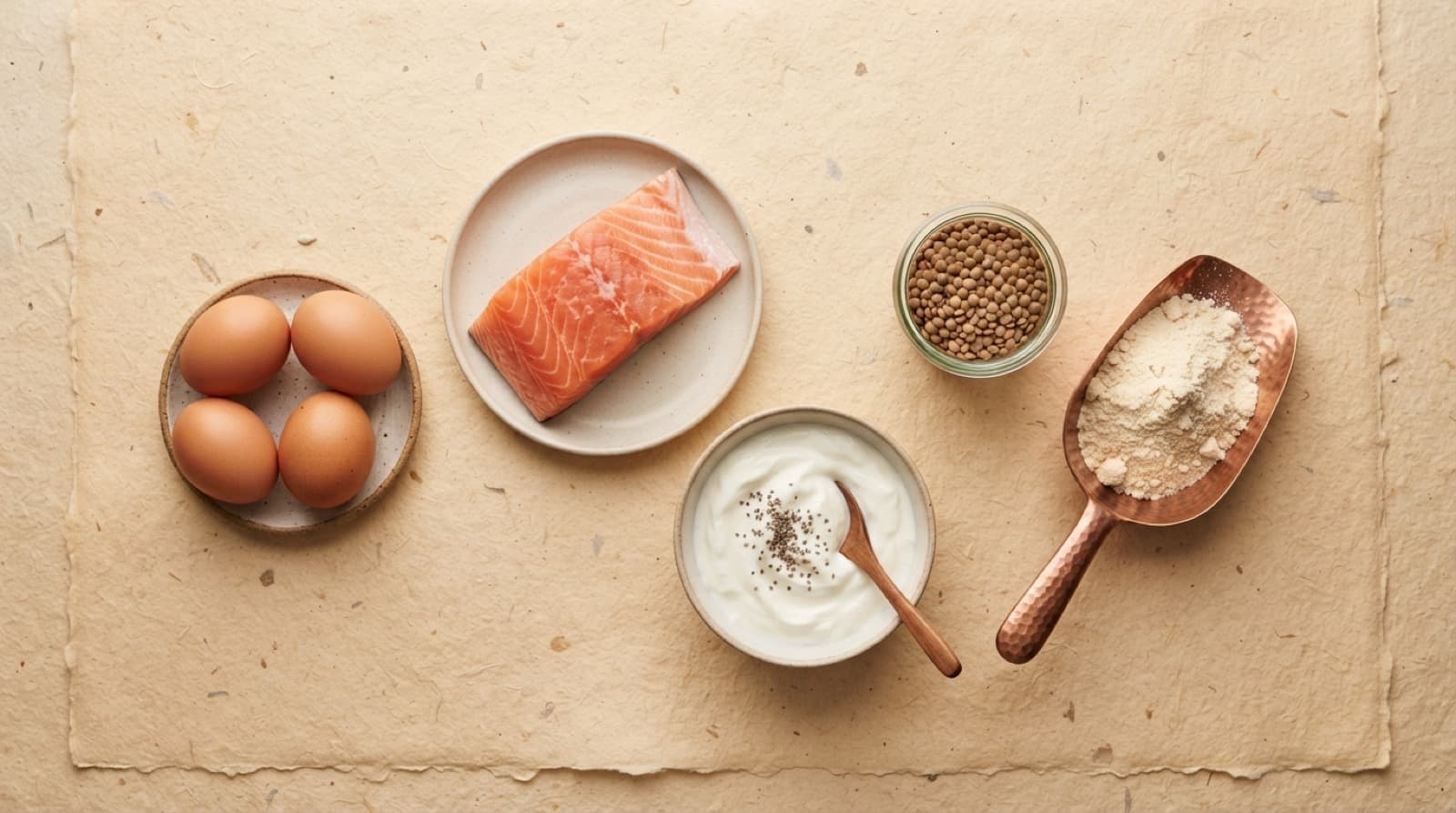
Protein is chains of amino acids that build muscle, enzymes, and hormones. What it does, why leucine and completeness matter, and the evidence-backed daily target.
- 01
Built from amino acids, nine of them essential
Protein is a chain of amino acids, of which there are 20. Nine are essential: the body cannot make them, so they must come from food (histidine, isoleucine, leucine, lysine, methionine, phenylalanine, threonine, tryptophan, valine). The body breaks dietary protein down to these building blocks and reassembles them into whatever it needs. This is why amino acid profile, not just grams, determines a protein's value.
- 02
Builds and repairs muscle and tissue
The role most people associate with protein is structural: it builds and repairs skeletal muscle, and it forms collagen in skin, tendon, and bone. After resistance training, muscle protein synthesis rises and stays elevated for ~24-48 hours, and dietary protein supplies the amino acids that turn that signal into actual tissue (Phillips & Van Loon 2011). Without adequate intake, training breaks tissue down faster than it rebuilds.
- 03
Runs metabolism as enzymes and hormones
Beyond muscle, nearly every enzyme is a protein, and enzymes catalyze essentially all metabolic reactions. Many hormones (insulin, growth hormone) and all antibodies are proteins, and proteins transport molecules, hemoglobin carries oxygen, albumin carries fats and drugs. This is why protein is non-optional: a chronic shortfall does not just cost muscle, it degrades the body's functional machinery.
- 04
Leucine triggers muscle protein synthesis
Not all amino acids are equal for building muscle. Leucine acts as the molecular trigger for muscle protein synthesis, and a per-meal dose needs to clear ~2.5-3 g of leucine (roughly 0.4 g/kg of protein) to maximally switch it on (Moore et al. 2015). This is why protein quality is measured partly by leucine density, and why our protein powder ranking prices products on $/gram of leucine rather than $/gram of total protein.
- 05
Completeness separates the sources
A 'complete' protein supplies all nine essential amino acids in usable proportions. Animal sources (meat, eggs, dairy, fish) and soy are complete; most single plant sources are limited in one amino acid (grains in lysine, legumes in methionine). The modern standard for ranking this is DIAAS, which scores digestibility and amino acid adequacy. Plant eaters solve it by combining complementary sources, beans plus rice being the classic pair.
- 06
How much you need, and how it is satiating
The consensus target for people who resistance train is 1.6 g/kg/day, with diminishing returns above ~2.2 g/kg (Morton et al. 2018). For an 80 kg lifter that is ~128 g/day. Protein is also the most satiating macronutrient per calorie, which is why higher-protein diets help with appetite control on a cut. Our how-much-protein-per-day breakdown and the Macro Calculator turn the per-kg target into your specific daily grams.
What people ask us next.
- What is protein, in simple terms?
- A macronutrient made of amino acid chains. There are 20 amino acids; nine are essential and must come from food. The body breaks dietary protein into these building blocks and reassembles them to build muscle, enzymes, hormones, and antibodies. Protein quality depends on having all nine essential amino acids (completeness) and on leucine content, the trigger for muscle building.
- What does protein do for your body?
- It builds and repairs muscle and connective tissue, forms every enzyme that runs metabolism, makes many hormones and all antibodies, and transports molecules like oxygen. It is also the most satiating macronutrient per calorie. A chronic shortfall costs not just muscle but the body's functional machinery, which is why adequate intake is non-optional.
- How much protein do I need a day?
- For people who resistance train, the consensus is 1.6 g/kg/day, with diminishing returns above ~2.2 g/kg (Morton et al. 2018). For an 80 kg lifter that is ~128 g/day. The 0.8 g/kg RDA is a deficiency floor, not a performance target. Our how-much-protein-per-day page and the Macro Calculator convert your bodyweight and goal into a specific daily number.
- What makes a protein 'complete' or high quality?
- Completeness means it supplies all nine essential amino acids in usable ratios. Animal sources and soy are complete; most single plant sources are limited in one amino acid. Quality is scored by DIAAS (digestibility plus amino acid adequacy) and by leucine density, which drives muscle protein synthesis. Plant eaters reach completeness by combining sources like beans and rice.
- Why does leucine matter so much?
- Leucine is the amino acid that triggers muscle protein synthesis. A meal needs to clear roughly 2.5-3 g of leucine (about 0.4 g/kg of protein) to maximally switch on muscle building (Moore et al. 2015). This is why a source's leucine content, not just its total protein, determines how effective it is for muscle, and why our protein powder ranking prices products on $/gram of leucine.
- Can you eat too much protein?
- For healthy adults, no, within reason. Antonio et al. ran resistance-trained men at up to 4.4 g/kg/day with no renal, hepatic, or lipid harm. The renal caution applies only to pre-existing chronic kidney disease. For healthy adults, ~2.2 g/kg is the practical ceiling on performance returns, not a safety limit; above it you are paying for protein you will not use for muscle.
Every claim, cited.
- [01]Morton RW, Murphy KT, McKellar SR, et al. 2018. A systematic review, meta-analysis and meta-regression of the effect of protein supplementation on resistance training-induced gains in muscle mass and strength. Br J Sports Med 52(6):376-384. Consensus 1.6 g/kg/day target.
- [02]Moore DR, Churchward-Venne TA, Witard O, et al. 2015. Protein ingestion to stimulate myofibrillar protein synthesis requires greater relative protein intakes in healthy older versus younger men. J Gerontol A 70(1):57-62. Per-meal leucine threshold.
- [03]Phillips SM, Van Loon LJ. 2011. Dietary protein for athletes: from requirements to optimum adaptation. J Sports Sci 29 Suppl 1:S29-38. Muscle protein synthesis and recovery.
- [04]Jager R, Kerksick CM, Campbell BI, et al. 2017. International Society of Sports Nutrition Position Stand: protein and exercise. J Int Soc Sports Nutr 14:20. Protein quality, timing, and requirements.
- [05]FAO. 2013. Dietary protein quality evaluation in human nutrition (DIAAS). FAO Food and Nutrition Paper 92. Basis of the modern protein-quality score.
The Larderlab Team builds evidence-led frameworks for eating, lifting, and stocking a kitchen. We cite every claim. We publish the spreadsheet when possible. We buy what we review at retail price. When new data lands, we revise with a dated note.
Next in this hub.
Casein vs Whey Protein: Whey Wins the Hour, Casein Wins the Night
Whey raised muscle protein synthesis about 93 percent above casein at rest and 122 percent after exercise, yet casein produced the more positive 7-hour net leucine balance. Pre-sleep casein added 3.6 square centimetres of quadriceps growth over 12 weeks against a noncaloric placebo.
14 min · rev 2026-09-10Best Protein Powders Ranked by $/gram of Leucine
We ranked 14 protein powders by the metric that actually matters, cost per gram of leucine delivered, with third-party testing filters.
14 min · rev 2026-04-21Best Whole-Food Protein Sources, Ranked by $/gram
20 whole-food protein sources priced per gram of protein, with Costco and grocery-store benchmarks. Updated quarterly.
10 min · rev 2026-04-21Get the Larderlab Macro Planner.
A Google Sheet that calculates your protein target, splits it across 3-5 meals, and ranks 20 protein sources by $/gram. Free. Copy-and-modify your own version.
By subscribing, you agree to our Privacy Policy. Unsubscribe anytime.