What whey protein is, and how the types differ
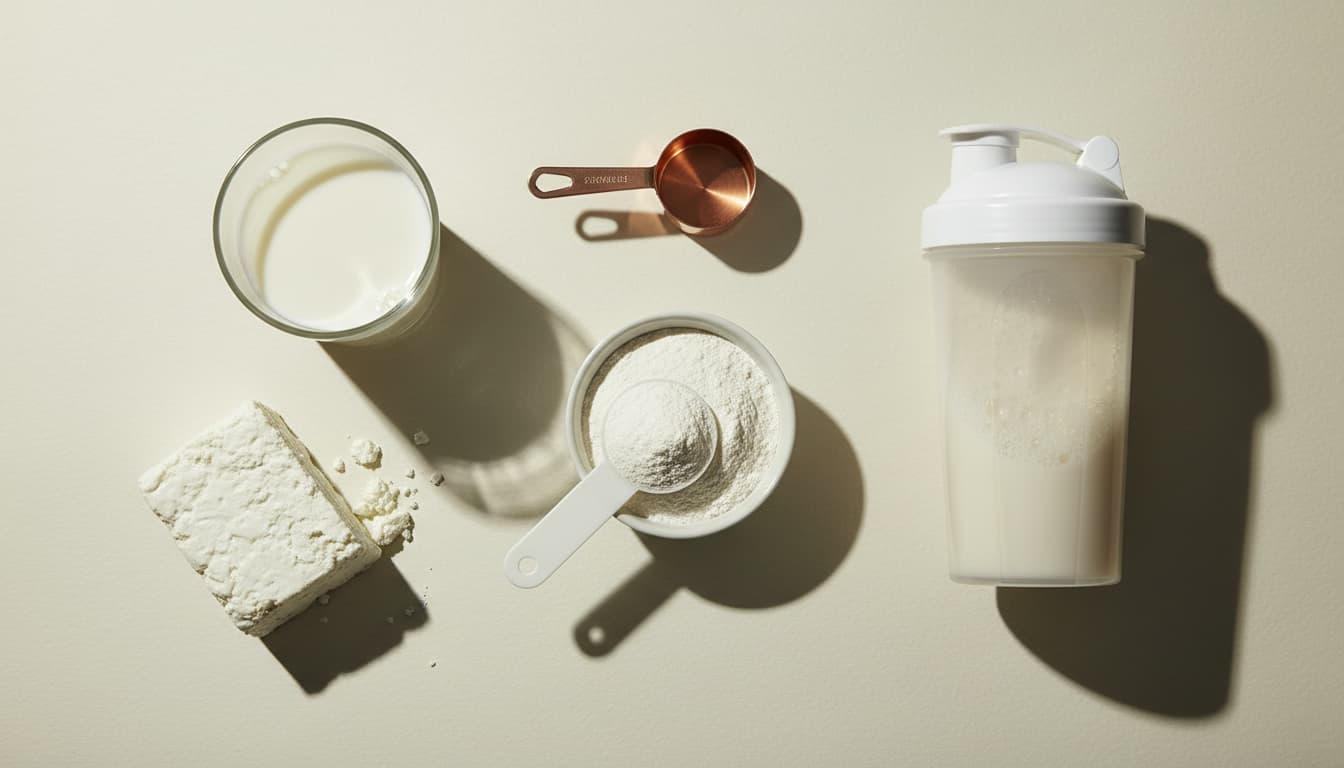
Whey is the fast-digesting, complete protein separated from milk during cheesemaking, and it carries more leucine per gram than almost any other source. What whey protein is, how concentrate, isolate, and hydrolysate differ, why leucine makes it effective, and who actually needs it.
- 01
It is the liquid fraction of milk protein
Milk protein is roughly 80 percent casein and 20 percent whey. When milk is curdled during cheesemaking, casein forms the solid curds and whey is the liquid left over, historically a waste product. Modern processing filters, concentrates, and dries that liquid into the protein powder sold today. Because it comes from milk, whey naturally contains lactose, which is why the more filtered grades that remove lactose matter for people who are lactose-intolerant.
- 02
It is a complete, top-scoring protein
Whey supplies all nine essential amino acids in usable proportions, so it is a complete protein, and it sits at the top of the DIAAS scale that ranks protein quality by how well amino acids are actually absorbed. That places it alongside eggs and above most plant proteins, which typically lack adequate amounts of one or more essential amino acids. Completeness is one of the two factors, along with leucine content, that determine how effective a protein is for building and repairing tissue.
- 03
It is exceptionally high in leucine
Leucine is the amino acid that triggers muscle protein synthesis once a per-meal dose of about 2.5 to 3 g is reached (Moore et al. 2015). Whey is one of the richest leucine sources available, so a single 25 to 30 g scoop clears that threshold, which is why whey is the reference protein in muscle-building trials. This is also the metric that matters when comparing products: our protein powder ranking prices whey on $/gram of leucine rather than $/gram of total protein, because leucine is what actually drives the effect.
- 04
It digests fast
Whey is water-soluble and empties from the stomach quickly, so its amino acids appear in the blood within roughly 30 to 60 minutes, a sharp spike compared with the slow, sustained release of casein. That speed is useful around training and makes whey an efficient way to reach the leucine threshold quickly, though the total daily protein intake matters far more than precise timing for most people. The fast-versus-slow contrast is the main practical difference between whey and casein, the two proteins milk provides.
- 05
Concentrate vs isolate vs hydrolysate
The three grades differ by how much they are filtered. Concentrate is 70 to 80 percent protein, keeps some lactose and fat, and is the cheapest and most common. Isolate is about 90 percent protein with most lactose and fat removed, useful for lactose sensitivity or a tight macro target, at a higher price. Hydrolysate is pre-digested isolate for marginally faster uptake, usually a premium with little added benefit for ordinary users. They build muscle essentially the same; the choice is about tolerance and cost, not effectiveness.
- 06
Who actually needs it
Whey is a convenience, not a requirement. It is a cheap, fast way to close the gap to a daily protein target of about 1.6 g/kg for people who resistance train, and it is genuinely useful for those who struggle to eat enough protein from food, are very active, or want a quick option around training. But it offers no advantage over whole-food protein if the daily total is already met, and it should be treated as a supplement to a food-first diet, the same amino acids are available from eggs, dairy, meat, and fish, just at a different cost and convenience.
What people ask us next.
- What is whey protein made from?
- Whey is made from milk. Milk protein is about 80 percent casein and 20 percent whey; when milk is curdled to make cheese, the solid curds are casein and the leftover liquid is whey. That liquid, once a waste product, is filtered, concentrated, and dried into the protein powder sold today. Because it originates from milk, whey naturally contains some lactose, which the more heavily filtered grades (isolate) remove.
- What is the difference between whey concentrate and isolate?
- The difference is filtration. Concentrate is 70 to 80 percent protein and retains some lactose and fat, making it the cheapest and most common form. Isolate is filtered further to about 90 percent protein with most lactose and fat removed, which suits people who are lactose-sensitive or want minimal carbs and fat, at a higher price per gram. Both build muscle essentially the same way; the choice comes down to lactose tolerance, macro goals, and cost, not effectiveness.
- Is whey protein better than plant protein?
- For building muscle, whey has two measurable advantages: it is a complete protein that scores at the top of the DIAAS quality scale, and it is exceptionally high in leucine, the amino acid that triggers muscle protein synthesis. Most single plant proteins lack adequate amounts of one or more essential amino acids and are lower in leucine, so a larger dose is needed for the same effect. Blended or higher-dose plant proteins can close much of the gap, but gram for gram whey is the more efficient muscle-building protein.
- Do you need whey protein?
- No, whey is a convenience, not a requirement. If your diet already supplies roughly 1.6 g/kg of protein per day (the target for people who resistance train), whey offers no added benefit over whole-food sources like eggs, dairy, meat, and fish. It is genuinely useful for closing a protein gap cheaply and quickly, for very active people, or for those who struggle to eat enough protein from food, but it should supplement a food-first diet rather than replace it.
- When should you take whey protein?
- Total daily protein intake matters far more than precise timing for most people, so the practical answer is whenever it helps you reach your daily target. Whey's fast absorption, amino acids in the blood within 30 to 60 minutes, makes it convenient around training, but the once-emphasized post-workout anabolic window is much wider than early claims suggested. Spreading protein across the day so each meal crosses the leucine threshold is more useful than timing a single scoop precisely.
Every claim, cited.
- [01]Moore DR, et al. Beyond muscle hypertrophy: why dietary protein is important for endurance athletes / leucine threshold research. Per-meal leucine threshold ~2.5-3 g for maximal muscle protein synthesis.
- [02]Morton RW, et al. A systematic review, meta-analysis and meta-regression of the effect of protein supplementation on resistance training-induced gains in muscle mass and strength. Br J Sports Med 2018. Daily target ~1.6 g/kg.
- [03]US Department of Agriculture, Agricultural Research Service. FoodData Central. Amino acid and protein composition of whey protein and milk.
- [04]Food and Agriculture Organization of the United Nations. Dietary protein quality evaluation in human nutrition (DIAAS). Report of an FAO Expert Consultation.
The Larderlab Team builds evidence-led frameworks for eating, lifting, and stocking a kitchen. We cite every claim. We publish the spreadsheet when possible. We buy what we review at retail price. When new data lands, we revise with a dated note.
Next in this hub.
Casein vs Whey Protein: Whey Wins the Hour, Casein Wins the Night
Whey raised muscle protein synthesis about 93 percent above casein at rest and 122 percent after exercise, yet casein produced the more positive 7-hour net leucine balance. Pre-sleep casein added 3.6 square centimetres of quadriceps growth over 12 weeks against a noncaloric placebo.
14 min · rev 2026-09-10Whey vs Plant Protein: Which Builds Muscle Better?
Whey wins per gram on completeness, leucine, and digestibility, but soy and blended plant proteins close most of the gap at a higher dose. What separates them, when it matters, and how to choose.
8 min · rev 2026-07-16Best Protein Powders Ranked by $/gram of Leucine
We ranked 14 protein powders by the metric that actually matters, cost per gram of leucine delivered, with third-party testing filters.
14 min · rev 2026-04-21Get the Larderlab Macro Planner.
A Google Sheet that calculates your protein target, splits it across 3-5 meals, and ranks 20 protein sources by $/gram. Free. Copy-and-modify your own version.
By subscribing, you agree to our Privacy Policy. Unsubscribe anytime.