Stevia side effects, and why the symptoms people report usually belong to the bulking agent
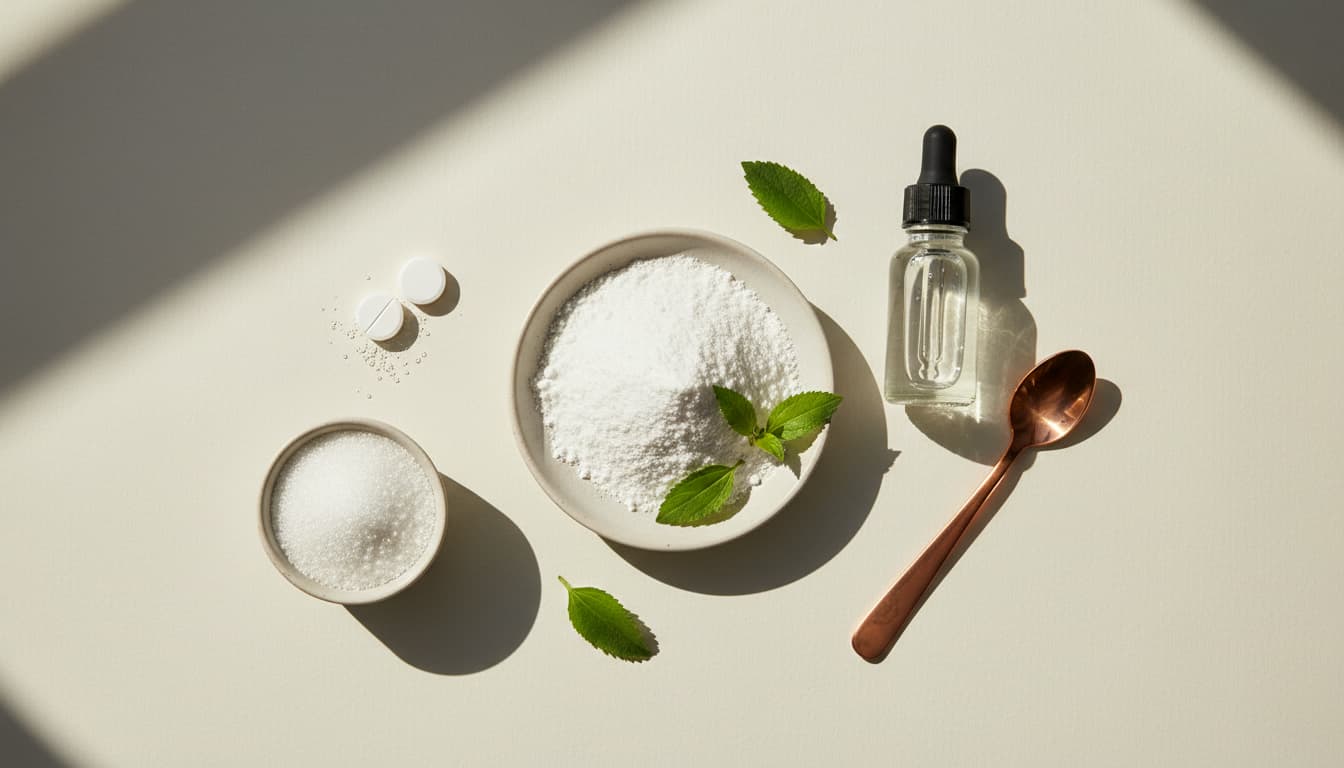
Steviol glycosides are 200 to 400 times sweeter than sucrose, so the sweetener is a trace of the packet and the rest is bulking agent. EFSA set an erythritol acceptable daily intake of 0.5 g per kg body weight and found every population group exceeds it.
- 01
A retail stevia packet is mostly not stevia
Steviol glycosides are 200 to 400 times sweeter than table sugar (FDA), so the quantity that sweetens a cup of coffee is measured in milligrams. A packet has to be roughly sugar-packet sized to be pourable, which means nearly all of its mass is a bulking agent, usually erythritol and sometimes dextrose or maltodextrin. Anyone reporting bloating, gas or cramping after a packet was exposed to milligrams of glycoside and roughly a gram of sugar alcohol.
- 02
The steviol glycoside limit is 4 mg per kg body weight per day
The Joint FAO and WHO Expert Committee on Food Additives set an acceptable daily intake for steviol glycosides of 4 mg per kg body weight per day, expressed as steviol equivalents, and FDA gives the practical translation as about 27 tabletop packets a day for a 60 kg person (FDA). Ordinary tabletop use sits far below that ceiling, which is why the glycoside itself is rarely the source of a reported symptom.
- 03
Whole-leaf and crude stevia extracts are not permitted as sweeteners
FDA has received GRAS notices for certain steviol glycosides obtained from the leaves of Stevia rebaudiana and has not questioned those determinations, while whole-leaf and crude stevia extracts are subject to an import alert and are not permitted for use as sweeteners (FDA). That inverts the usual less-processed-is-safer heuristic: the purified high-intensity form is the cleared one, and the green whole-leaf powder is the one the regulator has not accepted.
- 04
EFSA set an erythritol limit of 0.5 g per kg body weight in December 2023
Re-evaluating erythritol as the food additive E 968, EFSA established an acceptable daily intake of 0.5 g per kg body weight per day, set to protect both against the immediate laxative effect and against any potential long-term effects, derived from a human no observed adverse effect level of 0.5 g per kg body weight for a single dose (EFSA 2023). For a 70 kg adult that is 35 g of erythritol a day, which a few packets will not reach and a cup-for-cup baking blend easily can.
- 05
EFSA found every population group already exceeds that limit
The same opinion concluded that in all groups of people, both acute and chronic exposure to erythritol is above the newly set acceptable daily intake, and that people with high intake may experience adverse effects after either single or repeated exposure (EFSA 2023). That is an unusually blunt population-level finding, and it explains why gastrointestinal complaints attributed to sweeteners cluster around erythritol-bulked products rather than around the high-intensity molecules.
- 06
The laxative warning stays, and the exemption request failed
EFSA concluded that the warning excessive consumption may produce laxative effects remains valid for erythritol, and that the available data do not support the proposal for exemption from that laxative warning label requirement (EFSA 2023). Erythritol does have a higher laxative threshold than other polyols, which is why it displaced sorbitol and maltitol in this role, but a higher threshold is not the absence of one.
- 07
The cardiovascular association is real, observational and quantified
In targeted metabolomics analyses of stable patients undergoing elective cardiac evaluation, circulating erythritol in the fourth quartile against the first carried an adjusted hazard ratio of 1.80, 95 percent confidence interval 1.18 to 2.77, in a United States cohort of 2,149 and 2.21, 95 percent confidence interval 1.20 to 4.07, in a European cohort of 833, following an untargeted discovery analysis in 1,157 patients (Witkowski et al. 2023). Those are cohorts of people already under cardiac evaluation, not the general population.
- 08
The endogenous production pathway is the reason causality is unresolved
Erythritol is produced in humans through the pentose phosphate pathway, so a high circulating concentration can reflect the metabolic state that also drives cardiovascular risk rather than reflecting what somebody consumed. Separating dietary from endogenously produced erythritol is the central unresolved problem in interpreting the cohort findings, and it is why the association, however consistent across two validation cohorts, does not establish that eating erythritol causes events.
- 09
The platelet mechanism is the strongest part of that paper
At physiological levels erythritol enhanced platelet reactivity in vitro and thrombosis formation in vivo, and the authors ran a prospective pilot intervention examining ingestion in healthy volunteers (Witkowski et al. 2023). A mechanism demonstrated at physiologically relevant concentrations is a meaningful finding and is still not the same as a demonstration that dietary intake causes cardiovascular events. The reasonable response to it is moderation of heavy daily intake, not avoidance of a packet in coffee.
- 10
Monk fruit is the same purchase with a different botanical on the front
FDA has received GRAS notices for extracts obtained from Siraitia grosvenorii Swingle fruit, also known as Luo Han Guo or monk fruit, at 100 to 250 times the sweetness of sugar, with no acceptable daily intake specified (FDA). The same formulation arithmetic applies: at that sweetness the mogrosides are a trace of the product by mass, and retail monk fruit sweeteners are bulked with erythritol too. Comparing monk fruit with stevia on side effects compares two labels on largely identical contents.
- 11
The variable that changes the symptoms is the bulking agent
If the goal is to avoid the osmotic gastrointestinal effect, the useful choice is not between botanicals but between fillers. Products bulked with dextrose avoid the polyol issue while reintroducing a small quantity of digestible carbohydrate. Liquid stevia drops carry no bulking agent at all and are the cleanest way to isolate the glycoside from the sugar alcohol, which is also the only way to test personally whether the glycoside was ever the problem.
- 12
The glycaemic claim is the one that holds up cleanly
Steviol glycosides are not metabolised to glucose, and erythritol has a measured glycaemic index of 0 with an insulinaemic index of 2, against 65 and 43 for sucrose and 100 and 100 for glucose (Livesey 2003). This is the strongest legitimate claim available to the category and it is usually buried under vaguer language about being natural. For someone managing postprandial glucose, that is the reason to use these products and the reason the WHO carve-out below matters.
- 13
The WHO guideline covers the glycoside and not the erythritol
WHO recommends against the use of non-sugar sweeteners to control body weight or reduce the risk of noncommunicable diseases. The recommendation is conditional, applies to all people except individuals with pre-existing diabetes, names stevia and stevia derivatives among the sweeteners covered, and explicitly does not apply to low-calorie sugars and sugar alcohols (WHO 2023). One sachet, two ingredients, two regulators, two opposite directions of concern.
- 14
Conditional and low certainty are technical terms, not softeners
WHO designates the recommendation conditional, meaning policy decisions require discussion within specific country contexts rather than direct adoption, and the underlying evidence on long-term body fat and on associations with type 2 diabetes, cardiovascular disease and mortality is observational (WHO 2023). Reading conditional as a hedge understates it and reading it as a ban overstates it. It is a formal grading that signals the evidence would not survive a change in assumptions.
What people ask us next.
- What are the actual side effects of stevia?
- The symptoms most often reported, bloating, gas, cramping and an osmotic laxative effect, are attributable to the bulking agent rather than to the sweetener. Steviol glycosides are 200 to 400 times sweeter than sugar (FDA), so a packet contains milligrams of glycoside and roughly a gram of erythritol or dextrose. The steviol glycoside acceptable daily intake is 4 mg per kg body weight per day as steviol equivalents, about 27 tabletop packets for a 60 kg person (FDA), which ordinary use does not approach.
- Is erythritol the same as stevia?
- No, and confusing the two is the central error in this topic. Stevia refers to steviol glycosides extracted from the leaves of Stevia rebaudiana, which are high-intensity sweeteners used in milligram quantities. Erythritol is a sugar alcohol used as a bulking agent to give a stevia product the volume and pouring behaviour of sugar, and it makes up most of the mass of a typical retail packet or spoonable blend. They are regulated separately: JECFA set the steviol glycoside limit, and EFSA set a separate erythritol acceptable daily intake of 0.5 g per kg body weight per day in 2023.
- How much erythritol is too much?
- EFSA set an acceptable daily intake of 0.5 g per kg body weight per day, derived from a human no observed adverse effect level of 0.5 g per kg body weight for a single dose for the laxative effect (EFSA 2023). For a 70 kg adult that is 35 g a day. The same opinion concluded that in all groups of people both acute and chronic exposure is already above that limit and that people with high intake may experience adverse effects after single or repeated exposure. A few packets in coffee stays well under; cup-for-cup baking blends do not.
- Does erythritol cause heart attacks or strokes?
- The evidence shows an association, not causation. Circulating erythritol in the fourth quartile against the first carried adjusted hazard ratios of 1.80, 95 percent confidence interval 1.18 to 2.77, and 2.21, 95 percent confidence interval 1.20 to 4.07, in two validation cohorts of patients undergoing elective cardiac evaluation, with platelet reactivity and thrombosis enhanced at physiological levels (Witkowski et al. 2023). Erythritol is also produced endogenously through the pentose phosphate pathway, so high circulating levels may reflect the metabolic state rather than the diet.
- Is monk fruit better than stevia?
- For side effects, usually not, because retail monk fruit sweeteners are bulked with erythritol in the same way. FDA has received GRAS notices for Siraitia grosvenorii Swingle fruit extracts at 100 to 250 times the sweetness of sugar, with no acceptable daily intake specified (FDA), so at that sweetness the mogrosides are a trace of the product by mass. Choosing between the two on tolerability compares labels rather than contents. The variable that actually changes tolerability is the bulking agent.
- Is whole-leaf stevia the more natural option?
- It is the option the regulator has not cleared. FDA has received GRAS notices for certain purified steviol glycosides obtained from the leaves of Stevia rebaudiana and has not questioned them, while whole-leaf and crude stevia extracts are subject to an import alert and are not permitted for use as sweeteners (FDA). That inverts the usual assumption that less processed means better assessed. The purified high-intensity glycoside is the form with the acceptable daily intake and the regulatory clearance behind it.
- Does stevia raise blood sugar or insulin?
- No on both counts, and this is the claim in the category with the cleanest support. Steviol glycosides are not metabolised to glucose, and erythritol has a measured glycaemic index of 0 with an insulinaemic index of 2, against 65 and 43 for sucrose and 100 and 100 for glucose (Livesey 2003). For someone managing postprandial glucose that is a real advantage, and it is also why the WHO recommendation against non-sugar sweeteners explicitly does not apply to people with pre-existing diabetes.
- Did WHO advise against stevia?
- It issued a conditional recommendation against using non-sugar sweeteners to control body weight or reduce the risk of noncommunicable diseases, naming acesulfame K, aspartame, advantame, cyclamates, neotame, saccharin, sucralose, stevia and stevia derivatives. It applies to all people except individuals with pre-existing diabetes, and it explicitly does not apply to low-calorie sugars and sugar alcohols, which excludes the erythritol that makes up most of a stevia packet (WHO 2023). Conditional means policy decisions require discussion in specific country contexts.
Every claim, cited.
- [01]US Food and Drug Administration, Aspartame and other sweeteners in food. The agency's summary table gives steviol glycosides as 200 to 400 times sweeter than table sugar with an acceptable daily intake of 4 mg per kg body weight per day expressed as steviol equivalents, established by the Joint FAO and WHO Expert Committee on Food Additives, translated as approximately 27 tabletop sweetener packets per day for a 60 kg person. Siraitia grosvenorii Swingle fruit extracts, also known as Luo Han Guo or monk fruit, are given as 100 to 250 times sweeter than sugar with no acceptable daily intake specified. The same table lists aspartame at 200 times sweetness with an ADI of 50 mg per kg body weight per day, acesulfame potassium at 200 times with 15 mg per kg, sucralose at 600 times with 5 mg per kg, neotame at 7,000 to 13,000 times with 0.3 mg per kg, advantame at 20,000 times with 32.8 mg per kg, and saccharin at 200 to 700 times with 15 mg per kg.
- [02]US Food and Drug Administration, High-intensity sweeteners. The agency states that GRAS notices have been submitted for certain steviol glycosides obtained from the leaves of the stevia plant, Stevia rebaudiana (Bertoni) Bertoni, and that FDA has not questioned the notifiers' GRAS determinations. It states separately that whole-leaf and crude stevia extracts are subject to an import alert and are also not permitted for use as sweeteners. GRAS notices have also been submitted for extracts obtained from Siraitia grosvenorii Swingle fruit, also known as Luo Han Guo or monk fruit. The page notes that in the case of steviol glycosides an acceptable daily intake was established by the Joint FAO and WHO Expert Committee on Food Additives, and that an acceptable daily intake has not been specified for monk fruit.
- [03]EFSA Panel on Food Additives and Flavourings. 2023. Re-evaluation of erythritol (E 968) as a food additive. EFSA Journal 21(12):e8430. The Panel set an acceptable daily intake of 0.5 g of erythritol per kg body weight per day, established to protect from the immediate laxative effect of erythritol and also from any potential adverse long-term effects. Erythritol was found to have a laxative effect at higher doses than other polyols, and a no observed adverse effect level for this effect in humans of 0.5 g per kg body weight for a single dose was identified. The Panel concluded that in all groups of people both acute and chronic exposure to erythritol is above the newly set acceptable daily intake, that people with a high intake of erythritol may experience adverse effects after either single or repeated exposure, that the warning excessive consumption may produce laxative effects is still valid, and that the available data do not support the proposal for exemption from the laxative warning label requirement.
- [04]Witkowski M, Nemet I, Alamri H, Wilcox J, Gupta N, Nimer N, Haghikia A, Li XS, Wu Y, Saha PP, Demuth I, Koenig M, Steinhagen-Thiessen E, Cajka T, Fiehn O, Landmesser U, Tang WHW, Hazen SL. 2023. The artificial sweetener erythritol and cardiovascular event risk. Nat Med 29(3):710-718. In initial untargeted metabolomics studies in patients undergoing cardiac risk assessment, n equals 1,157 in the discovery cohort, circulating levels of multiple polyol sweeteners, especially erythritol, were associated with incident major adverse cardiovascular events. Targeted metabolomics analyses in independent United States, n equals 2,149, and European, n equals 833, validation cohorts of stable patients undergoing elective cardiac evaluation confirmed this association, with fourth versus first quartile adjusted hazard ratios of 1.80, 95 percent confidence interval 1.18 to 2.77, and 2.21, 95 percent confidence interval 1.20 to 4.07, respectively. At physiological levels erythritol enhanced platelet reactivity in vitro and thrombosis formation in vivo. A prospective pilot intervention study examined erythritol ingestion in healthy volunteers. The design is observational plus mechanistic and does not establish causality, and erythritol is also produced endogenously via the pentose phosphate pathway.
- [05]World Health Organization. 2023. WHO advises not to use non-sugar sweeteners for weight control in newly released guideline, 15 May 2023. WHO recommends against the use of non-sugar sweeteners to control body weight or reduce the risk of noncommunicable diseases. The recommendation is conditional, meaning that policy decisions may require substantive discussion within specific country contexts. The guideline applies to all synthetic and naturally occurring or modified non-nutritive sweeteners, including acesulfame K, aspartame, advantame, cyclamates, neotame, saccharin, sucralose, stevia and stevia derivatives. The recommendation applies to all people except individuals with pre-existing diabetes. It does not apply to personal care and hygiene products containing non-sugar sweeteners, nor to low-calorie sugars and sugar alcohols, which are polyols. WHO states that the available evidence suggests no long-term benefit in reducing body fat and points to possible undesirable effects including increased risk of type 2 diabetes, cardiovascular disease and mortality in adults.
- [06]Livesey G. 2003. Health potential of polyols as sugar replacers, with emphasis on low glycaemic properties. Nutr Res Rev 16(2):163-91. The review analysed the literature on glycaemia and insulinaemia after polyol ingestion and expressed the results as glycaemic index and insulinaemic index values: erythritol 0 and 2, xylitol 13 and 11, sorbitol 9 and 11, mannitol 0 and 0, maltitol 35 and 27, isomalt 9 and 6, lactitol 6 and 4, polyglycitol 39 and 23, against sucrose at 65 and 43 and glucose at 100 and 100. Glycaemic index values on replacing sucrose were independent of intake up to 50 g and of the state of carbohydrate metabolism, covering normal metabolism, type 1 diabetes with an artificial pancreas, and type 2 diabetes. Polyols ranged from low to very low glycaemic index, with erythritol at the non-glycaemic end of the range.
The Larderlab Team builds evidence-led frameworks for eating, lifting, and stocking a kitchen. We cite every claim. We publish the spreadsheet when possible. We buy what we review at retail price. When new data lands, we revise with a dated note.
Next in this hub.
Microplastics in Food: The Exposure Is Real, and Two Sources Carry Most of It
The best particle-count estimate is 39,000 to 52,000 particles a year from food, and drinking only bottled water adds 90,000 against 4,000 for tap. One plastic teabag at 95 degrees Celsius releases 11.6 billion particles. The mass estimate spans 0.1 to 5 g a week, a fiftyfold range.
14 min · rev 2026-09-10Acrylamide in Food: The Measured Levels and What Moves Them
Fast-food french fries measured 381 to 450 parts per billion in the FDA market basket while boiled potatoes were non-detect. The chemistry explains the spread, and four preparation decisions move it.
9 min · rev 2026-09-01Berberine Side Effects: Why the Gut Takes the Dose and the Liver Takes the Interaction
Absolute oral bioavailability measured 0.36 percent in rats, so the gut receives almost the whole dose and 34.5 percent of patients reported transient gastrointestinal events. Two weeks at 300 mg three times a day raised the CYP2D6 probe ratio ninefold.
14 min · rev 2026-09-05Get the Larderlab Macro Planner.
A Google Sheet that calculates your protein target, splits it across 3-5 meals, and ranks 20 protein sources by $/gram. Free. Copy-and-modify your own version.
By subscribing, you agree to our Privacy Policy. Unsubscribe anytime.